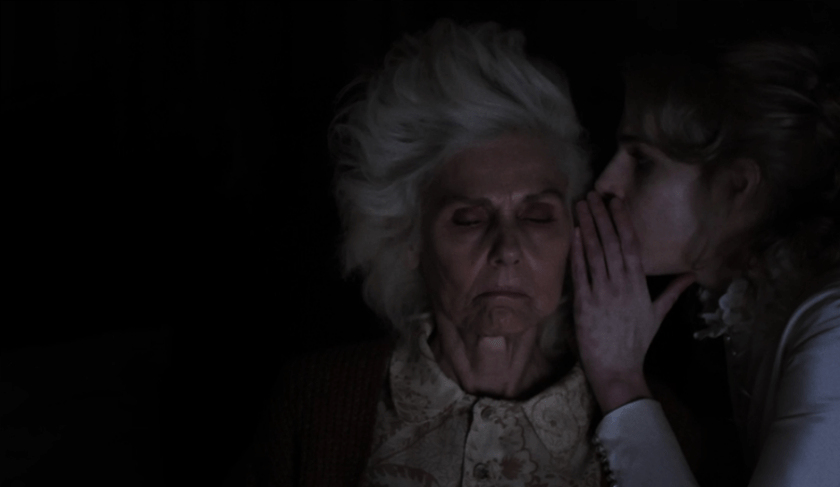
The A.V. Club said of The Eyes of My Mother as “If Ingmar Bergman helmed Texas Chainsaw Massacre” and I couldn’t think of a more apt description. The film is a coming of age story centered around Francisca, the daughter of a much older husband and wife. Her mother is an immigrant from Portugal who was a surgeon there and is very direct with her daughter about the intricacies of anatomy. A chance encounter with an extremely twisted individual begins Francisca’s journey down a dark, tragic path. The film is segmented into three chapters (Mother, Father, Family) and ends on what is an inevitable note.
The Eyes of My Mother captures that quiet, uncomfortable tone that you see in a lot of European horror films. It never shies away from the blunt horror of what people do, except in one very cleverly cut sequence. It’s not a film with a straightforward villain. A character appears early on and seems like they will be the villain but this is quickly subverted, and the story goes down an arguably darker route. Throughout, there is a dreamlike sense to the film. Its setting is a rural farmhouse, and the events are so far removed from the sight of civilization you can’t help but sink into the impending sense of hopelessness anyone who comes to the house faces. Something felt very familiar about the hushed tone of the horror in Eyes, and after some further research I found out director Pesce came from the Borderline Films production company which are also responsible for the similarly toned Martha Marcy May Marlene and Afterschool.
The plot of the film wouldn’t work so nearly as well without all the tonal elements in place. If the score had been more melodramatic or, performances were emotionally heightened all the horror would have dissipated. Instead, we are forced to linger in moments of horror. We see Francisca standing over a table working a hacksaw through a human body without revulsion, just a stoic sense of hard work. A character walks in on a brutal murder and, without a sound, deals with the killer. A mother runs after her stolen child only to receive a knife to the back and quietly cry out and squirm in pain on the floor. My personal favorite moment is the least explicit and involves the audience understanding information conveyed through a jump cut. An argument is going on between two characters, probably the most emotion at any point in the film. The tension is building, it’s well understood how this is going to end and then CUT. We see Francisca cleaning up the aftermath, and we immediately know what has happened between those scenes.
The Eyes of My Mother is not interested in pinpointing Francisca motivation. There is a possibility it is triggered by the inciting incident in the first act, or it is connected to things her mother taught her. Some reviews have been critical of this fact, but I personally feel that missing piece is essential to establishing horror. The best horror comes out of an inability to understand what is happening. Disorientation inspires a sense of fear in humans and by not having a long winded speech about why Francisca kills the audience is forced to contemplate why the events of the film occurred. In horror, it is what is unsaid and unexplained that haunts us the deepest.
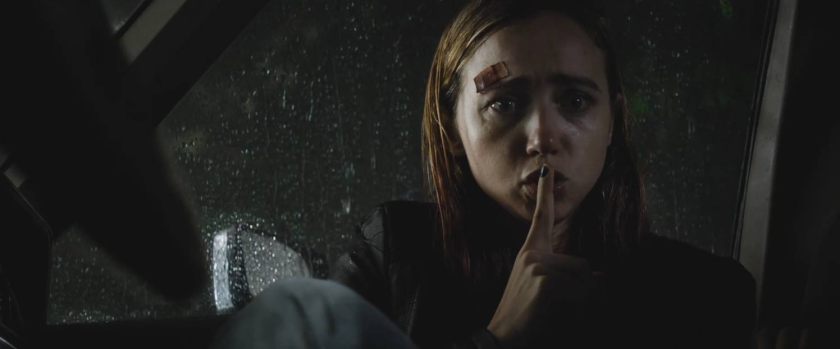
Lizzy (Ella Ballentine) is ready to leave her mother and go live with her father. After growing up in the shadow of her mom’s alcoholism, the young teenager has had to raise herself and try to keep her mother alive despite overdrinking and the threat of drunk driving. Kathy (Zoe Kazan), the girl’s mother, goes through an emotional rollercoaster, unable to communicate that she is actually heartbroken that her daughter is choosing to leave. As they drive through the night, taking an old road off the highway that leads them through the dark woods, Kathy swerves to avoid a wolf that has run out into the road. The car’s axle breaks and they skid to a stop, trapped and waiting for help in the form of an ambulance and tow truck that they are assured are on their way. But something is watching them from the woods. Something was hunting that wolf and drove it into the road. Something is waiting to devour these two women.
The Monster is a tough one. There are some interesting ideas, and the acting is incredibly strong. But as a horror film, I think it fails to create an atmosphere of fear. The set up is rife for some really unnerving horror set pieces, but the director doesn’t seem confident in the monster or sure of what to do. Director Bryan Bertino is the filmmaker behind 2008’s The Strangers. My opinion of that film was that it handled the ambiguous nature of its horror pretty damn well but didn’t do much to help me care about its two protagonists. The Monster appears focused on giving us that needed character development but then delivers sloppy horror.
There are moments where the horror begins to emerge from Kathy’s lack of parenting skills, putting her daughter in dangerous situations and being generally stupid in the face of horror. The film is peppered with flashbacks detailing the most recent decline of Kathy to the drink. We see her struggle mentally and physically in the backyard trying to decide if she digs through the trash for the bottles she’s thrown out. We see Lizzy hiding car keys to prevent drunk driving. We see the two devolve into a screaming match of profanities as the daughter does not want her drunk mother attending her school play. It’s pretty obvious what the director wants us to feel about these characters and the actors work their asses off, but the direction seems to undercut or hold back the deeper emotional impact.
The Monster is a movie about the horrors of addiction, but I would argue it fails to make those horrors feel truly horrific. Where The Strangers is confident in its pacing and the slow build up of horror, Bertino feels clumsy and unsure through almost every step of The Monster. There is a really great movie here, a premise that can connect us to the characters and a horror that is left unexplained. But when all the pieces are assembled, and we view the final project, it just doesn’t add up to much of anything really.
Lovecraftesque is a game by Josh Fox and Becky Annison. The game seeks to evoke the creeping, brooding horror of H.P. Lovecraft’s work while getting rid of his problematic racism, misogyny, and inaccurate depictions of mental illness. There’s no GM. Instead, scenes are composed of rotating roles. There is the Narrator who sets the scene, creates conflict for the protagonist, and drops a clue in each scene. Then there’s the Witness who is the main character exploring the mystery being laid out before them. Finally, we have The Watchers who are the players adding flavor to the scenes the Narrator lays out or playing NPCs if asked by the Narrator.
Each scene The Narrator must drop a clue that The Witness discovers. These clues can be physical objects, strange sounds, or even odd behavior. The catch is that nothing overtly supernatural can reveal itself until the third act of the game. The one catch are special cards that are dealt out at the start of the game and, if triggered by a particular condition, can allow a player to actually put something overtly supernatural into the story either as an Interrupt or an Ongoing element. All the clues until then should be able to be explained with mundane reasoning. At the end of each the players, without consulting each other, record the clue and their conclusion of what it means in relation to the other clues revealed so far. Eventually, the story works its way to The Final Horror and whichever player wants can step forward and reveal how these clues add up to something beyond the Witness’s comprehension. As Pamela, one of the players Saturday night said, it’s like the game of Telephone but with Lovecraft horror.
This past weekend myself, my wife, and three friends played an online session of Lovecraftesque. It was everyone’s first time with the game, and as with all new systems, it was a little more about comprehending structure than developing an excellent story. To get us started, we used one of the seeds from the book, The Chateau of Leng written by Renee Knipe. The premise is that Latissha Hall, a black single mother of two has purchased her first home on Nash Avenue in Ypsilanti, Michigan. The story takes place in 2004 at the height of the U.S. housing bubble. The seed presents the players with four possible characters to appear in the story, and we did make use of that.
Our story had Latissha preparing to do some renovating due to buying the house “as is” and inheriting a lot of structural problems. The first clue discovered was a weathered photograph from around the turn of the 20th century, a portrait of a family with individual members faces crudely scratched off. This led to the next scene: an awkward meeting between Latissha and her gruff neighbor Cass. Cass attempted to spook Latissha by telling her about the string of owners who has lived briefly in her new home and were scared off by something. She also noticed him carrying around a cat as he meandered about his front porch in a bathrobe. Scene 3 introduced Latissha to Officer Newhall, a local beat cop who ends up telling her that Cass had gone for prison decades ago for murder but apparently new evidence was presented and he was released. As a misty rain falls, Officer Newhall appears to vanish into thin air leaving Latissha unnerved.
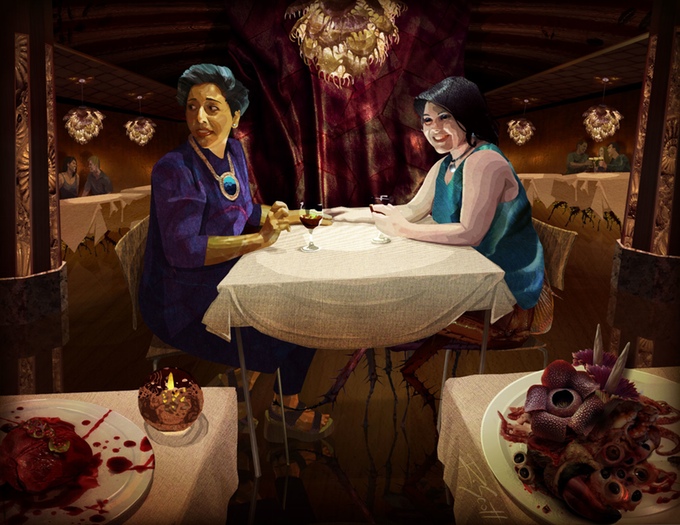
Absolutely beautiful and horrific art by Robin Scott
That evening while rummaging around one of the side rooms, Latissha finds a cobwebbed baby grand piano. Stuffed inside is an entire photo album with the pictures sharing a common theme: all the faces have been scratched out. They show different families throughout the century but all missing any trace of who they were. The next morning, Latissha goes to visit Geraldine, the elderly neighbor across the street. She’s lived in her house for decades and Latissha figures the woman might have some insight to the photos. She brings the album with her but finds herself unnerved by strange shadows and sounds in the woman’s house. Geraldine gets very aggressive about putting her hands on the album, and this causes Latissha to back away. There’s also a large number of framed photos of a cat that looks suspiciously like the one Cass was carrying around. That combined with the missing posters for the beast pinned up around the neighborhood has her questioning what is going on. Cass coincidentally comes by Geraldine’s to “check up” on her and Latissha can’t help but notice the gun he has tucked under his belt.
Our protagonist is unnerved even further by her youngest son’s drawings of their family, including her deceased husband his eyes scratched out looking remarkably like the photos she’s found. That night she’s awakened by the sound of glass breaking in the basement and movement. She investigates and find it empty but notices a panel from the wall moved to the side. Reaching into the space, she pulls out an almost identical album to the one she found in the piano. This album contains photography akin to Diane Arbus: portraits of people missing limbs, memento mori, and the visages of just slightly physically deformed people. Unlike the previous album nothing is violently scratched out, there appears to be an attempt to preserve these images. She also notices Officer Newhall driving down the street in his car as she looks out a basement window. He gets out and skulks in the yard between her and Cass’s house. Something about Newhall feels wrong, and she goes upstairs to search his name and the neighborhood online. She discovers very little except for a poorly scanned newspaper clipping about some wrongdoing on his part in a case. The grainy photo strikes her as bearing almost no resemblance to the man she met earlier.
Something compels her to return to the basement, and after searching further, she finds a hidden room. What lies inside finally reveals the horrific truth. The floor is almost breathing as she enters and finds lying across this flesh like floor her youngest son and herself…but proto versions, still growing and not yet alive. Pulsing tentacles, like umbilical cords, attach to them, some substance oozing through them and into the fleshy creatures. Latissha gazes into the dark void these tentacles disappear into, and she is startled when the proto-son finally stirs, blinking his eyes. She lets out a scream and descends into the void, discovering at its roots a great multi-legged multi-armed horror growing in the center of a carved out hollow. The fluctuating blob was surrounded by small hooded figures who turned to look at Latissha. These were the only faces she could see in the scratched out photos, the ones who had been left unmarked, the children. Unaged and without eyes, a dreadful glow emanated from the sockets. Latissha attempted an escape but found herself swallowed by the darkness between this ghastly place and her home.
Latissha finds herself waking up to the sound of her youngest called for her “Mama, mama. Wake up.” She is groggy and not sure what has been real and what was a dream. Standing in her room are her two children and Cass. Cass says that Latissha will be okay, but she will have a difficult pregnancy like she did with her first two. Duh duh duh!
I don’t think we managed to explicitly explain the connection between the clues in the game, but in a conversation afterward we had very similar ideas as to where the story was going. We all pretty much had collectively agreed that Officer Newhall was actually dead and a couple people had pegged Cass’ murder as being that of the cop. In my own notes, the story I was shaping was that Geraldine’s family had been involved in black magic and had done horrible things to the original family across the street. The result was that the house had become an Amityville type of entity, protected and fueled by Geraldine, the last of her family line. Cass had become aware of this fact around twenty years prior and attempted to kill her, but Newhall had gotten in the way. Cass’ methods were tied to very specific rituals and spells and Newhall’s disturbance set him completely back.
I believe that on a second playthrough, now with a stronger sense of the structure of the game and an idea of how it *should* flow and the way clues operate we’d have an even better time with an even more satisfying conclusion. Lovecraftesque is the kind of horror gaming I enjoy, where all players can be held in suspense until the very end. The Telephone style mechanic with the clues is my favorite part especially post game being able to see how others interpreted the story and what directions they would go. With players that have both a good background in understanding creeping horror and improv acting this could be a very magical game.
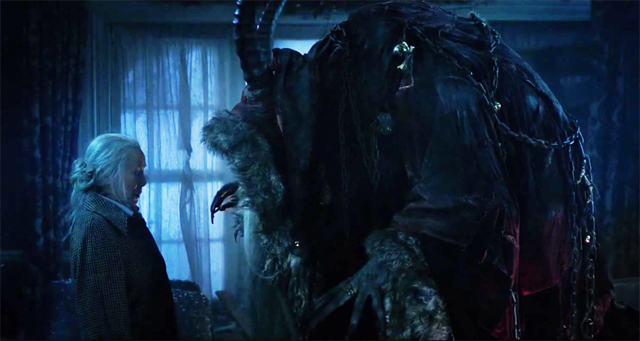
In the last few years, the Krampus has become quite a popular internet meme. The Germanic creature pre-dates Christianity but was adopted into Christmas traditions as a shadow to Santa Claus. Where Santa brings good girls and boys presents, Krampus would bring a rod to beat the bad kiddies. The character has popped up in The Venture Brothers, Scooby-Doo and even been the focus of some holiday themed films, the best of which is Rare Exports. It was only a matter of time until Hollywood decided to give the monster an American feature, this one at the hands of Michael Dougherty, best known for Trick R Treat.
Max is a kid nearer the end of that period of childhood where a belief in Santa is socially acceptable. He’s penned a letter with his numerous Christmas wishes for his family and visiting relatives, but his twin cousins decide to snatch the letter and openly mock him at the dinner table. Max responds by shredding the letter and silently wishing horrible things upon them all while tossing the letter to the snowy winds. Overnight a dark storm rolls in, the power goes out, and the neighborhood freezes over. One by one the family members are taken out by deadly gingerbread men, malevolent toys, and other assorted holiday-themed horrors before Krampus himself shows up.
Krampus is a hell of a lot of fun. It hearkens back to 1980s dark classics, Gremlins chief among them. The killer gingerbread men have a laugh reminiscent of those title villains. There is also a lot of heart in this film, about family and the holidays, but never overly sentimental. People die and get wounded. There is some blood but not an overabundance of gore. I would never say the film was scary, but it was exciting, and the design of the monsters was excellent. There is a jack in the box that is one of the best holiday horrors I’ve ever seen.
The adult cast is composed of some solid actors with strong resumes: Adam Scott, Toni Collette, Allison Tolman, and David Koechner. They play the parents perfectly, digging their heels in at the start focused only on rational explanation and finally cracking with the chaos breaches the walls of their home and cannot be ignored any longer. Tolman especially plays a character with a lot of underlying complexity. She and Koechner work as almost a counterpoint to Cousin Eddie and Catherine from National Lampoon’s Christmas Vacation. In that film the conservative, rural ideology of the characters is played for some incredibly strong laughs. Here we see the characters are not simpletons but working from a different paradigm. One of that works well and other times results in impulsive failure. Tolman has a number of scenes where her character proves her mettle and shows up her husband, who spends more of the film talking up his macho superiority than fulfilling those words.
Dougherty’s work in film has been a mixed bag. He was a co-writer on multiple Bryan Singer projects and some studio films. Trick R Treat was a breakthrough and Krampus is an awesome follow-up. He was ten years old when Gremlins was released so the perfect age to remember the feelings evoked by that film and others of its kind. Dougherty manages to do what Abrams accomplished so beautifully with The Force Awakens, the evocation of the sense of nostalgia without pandering. Krampus feels like the sort of film that would be in the cineplex alongside The Goonies and Honey, I Shrunk the Kids. But it also tells a fleshed out story that completes the arc of Max’s character and ends just the way a good horror film should.
The book for December 2016 will be The Visible Filth by Nathan Ballingrud.
After a bar fight, a man discovers a cell phone left behind. He decides to hold onto the phone until the owner contacts him. And then he begins receiving messages. The book is a nice short novella for the busy holiday season clocking in at 68 pages.
“This isn’t the type of horror you can easily categorize, put inside a box and say, ‘THIS. This is what makes this story scary.’ The Visible Filth is deeply unnerving and you’re not sure why. It has all the requisite thrills and chills, but it’s what’s under the surface that will be your undoing.” Joshua Chaplinsky, LitReactor.com
As temperatures drops, skies get cloudy, and the somber pallor of late autumn into winter creeps in, here are some wonderful audio horror stories to get lost in.
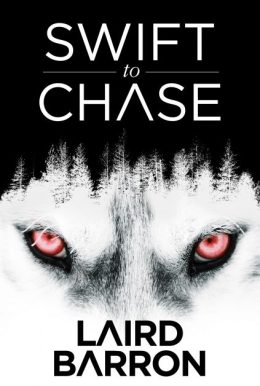
Swift to Chase: A Collection of Stories by Laird Barron (JournalStone)
Laird Barron’s latest work is everything I ever wanted out of American Horror Story but never got. It is the best season of a horror series you could ever pick up. I admit this was not the book I expected to get. Last year I worked my way through Barron’s three previous collections, saving his novels and novellas so I didn’t lose all his literature in one all you can eat buffet. His work touched on the same themes of cosmic existential horror developed by Lovecraft and Barron was placed in the same cluster of authors working in “weird horror.” His collection Occultation is one of my favorite works of horror literature with “Mysterium Tremendum” and “The Broadsword” being stories that profoundly affected me after years of consuming horror media.
Swift to Chase represents a significant sea change in the mythos that Barron will be exploring for the foreseeable future. The distant tentacled cosmic gods and Carcosa are gone. Barron never really did a Lovecraft pastiche, but there were cultists and cold alien presences that worked to undermine humanity. In this collection, we’re introduced to a brand new mythology that does touch on Lovecraft but brings in 1980s slasher tropes, MKULTRA like conspiracy theories, and a plethora of new concepts. Each story was published at different times in various publications before being collected here, but you would never know because they complement and flow into each other with such precision.
Told in non-chronological order, the stories all revolve around a small town in Alaska that seems to be the focal point of some evil presence. A house party held in 1979 acts as the hub where many of the stories return to, a night when a masked killer rampaged through the house and the survivors are cursed into the rest of their lives. The standard narrative conceits you come to genre lit with are tossed out the window and instead Barron gives us a very postmodern, deconstructed horror novel. It might seem like hyperbole, but I kept thinking back to James Joyce as I read the collection. There is such a mastery of language and particular character voice that reading the collection is less about finding plot threads but discovering the rhythm of the writing and letting its flow carry you through.
Barron refuses to present us with one type of protagonist, a la Lovecraft and makes certain stories are told from multiple perspectives and diverse voices. “Ardor” features a gay man hired to hunt down a missing horror film actor believed to have fled to the Alaskan wilderness. “(Little Miss) Queen of Darkness” features the story of a gay teenager involved in the occult club that the evil spawns out of in Alaska. Barron never plays these characters as “fey” or “limp-wristed.” Their sexuality is just one of many aspects of their character, and it’s not shied away from in the same way a straight character’s sexuality can play a role in their narrative.
The focus of the first third of the collection is Jessica Mace, the survivor of a brutal attack that left her neck with a signature scar. Her voice is that of a hardass, calloused by her experiences back in Alaska and now on the run from an evil that pursues her across the continental United States. Her story is finally told in the mind-blowing fragmented narrative of “Termination Dust.” There’s Julie Vellum, the captain of the cheerleading squad surrounded by hangers-on who ends up having an up close encounter with evil after trying to hire faux lounge singer Tony Clifton to meet her fan father in “Andy Kaufman Creeping Through the Trees.”
Upon finishing the collection, my first thought was “I want to read that again,” something I rarely think even when I have loved the book. I usually find myself ready to pick up the next text but this one has such a strong gravity, and it is pulling me back in. I highly recommend Swift to Chase as a magnificent piece of literature. I was reminded of the weight and horror I’ve read in Cormac McCarthy and the language complexity of Faulkner and Joyce. If you look around the internet, you’ll see many similar gushing reviews. These are not hyperbole, and I cannot wait to return to this world and explore the mythology again.
I don’t remember where I first discovered Creepypasta or which one was my first. What I remember is that fearful exhilaration recalled from my childhood cracking open Scary Stories to Tell in the Dark. Short, sweet bursts of dread and horror. Horror cinema has attempted to capture that sense of growing unease with mixed returns and recently mainstream horror films have found themselves in a conceptual rut, churning out the same staccatoed jump scares over and over again. Creepypasta (or NoSleep) are not a new invention, but a remixing of the stories told around the campfire. At their best, they incorporate aspects of modern life into their horrors. With Candle Cove, the horror is that of nostalgia.
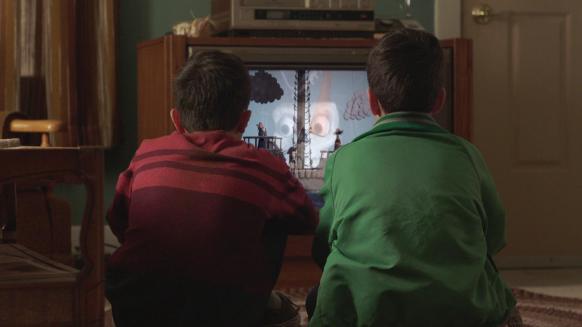
Mike Painter is a renowned child psychologist who has a deep trauma in his past. His hometown of Iron Hill was the sight of gruesome child murders in 1988, with one victim being Mike’s twin brother Eddie. As an adult, Mike is suffering from a mental breakdown and believe that returning to Iron Hill and confronting his past will help heal the wounds. Instead, he is welcomed back by something long forgotten: Candle Cove, a cheaply produced pirate-themed puppet show for kids. Mike and his now-grown childhood friends all remember these strange broadcasts that popped up and then faded away that bloody summer of 1988. A connection begins to form between this ominous show and the unsolved killings that bring Mike face to face with disturbing and mind-shattering horrors.
Candle Cove was directed by Craig William Macneill who made The Boy, an atmospheric and subtle horror film I previously reviewed. One of the strongest aspects of Candle Cove is slow, paced cinematography. I can’t recall any jump scares, and Macneil prefers the dread and tension built by a slow pan to reveal. Landscapes are broken down and large rural industrial spaces, signs of life that aren’t there any longer. The camera begins distant in many scenes and slowly zooms and pans to reveal small figures moving across grassy fields near the edges of woods. The camera peers around corners of quiet living rooms, children sitting in the blue glow of staticky televisions.
The acting in Candle Cove is restrained, not quite to the point of the stoic absurdity of Wes Anderson but not too far. Character react in stunned silence; no one breaks down in hysteric screams or tears. This one little touch adds to the eeriness and terror of the story. It also feels more real, how people, when confronted with unimaginable horror, can do nothing but stand in silence in awe of it.
The horror of Candle Cove is the horror of nostalgia and remembrance. Mike Painter is the most haunted character in the story because he remembers what happened while the other citizens of Iron Hill have chosen to forget. When Candle Cove is discussed, it sparks memories in his friends, but it remains a pale and fragmented ghost. For Mike, Candle Cove revisits him as vivid, realistic nightmares. In his dreams, the monsters can hurt him and so memories are dangerous. It is only by confronting the nostalgia, seeing through how he remembers it to the ugliness that lives underneath the skin can he find peace.
The series goes far beyond the original short story. The first episode encapsulates the entirety of the Creepypasta, so the rest of the series is developing a larger mythology and giving just enough explanation to the mystery of Candle Cove. By the end of these six episodes you will know what Candle Cove is and where it comes from, but through that revelation lies more unanswered questions. We’re left with that beautiful ambiguity that makes horror such an enthralling genre. Channel Zero’s next outing starts in January and will adapt the series of stories called No-End House. I am excited to see how stylistically different each iteration of Channel Zero will be as it plays with the horror genre.
American Horror Story Season 6: Roanoke (FX, 2016)
After five seasons, I found myself getting burn out with American Horror Story. It’s such a strange duck, always reinventing itself, yet finding threads to connect its various incarnations. There is no television show quite like it, but I was still finding myself growing tired with portions of the formula. From the promos for Season 6 to the first episode, it became apparent creator Ryan Murphy was trying out something new. The season was shorter, making episodes tighter and more focused leading to what is arguably the best of ending of any season.
The framework at the start of the season is a reality television series covering the real life horror of an unsuspecting couple who moved into a mansion in the middle of the North Carolina wilderness. They quickly learn the land and house are haunted by the spirits of a succession of people who were murdered there going all the way back to the lost Roanoke colony. The series cuts back and forth between the re-enactments and the confessional interviews. And then at the halfway point the season becomes something entirely different.
Not everything in Roanoke works. There were some severe pacing issues I had, where events whizzed by at breakneck speed to hit certain plot points. This is not atypical of the series but this season’s particular framing highlighted how dizzying the show could be. Lots of plot was stuffed into these ten episodes, and not everything wraps up neatly. The horror surrounding the property gets explained a little but still we’re left wondering about things that seemed important (Stefani Germanotta’s role as the witch of the woods stands out as an unexplored mystery).
I have to admit; I fell for the novelty of the season’s framing. From the first episode, I started thinking about the fact we were seeing two of the main characters, one set as the “real life” victims of the horror telling their story and the re-enactors revisiting those horrors in a safe, facsimile. When the show begins to play with the role of media, it gets pretty interesting as re-enactors take on an entirely new role in the story. While not as garish and over the top as AHS can be, I was often reminded of A Head Full of Ghosts and House of Leaves this season, the former for its integration of reality television into a family’s personal horror and latter for its use of framing as an element of horror.
What was the horror of Season 6? It’s easy to peg The Media, and the show does often paint its metaphors with the broadest of strokes. But after the closing moments of the finale, I looked back at recurring themes in the story. Matt and Shelby Miller, the couple whom the season begins around, come to the house in North Carolina after a vicious hate crime. They are an interracial couple and were assaulted on the street due to the nature of their relationship. Shelby loses their unborn child as a result. Shortly, we’re introduced to Lee, Matt’s sister, who is in the midst of a custody battle with her ex. Lee is a former police officer that got addicted to pills and alcohol. Even the de facto leader of the evil spirits around the house has issues with her son. There’s a ghost girl, apparently an orphan, isolated and alone on the property. And then the Polk family…well, they have plenty of issues with their children. I believe this season had the horror of parenthood at its heart. Now, AHS is not an eloquent enough show to say anything truly meaningful about the topic, but it does bring up some interesting questions and ideas.
Ryan Murphy has promised that seasons 7 and 8 will be about exploring the connections between seasons and bringing together elements of the AHS universe. I have no idea where the show will go next and, despite its glaringly ugly flaws, that is what makes watching it so much damn fun.
I Am The Pretty Thing That Lives In the House (2016, dir. Osgood Perkins)
Horror is a genre that has grown nearer and dearer to my heart since I was a child watching the edited for television version of The Shining and reading kiddie anthologies from the public library. With time, I feel my taste has been refined, initially being genuinely scared of schlock like The House on Haunted Hill 1999 remake and now finding most mainstream jump scare driving horror sleep inducing. I’ve settled into a love of creeping horror, slow burning crawls toward the inevitable oblivion at the hands of what waits in the shadows. What truly feels like horror to me is that existential dread, the realization that you are powerless against horrors that have reached a level of forces of nature. A fated doomed is one of the worst horrors an individual could come across, learning that no matter what course of actions you took you were going to come head to head with the destruction of your life.
Lily has taken a job as the hospice nurse to the ailing Iris Blum, the author of mass market horror fiction. The house Ms. Blum inhabits has a dark history, the original owner and his wife vanished just after they were wed. From the outset of the story, Lily lets us know she will die within a year of working for Ms. Blum. Lily’s narration is intentionally anachronistic and flows in and out of readings of Blum’s The Lady in the Walls novel. This fluidity of time and the sense that we are not in a fixed location in time is essential to understand what is/has happened to Lily.
I Am The Pretty Thing is the second of director Perkins’ films I’ve seen in the last couple weeks. I previously reviewed The Blackcoat’s Daughter and would say I enjoyed it more than Pretty Thing. However, Pretty Thing is one of the most richly literary horror films I’ve ever seen. I recalled The Turn of the Screw as I watched it and the adaptation, The Innocents starring Deborah Kerr as a governess in very similar shows as Lily. There is not an interest in jump scares as there is in ratcheting up tension or exploring a more ethereal horror.
Perkins, son of the late actor Anthony Perkins, is very aware of the tropes at work in this film and his father’s iconic picture Psycho. However, there is an elegance to the horror that Psycho pushed to the side for shock value. Nothing ever feels like a shock in Pretty Thing, more a dreadfully expected outcome. There is a coldness to the proceedings; Perkins takes a very neutral observational tone. Lily’s narration, while intimate, is absent the sense of emotion, which makes sense as she is reflecting back from death at the circumstances at the end of her death. The way the threads of Lily, Ms. Blum, and the mysterious ghost that haunts the house are brought together for the climax is incredibly clever and is an example of how beautiful horror can be at moments.
I Am the Pretty Thing demands the patience of the viewer, so if you are a fan of fast-paced, instant gratification horror, then I don’t think you would find much to enjoy here. However, I would encourage anyone who seeks out horror as a truly emotional disturbing experience to sit down and view this film as soon as possible. Much like The Blackcoat’s Daughter, the film itself is a haunting, leaving questions open but answers implied, enough to force the viewer to live with for some time after.




 PopCult Reviews