Newbie Wednesdays – Greenberg


Greenberg (2010, dir. Noah Baumbach)
Starring Ben Stiller, Greta Gerwig, Rhys Ifans, Mark Duplass, Jennifer Jason Leigh

Hey, you know what isn’t an interesting topic for contemporary cinema right now? Angst ridden white people who live comfortably and don’t have to worry about any necessities. Especially when they aren’t in some sort of hyper-realistic universe (i.e. James Bond, comic book movies). When the films are meant to be set in reality and feature characters whose biggest problems are that their band when they were in their twenties didn’t work out, yet are still rich through other endeavors, then I don’t really have much empathy towards them. This is yet another hugely pretentious piece of cinema from the grating Noam Baumbach. If you’re interested in navel gazing claptrap you’ve found your film.

Florence (Gerwig) is the personal assistant to the Greenberg family, a wealthy couple with two kids and a dog. The Greenbergs are off to Vietnam to open one of the husband’s hotels and they let Florence know his brother, Roger will be visiting for a few weeks while they are gone. Roger had a nervous breakdown and is coming the mansion to relax and work a doghouse. Roger and Florence meet, and she inexplicably ends up liking him. She learns Roger was involved with a semi-successful band in the 80s and they would have made it big if Roger hadn’t freaked out and left. Roger runs into some of his old bandmates (Ifans, Duplass) and while one of them has gotten over it, the other still holds a grudge.

The character of Greenberg is not necessarily a bad concept. I think everyone enjoys a good curmudgeon every once and awhile. But the curmudgeonly attributes of Roger Greenberg come across as cliche and totally dishonest. It doesn’t help that Noah Baumbach is doing what he did in Margo at the Wedding, one of the least watchable films I’ve ever had the privilege of falling asleep during. This is film straining desperately to be so clever and erudite, yet maintain that angst white middle class tone I hate. While some people have the same things to say about Wes Anderson’s films, I argue that Anderson works his damnedest to make his work feel intentionally separate from reality, in effect making contemporary fairy tales. Baumbach thinks he’s making a movie grounded in realism, and I guess for self-absorbed upper middle class people it probably is. I just have zero sympathy who have these problems.

There are few moments of good in it. I think Greta Gerwig is a great actress, more so in more mumblecore type movies than this one. She has a very natural ease in front of the camera and is one of the few people in the movie who doesn’t feel like she is acting. There’s a sub plot involving her ex-boyfriend that I found to be good to see in a film, its something that never really happens even in movies, and if it does there seems to be some moral cultural obligation to make it a big deal. Here Gerwig simply does this thing and everyone moves on with their lives, the way in reality it would probably be. Many of the supporting players are quite good, with the exception of Jennifer Jason Leigh as Roger’s ex from back in the band days. Leigh is also the co-screenwriter, producer, and the wife of Noah Baumbach. She’s just not very good in this role. If you have the option to watch this film, I can’t really say its one of those worth one view ones. It really isn’t, it doesn’t say anything of importance, it doesn’t work to achieve any interesting artistic aesthetic, it is just simply nothing.

Wild Card Tuesdays – True Stories


True Stories (1986, dir. David Byrne)
Starring David Byrne, John Goodman, Swoosie Kurtz, Spalding Gray

I remember making long trips in the car as a child and feeling a sense of excitement as we pulled onto off ramps, stopping a strange gas stations and towns on our way. The journey and these stops always held much more interest to me than the destination it seems. I can distinctly remember driving through the Smoky Mountains and drinking Faygo Root Beet, a brand I had not had before. True Stories felt, for me, like stopping in of those little towns along the way and staying a bit longer than usual. Virgil, Texas is however a byproduct of the strange mind of David Byrne, lead singer of The Talking Heads. Things are quite off from the real world, but that just makes it all that more interesting.

Byrne is the nameless narrator, decked out in stereotypical Texan gear: Ten gallon hat, western wear, cowboy boots, and driving around a cherry red Cadillac. He delivers exposition with a very monotone demeanor, explaining the underlying psychological aspects of urbanization creeping into Virgil. Among the cast are John Goodman as Louis, a man so desperate to find a mate he has a marquee outside his home reading “Wife Wanted”, Swoosie Kurtz as Miss Rollings, a rich woman so lazy she never leaves her bed, and Spalding Gray as Earl, a man who has not spoken to his wife in 15 years but still seems to have a happy life at home. The stories are all leading towards a town-wide celebration taking place on stage being constructed in the wilderness. The Narrator visits with the characters who seem to have a familiarity with him, and various Talking Heads songs are re purposed to expand upon characters’ motivations.

I’ve always enjoyed when musicians set out to make films. They are rarely huge hits and usually end up as cult classic movies. I knew going into this one that Byrne has a very unique sensibility, which I had seen in videos of his concerts, and in particular the Jonathan Demme concert film Stop Making Sense. That sensibility is translated here into a film that is more like a quirky short story collection than anything overly cinematic. And it totally works. Certain songs, like “Dream Organizer”, so perfectly work for the character they are attached to that you have to wonder if this was the character Byrne had in mind when he originally wrote the song. The cinematography is also top notch, I think a lot of that coming from Byrne’s background in art school. The composition of many shots are not what we expect, leaving tons of negative space, and making for something that could be a framed photo on its own.

It’s also interesting to see some actors before they made it big, and one whom I never thought of as a traditional film actor. Spalding Gray was a quite a surprise to see, as I only knew him through his monologues (you should all check out Swimming to Cambodia). He does a decent enough job, though comes off a little stiff. Goodman and Kurtz are definitely the best of the bunch, each hamming it up in a way that totally works with the atmosphere Byrne has created. Jo Harvey Allen was also a standout as a perpetually lying woman who takes credit for “writing half of Billie Jean” as well as being JFK’s lover in Texas, whom he met with before the assassination. The film is definitely a fun, quirky picture that can be incredibly refreshing compared to most Hollywood films.

Wild Card Tuesdays – Afterschool

Afterschool (2009, dir. Antonio Campos)
Starring Ezra Miller, Michael Stuhlbarg, Jeremy Allen White, Addison Timlin

Stanley Kubrick, probably my favorite director of all-time, once said, “A film is – or should be – more like music than like fiction. It should be a progression of moods and feelings. The theme, what’s behind the emotion, the meaning, all that comes later.” The kind of films Kubrick made the most closely followed this philosophy, 2001 comes to mind immediately, were not films that met the aesthetic of pleasurable cinema. They were meant to provoke a reaction, positive or negative, and I suspect the negative would have interested Kubrick more. This is not to say director Antonio Campos is working at the same level of Kubrick, but is definitely more interested in cinematic language than plot or characters or dialogue. This sort of film is never going to appeal to a mass audience, but that doesn’t mean it isn’t incredibly well made and through provoking.

Rob is a sophomore at Bryton, a fictional East Coast prep school where is a quiet, reclusive young man, preferring to spend his time watching viral videos and porn on his desktop computer. His interest in video leads him to joining the A/V Club after school pressures to participate in after-school activities. Amy, the girl he has a slight attraction to, is partnered with him to film B-roll exterior shots of the school for a collective club project. Amy can’t make it to one session, so Rob goes it alone and happens to witness twin seniors stumbling into frame, bleeding profusely from their noses and mouths. Rob silently walks over to where they collapsed and that is where the teachers and other students find him. It turns out the girls died of drugs that had been tainted with rat poison. Add to the mix that Rob’s roommate Dave is the known supplier in the dorms, and Rob must contemplate what he should do.

Don’t for a second think this is going to be some sort of taut thriller. This is a incredibly meditative and slow paced film, that isn’t about the death of the girls, rather it is about this young man and his personal psychosis. Rob is of a generation who filters reality through the pixelated grain of buffered video. We see portions of the film told through the lens of the digital video cameras handed out in class and through cell phone video. When Rob finally has a moment alone with Amy and they begin to get amorous, he mimics the actions he has seen on an incredibly misogynistic internet porn site. Amy is obviously shocked, but surprisingly not phased, as we can infer she has seen the same being from the same generation. Rob is an incredibly neutral protagonist, which has an odd effect on the viewer. While he does nothing to appear noble or heroic, I found myself rooting for him because of how I have been trained to view movies. Campos seems to be working to make us aware of this fact, that we have no reason to be on Rob’s side.

Michael Stuhlbarg, who made an incredible turn as the lead in the Coen Brother’s A Serious Man, plays Bryton’s headmaster and is a darkly phony figure. Afterschool definitely draws parallels to the archetypal teen stories like A Catcher in the Rye and Heathers, where the maudlin sentiment of the adults is seen through the stark, cold eyes of adolescents. Stuhlbarg expresses false sympathy for Rob’s condition after witnessing the deaths of the twins, and it is obvious every decision the dean makes is about saving face for the school, and making sure those parents who have influence are  not offended. He reveals his true colors to Rob when the young man produces a video that does reflect the false regret and sympathy the dean wishes. The guise of a compassionate and sensitive educator melts away and he chastises Rob in an incredibly cruel manner.

Once again, I emphasize that this is not a film that will appeal to everyone. I suspect the audience that will “enjoy” the film will be quite small. It forces the audience to question their relationship between the tangible and the virtual, and beyond that how our view of the tangible can be distorted and effect the way we interact with the world around us. The ending of the film is incredibly chilling and unnerving and would do the great Kubrick proud, as it shrugs off the plausible and chooses to focus more on creating an honest tone. For those who are fans of Michael Haenke, I suspect parallels will be drawn between this and his contemporary classic, Cache.

Newbie Wednesdays – I Love You Phillip Morris


I Love You Phillip Morris (2009, dir. Glenn Ficara and John Requa)
Starring Jim Carrey, Ewan MacGregor, Leslie Mann

Audiences love a great scoundrel. Con men able to take on the persona of figures of power, then use that power to one up “The Man” have been archetypal figures. Most recently Steven Spielberg’s Catch Me If You Can proved again that audiences love a good scam. At last year’s Sundance Film Festival, audiences were shown I Love You Phillip Morris, a feature film based on the true story of a man who never met a swindle he didn’t like. Since then the feature has struggled to find distribution and has been thrown around the schedule by studios frightened of its content, finally with a July 30th release date it looks like the general public will finally get to see what is a surprisingly clever and funny picture.

Steven Russell (Carrey) was an easy going clean cut suburbanite with a beautiful wife and daughter and steady job. However, he was hiding his sexuality from his wife, sneaking off for trysts with men when he had the chance. This all changed with a car accident where he had an epiphany. He was honest with his wife and left Texas for Florida where he met a handsome Latin man and showered him with gifts. Steven also had another secret: he was a damn good conman. He resorts to purposefully injuring himself in department stores and using fake credit cards to finance his life. The authorities catch up to Steven and he is tossed in prison where he meets the titular Phillip Morris (MacGregor). Steven falls madly in love and makes it his mission to get both he and Phillip out of prison. What follows are a series of scams that are so outlandish its hard to believe this is all based on a true story, and that the real Steven Russell was actually able to do these things.

It’s very interesting that the screenwriters of the snarky and vicious Bad Santa, Ficara and Requa both penned and directed this incredibly funny and, in certain moments, tear-inducingly poignant film. There is definitely the self-aware and sarcastic tone of Bad Santa present, but the characters here feel much more fleshed out and sympathetic. The film never shies away from the sexuality of its leads but it also doesn’t make them spokesmen for the LGBT community. These are just two people in love who are living their lives. That’s not to say the more prudish elements in our society will be lured into the theater. The scene where we learn Russell is gay involves him in the middle of coitus with one of his late night trysts.

The picture suffers in the structure department, though. It appears that Ficara and Requa wanted to be as true to the chronology of events as possible, and real life just doesn’t translate into a traditional cinematic story arc. The film comes off as episodic and a series of acts: act one is Steven’s coming to terms with his sexuality, act two is Steven meeting Phillip, and so on. I have to say the film is better than I expect it would have been if its original director, Gus Van Sant, has stayed on. As much as I love Van Sant, I can’t see him creating a film as entertaining as this. While it does it entertain, Carrey refrains from being schitck-y and is more in line with his performance in Man in the Moon. It’s inevitable that the film is going to lack the publicity push it deserves and be dumped at the end of the summer in theaters, so if you have the chance to see it definitely go.

Newbie Wednesdays – Mystery Team


Mystery Team (2009, dir. Dan Eckman)
Starring Donald Glover, DC Pierson, Dominic Dierkes, Aubrey Plaza

I read through the Encyclopedia Brown books voraciously as a child. And out of the dozens published and the hundreds of mysteries contained in them, I think I only solved one without having to look at the answers in the back. The titular team of this newly released independent comedy were probably like me. They loved the possibility of solving the crime but when it came down to the actual investigation it was over their heads. Mystery Team is the first feature from YouTube comedy troupe Derrick Comedy. They were one of the first to upload videos to the now uber-popular website and because of their early adopter status they garnered an impressive fan based. So how does the transition from 5 minute web video to 90 minute feature film work out?

Once upon a time, Jason, Duncan, and Charlie were a beloved staple of their small town, solving harmless mysteries like “who ate the pie?” or “who stole Timmy’s lunch money?”. Now they are seniors in high school, on the precipice of adulthood, yet still behaving like scrappy tweens. They are suddenly hit with a case way out of their league when a young girl asks them to find out who killed her parents. Duncan, the brains of the outfit, immediately wants to turn this over to the police, but Jason, after becoming smitten with the girl’s older sister, demands that they take on the case. The result is a very high insanity journey into the suprisingly dark underbelly of their small town. It’s a mixture of grossout humor and eccentric characters, including a cameo by UCB alum Matt Walsh.

Donald Glover, who was a writer on 30 Rock before being cast in Community, has always been the standout in Derrick Comedy. He has an enthusiasm and charisma that make him incredibly likable. When I watch Glover acting I see the future of American comedy. He’s definitely a young actor with the potential to make it as big as someone like Eddie Murphy or Adam Sandler, with the hope that he remains true to his comedy roots rather then make a series of throwaway pictures (I’m looking at you Grown Ups). A recent Twitter trend popped up calling for Glover to be cast in the lead of the Spider-Man reboot. While I consider myself a traditionalist when it comes to the physical makeup of comic book characters on film, this is a casting move I am behind 100%. That’s how enjoyable it is to see Glover act, and he would make a hell of a Peter Parker.

The strength of the film is that it isn’t mean spirited towards its leading trio. It would be easy for a group of socially stunted teenagers to be cast in a mocking light, and while humor is found in their awkwardness, we’re meant to love them. And its impossible to resist liking these three guys, as they are living out the childhood fantasy of being a detective, finding clues, and being wrapped in a big mystery. The acting all around is spectacular. Bobby Moynihan, currently of SNL, appears as Jordy, a convenience store clerk who was an informant for the boys for years. Moynihan’s performance is phenomenal, getting across the pathetic nature of man who gave up on his dreams and is smothered by this small town, but playing it with over the top enthusiasm. It’s one of the best and most layered comedy performances I’ve seen in years. If you looking to see where film comedy is going in the next decade, this is it.

Maybe Sundays – Blind Date (2007)


Blind Date (2007, dir. Stanley Tucci)
Starring Stanley Tucci, Patricia Clarkson

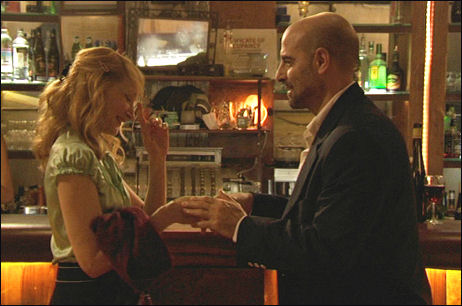
Navigating the waters of a relationship, especially one that has gone on for decades is a dangerous and fragile thing. It is almost instinctual on many people’s part to use the vulnerabilities of their mates in verbal combat, attempting to make painful digs. External circumstances can also damage both parties in a way that makes their relationship irreparable. This very quiet, simple film examines those moments of conflict by combining emotional realism but aesthetic surreality.

Don (Tucci) works in a bar/theater where he performs an intentionally bad magic act. He will regularly place and respond to singles ads in the newspaper, placed by he and his wife Janna (Clarkson) as part of a strange game they play. They always meet at the theater, where their ads have determined what roles they will play. In a few strange episodes, they play psychiatrist to each other. These meetings are revealed as ritual torture around the half way point when a tragedy is revealed as the reason why they do this back-and-forth routine. The rendezvous typically end in frustration on the part of Janna, unable to forget the pain that birthed this dance.

Despite the complex ideas and concept the film is very rough. The surreality of the setting the repetition, which on one hand is crucial to telling this story, feels tedious and the momentum of the film suffers. The acting is amazing, I wouldn’t expect less from these performers though. The film is part of a series which works to release English language remakes of Dutch filmmaker Theo van Gogh’s work. Van Gogh was murdered by an Islamic extremist in 2004 after releasing a film highly critical of the Islamic community’s treatment of women. Despite the flaws in this remake, it does have me interested in seeing the original and the rest of van Gogh’s work.

Newbie Wednesday – The Hurt Locker


The Hurt Locker (2009, dir. Kathryn Bigelow)

Starring Jeremy Renner, Anthony Mackie, Brian Geraghty, Guy Pearce, Ralph Fiennes, David Morse, Evangeline Lilly
“War is a drug”. That is the part of the opening quote on screen that is highlighted as the rest of the words fade away. While protagonist Sgt. William James takes pleasure in his work of diffusing bombs left behind by the Iraqi insurgents, I don’t know if I would ever equivocate this with a drug. Kathryn Bigelow, ex-wife of James Cameron and an incredibly successful action movie director and producer in her own right, brings us this unusually quiet film about living and surviving in a war zone.
The film follows Sgt. William James, a specialist in bomb diffusion during his 40 day tour with a pair of soldiers assigned to the Explosive Ordinance Diffusal (EOD). There is no villain or A to B plotline, rather a series of episodes centered around different types of incendiaries. While James exudes a smug bravado about the work he does, however Sgts. Sanborn and Eldridge think James isn’t taking the weight of his job seriously. Back home, James has an ex-wife and infant son and his relationship with both exists in a vague “other” state. An incident occurs during a routine mission to recover some stolen mortars that send James into a nervous breakdown. The rest of the film plays this breakdown out in an unexpected way and leaves us with a lot more questions about the nature of war.
I found this film to be addressing a lot of issues related to our understanding of mortality. The men who suit up and walk right up to the bombs to lay C-4 seem so comfortable with death that it creates unease in the men working under them. One character feels so threatened by James that at one point he talks to another officer about how easy it would be to set off an explosive in the sergeant’s face. Despite James being a “wild man”, as one colonel says, there are scenes that illuminate a nurturer. As Sanborn lies prone with a scoped rifle, seeking out the insurgents firing on them, James grabs a Capri Sun and holds it so Sanborn can drink. While he does this he talks encouragingly to Sanborn about his belief in his ability to take the enemy out, like a father cheering junior on at a Little League game. James also develops a relationship with a young boy selling bootleg DVDs on base. It’s his relationship with this child that creates an interesting counterpoint to his seeming coldness towards his own infant son back home.
The Hurt Locker is a Tense movie with a capital “T”. Very few films have me cringing in expectation of some thing bad happening on screen. In so many films and television series we see people working to diffuse bombs and we never feel the urgency. Bigelow manages to squeeze that from us through masterful editing. The Iraqi citizens who watch the procedures from balconies are viewed with suspicion, not knowing if one of them is holding a cell phone used to trigger the bomb being diffused. On the flip side, the film makes sure to state that this is not Blackhawk Down, every person you see is not a secret terrorist. Most people are simply average joes, working to make enough to keep on living and surviving. In the same way, this is why James devotes himself to this line work. He knows nothing else. He knows he should love his wife and son, but he just can’t. All he knows is how to deconstruct these vessels of death and in doing so he defeats his mortality till the next time.

Film 2010 #16 – Goodbye Solo


Goodbye Solo (2008, dir. Ramin Bahrani)

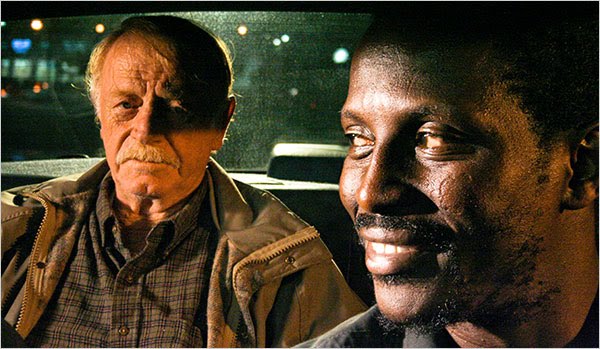
It begins in the middle of a conversation between two men, Solo and William. William wants a ride to national park in Eastern North Carolina two weeks from now and is offering Solo, the cab driver, a $200 down payment to ensure this. At first, Solo can’t quite understand why William wants a one way ride to the middle of nowhere, but soon he begins to figure out William’s motives and decides to do whatever he can to stop him.
I first became of aware of Ramin Bahrani with his 2007 film Chop Shop. Bahrani has found his niche in taking unfamiliar faces and non-actors and placing them in very human and very compelling stories. Goodbye Solo is no exception, and it owes the majority of its grounding in honest humanity to the acting of Souleymane Sy Savane who plays Solo. Solo is so incredibly genuine in his caring for William, that you cannot help but be pulled into this deceptively simple story.
Director Bahrani presents a very complex view of suicide in this film. We are never given explicit reasons as to why William wants to end his life, but there are hints dropped and Solo does some investigating of his own and learns some things about the elderly man’s past. The two characters are excellent foils for each other: both very connected to their role as fathers and both determined in their own ways. Solo is just as bullheaded as William, except Solo has the charisma and smile to get people on his side.
The film’s resolution will probably frustrate people more accustomed with mainstream cinema. There is a lot of ambiguity and Solo reveals the complexity he hides to most people. Bahrani is one of the most powerful new voices in American cinema. His landscape encompasses both the urban and rural masterfully and the faces in his films are a true representation of the diversity present in our nation. Bahrani also chooses to focus on the working class in all his films and really taps into the zeitgeist of daily life and the state of the economy today. His films are in no one overtly political and seem only to yearn to find commonalities between diverse groups in America today. Goodbye Solo is a film that, if you allow it, will stay with you for a long time to come.

Film 2010 #9 – Cold Souls


Cold Souls (2009, dir. Sophie Barthes)
Starring Paul Giamatti, Emily Watson, Dian Korzun, David Strathrain

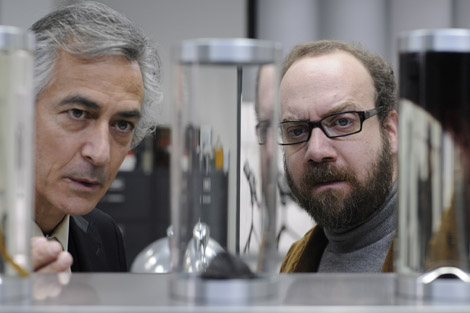
The premise is an intriguing one: Paul Giamatti playing an actor named Paul Giamatti, is having trouble tackling his role in an upcoming production of Uncle Vanya. His agent informs him of a new soul extraction service and hints that this might help him overcome his difficulties. Giamatti hems and haws over it and finally agrees and finds he’s lost his ability to act completely. Sounds like it could be good, right? Sadly, the film fails to explore its concepts fully and provides a picture that is moderately engaging.

Giamatti’s story is paralleled by that of Nina, a Russian woman who traffics souls back and forth to be used on the black market. Because the only safe way to transport a soul is to have a person carry it inside them. A side effect is that fragments of carried souls accumulate in a person and they begin to lose touch with the world. This story takes up more of the narrative and is eventually tied into Giamatti’s plot strand. It feels that the cleverness and originality of the plot concepts it lost on director Barthes.

The film owes a lot to the work of Charlie Kaufman, most notably Being John Malkovich and Eternal Sunshine of the Spotless Mind. Unlike those movies, there is an undeveloped nature to this script. The Giamatti angle doesn’t feel fully explored the true plot is Nina’s. In addition, Barthes creates a much darker landscape than Kaufman has ever attempted. His world’s lean more to the fanciful, while Cold Souls has merely dipped its toes. There seems to be a lot of influence from Russian literature and absurd and satiric theater, specifically that of Eugeneg Ionesco. There is not much humor in this picture, and for myself that is where I felt myself distancing from it.

I truly wanted to love this movie after seeing the trailer and seeing the interesting angle Giamatti was going to take. However, I finished it with a sense of dissatisfaction, wishing I could have seen the movie I had prepared myself for in my head. I wouldn’t encourage someone to not see this film, because there are some wonderful concepts and ideas, I just wouldn’t be able to recommend it enthusiastically.

Film 2009 #180 – Ballast

Ballast (2008)
Directed by Lance Hammer
Starring Micheal Smith, Jr., JimMyron Ross, Tarra Riggs

It begins with the discovery of a man who killed himself with pills. His body is found in his home during the winter in a Mississippi Delta township and has a life-changing effect on the last three members of his family.

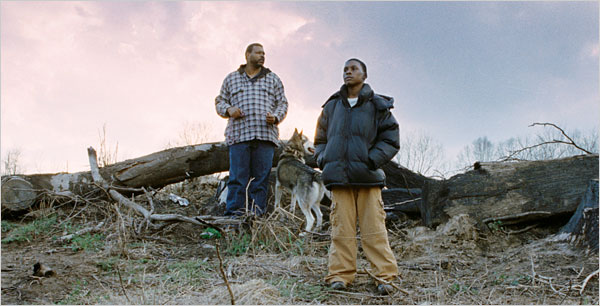
In the hands of a Hollywood studio this film would have felt the need to be over-emotive in its themes. Instead, first time feature director, Lance Hammer shows considerable restraint. Reactions are subdued and brooding, a truer reflection of how people deal with tragedy in their families. The landscape of rural Mississippi during the bitter winter adds to the tone of grief felt by the three main characters of the film. It’s interesting to note that the landscape is so wide open yet the characters all seem to be constrained and locked up in how they interact.

The plot follows Darius (Smith, Jr), Marlee (Riggs), and James (Ross). Darius is the deceased brother who attempts suicide on himself after discovering his brother. After recovering from the attempt, he delivers his brother’s will to the ex-wife and estranged son. Their various problems in life come to the surface and through their tense relationships with one another they come to an understanding.

The film presents an angle of the African-American experience rarely seen on film. Typically, we see only urban black youth in our theaters and Ballast focuses on the rural experience of the culture. The economic struggle appears more desolate and hopeless mainly because of the void-like expanse of nothingness surrounding them. Hammer chose to use local non-professional actors in the film and the choice results in amazing performances. The sadness and anger is so natural and real and truly displays the after effects of a suicide on the people left behind. The most revelatory aspect of the film is its abruptness. Throughout the film, jump cuts are used but most importantly the beginning and conclusion of the film are sudden. There’s a lot about the past we can assume from passing pieces of dialogue. As for the future, there are lot of plot points left unanswered but it fits with the cinéma vérité like tone of the picture. At the end, Ballast exists as a slice of life depiction of people dealing with tragedy across all fronts of their lives.