Games for Two – Lost in R’lyeh & Sushi Go

After attending Origins 2016, I returned home with a decent assortment of new card and board games. This year I focused on smaller games that worked with two players, as my wife is my most common playmate. Expect posts through the next couple months as I play these games.


Lost in R’lyeh (Atlas Games, designed by Kedrick Winks, Illustrated by Kelley Hensing)

lost in rlyeh

Lost in R’lyeh is one of my favorite games I played at Origins for couple reasons. First, we got to play it with our wonderful friend Renee who was putting in many hours at the Atlas Games’ space. She did a great job laying out the game and it’s mechanics. Second, it was a game that my wife and I picked up quickly and, when we returned to waiting at the Games on Demand area, were able to get out and play a couple games of.

Lost in R’lyeh is a Lovecraftian trick taking card game. The premise is that the players are all trapped in the realm of Cthuhlu and must escape. This involves laying out cards, trying to create matching sets of numbers. Numbered cards have effects and the more of them in a row the more powerful the effects become. There are also Elder Sign cards that are like Wild cards in Uno. They can be played at any time and can be very disruptive to other players. Certain Elder Sign cards duplicate numbered cards, force the entire stack of cards onto another player, allow you to take the stack and all the tricks within it, and more. The game ends when only one person is left with cards and they are trapped by the Elder Gods.

As I said before, very easy to learn and Renee even mentioned Uno as she was explaining it. So think of it as that classic card game with effects added if you stack up similarly numbered cards in a row. I can see it being one of those warm up games before a roleplay session or a great way to kill some time. We were lucky enough to buy a copy at Origins before the game dropped for all consumers. Good news, Lost in R’lyeh is available as of today!

Amazon link – https://www.amazon.com/Lost-Rlyeh-Kedric-Winks/dp/1589781635/

Cool Stuff Inc link – http://www.coolstuffinc.com/p/227156


Sushi Go! (Gamewright, designed by Phil Walker-Harding, illustrated by Nan Rangsima, Tobias Schweiger, Phil Walker-Harding)
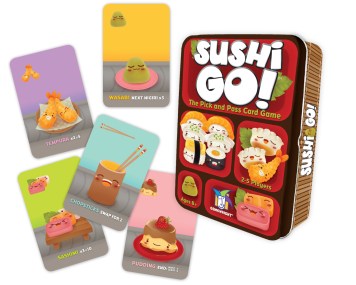
sushi go

When I went over to the Cool Stuff Inc booth on Sunday morning, looking for last minute slashes in pricing I didn’t find anything that caught my eye. Then when I looked to the register and smaller card games I noticed the little tin box for Sushi Go! I’d seen it before online, my wife likes sushi, it was only $9, so I bought it. Our friend Mark expressed a lot of enthusiasm over the game when he saw it in my bag so I wondered what this game was all about.

Sushi Go! is a “draft and pass” card game. Each player has a number of cards in their hand and chooses one and plays it face down. Once every player has done this they reveal their card and then pass their hand to the player on their right. You repeat drawing a single card face down and then pass. Your goal is to create sets. Different sets are worth different point values. Maki have either 1, 2, or 3 on them and at the end of the round the player with the most Maki gets 6 points, the next player down gets 3. Nigiri has a set value, but that can be multiplied by three if you play Wasabi first. Every two Shrimp Tempura offer up 5 points, every three Sashimi offer up 10. Chopsticks allow card swapping and Pudding stays on the table through every round and is used to add 6 points to the holder and take 6 points from the people without Pudding.

There is quite a bit of interesting strategy here. You can go for the quick points, just dropping Nigiri on the table, or set up larger point drops for later, laying out Wasabi or putting down Sashimi. If you only have two players, there is a Dummy player variant listed in the instructions. Playing this with two players has a much more subdued and direct strategy. I suspect with a larger number of players things get crazier and even more fun. Simple, easy for everyone to pick up on and play.

Amazon link – https://www.amazon.com/Sushi-Go-Pick-Pass-Card/dp/B00J57VU44/

Cool Stuff Inc – http://www.coolstuffinc.com/p/188409
Origins 2016 – Primetime Adventures and Final Thoughts

pic2393567

We’ve now come to the finale write up for Origins 2016. It was Saturday afternoon and I could feel myself running out of steam. I was going to just sit out the 2pm slot at Games on Demand, but our friend Mick Bradley encouraged me to take part in his Primetime Adventures game. I hemmed and hawed and with some prodding from my wife decided to go for it.

Primetime Adventures (Designed by Matt Wilson, Published by Dog-Eared Designs) allows a table of players to pitch, develop, and play out a television series of their own invention. The mechanics are there to simply create interesting outcomes from conflict in scenes. In a longer campaign, each character will get an amount of Screen Presence that determines how much influence they have over the events in episodes. For the purposes of the one-shot we played everyone had equal presence. Each scene is focused either on a personal Issue a character is dealing with or a more concrete plot related need. Cards a drawn and highest red card and highest total number of red cards determine how the rest of the scene should play itself out (Yes and, No and, Yes but, No but).

Mick presented the table with a number of series pitches, a good idea to save on time when running a convention game. The table collectively glommed onto a series Sojourn ‘66, an amalgamation of Deep Space 9, Babylon 5, and other various sci-fi media. A once proud hub of galactic diplomacy, now it was an outpost where planetary systems sent their rejects. The day to day operations were done by a couple series of clones, The Rogers and The Steves. The Rogers were the old model and The Steves were the shiny new ones. Player characters in our game consisted of one of the Rogers, a savvy barkeep, a scientist in charge of servicing clones that had gone awry, a past his prime diplomat, and the diplomat’s mysterious new assistant (really an exiled princess who refused to give into an arranged marriage). I played the past his prime diplomat, Tho Sint, who happened to come from the rival culture to our scientist (think Vulcans and Romulans).

The table has the right group of players who all listened closely and added to the story when it was their turn to set up a scene. By the end of the game, everyone would have signed up to continue this as a campaign if we were able. There was the right amount of humor and seriousness, so the game session never lagged. My particular favorite moment was when a bit of larping slipped into one of my scenes. Mick was played a black ops agent sent by my people, the Mox, to do some general nastiness. My character’s issue was always wanting to take control of every session so we played it as a character scene where I Thot was attempting to keep himself in check. The cards were dealt…and Thot was going to go off the handle. Mick and I both stood from the table and got in each other’s faces as our characters tried to chest bump and establish who was in charge. I’m sure we slightly frightened some of the other tables. But those are the moments that are magic when they happen in a tabletop game. Everyone is on the same page with the story and choices become very organic and fluid.


That night I played in an “off the books” game of Masks Brendan Conway ran. Once again, always fun, and the next game I planning on running for my own group.

I don’t have anything to really compare Origins to, I’ve never attended any other conventions. But I can say that the Games on Demand room has never been anything but the most inviting, kind space. The people who run GoD are always happy to welcome new faces and you’ll leave the convention with connections to a myriad number of people. There are people you can’t wait to have run a game for you and people you can’t wait to play alongside. You’ll leave having learned about a new, exciting game or with new ideas about how to run an old favorite. My wife and I had never attended a convention for any hobby until Origins 2015 and we now find ourselves reserving that time for every summer to come as long as we can.

For more information on Origins Game Fair – http://originsgamefair.com/

More importantly, for more information on Games on Demand – http://www.indiegamesondemand.org/

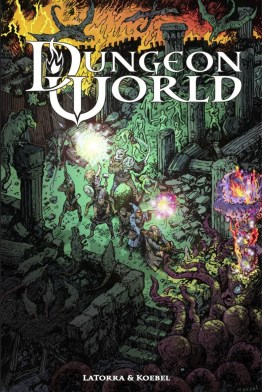
Origins 2016 – Dungeon World

dungeon world

When you tell people you play roleplay games most of them envision Dungeons & Dragons. They imagine you must spend your nights hacking and slashing orcs, or casting magic missile at kobold hordes, or firing off a volley of arrows at your enemies from a prime vantage point. Well, that has never really appealed to me. My first experiences roleplaying were in 2008 when I ran (yes ran, not played in) a 4th Edition D&D campaign. The amount of planning eventually turned me off and that’s when I sought out something different. After playing a variety of different games I ended up falling in love with the Powered by the Apocalypse engine which happened to have its own variation on that old D&D genre of game: Dungeon World (Designed by Sage LaTorra and Adam Koebel, Published by Sage Kobold Productions).

Our Friday night choice at Games on Demand was a no brainer. We’d noticed last year one particular GM’s sessions would fill up almost as soon as the doors to the room opened. Additionally, we were told he ran a damn good game of Dungeon World. Hamish Cameron is the designer of The Sprawl, a cyberpunk themed PBtA game, but is also a man who loves to run and and play Dungeon World. Having run Dungeon World many many times but never having played in it, this was a perfect opportunity. And I have to say, Hamish was one of the most energetic, engaging GMs I’ve played with in a long time. He was incredibly invested in the world the players collectively created and kept the momentum of the dungeon crawl going with interesting twists and dangers.

Dungeon World has all the basic trappings of a PBtA game: Basic and Playbook Moves triggered by player actions in the fiction, rolling two 6 sided die plus a stat to determine the outcome, and player directed worldbuilding. It’s both old fashioned but refreshing at the same time. In this particular game, I chose to play a Cleric, a playbook that doesn’t get as much love as say the Fighter or Ranger. The world the table created was focused around The City of Glass, an outpost in the middle of desert whose air was poisonous gas. Traders traveled across the desert on the backs of giant snails. The city’s religion revolved around the performing arts and so masks held an important religious significance. The various religious sects liturgies came in the form of dramas. My Cleric, Dahlia the Voice, came from the church of The Sage. Her people believed knowledge should be preserved in the mind and would memorize texts before burning them in a holy fire. They would then share their knowledge through dramatic performance or recitations of the knowledge they accrued.

Hamish gave our party a choice of dungeons to explore and we went with the (I might get this wrong) The Temple of Third Eye. It was an old mine in the middle of the desert and rumors about it housing a fallen sun god deep in its bowels were getting around. Dahlia’s purpose for being there was to uncover an ancient scroll that detailed life in these lands 10,000 years in the past. A very valuable find for my sect. In the party was a gruff Dwarven Templar, an illusionist Mage, and two orphans: Vaxx the Thief and Lillaine the Bard. Things went as you might expect in any typical dungeon delve. Lots of monsters, mystery and a dark god rising up from beneath the earth. Almost a total party kill, expect Dahlia the Voice escaped to warn The City of Glass that this angry sun god had risen.

Dungeon World is great fun. And Hamish was able to keep that fun going for four hours which is quite an achievement after running games all day. If you are a traditional tabletop gamer or someone who used to play and is looking for a way back into the hobby, I highly recommend Dungeon World as a great introduction to Powered by the Apocalypse. There’s no complex math, no worrying about line of site or other tactical minutiae, the emphasis is on weaving an interesting and entertaining adventure. The world you play in the world the people at your table want to play in so you always end up with something unique and keyed into motivation you to play.

Dungeon World can be purchased here – http://www.drivethrurpg.com/product/108028/Dungeon-World

And if you were to click on Dungeon World under Rules Systems on the right hand side, you’ll see there are myriad of resources available to add to your game if you like. My personal recommendation would be the playbooks and products produced by Awful Good Games – http://www.drivethrurpg.com/browse/pub/5695/Awful-Good-Games

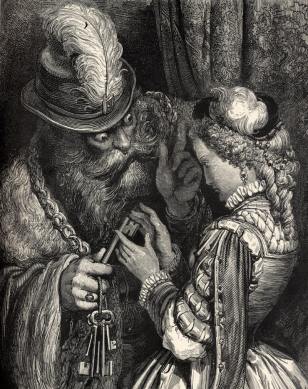
Origins 2016 – Bluebeard’s Bride

BarbebleueIf you know the overlooked fairy tale Bluebeard then you are good. If you don’t, let me summarize: A young maiden is convinced to marry a brutish, ugly aristocrat named Bluebeard. After their wedding, the maiden is left alone in Bluebeard’s home and told the place is her’s, except for one room that must remain closed at all times. As in all fairy tales, she succumbs to her temptation and discovers an abattoir of Bluebeard’s former wives. The husband returns and vows to kill her. Depending on the version, a family member arrives and saves the maiden.
Bluebeard’s Bride (designed by Whitney Beltran, Marissa Kelly, and Sarah Richardson, to be published by Magpie Games) takes this fairy tale and explores and turns the message of the original on its head. Intended to be a warning to young girls to obey their husbands, Bride is an exploration of the female experience through a lens of body horror. The game is yet another using the Powered by the Apocalypse engine, with some very interesting variations to the mechanics. The players are all a singular character, The Bride, but choose playbooks modeled after aspects of her mind: The Virgin, The Fatale, The Witch, The Animus, and The Mother. A physical “wedding” ring is used to represent which aspect is dominant at the moment and is passed voluntarily or when triggered by certain moves. This was our game for the Friday afternoon session of Games on Demand and we were lucky enough to have Sarah Richardson as our GM.

Game play consists of the controlling aspect describing a key on the key-ring left to her by Bluebeard, the GM referring to an oracle type sheet, and then describing the room. Once inside the room, the Bride may not leave until she declares a Truth about what is going on. The truth can either be one that strengthens her trust in her husband or grows the distance between them. While most PBtA games are open ended, Bluebeard’s Bride has two tracks that, once one is completed, bring about a series of endgame moves and decisions to be made.

It is difficult to talk about the game because in my personal experience it was a very visceral, emotional session. As my friend Mick said in a write up about the game: “[..] it felt like the kind of thing I’ve always been taught Eucharist is supposed to be like[..]”. It did feel a bit like moving through the stations of the cross or similar religious rite but much more interactive. Very quickly, based on the Moves and explanation from the GM, you realize that the typical response of fighting back is not an option. Instead you’re encouraged to explore and illuminate the purpose of each room or object. The Truth revealed before exiting takes your discovery and gives them context in the larger meaning of the Bride’s experience.

I don’t know if I could ever play Bluebeard’s Bride again. Not a slight to the game but a compliment to both the design of the piece and Sarah, our GM. I view the game in the same category as Requiem for a Dream or the films of Simon Rumley. They are perfectly made and one of their purposes is to interact with parts of your brain you aren’t used to experiencing in “entertainment”. Bluebeard’s Bride is one of those games that challenges the notion that all games should be “fun”, in the same way some films aren’t made to help you escape from reality but to examine it from new perspectives and with a creative twists.

The body horror of the game was not what affected me on such a deep level. The existential horror was what lingers with you in the wake of the session. I immediately thought about the works of some of my favorite horror author, Laird Barron foremost, who manage to find ways to disturb and shake me. For a piece of writing to wield that sort of power is admirable. Helplessness against a looming horror is profoundly more disturbing than any monster the mind can conjure up. In a climate where people are overfed stimulus through media it takes a deft and creative hand to fashion something that can shake a viewer/reader/player.

I would imagine Bluebeard’s Bride is a delicate game to run. You need the right GM and players with open minds who are ready to explore dark places. Like all games run at Games on Demand, the X Card is present for players who get uncomfortable if triggering subject matter is broached. A good GM would need to be agile in making sure the content strongly affects the players without venturing into territory that would bring up personal traumas. But I personally believe good horror can’t be too delicate. It loses its power when it is too restrained in the same way it loses power if it is allowed to go completely gonzo. The work exists as both a playable game and a poetic piece. I compare it to my purchase of Black Sun Death Crawl, something from a system I would never likely run, but a quality work of writing and craft

Bluebeard’s Bride has not yet been published, but a Kickstarter is coming. I would recommend backing it because you’re going to help get a game out there that deals with subject matter not often touched upon in tabletop gaming. For more on the game and the place to look out for the Kickstarter’s launch visit here – http://www.magpiegames.com/bluebeards-bride/

Origins 2016 – Monsterhearts

monsterheartsFriday morning rolled around and I knew exactly what table I would be at. We had the great honor of playing Monsterhearts with Joe Beason. Joe has been a Google Plus friend for awhile and I’d been very interested in his variation on Monsterhearts, Elderhearts which focuses on a retirement home rather than a high school. However, we were feeling the original that morning.
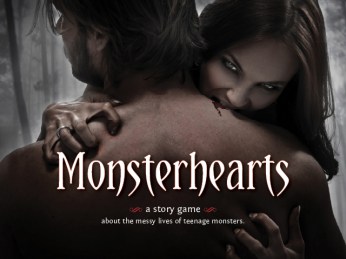
Monsterhearts (Designed by Avery Alder McDaldno, Published by Buried Without Ceremony) takes popular media like Buffy the Vampire Slayer, Twilight, Ginger Snaps and similar works and turns them into one of the most enjoyable systems I’ve ever run or played. Once again, this is a Powered by the Apocalypse game meaning it uses fictionally triggered Moves and two six sided die plus the relevant stat to determine the outcome of actions. The playbooks consist of what you would expect with some twists. There’s The Vamp, The Wolf, The Ghost alongside The Mortal, The Queen, The Ghoul and many more both official and fan made. In other PBtA games relationships between character are played as favors or debts, but in MH characters have Strings, representations of the emotional pull you have on others and they have on you. These are meant to be much more manipulative than debts or bonds and they help heighten that sense of adolescent emotional immaturity. Monsterhearts also heavily emphasizes the fluid nature of sexuality. Every character is expected to be able to be Turned On by any other character. The extent of how that arousal is acted on is determined in the fiction and how much detail the players want. Most games I play in typically fade to black or cut away before the descriptions get too gratuitous.

For Joe’s game we were students in a Florida high school that was in the path of Hurricane Danny, a brewing tropical storm. In our group we had The Ghost, The Chosen (a Buffy style hunter skin), The Witch, The Fae, and I played The Queen. Every experience I’ve had playing MH has been a lot of fun. Getting to indulge those over-dramatic hormone driven personalities of teenagers is a great time. I really hammed it up with The Queen, a stuck up rich girl whose twist involved her mind being taken over by a genetically engineered parasite her daddy’s medical research company brewed up. She was now the leader of a hive-mind (her clique) with a group text on her smartphone serving as the hub of communication. Lots of selfies were taken, many Snapchats were snapped.

Joe did a great job weaving a lot of elements through the fiction of the game based on the material we brought through our characters. The chief difference between traditional tabletop scenarios and PBtA is the planning. You can pick up Monsterhearts with no scenario in mind, sit down with friends, and simply listen and engage in conversation to build the world. Games like this will definitely stretch your mind and your creativity but you’ll up getting quicker on your feet as a result. Our high school Spring play had ground to halt with the death of the drama teacher. In his place an older, former teacher at the school was substituting, the same teacher responsible for our Ghost’s murder in the 1980s. My Queen was missing one of her clique, the girl was part of the trio of backup singers in the school’s production of Little Shop of Horrors. After a power outage, The Queen found her way to the auditorium and, along with the other player characters, got caught up in an occult ritual that was connected to the presence of the powerful storm outside.

This was one of those table at Games on Demand where everyone was firing on all cylinders and we were simpatico. The story flowed from player to player and GM. In those four hours we had a complete and satisfying narrative that left hints of other plots that could come from these characters had we been able to continue. That is also recurring note at almost every game I played: the players getting so deeply into the session they wished it was a regular weekly or monthly game so they could discover what happened next to these characters.

Avery McDaldno is currently looking at revising and releasing a second edition of the game. Since Monsterhearts’ publication in 2012, many more variations and hacks on PBtA have been released and the best iterations have brought new and intriguing mechanics to the community. As with Vincent Baker’s revision of the original Apocalypse World, I cannot wait to see what Avery adds and refines with Monsterhearts.

Even if you don’t care for the inspiration behind Monsterhearts, I’m confident you would love the game. The places the game explores aren’t represented in many other tabletop games and, with the right group of people who have buy in with the material, you’ll end up with some of the most satisfying sessions of gaming you’ve ever experienced.

You can purchase Monsterhearts here – http://www.drivethrurpg.com/product/100540/Monsterhearts

Later today: Bluebeard’s Bride and Dungeon World

Origins 2016 – Urban Shadows

urban shadows

Urban Shadows (Designed by Andrew Medeiros and Mark Diaz-Truman) is another game from Magpie Games and another variation on the Powered by the Apocalypse system. Are you noticing a trend with me? Urban Shadows was actually the first Magpie game I went all in for. I heard of some of their previous work but didn’t know these games were all from the same publisher. Urban Shadows is also a system I’ve run about 30 times in a series of small interconnected campaigns. I always love playing with a new GM though, because I learn techniques on how to run the game or discover subtleties about it that had completely gone over my head.

Urban Shadows takes many of the elements of World of Darkness with a focus on the faction politics. The four factions of the game are Mortality (Aware humans, monster hunters), Night (vampires, werewolves, ghosts), Power (Wizards, Oracles, Immortals) and Wild (Fae, Humans tainted by demons). Players have two sets of stats: one related to their individual abilities and the second for their knowledge and connection to each Faction. There are Basic Moves but also Faction Moves that require rolling with the relevant Faction stat. You accumulate Debts on other players and NPCs and can spend those debts for favors or greater influence in negotiations. You “level up” or advance by interacting with the four Factions. On top of all of this, there is a Corruption track that is advanced by certain choices in the Basic Moves and by a Corruption condition specific to each playbook. You can pick up new Corruption moves but in the fiction this moves you closer to your character becoming an NPC threat in a later game or campaign.

Thursday evening we sat down at the table with Derrick Kapchinksy, a member of Magpie. This was our first time with him running a game so I was very interested to see how things went. There was also a complete newbie to the PBtA style of game and appropriately Derrick spent time going over the basic mechanics and making sure he was comfortable with the game. After the game, my wife and I talked about how perfectly Derrick described how the system worked, talking about it in the context of a conversation with some mechanics that come to the surface only when needed. Our novice player definitely seemed to take to the game quickly. The urban environs of our game was Albuquerque, New Mexico, a city Derrick is very familiar with. As with all Urban Shadows games it’s fairly important that the GM have a good understanding of the city so they can weave real world elements with a fictional supernatural underbelly.

I played Raul, a Tainted Iraq War vet. He sold his soul in the midst of a firefight to an Ifrit. The result was that he was the sole survivor of his unit and returned to the state haunted by the fiery demon. Now the Ifrit had turned its attention to Raul’s nephew as a potential new host. Raul’s own rage built as the influence of the demon increased causing him to becoming brutally violent with bystanders, he particularly focused on the homeless population knowing they wouldn’t have many people looking out for them. In the opening hour of the game we established that vampires had been wiped out by a fellow player’s Veteran hunter. The Fae filled in that power vacuum but now the vampires were returning to the city.

I was particularly impressed with Derrick’s Redcap enforcers. They appeared as teenage Native American young men in backwards red baseball caps for the Albuquerque Cannons (now the Isotopes). I love that clever blending of traditional folkloric beings with touches of modern life. It helps to create the atmosphere of the supernatural embedded among us. The game consisted in the players getting their characters deeper and deeper into trouble between the Vampires and Fae, culminating in a showdown at a vampire nightclub.

Urban Shadows is one of the best adaptations of the PBtA system. It has a lot of moving parts and thus can be daunting the first time you look over a character sheet. With a little reading up and given some time the fluidity of these elements comes to the surface. As long as you run and play the game with an emphasis on the political you’ll have a great time. This does involve a shift in the traditional tabletop mindset where players receive plot from the GM. Here the GM looks to the players to communicate what things they are interested in doing and see happen. When everyone is on the same page the system sings. If this type of dark, political, supernatural style of storytelling appeals to you then I say you need to buy this game. I know for me it’s provided hours and hours of great gaming sessions.

Urban Shadows – http://www.drivethrurpg.com/product/153464/Urban-Shadows

You can also see Urban Shadows in play, run by the masterful Jay Brown here – https://www.youtube.com/watch?v=NZ5Vuy-KoEM

Tomorrow: Monsterhearts & Bluebeard’s Bride

Origins 2016 – Zombie World

zombie_horde_by_joakimolofsson-d5mudbk

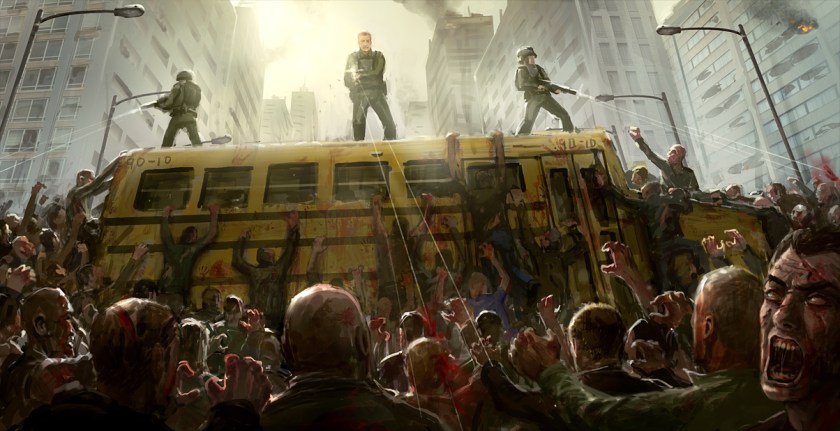
For the Thursday afternoon slot at Games on Demand, my wife and I went with Zombie World (designed and published by the team at Magpie Games). Our main reason was the game’s GM, Mark Truman-Diaz, co-founder of Magpie. Mark is both a stellar GM and an all around awesome human being so we knew we were in for a great experience. Two additional players joined our table and we were ready to begin.

Zombie World is another game that is Powered by the Apocalypse. Unlike with Masks, and most PBtA games, Zombie World uses playing cards instead of dice for resolution. Character creation involves drawing three cards and referencing an Oracle document for their meanings. The cards represent your character’s Past, Present, and Trauma. Each aspect provides specific moves or boons that only your character will have, as well as informing you on how to roleplay that character. Character creation in this style makes you think on your feet to connect what has the chance to be three very conflicting, yet compelling, aspects.

My character’s Past was Social Worker, Present was Scavenger, and Trauma was Imperious (I interjected myself into social conflicts, always wanting to solve problems). Holloway, was a social worker who still had a sense of concern for others, but this was balanced with his survival instincts. Getting involved in other’s arguments could shore up power and over time he could be seen as a de facto leader, or least open up avenues to get much needed resources if he was seen as a helper. He made a good Scavenger because his job required him to find resources for people in need and he also navigated the tougher parts of the city for many years.

Our particular game was set in an abandoned prison, which came with a playbook that we at the table collectively fleshed out. Cards were used to determine resources, threats, needs, etc. Once we had our characters and settings complete we began. Mark described a caravan of vehicles, some being manually pushed along a road outside of town. One of our hunters had spied the scene and said there was a chance a devastatingly large horde was following in the wake of these people. Two characters, our sharpshooter and a former cop, took the direct approach on the caravan while a third character, a guard who worked at the prison, led a group of Syrian refugees that had been living with us out into the woods to provide backup in case relations went south. Holloway, my social worker, didn’t volunteer to go, but snuck out of the prison to spy from a distance.

Things definitely fell apart and, while no one died, the characters suffered a number of serious setbacks, injuries, and were forced to make brutally hard choices. Conflict resolution was done by triggering one of the Basic Moves in the fiction of the game, then drawing a number of cards equal to the relevant stat. The highest card drawn would be used to determine how successful an action was. Jacks were complete successes, 8-10 was a success with a cost, and anything less than a 7 was a failure. Queens represented expendable resources and their effects and were removed from the deck after a use until they could be replenished or maintained in the fiction. For instance, our prison had a strong fence. Having a strong fence could have allowed you get very restful sleep because you didn’t need to be walking the perimeter all night. That rest could be what helped you stay alert in a firefight. But, if you don’t look for damage to the fence periodically or a massive horde crushes it to the ground then that Queen would not be reinserted into the deck again. Aces could be successes but required the player to take Stress if they wanted that boon.

I felt the character creation had light touches of Fiasco with the use of the Oracle. The drawing of cards created a sort of meta-tension. It worked even better because the higher your stat the more cards you had to draw. So being good at something actually meant the tension could be higher with each pull from the deck. From a fictional standpoint, the game completely got across the atmosphere of popular character focused zombie media (The Walking Dead). The zombies were there but not necessarily the greatest danger to our characters. As is typical with this sort of thing, it’s the other human beings you need to worry about. The game seems incredibly well suited for both one shots and small campaigns. It’s yet another Magpie production that has me excited as a hell to get my hands on it and run for friends. Zombie World does not yet have a release date, but Mark said it is pretty much at completion and will be released in the near future.

Later today: Urban Shadows.