Mature Reading: Sweet Tooth


Sweet Tooth #1-11
Written and Illustrated by Jeff Lemire

This blog is intended to be mostly for people unfamiliar with comic books and what’s out there. I know some friends who read Watchmen for a college English class or people who may not be up to date on the newer series out. For those of you not too up to date, DC Comics has an imprint called Vertigo which specializes in non-superhero fare aimed at adults or adolescents with literary maturity. Most of the time the series their present are great, a few seem to fall flat. Sweet Tooth is very much the former. It’s a post-apocalyptic story about mutants and survival and humanity becoming incredibly tribal. The art style increases the uneasy feeling you’re meant to have reading that this scary and violent world. And its all the work of Jeff Lemire, recently signed as an exclusive creator for DC Comics.

Gus is 9 years old and lives with Pa in the middle of the forest. He’s never left the forest and Pa has warned him that outside of it is all the evils in the world, and if Gus doesn’t want to go to Hell he’ll stay put. Then Pa dies and Gus is left alone in the world, slowly running out of food in their desolate cabin. Then one day some men enter the woods carrying guns, and when they see Gus they know they have found something special. You see, Gus has a pair of deer antler growing from his head. His mother died in childbirth and Pa ran away with Gus to keep him safe. The hunter surround the little boy but he is saved by Tommy, a lone mercenary who becomes Gus’ protector. The duo set off to a place Tommy says will be safe for Gus. Along the way they encounter roving bands of killers and thieves that populate the now devastated American Midwest.

Sweet Tooth is a slow burn, and its perfect that way. Almost one year in and we still know very little of the mystery behind Gus. We know that his mutation is one of many that occurred as a result of a virus that killed millions. All the children born in the wake of the virus had animal mutations. There’s even a brothel they run across where a few women dress in animal masks to satisfy the cravings of some of the more perverted clientèle. The environments in the comic are very wide and very open, because its the Midwest it was already like that, but the apocalyptic air increases it a million times.

The artwork in Sweet Tooth is incredibly aesthetically inventive. In one of the more recent issues, Gus is put under hypnosis to pull out his memories of his life in the woods. The way Lemire stages is this is by miniature versions of Gus and the hypnotist walking along the full size Gus’ head, crawling into and out of his ears. It runs through the entire issue and is just one example of the creativity and interesting storytelling at work. This is a very easy one to get caught up on. Only two collections out right now so you could be ready to follow it month to month by catching up in day. A series that I am looking forward to seeing where it goes.

Wild Card Tuesdays – Right At Your Door


Right At Your Door (2005, dir. Chris Gorak)
Starring Mary McKormack, Rory Cochrane

The concept of Right At Your Door has the makings of an amazing movie. The story is relegated to single home with a small number of cast (2 lead, 2 supporting) and brings up topics and themes very relevant to modern America. With all of these elements present, you would expect the film to be good. Sadly, it never really becomes about anything. It touches on a lot of ideas briefly, then abandons them, then collapses as film that never really goes anywhere. Its definitely working hard to be important but the substance isn’t there. It’s truly disappointing though, because it could have been one of the best films about post-9/11 America.

It’s a normal weekday morning in Los Angeles, Brad makes sure Lexi wakes up on time so she can head downtown for work. A few hours after she leaves, news reports come on talking about a series of coordinated explosions that have gone off in the most densely crammed traffic areas of the city. Authorities believe these were dirty bombs and that people need to stay in their homes, sealing their doors and windows off. Brad tries to head down but police have things blocked, so he gives up and waits in his home, terrified that Lexi is dead. However, Lexi turns up at the house, after Brad has sealed it off and now the heavy weight of confronting mortality is before them.

I see this as an awesome stage play. Two actors on stage, divided by a prop door. Very minimalist and very open to exploring lots of ideas about relationships, love, death, and the effects of terrorism and fear on contemporary America. Instead, the film has a great set up, I was completely onboard and ready to take this journey. And when Lexi first shows up after the explosion things are interesting, Brad is very torn. However, the film becomes repetitive in a way that is a technique of stalling. The picture is an hour and a half long and the screenplay doesn’t seem to know how to stretch that one day out in an interesting way. So all sorts of ludicrous things are thrown in. A friend of the couple shows up, a neighborhood child is wandering the street, there’s gestapo like military wandering the city. But it never adds up to a point, never reaches the profound pinnacle that it feels like it should. Instead we get a third act twist that is technically plausible, feels forced as a way to end the film on  quasi interesting note.

My 40 Favorite Film Moments – Part 1

This month I will be looking at my favorite moments in movies. These are not necessarily the best ever in films, but they are my personal favorites. In no particular order, here we go:

1) Let Me Out (Young Frankenstein, 1974, dir. Mel Brooks)

Gene Wilder is at his best when he goes from calm to frantic in a split second. His red-faced blue blanket tirade from The Producers is a gorgeous moment. This one however goes up there as one of my all time faves. Wilder as the nephew of Victor Frankenstein shines. In this scene we see him go from calm, to manic, to desperate, and finally to confident in his macabre heritage.

http://www.youtube.com/v/pu1DMSqTLyk&hl=en_US&fs=1&

2) Mike Yanagita (Fargo, 1996, dir. Joel and Ethan Coen)

Two actors here who deserve a lot more credit. Frances McDormand won the Oscar for her role of Marge Gunderson, but this scene also showcases the chops of Steve Park. Park is able to create a three dimensional character in a single scene of this film, its amazing what he does. Its hard not to imagine the life of Yanagita after watching this. A powerful example of what happens when good writing and acting are paired up.

http://www.youtube.com/v/r_Ge4F4E9JE&hl=en_US&fs=1&

3) Oh, Are They? (Rushmore, 1998, dir. Wes Anderson)

The film that really broke Anderson out and still one of his best. Max Fischer (Schwartzmann) turns a post opening night dinner into a farce when his love interest invites her male nurse friend along. Would be nice if Anderson tried to go back to his more comedic roots, not that his current work is bad.

http://www.youtube.com/v/VbqgSjik9NE&hl=en_US&fs=1&

4) Binary Sunset (Star Wars, 1977, dir. George Lucas)

It’s a short scene, but it says a lot. The dual suns reinforce the alien nature of this world, the lighting sets the perfect tone as Luke Skywalker stares out across the vast landscape of Tatooine, and the music gets across his desire to explore. Simple and perfect.

http://www.youtube.com/v/wEUGF3NGbPg&hl=en_US&fs=1&

5) Come Play With Us, Danny (The Shining, 1980, dir. Stanley Kubrick)

A perfect horror movie scene. The music and cinematography are in perfect unison and there isn’t much more to say other than, experience the scene yourself.

http://www.youtube.com/v/jFVyAjj3Bs0&hl=en_US&fs=1&

The Summer Blockbuster: 1975 – 1985

It began with a great white shark.

It wasn’t until the mid-70s that the concept of summer being a time to release big budget, special effects driven pictures came into the zeitgeist. Looking at the current wave of summer movies, its easy to see that science fiction and fantasy dominate, but back in the 1950s and 1960s the majority of these genre films were low budget and full of poor acting. The novel Jaws by Peter Benchley was purchased by Universal in 1973 and went through two directors before the studio settled on the relatively green Steven Spielberg. Universal’s first choice had been John Sturges (The Magnificent Seven) and then Dick Richards, who was fired after continually referring the shark as “the whale”.


To Universal, Jaws was going to be a successful film, but they never expected to be as huge a hit as it became. On June 20th, 1975 the picture was released nationwide, meaning it opened in Los Angeles and New York as well as smaller venues across the country. In the past, a film would open in a larger market and slowly spread across the country. Many film historians see this business move as the one that ensured Jaws‘ success. Up to this point the late 1960s and early 1970s had been dominated by artist driven pictures, and the studios had given up the reigns to young and headstrong young directors with a vision. Directors like Bob Rafelson (Five Easy Pieces) and Hal Ashby (Harold and Maude) had been the kind of filmmakers producing studio pictures, something very unlikely even today. In many ways, by using Spielberg, a contemporary of these young directors, but saddling him with a very studio controlled and non-character driven film, the studios were attempting to reassert their control. But the success of Jaws was nothing compared to Star Wars‘ release two years later.

There’s not much to say about Star Wars that isn’t well-known already. George Lucas, after establishing himself with American Graffiti and THX-1138, released his science fiction epic using the tropes of the serialized films of his childhood. Unlike Jaws, Lucas didn’t have a plethora of studio support behind his film and clashed with his crew, who were veterans of the film industry while Lucas was seen as an upstart. After missing its Christmas 1976 release, 20th Century Fox moved it to May 1977. Early director’s cuts were screened for Lucas’ friends, including Brian de Palma and Steven Spielberg and their reactions were disappointing. Every thing seemed to be pointing at Star Wars being a colossal failure. Lucas finally screened the picture to 20th Century Fox executives and was shocked. They loved it. One executive admitted to crying during the film at how beautiful it was, and Lucas was completely blown away from getting studio approval on a film for the first time in his career.

However, instead of becoming a studio lackey, Lucas began to build his own quiet corner of the film industry and cleverly established production facilities for sound and other technical aspects of film to create a financial safety net.  Filming for The Empire Strikes Back began in 1979, with Lucas letting Lawrence Kasdan direct while Lucas supervised as producer. While the budget for Star Wars has been $11 million ($3 million over budget), Empire had a pool of $18.5 which, after a studio fire, became $22 million. Lucas always seemed to be struggling with the limitations of the contemporary technology to realize his vision. It can be seen in the concept art of Ralph McQuarrie, that Lucas wanted to make something so expansive and ground breaking. It wouldn’t be till 1999’s The Phantom Menace that he got his wish, while audiences felt the heart of the series was lost amidst masturbatory world building.

For most of the 1970s and 80s, Spielberg and Lucas dominated the summer movie. Spielberg went on to give us Close Encounters of the Third Kind and E.T. He then teamed with Lucas to create the Indiana Jones franchise, a film series that seemed to up the ante in terms of character based blockbusters. Harrison Ford has said in interviews that he is always much more eager to play Indiana Jones again, than Han Solo. With Indiana Jones and the Temple of Doom, Hollywood underwent a change that would shape the industry for decades to come. The level of violence in Temple challenged the MPAA’s standards and Spielberg desperately didn’t want the film to be slapped with the death sentence of an R rating. These Spielberg/Lucas films depended greatly on the viewer-ship of young audiences, particularly for the merchandising tie-ins. As a compromise, the MPAA invented the rating of PG-13.

One year after Temple, Spielberg released the Robert Zemeckis-directed Back to the Future, a film that combined special effects driven sci fi with the teen comedy. The film proved that you didn’t have to have Spielberg or Lucas directing a film to make it a huge success. Both Zemeckis and screenwriter Bob Gale were terrified that the film had not lived up to their vision and figured it would bomb. Audiences went crazy for it however, and critic Roger Ebert pointed out that at its core it shared a lot of thematic similarities with the beloved It’s A Wonderful Life. As we entered into the mid-80s, Lucas began to fade from the scene as a director and Spielberg would continue to top the grossing-lists. However, there were now a group of directors moving in to prove their own ability to pull audiences in.

Next: 1986 – 1995: Gump, Disney, and Ahnold.

Newbie Wednesday – Daybreakers


Daybreakers (2009, dir. The Spierig Brothers)
Starring Ethan Hawke, Sam Neill, Willem Dafoe

Vampires are on the brain of many a Hollywood screenwriter these days. From the Twilight franchise to CW teen drama The Vampire Diaries, the sanguine are a hot commodity. The vampire is one of those monsters that seems to have a couple different interpretations. You have the elegant sex object popularized by Dracula and the Anne Rice novels, you have the eerily inhuman humanoid seen in the classic Nosferatu, and then occasional we see a completely bestial form. What’s interesting about Daybreakers is that it touches on each of these forms; and while the film is high concept, does it live up to the ideas it presents?

In a world where humans were overtaken by vampirism about a decade earlier, humans are becoming extinct and without a steady blood supply, the vampires are experiencing a secondary mutation. The blood deprived vampires end up feeding on each other, poisoning their systems and becoming more animal than human. Edward Dalton (Hawke) is a corporate hematologist seeking to synthesize a blood substitute and tests are less than successful. He’s overseen by his intimidating boss (Neill) and army grunt brother. Eventually, Dalton crosses paths with the human resistance movement and their leader, Elvis (Dafoe). Elvis was once a vampire but through a random circumstance he reverted back to human. Dalton sets out to figure out why and see if he can cure humanity once and for all.

The film is chock full of amazing ideas. Life is lived at night or in a series of interconnected tunnels beneath the city where there are copious little cafes or newspaper stands. Life is fairly similar to our own, except for the whole needing to feed on blood part. It was also refreshing that there would be select vampires who retained empathy that outweighed their biological needs to feed. There’s even a senator featured on a news program whose big issue is humanity rights and wants to remove humans from being used a cattle. The cinematography is also very clean and sharp. The directors definitely know how to set up a stylistic shot and their previous special effects works comes through.

On the flip side, the actual story of the film is complete and total mess. The transformation of Dafoe’s character never gets a comprehensible explanation and seems to be boiled down to wrapping yourself in a wet blanket and being exposed to sunlight, literally. This is the elusive cure for vampirism. The twists and turns the plots takes are either incredibly forced with no real reason behind them or simply an excuse to show people being torn limb from limb. Its apparent early on that the actors in this film are better than the material they are working with, and they most definitely don’t raise it beyond its mediocrity.

DocuMondays – Harlan Ellison: Dreams With Sharp Teeth


Harlan Ellison: Dreams With Sharp Teeth (2008, dir. Erik Nelson)
Featuring Harlan Ellison, Robin Williams, Neil Gaiman, Peter David, Ronald D. Moore

One of the first things you learn about Ellison in this documentary is that once he was so pissed with a television executive that he boxed up a dead groundhog and mailed it to the man. Ellison made sure that he paid the cheapest postage possibly so that it would take upwards of a week to reach the man and be sufficiently bloated and rotting. This is tempered with his friend Neil Gaiman saying that Ellison’s entire life’s work is one large piece of performance art. That it is not about his 1000+ short stories or numerous award-winning teleplays, but its about the cultivation of this quick-witted curmudgeonly persona.

For those of you not in the know, Harlan Ellison is an acclaimed author of literature both of the science fiction genre and not. He’s actually famous for calling the “sci-fi” abbreviation a “hideous neologism” that “sounds like crickets fucking”. Needless to say, he is a very opinionated man and any attempt to make a documentary about him is going to be caught up in his fiery and impassioned rantful nature. Ellison was responsible for the classic “City on the Edge of Forever” episode of the original Star Trek, “Demon With a Glass Hand” episode of The Outer Limits (which he sued James Cameron for ripping off to make The Terminator), and for much script work on Babylon 5.

The film focuses on exploring the history and personal philosophy of Ellison. It is near impossible to get the experience of prose across on screen, though the film attempts it by having Ellison recite a few passages from his more famous work against the backdrop of incredibly shitty lava lamp-esque green screen backgrounds. The more interesting pieces are of Ellison expounding on his personal beliefs. He his passionate about writers not being treated like second class citizens by the studios. Ellison tells of how he received a call from woman who told him that on an upcoming Babylon 5 DVD they were wanting to make an extending interview with him a special feature and he agreed, with the stipulation that he receive a paycheck. She replied that everyone else just said yes and did it for free, resulting in a verbal lashing from Ellison about how she and the others in the business side of things wouldn’t work for a second if they weren’t getting paid.

The documentary suffers due to the absence of any counter to Ellison. He is infamous for public spats and lawsuits and it would have given a interesting balance to the film to have a group of people who disliked the man. Instead all we get is fawning praise and admiration from people who grew up reading his work. Ellison’s writing is wonderful, and he is one of the best writers of the late 20th century. The film just hurts from not having those voices to temper Ellison’s oft loud and bombastic one.

Cinematic Television – Science Fiction & Fantasy

One of the television genres to really rise to the level of cinematic programming are those based around science fiction and fantasy. Television is full of shows that either go the hard sci-fi route (Stargate, Battlestar Galactica) or incorporate their elements more subtly (Lost).


Twin Peaks (1990 -1991, created by David Lynch and Mark Frost)
Starring Kyle MacLachlan, Michael Ontkean, Sherilyn Fenn, Madchen Amick, Sheryl Lee, Lara Flynn Boyle, Jack Nance, Grace Zabriskie, Ray Wise

There had never been a show like, and probably never will be another show like, Twin Peaks. The series was a perfect combination of the avant-garde sensibilities of filmmaker David Lynch and primetime soap producer Mark Frost. The show is at moment high camp and melodrama, then switching to tense neo-noir thriller, and over to creep-infused cinematic horror. The premise is incredibly simple: Young girl’s body washes up on the shores of her small Washington state town, FBI eventually called in to investigate. Out of this premise rises one of the most eclectic casts ever assembled on the small screen. Kyle MacLachlan plays Special Agent Dale Cooper, an investigator the likes of which you have never seen. He doesn’t put much stock in typical detective work, but rather relies on Eastern philosophy and his enigmatic dreams to guide the case. The series will introduce you to the wonders of the Log Lady, the Backwards Talking and Dancing Midget, The One-Armed Shoe Salesman, and a coffee percolator with a trout inside. You’ll never have coffee and pie the same way again. Though the series lacks horribly in the middle of its second season (Lynch was away from the series to work on a film), it is still light years better than anything you’ve ever seen on TV.


Battlestar Galactica (2004 – 2009, created by Glen A. Larson, Ronald Moore, and David Eick)
Starring James Edward Olmos, Mary McDonnell, Katie Sackhoff, Jamie Bamber, James Callis, Tricia Helfer, Grace Park, Michael Hogan, Tamoh Penikett, Aaron Douglas

When I first heard they were doing a remake of the cheesy Star Wars knock-off Battlestar Galactica I was a bit suspect. It wasn’t till 2006 that I actually sat down and began to work my way through the first two seasons of the series and was amazingly surprised. The names were the same, and original premise was fairly intact (Cylons destroy the Twelve Colonies, forcing a small fleet of ships to begin searching for a new home), but the themes and tone of the remake was startlingly fresh. What was done so well in BSG was that is stayed true to the great science fiction trope of being more about our present society and context, much more than any future environs. The series manages to capture a lot of tension in post-9/11 America, with characters finding it easy to dehumanize their enemies, debating if authority has the right to seize power in the midst of crisis, and approaching issues of religious conflict. Despite the first half of the third season being one of the most brilliant things ever, the show begins to crumble in the second half and never recovers during the final season. The show’s focus began to get tied up in trying to explain its overly dense mythology and characters behaved in erratic ways. The series is definitely one of the best science fiction series ever aired and spawned a spin-off prequel series, Caprica.


Lost (2004 – 2010, created by Jeffery Lieber, JJ Abrams, Damon Lindeloff, and Carleton Cuse)
Starring Matthew Fox, Terry O’Quinn, Michael Emerson, Josh Holloway, Evangeline Lilly, Jorge Garcia, Daniel Dae-Kim, Yunjin Kim, Naveen Andrews, Henry Ian Cusick

I must admit my bias. Lost is one of my favorite things ever. EVER! I was less than interested when I watched the premiere during its original airing, but returned to the series when my roommate ‘s obsession pulled me back in at the start of the 2nd season. I have been hooked ever since. What makes Lost great is that it took its time to get to its big mysteries. The entire first season is all character based, with slight touches of mystery sprinkled throughout. Because we have an emotional investment in these people when the trouble goes down, we feel it more. The production values of the series are astonishing. Every episode features beautiful cinematography, gorgeous music, and writing that is very clever and knows how to dole out pieces of a mystery perfectly. The show has a dragging point in the first half of season three, but quickly recovers and hasn’t let up since. The current and final season has been carefully pulling the layers of the onion back before the full reveal is made. The creators of the series have an apparent love of classic crazy sci-fi TV, particularly the shows of Irwin Allen (Land of the Giants, Lost in Space, Time Tunnel). That is mixed with some fascinating spiritual themes and literary references, that make the show enjoyable if you want to simply watch for fun or mine it for all its thematic richness.


True Blood (2008 – present, created by Charlaine Harris and Alan Ball)
Starring Anna Paquin, Stephen Moyer, Sam Trammel, Ryan Kwanten, Rutina Wesley, Chris Bauer, Nelsan Ellis, Todd Lowe, Carrie Preston

If Tennessee Williams wrote a vampire novel, this would be what was produced. The accents are garish, the acting sickeningly melodramatic, and the plots are over the top. But I can’t stop watching it! Set in the fictional hamlet of Bon Temps, Lousiana, True Blood focuses on Sookie Stackhouse, a dive bar waitress with psychic powers and in love with a Civil War era vampire, Bill. In the world of the series, vampires have “come out of the coffin” and are attempting to become integrated into modern society. The impetus behind this is that scientists have managed to synthesize blood, meaning vampires can crack open a cold one rather than gnawing on a warm one. However, there are certain vampires who see this as selling out to the establishment, and there are humans who have fetishized being the playthings of the living dead. The heart of the show are not the leading romantic pair, but all the supporting citizens of Bon Temps. The short order cook is secretly dealing “V”, vampire blood used to trip like acid but better. His replacement is an Iraq War veteran suffering from PTSD. The bar’s owner vanishes on certain nights, showing up naked in the middle of nowhere. A voodoo priestess lives in a trailer just outside of town performing exorcisms. This is not for people looking for Mad Men, though you can enjoy both shows. If you like some supernatural insanity then definitely check this one out.

I’d like to know what dramas, comedies, and sci-fi/fantasy series YOU are watching that I haven’t included and you believe should be. Reply to the comments here or e-mail me at huckabees@gmail.com

Maybe Sundays – I’m Here


I’m Here (2010, dir. Spike Jonze)
Starring Andrew Garfield, Sienna Guillory

I’m Here is available to watch at http://www.imheremovie.com/
I would recommend you go here instead: http://www.youtube.com/watch?v=_TQuzRCbpsY

Brief note on the presentation of the film, before I get into my review: The film is sponsored by Absolut Vodka, who decided to offer the film to online audiences in one of the stupidest ways possible. The film has scheduled showings, forcing you to wait in a queue to watch it. There’s no reason why this should be, as plenty of other video media is offered on demand. This seems to have been a move on the marketing department, and who knows how many countless viewers they will lose because of this nonsensical wait time. Onto the review:

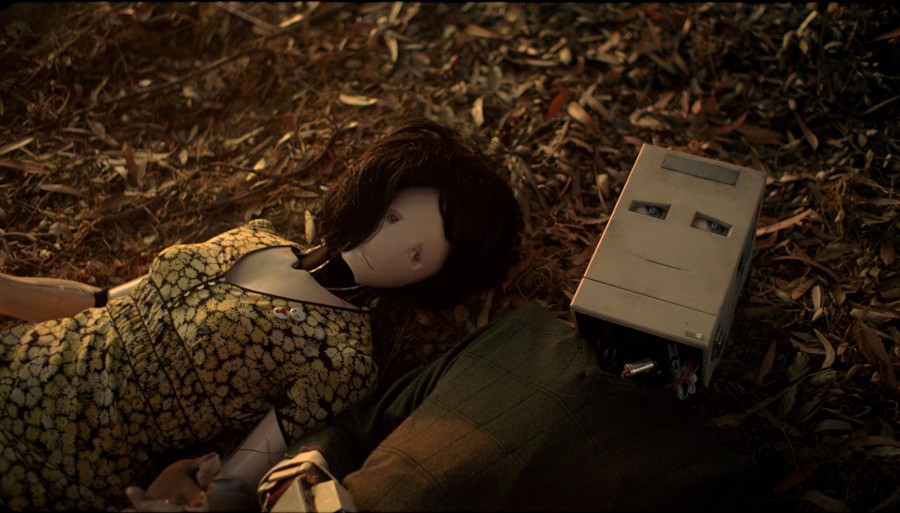
Spike Jonze knows how to work with very little, and create a lot. Here he employs his trademark marriage of low-tech and high tech to create a very fleshed out world in just about 30 minutes. The story is a science fiction one, but a sort of retro-futuristic Los Angeles. Humans and robots live together, the robots appear to be built of those unattractive beige computer cases from the 90s. The only CG employed are in the eyes and mouths of the characters, and that is done in a subtle way.

The story follows Sheldon, a librarian robot who is introverted and nervous, returning to his apartment every evening, plugging into the wall recharger and sitting alone. One day he happens to meet Francesca, a female robot who is driving a car, something robots are not allowed in this world. The two hit it off and a romance develops. During a concert, the crowd gets a little rough and Francesca loses her arm. In an act of love, Sheldon unscrews his own and gives it to her. As their relationship continues, it becomes apparent a larger sacrifice will be made. The film is an interesting mix of heartbreaking and unsettling. A lot of the choices made in this relationship appear to be one sided, and it can be read as an act of unconditional love or of a selfishness. Definitely worth a watch and a beautiful looking film from director Jonze.

Maybe Sundays – The Crazies (2010)


The Crazies (2010, dir. Breck Eisner)
Starring Timothy Olyphant, Radha Mitchell, Danielle Panabaker, Joe Anderson

The Crazies is only a zombie film by default. It’s “monsters” aren’t the walking dead at all, but people infected by viral weapons designed by the United States military. And one could easily debate if the villains in the film are the townsfolk or the emergency response military troops that come to kill them all. Based on a 1973 George Romero cult flick, this film follows the same premise but with some modern tweaks and a lot better character development than the original.
The story begins with Ogden Marsh Sheriff David Dutton attending the opening game of the high school baseball season. A town farmer arrives on the field, behaving strangely and brandishing a shotgun. David to shoot and kill the man when he draws his weapon on the crowd. Over the next day, more cases of similar behavior surface causing David and his doctor wife, Judy to suspect something sinister is at work. In the middle of the night military forces show up in Ogden Marsh, rounding up citizens in makeshift internment camps.
It’s obvious the film is expanding on the anti-government paranoia of the 1970s with a post 9-11 spin. What I picked up on most was that almost every infected townsperson is a familiar face that we’re allowed to pick up some details about before they become a monster in the film. With the military, we only see one soldier’s face. The rest are constantly wearing hazmat suits or full fatigues with gas masks securely planted over their faces. This conceit causes the military to come off as much more of the mysterious evil force than the infected. In fact, the greatest horror of the film is performed by the military in the film’s finale.
Despite this, the film falls into the most cliched of cliches in the horror business. There was an inordinate number of times where we were given a cheap jump scare from someone being touched on the shoulder. And I counted at least twice where a scare was revealed by the camera simply panning to the right to reveal an infected in the room. It’s these easy paint-by-the-numbers techniques that take a film, which could have been interesting and tapped into some interesting zeitgeist, and turn it into a $5 DVD bin flick for Wal-Mart.

Wild Card Tuesday – Gentlemen Broncos


Gentlemen Broncos (2009, dir. Jard Hess)
Starring Michael Angarano, Jemaine Clement, Sam Rockwell, Jennifer Coolidge, Mike White, Halley Feiffer, Hector Jimenez

In 2006, after he had been hired to develop the score for Nacho Libre, singer-songwriter Beck said of director Jared Hess, “No filmmaker since Fellini has had such an eye for amazing characters”. That’s a pretty strong statement to make about a filmmaker who had only released one feature film at the time. And while Nacho Libre left me wanting for the disjointed narrative of Napoleon Dynamite, Gentlemen Broncos has shown me exactly what Beck was seeing.
It may come as no surprise at how much I loved Broncos as it definitely hit me where I live. The film’s protagonist, Benjamin Purvis (Angarano) is a homeschooled, amateur science fiction writer who has developed a novel based on his late father. He attends a young writers conference with a group of fellow homeschooled students from his co-op and meets his idol, Ronald Chevalier (Clement) who proceeds to steal Benjamin’s story and change key details to hide the theft. Simultaneously, Benjamin sells the film rights of his novel to an incredibly amateur filmmaking duo, one of whom has romantic intentions on Ben.
The level of the theatrical grotesque in this film is so incredibly over the top. As bizarre as this world is, it feels so familiar and fleshed out. There are so many rich details and background pieces of minutiae that part of me didn’t want to leave this universe. Added to all of this are dramatized excerpts from both Benjamin and Chevalier’s versions of Yeast Lords (the name of the stolen novel). In both versions Sam Rockwell plays the protagonist and proves once again why he is one of the most talented actors working today. In Benjamin’s version he plays the hero as a gruff, Southern accented redneck and in Chevalier’s is a lisping, albino.
Aside from Rockwell, there were many great performances, in particular Hector Jimenz (also in Nacho Libre). I have no idea what sort of acting choices Jimenez made for his role as Lonnie Donaho, the auteur responsible for making over 80 films (most of them trailers he tells us) but they result in one of the strangest characters I have ever seen on the big screen. The moment I knew Lonnie would be one of my favorite characters to pop up in the film comes early on. He and Tabitha (Fieffer), Benjamin’s love interest, take a seat next to Ben on the bus heading to the writers conference. Tabitha asks Ben to give her a hand massage, and as he does Lonnie proceeds to blow in Tabitha’s ear with a sound resembling a clogged vacuum cleaner.
Jared Hess, and his wife and writing partner Jerusha, have renewed my hope in their work. They come across as a combination of the clean, crisp filmmaking of Wes Anderson and the love of the mundanely bizarre of Tim & Eric. I think Nacho Libre’s flaws came from having a third party intervene and make rewrites to make the film more “palatable” for mainstream audiences. Hess isn’t built to make mainstream cinema and the more freedom he is allowed to pursue his skewed vision of middle America the better.