Movie Review – Gladiator

Gladiator (2000)
Written by David Franzoni, John Logan, and William Nicholson
Directed by Ridley Scott

I am not a fan of Ridley Scott, a statement I’m sure I’ve made multiple times on this blog. I have certainly said it out loud plenty of times. I think he is a fantastic production designer, building worlds in intricate detail. But he is not a consistently strong storyteller or director of human beings. Filmmakers with prolific careers often reveal their personal views for their work, especially if they make big-budget Hollywood pictures. In Scott’s work, I see themes centered around a disdain for how humanity is crushed by institutions and the military’s glorification. In this film, Blackhawk Down, and others, he romanticizes and mythologizes the warrior figure in a personally uncomfortable way.

Continue reading “Movie Review – Gladiator”

Comic Book Review – Wonder Woman by John Byrne Volume 2

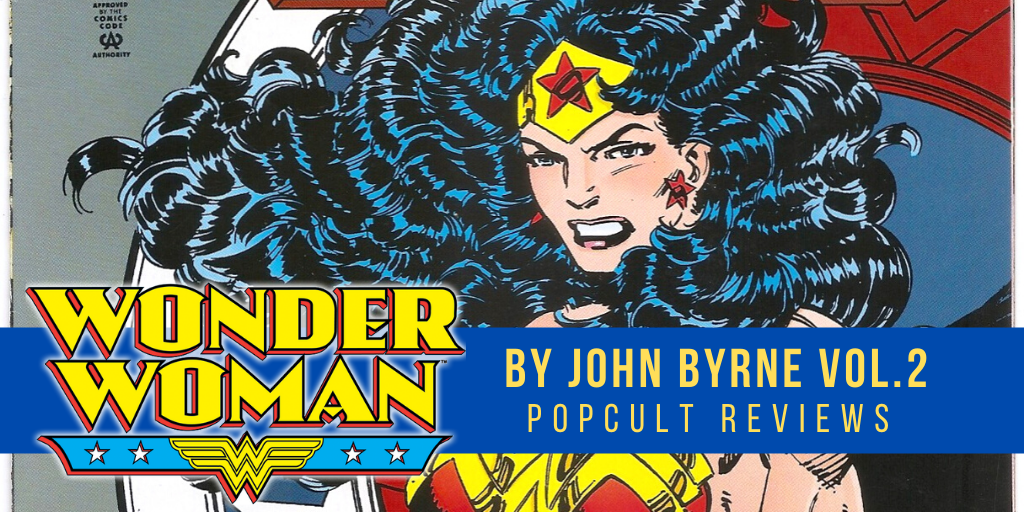
Wonder Woman by John Byrne Volume 2 (2018)
Reprints Wonder Woman #115 – 124, Annuals #5,6
Written by John Byrne
Art by John Byrne, Norm Breyfogle, Dave Cockrum, and Tom Palmer

The one thing that can’t be denied about John Byrne’s run on Wonder Woman is that he most certainly made it his own thing. At this point in his career, his name carried tremendous clout, and he could essentially do what he wanted. In the early 2000s, he rebooted the Doom Patrol during his run on JLA and completely scrambled established continuity that rippled through characters in the Teen Titans and didn’t care. His run on Wonder Woman definitely carries on George Perez’s rebooted version of the heroine and the Amazons, but he seems much more interested in pitting her against very different foes.

Continue reading “Comic Book Review – Wonder Woman by John Byrne Volume 2”

Movie Review – Traffic

Traffic (2000)
Written by Stephen Gaghan
Directed by Steven Soderbergh

Steven Soderbergh’s career has been one of the most eclectic and prolific of most modern directors. It was a slow burn, though. His directorial debut, sex, lies, and videotape, was a massive breakthrough in 1989. However, for all his promise, it led to a decade of commercial failures and an embrace of independent filmmaking and experimentation. It was 1998’s Out of Sight that changed things and led to his reemergence as a mainstream film director. Soderbergh never lost sight of those formative experimental years, and Traffic served as a bridge between more conventional filmmaking and the director’s insistence on playing with form and presentation.

Traffic is a film based on a BBC mini-series that follows three separate but intersecting plots centered around the War on Drugs in the United States & Mexico. In Tijuana, we follow police officer Javier Rodriguez (Benicio del Toro), who is brought into General Salazar’s inner circle, a high-ranking official that wants to take down the Obregón brothers who head the local cartel. Rodriguez and his partner become further intertwined with Mexico’s corruption, quickly realizing every side is out to have a piece of the drug trade and is only interested in eliminating the competition.

In the Midwest, we meet conservative judge Robert Wakefield (Michael Douglas) is appointed to head the President’s Office of National Drug Control Policy. It becomes clear to Wakefield from his predecessor and longtime staff members that the War on Drugs is unwinnable, but he keeps moving forward with the transition. Meanwhile, his daughter Caroline (Erika Christensen) has become involved in drugs, her latest vice being freebasing cocaine. She and her boyfriend (Topher Grace) hole up in a cheap motel room where they spend the day blasting their minds with drugs. When her addiction comes to light Wakefield and his wife (Amy Irving) struggle with the best way to help their daughter.

The final plotline centers on Helena Ayala (Catherine Zeta-Jones), who’s husband is arrested by the DEA for his role as a drug trafficker. Meanwhile, DEA agents Gordon (Don Cheadle) and Castro (Luis Guzman) are leading the investigation on Ayala’s operations, which also involves surveilling his wife. Helena finds herself becoming financially desperate. People whom her husband owes come around making threats, and she finds herself reaching the edge. Gordon and Castro get their hands on a significant witness against Ayala, Eduardo Ruiz (Miguel Ferrer), whose testimony makes him a valued asset of the US government and the cartels’ target.

Soderbergh bit off so much with this film and does an excellent job developing each plot thread, allowing light crossing over but making sure each story has its own complete arc. One technique he uses to help the audience is by using three different color correction techniques for each story. Rodriguez’s sun-bleached Mexico story is shown in an overexposed sepia, Wakefield & his daughter’s journey through addiction is presented in a stark, cold blue. The California storyline looks the most conventional, with colors just slightly oversaturated. Soderbergh was an early adopter of digital filmmaking, and it shows here as those first cameras could show a lot of grain & distortion in the video. This was a detractor in some pictures, but here it helps with the cinema verite style that Soderberg was going for, a semi-documentary atmosphere with handheld camera work.

The best thing about Traffic is how Soderbergh presents the War on Drugs as an unwinnable conflict. Wakefield delivers a speech in the third act about how we are asked to go to war with our own children, and that understanding and offers of help will do more to curb the desire for drugs. The film does an excellent job of showcasing how overly complicated and pointless the mission to wipe out drugs is. It’s pointed out early in the movie that the cartels would have no power if the demand in the white suburbs of America weren’t there. The very law enforcement that claims to be fighting the spread of drugs regularly turns out to be on cartels’ payrolls.

The way Soderbergh delivers this message is not through the characters didactically spouting platitudes (I’m looking in your direction, Aaron Sorkin!). He keeps that documentarian style that distances his own views from the characters and never editorializes things. A few moments, particularly with the Wakefield character, come close to that, though, but the director manages to avoid going over that cliff into a movie of the week.

Traffic’s biggest problem is the scope of its story and how, even with a three hour running time, so many characters are still relatively undeveloped. I have to think that the original television version could do this, but you lose that in a feature film. Caroline is a non-character for most of the movie, just a drug-addicted teenager with minimal other defining characteristics. I also think Helena deserved some more development because we see her story arc rushed along to make her the head of her husband’s operations without really seeing her struggle along the way. Traffic certainly still holds up, one of those movies that created an aesthetic for the 2000s that is even mimicked today.

Movie Review – Chuck & Buck

Chuck & Buck (2000)
Written by Mike White
Directed by Miguel Arteta

Discomfort is a feeling often avoided in mainstream cinema. Movies made by large studios are interested in getting a return on profit, which usually involves making their products pleasant & easy to digest. Independent cinema in the late 1990s/early 2000s didn’t seem very interested in that route. For the most part, movies were transgressive, sometimes cleverly and other times in clunky, awkward ways. Even then, they tried to cater to their imagined audiences. Kevin Smith spoke to his fellow Gen X pop culture kids with Clerks while Tarantino delivered tense machismo in Reservoir Dogs. Neither of them really made the audience deeply uncomfortable beyond some sex or violence. Mike White was a different story, a writer/actor whose career is built around cringe.

Buck (White) has just lost his mother and invites childhood friend Chuck (Chris Weitz) to the funeral. Chuck brings his fiancee Carlyn along, and the encounter ends with Buck trying to touch his friend’s crotch in the bathroom. It’s not clear at first, but we begin to realize that the two men were sexually intimate as children. For Buck, this has been a defining experience in his life, fully embracing his sexuality. Chuck saw it as a passing phase and wants to live what he perceives to be a “normal” life. Buck can’t let go and cashes out his bank account to move to Los Angeles to be closer to Chuck. There’s a theater across the street from Chuck’s office, and Buck decides to write a play about them, put it on, and invite his friend in the hopes everything will be understood. But life doesn’t turn out that way.

There’s a cutesy veneer over the entire movie but is most certainly a dark comedy that is fearless about embarrassing its main characters and making the audience feel deeply uncomfortable. There is never a villain in the story, but you do have characters being terribly cruel, almost immediately regretting it or saying things because they are upset. In that way, it reflects how people really engage in challenging, uncomfortable situations. At first glance, this appears to be a story about unrequited love and heartbreak, but Mike White has so much going on underneath that.

Chuck & Buck is ultimately a film about allowing nostalgia to stop us from progressing as people. Buck brings along bags of artifacts from his childhood bedroom when he comes to Los Angeles. At one low point, he surrounds himself with these toys and baubles to derive comfort. The play he writes is a fairy tale interpretation of his situation with Chuck, framing Chuck’s fiancee as a wicked witch. The theater is putting on a production of the Wizard of Oz at another time, so the background during Buck’s play is the Yellow Brick Road going into Emerald City. It’s another visual signifier of wistful nostalgia.

At first, this feels like it might end up being a creepy dark comedy about Buck becoming a stalker, maybe hurting Chuck. But White is smarter than that and, while he does show Buck has stalker tendencies, the film is more human than exploitative. There’s a lot of question to the nature of what the men’s relationship was like as children. Did Chuck take advantage of Hank? During the play, Chuck’s analog expresses regret to Buck’s for having him eat magic cookies. He tells him he was too young to do that, and he took advantage of him. The arc here is how Buck will become a fully realized person, and that won’t happen until he works through these things that have kept him stunted.

Chuck & Buck ends on a hopeful note, the idea that we can move on from our traumas and find new places where we flourish. Through staging a play, Buck finds a family with the actors and the stage manager. He learns that creating art in a place where he can really soar, expressing difficult emotions, and finding connections with others. This is a pretty fantastic human-centered film that doesn’t lean into its indie quirkiness but relies on great performances and White’s solid script.

TV Review – Monsterland Season 1

Monsterland (Hulu)
Written by Nathan Ballingrud, Mary Laws, Scott Kosar, Wesley Strick, and Emily Kaczmarek
Directed by Anne Sewitsky, Kevin Phillips, Craig William MacNeil, Eagle Egilsson, Logan Kibens, Nicolas Pesce, Desiree Akhavan, and Babak Anvari

Oh, dear. As I have said many times before that television horror anthologies are a tough feat to pull off. So, I want to acknowledge that making this series had to be a challenge. You have a new cast every episode with a new director. That can’t be easy to do. You have between forty-five minutes to an hour to tell a full character arc, which is another near impossibility. All of this said, I really hated Monsterland. It was a real slog to get through all the episodes, and I found myself forcing the last two down just so it could be over.

Continue reading “TV Review – Monsterland Season 1”

Movie Review – O Brother, Where Art Thou?

O Brother, Where Art Thou? (2000)
Written by Ethan Coen & Joel Coen
Directed by Joel Coen

The Coen Brothers were coming off some iconic films by the time the new millennium rolled around. In the 1990s, they established themselves with pictures like Miller’s Crossing, Barton Fink, Fargo, and The Big Lebowski. Their first entry into the 2000s was a big-budget comedy based on Homer’s Odyssey. It was just the sort of strange left turn their entire career has been filled with. The result was a decent movie, most certainly their most outstanding technical achievement but definitely not one of my favorites in their filmography.

Continue reading “Movie Review – O Brother, Where Art Thou?”

Movie Review – Possessor

Possessor (2020)
Written & Directed by Brandon Cronenberg

Possessor is the film Christopher Nolan wishes he could make. It’s a cooly stoic film centered around an incredibly creative concept that delivers on real human emotion. But Possessor goes places Nolan just creatively cannot; he is too conservative in his ideology, a constant desire to frame things in stark objectivist Black & White. Writer-director Brandon Cronenberg knows it is more complicated than that, and, especially when dealing with monolithic tech corporations, you are entering a transcendental world where morality has been so blurred it’s not even recognizable any longer.

Continue reading “Movie Review – Possessor”

Movie Review – Cast Away

Cast Away (2000)
Written by William Broyles Jr.
Directed by Robert Zemeckis

I recently wrote about Robert Zemeckis in my review of his adaptation of The Witches. He’s a director whose work on the Back to the Future films I absolutely love. But I think much of his output in the 2000s & 2010s has been pretty lackluster. After Forrest Gump, he collaborated with Tom Hanks on this film and The Polar Express. In Cast Away, you can see Zemeckis’s continued fascination with digital effects, but he hasn’t been so taken with motion capture yet. This is one of those films that has permeated pop culture with references to Wilson the Volleyball being a fairly ubiquitous sight gag since. I’d never seen Cast Away and thought if I was flashing back to 2000, I had to watch it.

Continue reading “Movie Review – Cast Away”

Movie Review – Sexy Beast

Sexy Beast (2000)
Written Louis Mellis & David Scinto
Directed by Jonathan Glazer

Jonathan Glazer has been working in the performing arts for over thirty years, starting as a theatrical director and building a reputation for himself in the world of music videos through the 1990s. He was responsible for some iconic Radiohead, Blur, and Jamiroquai videos, which displayed his creativity and ability to build powerful moods through images and music. Glazer also directed some brilliant advertisements, with his Levis ads being some of my favorites. So before he had settled on a feature film debut, those who were aware of Glazer’s talents knew he was going to make incredible movies. That debut ended up being 2000’s Sexy Beast.

Gal Dove (Ray Winstone) is a retired English criminal living happily in Spain with his wife, DeeDee. They have been joined by friends Aitch and his wife, Jackie. Every day is spent lounging by the pool, eating at fantastic restaurants, and drinking wine as they joke about the old days. It all comes crashing down when Jackie receives a call from Don Logan (Benjamin Kingsley), a criminal associate and cold sociopath they thought was a memory. Don shows up demanding Gal take a job being offered by crime lord Teddy Bass (Ian McShane). Gal doesn’t want to go back to that life and wants to be left alone, but Don’s insistence and eventual violence are pushing him into giving in.

Sexy Beast is a gorgeous mood piece. The characters are incredibly well-written, but what makes the film are the stylistic flourishes Glazer adds on. The entire movie, despite some intense and violent moments, is overflowing with passion and love. Gal is whole-heartedly devoted to DeeDee, a fact that Don Logan knows and attempts to undermine by digging up sordid details of DeeDee’s past. She has already shared these with Gal, and his pain is less about the besmirching of his honor but knowing how much it must hurt for DeeDee to be reminded of regrettable choices. 

Before we see Don Logan on screen, we feel his presence. The movie opens with an iconic scene of a boulder that nearly kills Gal and falls into the swimming pool behind the house. Later, Gal has a dream about a monstrous anthropomorphic rabbit coming to gun him down. These are all portents of something terrible on a direct path to ruin the idyll that Gal and his friends have created. When Kingsley shows up as Don on the screen, we immediately understand the characters’ gloom. 

Don is this angry, little dog that just won’t let go. He tries to engage in social niceties, but it’s clear he’s disinterested in it all. He wants to make sure he dominates the space and that people do as he says. Don doesn’t show emotions; he assumes behaviors he’s observed in people but delivers them awkwardly. One minute, Don pretends to want to know what you’ve been up to, and in a hairpin second, he switches to not giving a shit and getting down to business. A compliment can transition to a ribald joke about your wife moments later.

I’m not such a great fan of Kingsley. He can be excellent in the right roles, but more often than not, I think he picks terrible projects, and it ends up being embarrassing. Here we get to see a side of the actor not glimpsed often. Gone is the fatherly gentleness of Gandhi, and in its place is a vicious pit-bull of a human being. It becomes evident that the story cannot end in anything but violence when such a person is present. Gal is steadfast that he won’t do the job, and Don cannot handle this fact. The madman teeters between angrily accepting the decision to physically strike Gal to the floor when he doesn’t comply.

Jonathan Glazer picked a fascinating film to begin with, the most accessible film in his very selective film directing career. When you look at his later two features, Birth and Under the Skin, they are very different in aesthetics, themes, and tone. Unlike his contemporaries, Michel Gondry and Spike Jonze, Glazer is a more versatile filmmaker. You might not always know a movie is a Glazer work because he is malleable without losing his insistence on smart stories and striking visuals.

Comic Book Review – Batman: Three Jokers

Batman: Three Jokers (2020)
Written by Geoff Johns
Art by Jason Fabok

In 2015, in the pages of Justice League #50, Batman used the Mobius Chair, a device of great cosmic power, to ask who the Joker really is. He suddenly appears shocked at the answer. That same day, in the pages of DC Rebirth #1, we follow up and find Batman contemplating that he now knows the Joker is three different people. For five years, that plot beat remained unresolved. Promises were made that a mini-series was forthcoming that would address this shocking revelation, but it took until this year for readers to finally get access to Batman: Three Jokers. There was a lot of hype leading into this story arc and many questions about how much continuity would be changed by the answers revealed inside.

Continue reading “Comic Book Review – Batman: Three Jokers”