Weekend Trailer Roundup

The Eclipse (dir. Conor McPherson) – a very non-exploitative looking ghost story from Ireland

Mother (dir. Joon Ho-Bong) – South Korean psychological thriller from the brilliant mind behind The Host.
Mystery Team (dir. Dan Eckman) – From the brilliant comedic minds behind Derrick Comedy, one of whom is Donald Glover, former writer of 30 Rock and current star of NBC’s Community. This one look damn good.
Afterschool (dir. Antonio Campos) – A disturbing murder mystery at a prep school. Something about the cinematography and ambient noise is incredibly eerie.
Wall Street 2: Money Never Sleeps (dir. Oliver Stone) – Stone’s stock has fallen in the last decade, W. was a huge disappointment. Here’s hoping he recaptures some of what made him great in the late 80s.

http://www.youtube.com/v/m0CSjX2h-k8&hl=en_US&fs=1&

Film 2010 #18 – Broken Embraces


Broken Embraces (2009, dir. Pedro Almodovar)

Starring Penelope Cruz, Lluis Homar, Blanca Portillo, Jose Luis Gomez, Ruben Ochandiano, Tamar Novas
Director Pedro Almodovar has never disappointed me and continues that successful streak with his latest picture. There is something captivating about how he calmly lays out the strands of a plot. He does it so masterfully that before you know it, you’re completely absorbed in the story he is telling. With Broken Embraces, Almodovar weaves together his dramatic tones as seen in films like All About My Mother and Talk To Her with noir elements he began using in Bad Education. The result is a masterpiece.
The story begins with blind screenwriter Mateo Blanco, who signs his scripts under the pseudonym Harry Caine. His day to day affairs are looked over by his long time production assistant Judit Garcia and her son, Diego. Into their life comes Ray X, a mysterious director who appears to know something of Mateo’s past. Diego wants to know more and Mateo begins to tell the tale of he and an actress named Lena’s relationship.
Everything about the structure and pace of the film is spot on. Almodovar takes his time before getting to the core story, which is told mostly in an extended flashback, framed by the present day story. I’ve begun to look at the director’s films as having a lot of similarities with Shakespeare’s work from a structural standpoint. The plots are fairly straightforward with a cluster of key characters and flashbacks and framing devices are used frequently. I think by refraining from attempting to over complicate his scripts with too many characters or sub-plots and twists, Almodovar creates very classic films that are going to last for decades to come.

Hypothetical Film Festival #4 – Deconstructing Darko

One of my favorite indie flicks of the early 00s is Donnie Darko. Though it has been inflated beyond any acclaim in deserves in the years that followed I still believe its an interesting puzzle of a film, made by a director who truly does love movies. That said, Richard Kelly hasn’t directed anything worth a flip since (Southland Tales, The Box). Kelly infuses lots of film references into the flick, and they are worthy of a film festival:

It’s a Wonderful Life (1939, dir. Frank Capra)
This one is probably throwing you for a loop, right? Well Darko owes a lot to this film. Its concept of a man being allowed to experience a world without his presence is flipped as Donnie is allowed to be pulled from the moment of his death and experience how life would have continued if he had lived. In the same way things go downhill for the people in George Bailey’s life without him, Donnie’s survival seems to be a keystone in the downfall of many of the people around him. Yes, a depressing sentiment, but it makes the film that much more poignant.


E.T. (1982, dir. Steven Spielberg)

Kelly confesses that the bicycle chase scene in the finale of E.T. inspired the bicycle ride on Halloween night in his film. And the director is an admitted fan of directors like Spielberg and Zemeckis, who defined 1980s sci-fi and fantasy on the big screen. An understanding of Donnie Darko would be incomplete without an understanding of the kid-targeted fantasy cinema of the 80s.

Rebel Without A Cause (1955, dir. Nicholas Ray)

This was the picture that created a solidly defined picture of teen angst in a post-War America. In effect, all films to follow that focused on troubled adolescent protagonists owe a debt to this James Dean flick. Both Darko and Rebel use a decrepit old house as a key set piece for tragedy. I’d even say Donnie is an updated variation on Plato, the moody disturbed kid who is headed down a hopeless track.

Watership Down (1978, dir. Martin Rosen)
Donnie’s English teacher is reading this novel to him and there are some important themes in it that tie to what is going on in the indie film. An animated adaptation was made of Richard Adam’s novel in the late 70s and is definitely not kiddie fare. The story follows a group of rabbits in the English countryside whose land is being torn up for new developments. They escape and go on a harrowing journey that leads them to a land that appears to be unpopulated. However, a group of rabbits are already there and they don’t flinch at killing their new neighbors to keep their home.


The Last Temptation of Christ (1988, dir. Martin Scorsese)

This adaptation of the classic novel of Greek writer Nikos Kazantzakis, is referenced twice overtly in Kelly’s film and once in a sub-textual manner. Donnie waking up in the woods is paralleled by Christ waking up in the wilderness, hearing the voice of God. The second reference is when Donnie and Gretchen go to see the Evil Dead and this film is also playing. The more subtle reference is Donnie living out a life where he does not, which is the temptation in the title of Scorsese’s film. Christ is tempted by Satan while he hangs on the cross with a vision of living to old age, having a wife and children, but he also sees a world devoid of his message. In the end both Donnie and Christ chose to sacrifice themselves to save the world around them.

A Decade in Love With Movies – 2007-2009 – Opinions

I got into quite a strong flow of watching film during this time. My roommate Eddy would watch many of them with me, and because of his background an English major, we could discuss them like the nerd we truly were. I watched many documentaries during the first half of 2007, while I was still in Bellingham. Simultaneously, I was finishing up my year with AmeriCorps and starting to realize that working in schools at the elementary level was the job I was meant to do. Many of the documentaries I watched corresponded to this as they focused on the social welfare of children internationally (Born into Brothels, The Children Underground).

I found myself missing Tennessee, despite the beauty of the land around me. I made arrangements to return home in July and once my term with AmeriCorps finished in June, I had about a month of nothing to do. I discovered Spanish director Pedro Almodovar during this time and fell in love with his films. I started with Bad Education and quickly found All About My Mother, Talk To Her, and Women on the Verge of a Nervous Breakdown. What I loved about Almodovar was how visually alive his films looked. They’re full of color and bombastic characters, but on the flip side they have very deeply emotional moments that never feel dishonest.
I also picked up my own copy of the Scarecrow Movie Guide, a book put out by Scarecrow Video in Seattle, that catalogues a massive amount of films, some well known but most very obscure to the casual filmgoer. This book was crucial in helping me develop into a true appreciator of cinema and I feel that I have reached the point where I can put it aside and guide myself independently through film history. The Scarecrow Movie Guide encouraged me to pick a director and fully devour their work completely, helping me finish up viewing Kubrick’s work.
Back in Tennessee, I discovered the beauty of BitTorrent and it ability to open the door to an almost infinite number of film experiences. So many films, not available at the library or even in the country on DVD, were waiting there and I found my consumption increase a hundredfold. It was also in this time that I solidified my decision to go into teaching and began a relationship with the most amazing person I have ever met in my life, Ariana. There are few experiences greater that being curled up with her and watching movies. I find myself impressed with how much she is growing in her film knowledge now. She even admits I’ve helped her appreciate the role a director plays in shaping a film.
I know that for the rest of my life, I will be in love with film. I look forward to sharing cinematic experiences with Ariana, with friends, with future children. I can’t wait to sit down with my own kids and show them The Wizard of Oz or Star Wars for the first time, and get to see their amazement as they discover these worlds.

Film 2010 #17 – Legion


Legion (2010, dir. Scott Stewart)
Starring Paul Bettany, Dennis Quaid, Tyrese Gibson, Adrienne Palicki, Charles Dutton, Lucas Black

Interesting concepts, poor execution. Par for the course with a lot of sci-fi and fantasy on film these days, and Legion is no exception. The film has a few little twists but at the end of the day fails on pretty much all fronts.
Michael the Archangel (Bettany) learns of God’s plan to finally wipe out humanity and cannot go along with this plan. He rejects his angelic nature, falls to Earth, and gets a bunch of machine guns to fight with. Michael makes his way to a diner in the middle of New Mexico where a young woman lives who is pregnant with a child that is somehow the last hope for mankind, though what exactly this kid can do is never explained in the film. Michael even goes so far as to say if the child lives or dies it doesn’t matter near the end of the film. Okay…then why all the hubbub?
There is a lot in this film that is never explained and that is incredibly frustrating. In an arthouse film like Eternal Sunshine, the tone of the film never takes itself too seriously, hence we never wonder how the memory removal process works. In a film like Legion, which can’t laugh at itself once, the tone dictates that when action is taken there is a concise rhyme and reason. The biggest example is of how exactly does a machine gun hurt a being like an angel. Not a single effort to justify that one.
The biggest concept I like from the film was the idea of angelic possession. The movie is basically a zombie film with angel-possessed human hordes attacking the diner and trying to kill the pregnant woman. While the execution of the idea is downright yawn-inducing, the concept itself is incredibly originally. I’ve read a hell of a lot of comics and seen a lot of films but have never encountered the idea of angelic possession. Pretty cool idea, would like to see it implemented in a different film.

A Decade in Love With Movies – 2003 -2006 – An Education

Throughout this period of time, I became a frequent theater hopper at the Green Hills 16. About one or two Saturdays a month, I would walk over to the mall and take advantage of the basement like setup of the 16, where a person could easily move from screen to screen and never be seen. I was able to devour so much cinema during this period, helped in part because the 16 is a Regal Arts Cinema, meaning it focused on artsy fare mixed in with the blockbuster junk. I saw such films as Secretary, Late Marriage, Spirited Away, Adaptation, and more.

It was also in this time, that I switched from being a communications major to English, and never regretted the decision once. I was immediately with peers with whom I clicked, who saw the world in a similar way to me. I was in classes that motivated me with great discussions and analyses. I also became part of the English Major Movie Night, suggesting titles such as Eternal Sunshine of the Spotless Mind and I (Heart) Huckabees.I became more and more interested in reading about the ideas behind and interpretations of cinema at this point.
I began to think about tracing footsteps back in film. I was very aware of contemporary cinema but wanted to know more about the films of the past that influenced today’s pictures. During summers on campus I got my library card for the Metro library and was able to consume massive amounts of cinema, going back every other day at some points to pick up new holds. It was in 2004, that I became enthralled by a filmmaker who would influence me in my writing and thinking even today, Robert Altman. In the matter of a few weeks I saw MASH, The Long Goodbye, Brewster McCloud, The Player, and Short Cuts. The fractured and cacophonous nature of Altman’s filmmaking appealed to the same part of me that ate up the more post-modern literature I was consuming at the time.
I also graduated from college in this time and suffered an intense post-collegiate depression.
One of the things I began doing at the time was cataloging the films I saw over 2005, a practice I still maintain today. I began to fight my way through the depression and film played a major part. The apartment I lived in had cable with every premium channel plus a DVR unit. I began checking the schedule a week in advance and planning out what to record and was able to see volumes and volumes of excellent film that continued my education. In 2006, I worked for a brief time at the Edmonson Pike branch library and was able to have daily access to great works of film, having 20 or more DVDs out at a time. I was able to continue keeping up with contemporary works as well as back tracking and seeing more historical films.
I came to a conclusion in early 2006, that I wanted to live somewhere else and made plans to move to Washington state. The last film I saw, the night before my flight to WA, was the opening night of Superman Returns. While the film hasn’t aged well, the experience remains as one of the most significant in my life. I saw it with my father and brother, both of whom since my relationships with have become very damaged and we haven’t spoken for over a year. We got to the theater only to see a long line coming out. I remembered my former roommate Seth Hatfield was a manager there so we stepped inside. I found him and he let us in for free and into the theater before every one else. Seats were found in the very middle of the theater and I remember being taking back to my childhood by things as simple as that iconic theme by John Williams.
The second day I was in Bellingham, WA I got a library card and began using their system for its film potential. Ups and downs were had those first six months in Washington and I found film to be a way of helping me get through the tougher times.

Sundance Film Festival – The History


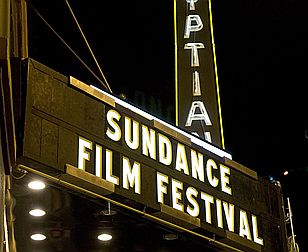
Right now the 2010 Sundance Film Festival is in full swing in Park City, Utah. American films of all sorts are being rolled out every day till January 31st. For the blog, I’ll be looking at the general history of Sundance here in part one, and then in part two I’ll look at some of this year’s films that I’m most excited to see.

The Sundance Film Festival began in 1978 as the Utah Film Festival. At the time there was no prominent American filmmaker-only festival in the existence and the hope was that this small gathering in Utah would provide a focal point for the iconoclastic film being made at the time. The festival was originally held in Salt Lake City and its biggest event was the awarding of the Frank Capra Award, given to filmmakers who worked outside the mainstream Hollywood system. The first year it was awarded appropriately to Jimmy Stewart, who worked with Capra on It’s A Wonderful Life and Mr. Smith Goes to Washington.
In conjunction with the festival, the Sundance Institute was formed, named for Robert Redford’s iconic character and chaired by the actor. The Institute provided young filmmakers with funding for their projects. It was Redford’s involvement in the program that raised the prominence of the film festival. In 1981, the festival moved to its current location of Park City, suggested by director Sydney Pollack due to the resort and tourist nature of the area.
Originally, the festival only dealt in incredibly obscure films but in the late 80s and early 90s, a few young directors gained a large amount of attention. Steven Soderbergh’s sex, lies, and videotapes hit the festival in 1989, followed by a huge year in 1992 with the debut films of Quentin Tarantino (Reservoir Dogs), Kevin Smith (Clerks), and Robert Rodriguez (El Mariachi). Even Wes Anderson’s short film, Bottle Rocket (the basis of the later feature) debuted in the 90s at Sundance.
As Sundance grew in prominence, many argue that its dedication to burgeoning filmmakers waned. Big money is to be made from distribution sales at the festival now, especially in 2001 when Mariah Carey’s Glitter debuted. Many independent filmmakers saw Sundance as becoming more interested in the business and paparazzi side of things. In response, the rival Slamdance festival started in 1995. Slamdance has discovered its own fair share of talent, including Marc Forster (Monster’s Ball), Jared Hess (Napoleon Dynamite), and Christopher Nolan (Memento).
Up Next: A Look at 2010’s Sundance line up

Film 2010 #16 – Goodbye Solo


Goodbye Solo (2008, dir. Ramin Bahrani)

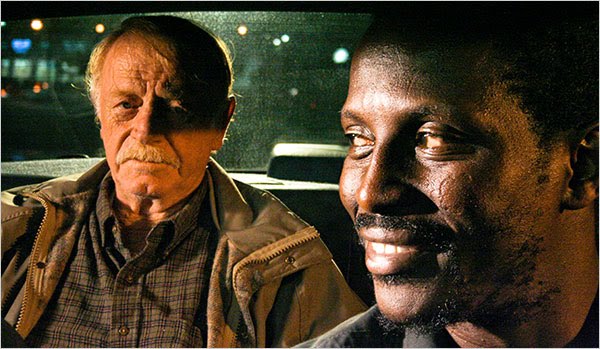
It begins in the middle of a conversation between two men, Solo and William. William wants a ride to national park in Eastern North Carolina two weeks from now and is offering Solo, the cab driver, a $200 down payment to ensure this. At first, Solo can’t quite understand why William wants a one way ride to the middle of nowhere, but soon he begins to figure out William’s motives and decides to do whatever he can to stop him.
I first became of aware of Ramin Bahrani with his 2007 film Chop Shop. Bahrani has found his niche in taking unfamiliar faces and non-actors and placing them in very human and very compelling stories. Goodbye Solo is no exception, and it owes the majority of its grounding in honest humanity to the acting of Souleymane Sy Savane who plays Solo. Solo is so incredibly genuine in his caring for William, that you cannot help but be pulled into this deceptively simple story.
Director Bahrani presents a very complex view of suicide in this film. We are never given explicit reasons as to why William wants to end his life, but there are hints dropped and Solo does some investigating of his own and learns some things about the elderly man’s past. The two characters are excellent foils for each other: both very connected to their role as fathers and both determined in their own ways. Solo is just as bullheaded as William, except Solo has the charisma and smile to get people on his side.
The film’s resolution will probably frustrate people more accustomed with mainstream cinema. There is a lot of ambiguity and Solo reveals the complexity he hides to most people. Bahrani is one of the most powerful new voices in American cinema. His landscape encompasses both the urban and rural masterfully and the faces in his films are a true representation of the diversity present in our nation. Bahrani also chooses to focus on the working class in all his films and really taps into the zeitgeist of daily life and the state of the economy today. His films are in no one overtly political and seem only to yearn to find commonalities between diverse groups in America today. Goodbye Solo is a film that, if you allow it, will stay with you for a long time to come.

The James Dean Trilogy – Rebel Without a Cause


Rebel Without a Cause (1955, dir. Nicholas Ray)
Starring James Dean, Natalie Wood, Sal Mineo, Jim Backus, Dennis Hopper

Where in East of Eden, we have the contorting and convulsing Dean, here we have a more muted and subtle performance, and the one that made Dean the icon that he is today. The film was helmed by director Nicholas Ray, who would not find much more cinematic prominence in his career after this picture. It’s also notable that James Dean was only alive for the release of one of his films, the aforementioned East of Eden. Both this film and Giant were released posthumously and caused many fans to read into bits of dialogue here and there in hopes of gaining some insight into the actor’s psyche.

Dean plays Jim Stark, a young man who has frustrated his parents and forced them to move multiple times because of his anti-social behavior. Jim is not a “bad boy”, as the iconography of Dean has informed pop culture, but more of a quiet, troubled young man. And Jim doesn’t have an issue with figures of authority as long as they show him respect. One of the most remarkable characters in the film is Officer Ray Fremick, who genuinely wants to help Jim and offers him an ear any time he needs to talk. In turn, Jim’s parents are an utter mess attempting to hide this to public.

A scene early on sets of the thesis of the film: Jim and his classmates are attending a planetarium show at Griffith Observatory where the presenter tells them of the sun’s eventual implosion and the earth’s destruction, utter the phrase “Through the infinite reaches of space, the problems of man seem trivial and naive indeed, and man existing alone seems himself an episode of little consequence.”. This is why Jim is a rebel without a cause, he fights against a system for no reason other than to fight. At one point in the film, Jim is challenged to a game of chicken by school bad boy Buzz. As they prepare to race, Buzz tells Jim he likes him, Jim asks why they are doing this then, and Buzz replies “Well, what else are we gonna do?”

Another interesting aspect of the film is Plato (Sal Mineo), a fellow student of Jim’s whose father has left and whose mother is little involved in her child’s life. The family’s housekeeper is the most concerned person about Plato, as the boy tortures small animals and grows increasingly aggressive and upset. Plato immediately clings to Jim and, as it wouldn’t have been apparent to audiences in the 1950s, has homosexual feelings for the new boy in school. There are scenes where Plato reaches out simply to touch Jim’s shoulder, and when Jim heads home for the night, Plato informs him that there’s no one at his house and that he and Jim could hang out there if he’d like. I found it to be tremendously progressive for a film of this period to feature a character to so blatantly gay and not make him a villainous figure.

The film shows major growth in Dean’s acting ability, as this character chooses to simmer instead of explode. It’s definitely not his best performance, which I believe is in Giant.

Film 2010 #14 – The Book of Eli


The Book of Eli (2010, dir. The Hughes Brothers)
Starring Denzel Washington, Gary Oldman, Mila Kunis, Jennifer Beals, Malcolm McDowell

The post-apocalyptic world has been the setting for many films, the most obvious that comes to people’s minds would be the Mad Max trilogy. In the last few years we’ve seen I Am Legend, Terminator: Salvation, and The Road. So how does this latest entry into the sub-genre stack up? Not exactly a masterpiece, but not without its merits either.

The story follows the enegmatic Eli (Washington), a traveler across the devastated landscape who lives by a stoic system of conduct. He has the reflexes of superhero and a stony resolve. There isn’t much depth given to the character, and he is definitely in the category of Clint Eastwood’s The Man With No Name. We have no back story ever given for Eli and in fact it probably doesn’t matter too much anyway. There are some interesting twists that provide a different context for the film if you were to go back and rewatch it, however, the film never provides any real reason to want to.

The post-apocalyptic world the Hughes Brothers have designed feels incredibly bland. They add some new details: a world so sun bleached everyone must wear sunglasses when going outside. But other than a few details here and there, there is nothing that sets this world apart from richer futurist visions. The one thing that elevates the picture is the acting, particularly of Washington and Oldman. These two actors are much better than the material they are working with and its only due to their acting prowess that they make it enjoyable.

In the end, its a case of great concepts but poor delivery, very much like last year’s Pandorum. The film feels way too rushed (it’s about an hour and half), and the action doesn’t really kick in until an hour in. This imbalance of the plot can definitely be felt and ends up showcasing some of the sloppiness in the screenplay. It’s a film with a look once its on DVD or you come across it on HBO, but definitely not one to rush out to the theaters and see.