
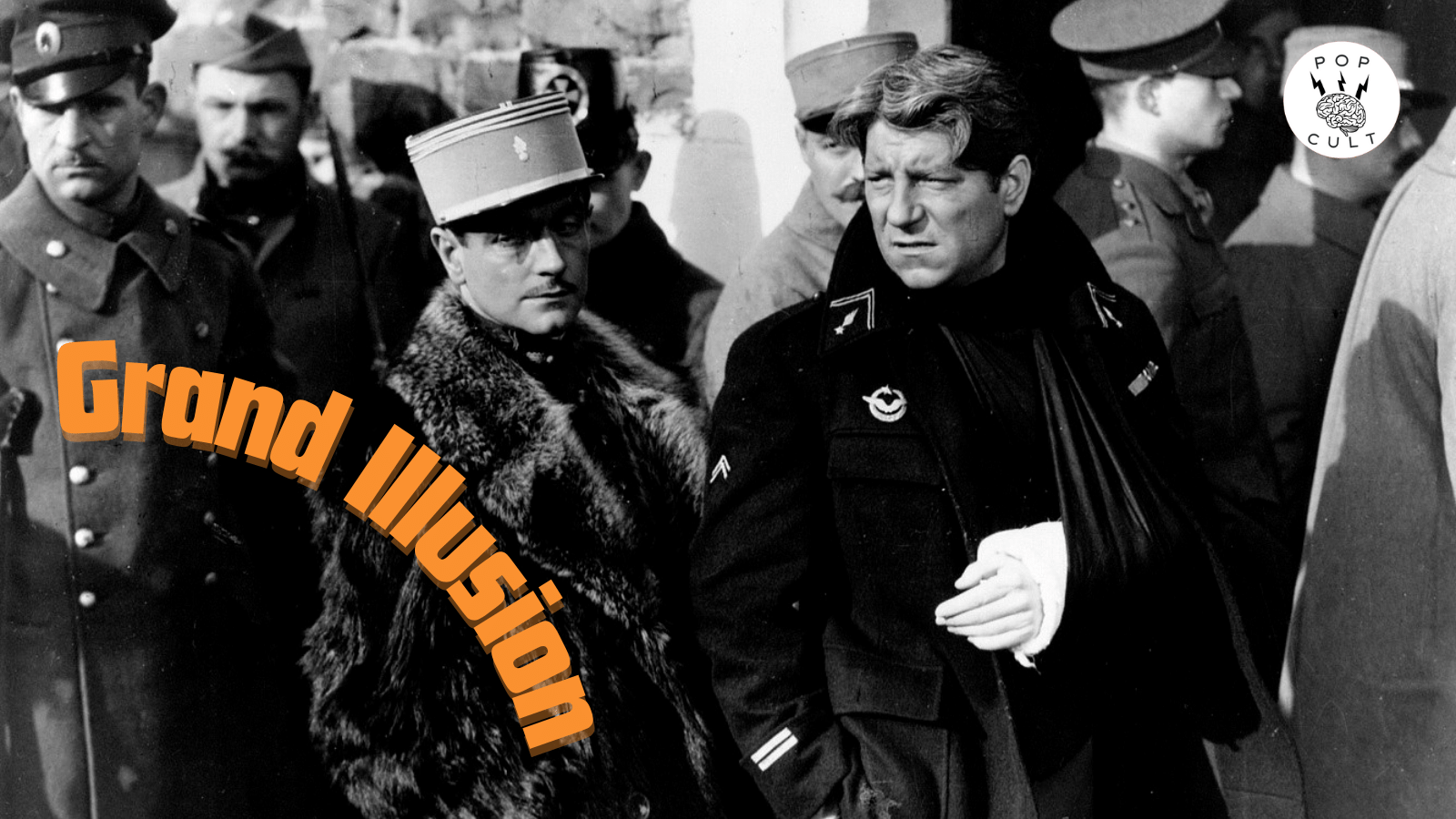
Grand Illusion (1937)
Written by Jean Renoir and Charles Spaak
Directed by Jean Renoir
The actor/filmmaker Warren Beatty tells how, near the start of his career after making Splendor in the Grass, he was at a party where he met playwright Clifford Odets. Odets mentioned in passing the films of Jean Renoir, who was also at the same party. Beatty had yet to learn who this was but knew the name. “Renoir? Like the painter?” In Beatty’s words, Odets was “too kind” and didn’t embarrass him. He told the young actor yes. Jean Renoir is the son of the French impressionist painter Pierre-Auguste Renoir. The playwright suggested Beatty track down Grand Illusion and The Rules of the Game to better acquaint himself with the work of Renoir. Beatty got copies of both and a 16mm projector. Afterward, he remarked: “These may be the best movies I have ever seen.”
Two French aviators are shot down while taking reconnaissance photos over enemy lines. Captain Boëldieu (Pierre Fresnay) is an aristocratic officer, while his comrade in arms is Lieutenant Maréchal (Jean Gabin), a working-class officer. The man who shoots them down is German flying ace Rittmeister von Rauffenstein (Erich von Stroheim), who treats them to lunch while they wait for soldiers to come and transport the Frenchmen to a prisoner of war camp. It comes out that Boëldieu and Rauffenstein share mutual acquaintances due to their socioeconomic positions.
Life in the camp is rough, and the two soldiers find solidarity with other Frenchmen imprisoned there. A plan to dig a tunnel is undertaken with mixed results. Maréchal gets tossed in solitary after celebrating news of the French retaking of a critical location in the Battle of Verdun. Eventually, command of the fort changes, and prisoners are shuffled from one camp to another. Rauffenstein turns out to be the commander of their new camp, an injury having grounded him and his superiors assigning this task. Here, Boëldieu and Maréchal meet a nouveau riche French Jew, Rosenthal (Marcel Dalio), who happily shares the food from his packages sent from back home. Eventually, some men die, and others go free.
There’s a critical conversation in the middle of the second act when Rauffenstein invites Boëldieu to his office in Castle Wintersborn. They talk about a shared background, and the German speaks about how important it is to maintain the social structures that have kept them both at the top of the collective heap. Boëldieu is visibly uneasy hearing this, and we know it’s because of what he has gone through with the non-aristocratic Maréchal. A second conversation, whose context I won’t spoil, occurs between these two men at the second act’s close. Boëldieu states, “For a commoner, dying in a war is a tragedy. But for you and me, it’s a good way out” and then laments for those aristocrats who will have to figure out what role they play in the new world that is coming, one in which their power is diminished.
Renoir is leveling a critique of the concept of duty imposed by society. Among the non-wealthy officers, Maréchal and Rosenthal, there is little in common, at least on the surface. Yet, they find a solidarity that Maréchal never has with Boëldieu. For those men, there is a constant distance, an unspoken understanding that one “outranks” the other outside of this war. Renoir is also responding to the growing tide of antisemitism in Europe at the time by making Rosenthal such a critical character.
Correcting the record, Renoir shows how Rosenthal is generous, giving what little he has to help his brothers in arms. This is intended to push back against gross stereotypes being perpetuated by the fascists. And yet, Renoir is too clever to let some characters be simply “good” and others “bad.” He understands the layers of the illusion of solidarity. There’s one Black French officer at Wintersborn who is routinely ignored by the white soldiers, even when he is directly speaking to them. His contributions are handily ignored.
The Grand Illusion of the title is the myth that war accomplishes anything constructive. We never see a single battle throughout the picture, just prisoners sitting around trying to kill time or figure a way out. The “great” victories of specific battles are reduced to collateral damage, focusing on what was lost and how nothing was gained that ever came close to replacing those lives.
When looking at the role the wealthy & powerful play, war is like a rite of passage for them; with little regard to the working class people, they are always placed at the frontlines to be sent through meat grinders. The war for humanity to end war is to rip away the reins of power from those who profit & exploit war. Most importantly, Renoir tells us that nothing that one common man does in propping up such a system does anything to make life better for anyone outside of those for whom life is already a luxury & privilege.
Grand Illusion was labeled “Cinematic Public Enemy No. 1” by Nazi propaganda minister Joseph Goebbels who had all copies in Germany confiscated & destroyed. Even the French, already setting the table for their Nazi captors to swoop in, banned the film. The Nazis would destroy every copy they could when they marched into France. Orson Welles would say this was one of two films he would preserve on an ark if humanity were on the verge of such an extinction event.
Seeing Grand Illusion today draws a line from so many films we know to their origins in the first few decades of cinema. There is no Billy Wilder’s Stalag-17 without this, The Great Escape, The Grand Budapest Hotel, or so many others. What some of those fail to do is to fully take in the themes Renoir was exploring about war. It is not a glamorous thing; it’s also not a constant bloodbath for everyone involved. What war is at its core is a crushing of the human spirit, limiting what can be, reducing our interactions to a stupid game where lines on a map are moved only to be moved again when the next generation comes of age. All the while, the poor still starve & suffer, the disabled still yearn for aid, and the people who live on the margins of society are never respected for what they were forced to contribute to the fruitless conflict.
That subtle moment where the Black soldier shows a painting he’s been working on and his fellow soldiers simply turn away as if they saw nothing is the moment for me. This is where Renoir says volumes and exhibits an understanding of how flawed humanity is. We have grown, but not enough. We are enlightened, but dimly. It is good that the working-class Frenchman and the French Jew found a connection amid this war. But that is not enough. We have leagues to cross before our species begins to reach its potential. We are still bogged down by prejudices and irrational hatreds that leave us walking in circles.


One thought on “Movie Review – Grand Illusion”