
Night and Fog (1956)
Written by Jean Cayrol
Directed by Alain Resnais
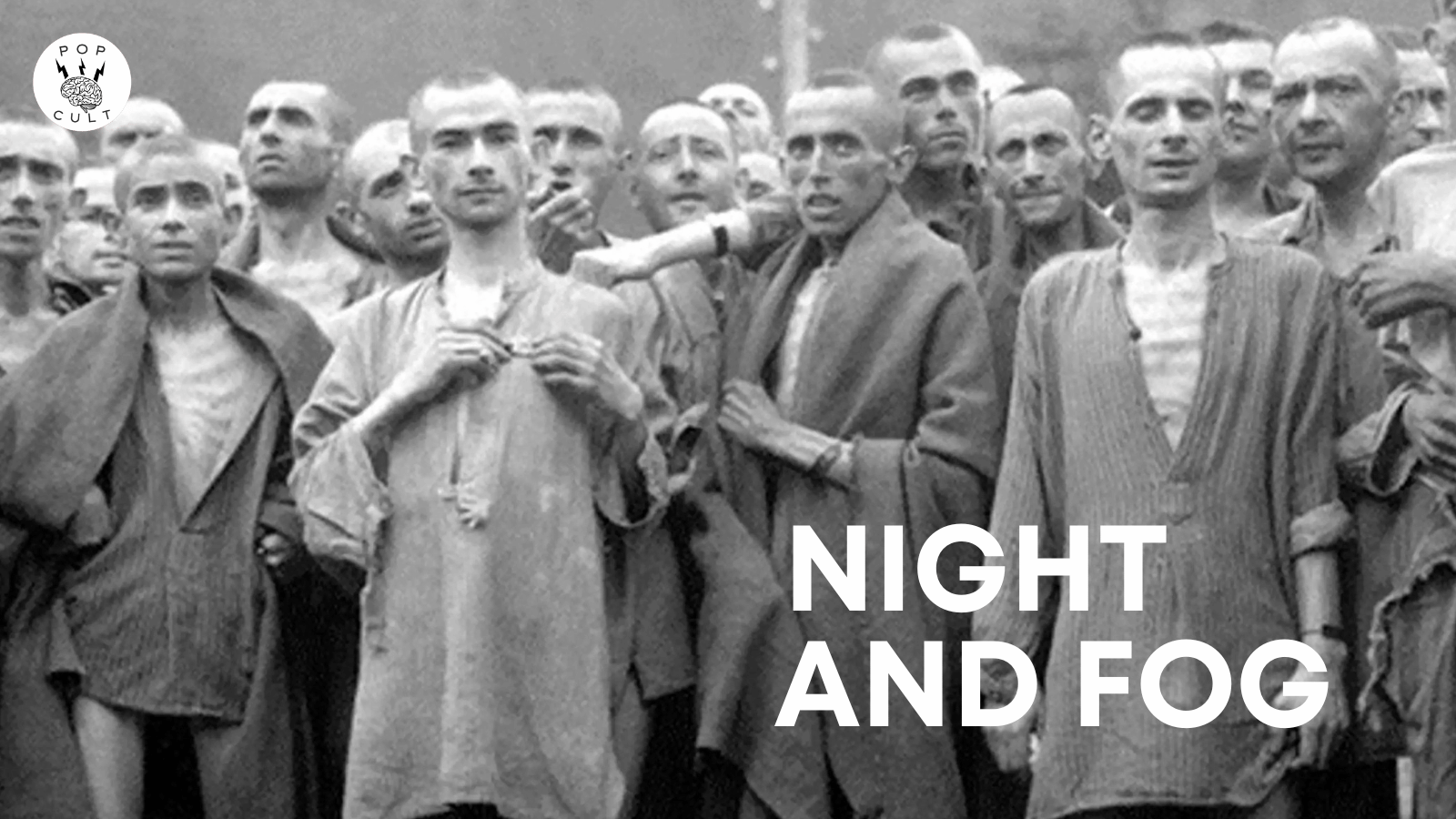
It’s an image that your brain can’t quite comprehend at first. Then the camera pulls out. And continues to pull out. And just keeps going beyond anything you could have anticipated or expected. Literal mountains of human hair piled up into a range of which I could not see the boundary. It seemed to go on forever. This isn’t just violence inflicted on one person to another. This is something different. There is a scope & scale that could not have happened by accident. Each action, each cut, each kill was planned. Starvation was part of the plan. This was the same thought an exterminator puts into eliminating an infestation of rats because that is how the Nazis saw these human beings as something to be erased. And with cold, calculated action, they built an entire machine to kill them all.
Alain Resnais made short documentaries about well-known artists & works of art. His first was in 1948, a picture about Van Gogh, which won him an Oscar, followed by a picture about Picasso’s Guernica. He went political with Statues Also Die, a piece on the destruction of African art at the hands of French colonialism. Resnais did not want to make Night and Fog. When he was offered the job, he examined the script that had been written already and felt that he was incapable of making anything that could capture the horror of the Holocaust. Surprisingly, a decade later, few documentaries were made on the subject. In the context of French remembrance, the culture at the time saw the Holocaust as a “Jewish issue”, something for that community to handle. Resnais saw it as a dark monolith. How could he do it justice in a short film?
The decision to take a poetic approach rather than document the timeline of events was correct. The fact that Night and Fog is just 32 minutes is to its benefit. Within this short time frame, the viewer will see a lot of harrowing footage. During research and filming, Resnais would say he often woke up from the worst nightmares of his life, sometimes even screaming out. While reviewing file footage of the camps, writer Jean Cayrol became nauseated in the editing room and had to hand some of his duties over to Chris Marker who helped complete the script. Marker took Cayrol’s words and helped find a rhythm between them and the images on the screen.
Resnais worried about making the picture “too beautiful” so that the viewers lost the weight of what they saw, the sheer human devastation of it all. There were some at the time who thought the concentration camps should be forgotten. But the only way any meaning could be derived from what happened was to not let us forget. The problem in the remembrance is that this has become the only genocide the public is allowed to examine so closely. There were many before this one and many after. The existence of these does not diminish the impact of the Holocaust. It has an effect because of how documented it was by the Nazis, and so we have so much evidence. We must study all genocides because they establish a pattern of behavior in certain societies. They reveal to us ideologies so insidious that they depend on the mass termination of human life to proliferate.
The director tells this story by cutting from the present, weed-overgrown skeleton of two camps, Auschwitz and Majdanek, with file footage from across all the locations where the atrocities were committed. The voice-over narration describes the acts that were done. It ponders on what it must have been like. It asks questions about how anyone witnessing these things was able to allow them to go on. There are no answers in Night and Fog, just what remains and the pure evil of it all.
I have never felt at ease with narrative films about the Holocaust. Something about fictionalizing the event to any degree feels deeply wrong. I think Son of Saul is the only Holocaust narrative film I felt conveyed what happened without attempting to “beautify” it. I also don’t know if I will ever have the stamina to take on Shoah with its nine-hour runtime. I also don’t know how I feel about that documentary choosing not to use any archival footage of the Holocaust. I can see why you might not use it, but the impact of these 30 minutes feels so strong. Seeing the people. Seeing their corpses. I saw a basket of human heads so casually sitting beside a bench. To look into this version of Hell is not a pleasant experience, but our discomfort is nothing compared to what happened there.
The narrator reads this line near the film’s end:
“Who among us keeps watch from this strange watchtower to warn of the arrival of new executioners? Are their faces really so different from ours?”
Night and Fog exists not as a standard piece of cinema but as something dug out of a rotten, festering evil. It had to be unearthed. It had to be shown. Sadly, in our chorus of “never again,” we have let this happen again and again and again. It’s happening right now in multiple locations around the planet; in almost all of them, the United States has provided arms or is directly assisting the genocide. “Never again” meant nothing to many people who have seen these images, too. I can only theorize as to how they have closed themselves off. I don’t know how people convince themselves not to see another as a human being.
The images of Jews as living skeletons or empty husks I see in this movie are paralleled with the footage coming out of Gaza. I have seen both Jewish and Palestinian bodies deconstructed in so many vile ways at this point. I don’t know how someone could justify it, either. If you can construct some twisted justification for any genocide, I don’t know what to do for you. I hope you can be changed, but if you cannot, I don’t see what this life has to offer you, honestly. I cannot see the purpose of my humanity as the deprivation of another’s.
I recall another piece of narration:
“I’m not responsible,” says the Kapo.
“I’m not responsible,” says the officer.
“I’m not responsible.”
Who is responsible then?
All of us. Every single one of us who has privilege is responsible. There are degrees to that responsibility, but we all bear the weight of it. There is a refrain amongst the milquetoast Liberals in the United States, a rabid insistence that “violence is not the answer.” These same voices will also be the first to call the police at the slightest discomfort caused by a marginalized person existing in their space or support endless military aid to fund human devastation. What they actually mean is that “only institutional violence is acceptable,” and the Holocaust was an act of institutional violence. Under German law at the time, none of the acts committed were illegal. The same can be said of many other genocides, including chattel slavery in the United States’ past and the present scourge of carceral slavery.
Violence can be an answer; it simply depends on the question. Self-defense is violence. Striking & withholding one’s labor is an act of violence. The strategic destruction of infrastructure critical to genocide is a form of violence. These are all good acts. These are all things that must be done to halt present-day genocides and prevent future ones from occurring. That is our responsibility. In whatever manner we can, no matter how small, we work to clog up the machine until it collapses under its own weight.
When will “never again” become a truth, not simply a slogan?

 PopCult Reviews
One thought on “Movie Review – Night and Fog”