
Sirāt (2025)
Written and directed by Oliver Laxe
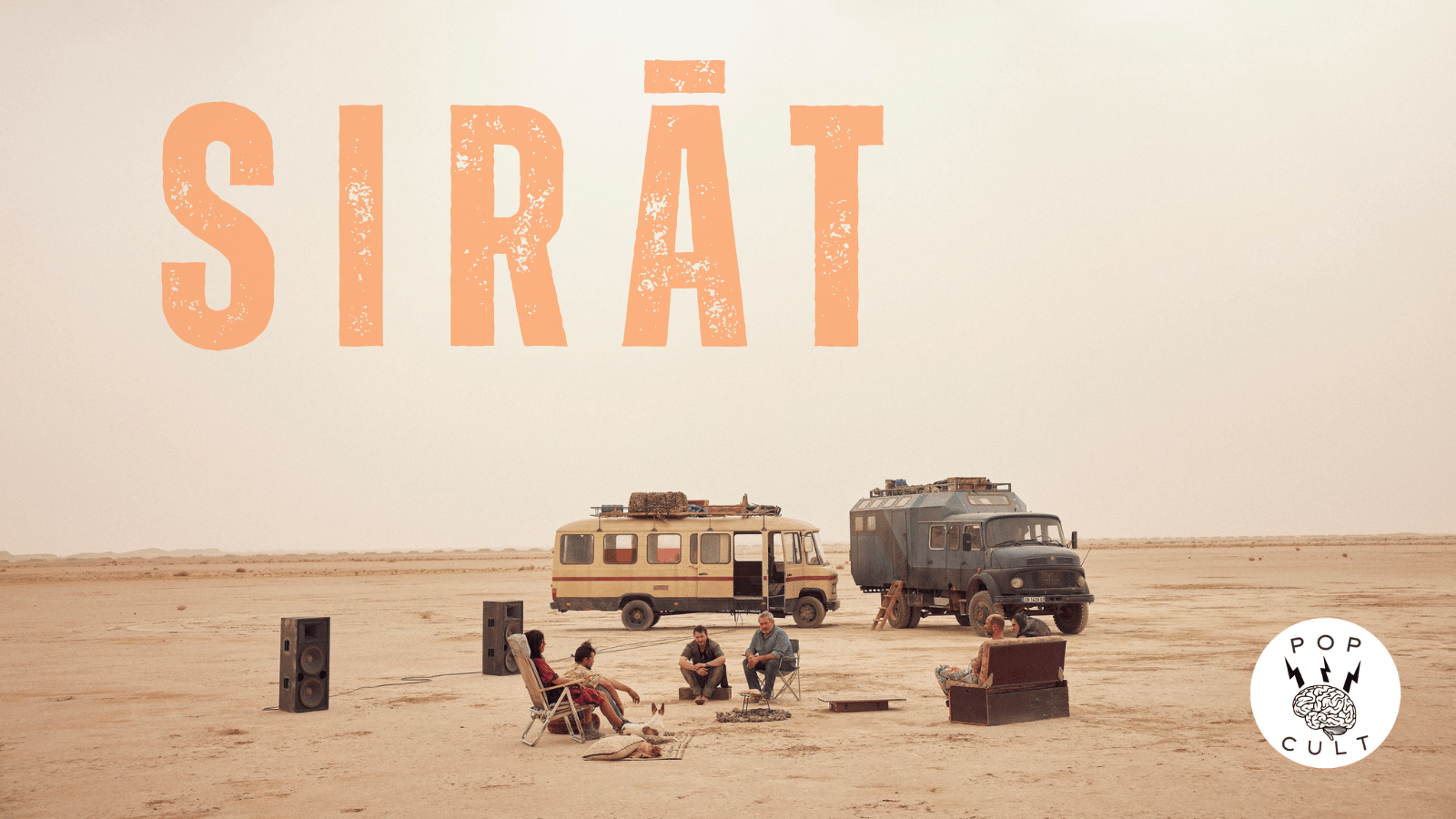
A man walks through a dancing crowd as deafening music booms. He walks with his preteen son, showing strangers a photograph. They shake their heads and go back to dancing. In an interview with Film Stage, director Oliver Laxe stated, “An image doesn’t have the responsibility to say something; they have to evoke something.” This is exactly what these images do. A search that feels fruitless. The people around you, distracted by the cacophony. People seeking distraction and a person seeking answers. While the film begins with a bit of a plot, the longer we spend on this journey, the less those specifics matter, and the experience becomes about the human condition in a world where violence is so sudden and devastating.
Sirat follows father Luis and his son Esteban as he searches for his missing daughter. When the film opens, the pair have come to a rave in southern Morocco where they think she might be. They befriend a group of ravers headed to another event deeper in the desert. Luis decides to follow them on a journey that will be harrowing as they fight to get through the challenges presented by the environment. The radio and their own encounters on the road hint at the explosion of a world war happening far away but encroaching into the ravers’ space. It will be hard to talk about this film without spoiling some major moments, so proceed with caution if you have not already seen Sirat.
The Arabic word “sirat” means “path” or “way” and is used in the Islamic religion to talk about a treacherous bridge between their concepts of Heaven and Hell. The metaphor is that to get out of eternal damnation takes a lot of effort and struggle, with most being lost along the way. The journey of our characters in the film reflects this, with a strong focus on the way community is built as we go through the struggles of living, how we mourn collectively knowing it won’t prevent the next moment of loss. We keep going because we have to, for ourselves and those we’ve lost.
The film never lets us forget about the war unfolding in the urban environs, but it never overly focuses on that fact. The characters are feeling some anxiety about this, but it’s not at the forefront of their minds. Instead, they are taking on each obstacle as it arises. They have to ford a river. They have to deal with the accidental ingestion of some LSD. They must brave a treacherous mountain pass. Several of the ravers have physical disabilities, which highlights an ongoing challenge that they have partially adapted to but won’t ever fully be free of. The war is bad, but they aren’t dodging missiles right now.
Director Laxe has a solid understanding of cinematic language and allows tension to develop based on our expectation of tropes. For the first half of the film, I kept expecting the ravers were going to somehow betray Luis and Esteban. That feels like a plot you would see in a movie like this. The ravers are social outcasts, and Luis is so far out of his depth. The film withholds information and keeps the characters separate in their vehicles during the journey, so we don’t see much interaction for a while. Where this film goes, and the moment everything pivots on, was so shockingly unexpected. The moments that follow are going to take you through an emotional ringer of grief, quickly followed by your jaw hitting the floor.
The apocalypse is an ever-present motif in the film. The location is desolate; our characters are the only sign of life across it all. As the group is pushing over a mountain during a rainstorm, one person remarks that this feels like the end of the world, and another replies, “It’s been the end of the world for a long time.” In the last few years, especially while living in the Netherlands, I developed a strong sense of existential dread. There were moments, especially during the thick, clouded winters there while reading news about the genocide in Gaza and other world events, that I felt like this was the end of all things. These words come from the mouth of a raver who doesn’t live cowering, glancing up at the sky, looking for bombs.
My favorite scene in the picture comes close to the end, where our characters have just faced something horrific. They are regrouping on a flat, and the ravers decide to unload their speakers, blast their music, and dance. In the States, we’re living in an era of intense cynicism, where displays of earnest emotion get shit on pretty regularly. In this moment of the film, characters dance. They are not choreographed; they move only the way their hearts and the music tell them. Luis also joins in, weeping as he dances. As someone who has never gotten into this subculture, the moment offered a brief window into understanding. I could feel the grief in their movement, and it brought tears to my eyes.
This brief respite is cut short by another horrifying moment in the journey. Grief switches to panic. This is followed by a greater sense of desolation. The environment around our characters doesn’t care about them and will wipe them off the map without ever contemplating human presence in the first place. But isn’t that the nature of life? We find moments in the struggle to celebrate, to grieve, to dance, and then are suddenly thrust back on the journey. A character explains that the music in rave culture is not there to be listened to, but danced to, and that is the core of the film.
I wake up often these days knowing how bad things are and that they are likely to worsen in time. Yet, I don’t feel the dread that I used to. I don’t hold some candy-colored optimism, but an understanding that we live one moment at a time in a universe that is unaware of us. The meaning we derive won’t come from the universe or even the societies we live in as they descend into forever wars. The meaning that fulfills us comes from within and among communities of people. The rave culture we see is just one of those communities. How you understand that connection exists beyond what can be explained in words, rather as a more visceral emotional feeling. We’re all walking along the sirat; the best we can do is stop and commune with those on the same journey.


