Movie Review – Doctor Strange

Doctor Strange (2016, dir. Scott Derrickson)

landscape-1459632762-benedict-cumberbatch-doctor-strange

Doctor Stephen Strange is one of the best neurosurgeons on the planet and he definitely knows it. Everything in his life changes when a near fatal car accident shreds the tendons in his hands and takes away his ability to practice his medical skills. Stephen begins searching for a cure and it leads him to a city in the Himalayas where The Ancient One resides. The Ancient One leads an order of mystics who transcend our physical plane to interact with and manipulate the elements of the multiverse. Skeptical at first, Stephen eventually comes around and begins his path to becoming the Sorcerer Supreme. Conflict comes in the form of Caecilius, a former student of the Ancient One who seeks to rupture the reality of our world and unleash Dormammu and his Dark Dimension.

We are fourteen films and nine years into the Marvel Cinematic Universe. While characters considered 1st Tier have already been developed we’re now to those that are lesser known to the general public. Doctor Strange has always occupied a limbo between tiers, sometimes becoming an Avengers level figure and other times fading into slight obscurity. I can’t stay I’ve been a huge fan of the character, but Jason Aaron and Chris Bachalo’s current run on the comic have me interested. The key to the character is to play up the out there, surreal other realms he explores and fights enemies from. In this way, the film understands Strange. It is full to the brim with strong surreal effects and is arguably the most visually appealing Marvel film to date.

Beyond the visual embellishments the plot is fairly thin. This is another origin story and like with most origin stories there is a formula that is followed very closely. Nothing that happens in the film will likely surprise you if you’ve seen any of the others. Character development is fair superficial, especially the relationship between Strange and Rachel McAdams’ nurse. That entire love story side plot felt completely pointless and could have worked better as simply a colleague Strange had wronged and now, seeing the error of his arrogance, sought amends.

There is an attempt at humor throughout and that was one of the most painful parts of the picture. Benedict Cumberbatch as never struck as me as particularly funny (though he was good in Four Lions). Not sure if it’s his timing or the actual joke itself but every single one falls flat. There is a Beyonce joke between he and Wong, the librarian at the monastery that film keeps pushing with the sense that there is something funny about this exchange. There is not. The film is at its best when it takes its subject matter with seriousness and Strange is not a jokey character by nature.

I personally am starting to feel fatigue with many of the superhero films. Warner Brothers have burnt bridges for me with their DC franchise. Marvel has become okay, and I can’t imagine where it goes after the next Avengers film it’s building to. At this point the formula has been so entrenched, I hope future superhero films can break it and go in some new and interesting directions. Not holding out hope, but it would be nice.

Movie Review – The Alchemist’s Cookbook

The Alchemist’s Cookbook (2016, dir. Joel Potrykus)

alchemist

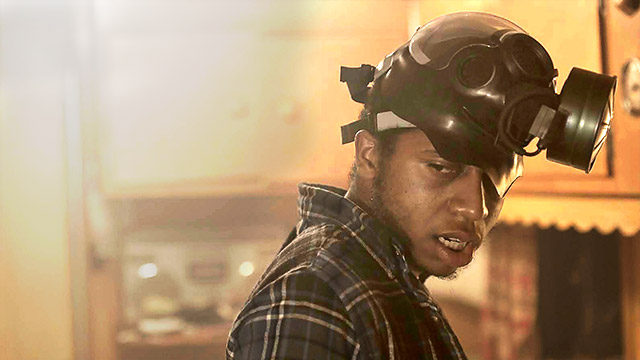
A man named Sean lives in a trailer home deep in the woods outside of Grand Rapids, Michigan. At first glance, it would be easy to mistake his set up as a meth lab, but after further observation, it is revealed he is an amateur alchemist. His only constant companion is Kaspar, his cat, but he does receive erratic visits from Cortez, a cousin, who brings supplies. Cortez is unaware of just what his Sean is up to and that his cousin is close to making contact with demon Belial, whom Sean believes will provide him with incalculable wealth.

It’s hard to classify this film as any one thing. There are touches of drama and of horror and a little comedy. It never settles on one thing, and some reviewers have taken to calling it a “punk” film more than anything else. Director Potrykus has a track record of making films in this off-kilter, low-fi style. I personally don’t connect with much from the punk genre, and that would likely explain why this movie left me frustrated. I can’t see any reason I’ll remember this film.

There is so much here in the ingredients list that should have guaranteed I’d love it. The rural setting, deep in the woods, always an excellent location for horror. I definitely have an affinity for stories about the demonic and humans who are a little too arrogant in their abilities to deal with a summoned entity. There is a sense of danger and tension from the first moments of the film. However, that feels undercut as the tone shifts from chapter to chapter. Or worse yet, the tone goes with a distant documenting of a man pouring substances into various vials without informing the audience of what is going on.

The biggest problem I had with Cookbook was the lack of character development. There is only one real presence on screen, Sean. And with an hour and a half, I ended the film feeling like I still didn’t know much about him. I never needed anything explicit, but some reasons could have been hinted at as to why he was driven to the wilderness and devoted himself to this pursuit of gold. Lots of scenes give us the sense of what this world feels like and Sean’s mannerisms, but never a good sense of motivation. The entire picture seems like a tedious exercise in improv where nothing really bubbles to the surface in the end.

There are great moments throughout, though. Sean and Cortez’s interactions are funny and entertaining, though they mess with the tension. There is a sense of some sort of structure through the chapter breaks and the progression of day into darkness that some key scenes touch on. As a whole, Alchemist’s Cookbook sadly failed to meet my expectations. I was honestly, excited to sit down and watch this one after seeing it’s great trailer. In the end, it feels too insubstantial to recommend and won’t really satisfy any fans of the many genres it touches on.

Movie Review – Invasion of the Body Snatchers (1978)

Invasion of the Body Snatchers (1978, dir. Philip Kaufman)

body-snatchers-guys

Elizabeth Driscoll (Brooke Adams) is convinced something is wrong with her boyfriend Geoffrey. His behavior has changed overnight, and she witnesses him meeting with strange people across San Francisco. She seeks out help from her coworker at the city’s Department of Public Health, Matthew (Donald Sutherland) and the two unravel a dark conspiracy that threatens the future of humanity. Along with friends Jack and Nancy (Jeff Goldblum, Nancy Cartwright), they soon find themselves up against a menace that is growing and in turn becoming increasingly unstoppable.

Invasion of the Body Snatchers was a remake of the 1956 classic which in turn was an adaptation of the 1955 novel The Body Snatchers. It’s a classic tale that has been in turn remade many times over (Body Snatchers, The Invasion) and has always served an allegory for some sort of societal strike. The original film adaptation was influenced by the McCarthy Hearings the hunt for communists in America. For the 1978 version, there is a sense of Watergate on the edges of the script. There’s also the overall sense of malaise that came out of The Me Generation and disconnection from others as a person became focused on self-fulfillment. This can be seen most overtly in the bookstore scenes with Dr. Kibner (Leonard Nimoy), a pop psychologist who advises a paranoid wife about reconnecting with her husband and blaming his distance on her own doubts about the relationship.

This is a fantastic film and one we don’t hear about often enough. The cast is composed of some acting greats who are firing on all cylinders. I’ve always felt Brooke Adams was terribly overlooked and this performance is one of those that reminds you of her strengths. Leonard Nimoy who we never got to see outside of Spock very often is excellent as the laidback Dr. Kibner who becomes a very different character by the film’s conclusion. Nimoy plays both sides of the character wonderfully.

Beyond the fantastic cast, you have members of the production who are delivering masterful work. Cinematographer Michael Chapman (Taxi Driver, Raging Bull) finds interesting angles and ways to convey a character’s point of view that provides volumes of information. Chapman is able to obscure enough to keep us wondering and the sense of paranoia building. Almost every shot has some background element that hints at the concrete conspiracy or plays with the thematics of the film. Anytime a plant is present it is grounds to get scared.

Composer Denny Zeitlin delivers a score that mixes elements of jazz and electronic music. The film uses more jazz at the start before finally being overtaken by an eerie alien electronic score for the finale. This way music plays along with the progression of the takeover is one of the examples of a film’s production being a collaborative effort. Sound engineering legend Ben Burtt worked on this movie just after his time on Star Wars and just as with the other elements the sound is textured and crucial to the full experience. The pods that contain the doubles have a wet, membrane sound, cracking and opening with viscous threads of mucus. The soundtrack fades in the scene where we first see a birth taking place, and Burtt’s sound design is allowed to take center stage.

Invasion manages to create a palpable sense of paranoia minutes into the film. It brushes up against becoming cheesy early on but then goes so deep into the gritty bleakness of this event that it becomes chilling. As it is building horror in the literal background of the picture we are being introduced to our two leads and getting a strong sense of character. Elizabeth’s first scene establishes significant external traits (botanist, in a relationship) but also personality traits that help us connect with the character (curious, affectionate, intelligent). With Matthew’s first scene we have him on a surprise health inspection of a high-end French restaurant, and we know exactly who this character is. He’s very dedicated to his job, unwavering in following regulations, but also playful and wry. Neither of these characters feels one-dimensional in any way and, much like I felt about Gene Wilder and Jill Clayburgh in Silver Streak, they have natural chemistry.

The way the horror is developed is paced so well and reveals of information hit at the perfect moments. The film uses it’s first 30 minutes to introduce the leads and establish the sense that something is off. Around then we have the first glimpse of a partially developed clone and character’s sanity being questioned as evidence disappears. At the halfway mark we glimpse an actual birth from a pod occur and the film suddenly tilts. Our protagonists are in the minority and time is running out as the enemy surrounds them.

Released in the shadow of 1977’s Star Wars, Invasion of the Body Snatchers is a science fiction masterpiece that has been sadly overlooked by so many. It exists as a beautiful amalgam of 1970s director focused cinema and an acknowledgment of the remake/reboot film culture to come. It’s a film that still feels relevant and terrifying almost 40 years later.

Roots of Fear: I used to work in a Pill Mill in Florida

pharmacy

“I used to work in a pill mill in Florida Part One” – https://www.reddit.com/r/nosleep/comments/5k78ih/i_used_to_work_at_a_pill_mill_in_florida_ive_saw/

In the last couple months, I started to think about writing more on what makes something horror for me. I think horror can be just as niche a comedy. People’s senses of humor can vary wildly and so can their sense of fear. For some, nature is a terrifying concept. Stories about tornadoes and hurricanes are chilling. I personally don’t click with Man vs. Nature type stories. I feel that the evil needs some form of intelligence for me to be scared of them. Lovecraft’s cosmic horrors live in that space. Large and beyond human comprehension but also thinking and planning. The masked slasher (Jason, Michael Myers, Leatherface) has been a hugely popular horror trope followed by variants (Freddy Krueger most notable). There is an intimacy to that horror. Teens stumbling through dimly lit rooms and the close murder of the blade. But again, that type of horror has never clicked with me. Possibly because of the oversaturation of that genre during my formative years. Jason just isn’t scary anymore. Most of my scares have been coming from literature lately more than film, in particular, short stories.

Continue reading “Roots of Fear: I used to work in a Pill Mill in Florida”

Movie Review – Suicide Squad

Suicide Squad (2016, dir. David Ayer)

maxresdefault

Hey, kids. Did you ever want to know what it would be like to have Hot Topic produce a DC Comics superhero film? Are you tired of all those boring character development scenes in the good superhero films and just want fucking cool music, sexy chicks, and guns? The Suicide Squad is the film for you!

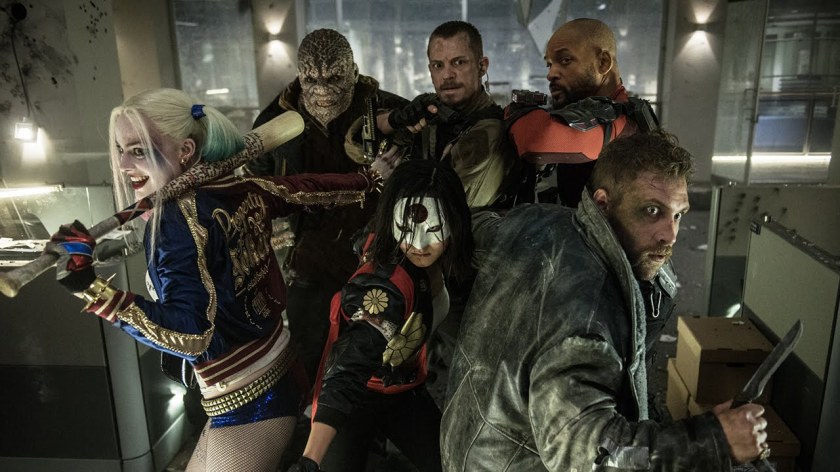
Continuing Warner Brothers apparent need to shit on every IP they own at DC, we are given the story of Task Force X, the Suicide Squad, a collection of lower-tier villains forced into government servitude. Amanda Waller (Viola Davis) is an intelligence officer who brings these supervillains together explaining that it’s a contingency plan in case Superman-level threat were to rear its head. Superman-level threat? Apparently, Harley Quinn, Captain Boomerang, and Deadshot could have taken down Doomsday? Oh well. A big bad villain makes a thing that shoots a beam of light into the sky and then something with the Joker.

The most glaring problem with Suicide Squad is the editing. Holy shit. The first twenty minutes of the film are obviously longer origins vignettes that have been sloppily cobbled together to serve as music video/trailer-esque introductions. The Harley Quinn origin feels like a much more dense side plot, but in a film that already goes just over two hours there is not much room to reasonably fit it in. That is another ongoing problem throughout the entire film: characters are pushed into the movie and we are given little to no reason to care what happens to them. Katana felt like the most egregious of these. As the team departs to deal with the menace, she comes out of nowhere and leaps onto the helicopter. Joel Kinnaman plays Rick Flag and seems to function as an exposition delivery device tells us who she is in about two sentences. Once again I ask, why should I give a damn about what happens to a character I don’t really know anything about and then doesn’t do much for the rest of the film.

Suicide Squad is a movie that is trying to “catch up” with Marvel. A good contrast would be Guardians of the Galaxy which did introduce five protagonists and managed to develop them into pretty well rounded characters. Suicide Squad opts to introduce seven characters on the team, plus The Joker plus the main villain and then expect us to care about what happens. It’s made even more disturbing when the film tries to make us swoon over The Joker and Harley’s relationship. It’s been very well established in the comics that the two have a textbook toxic relationship, not one based in love but abuse. The film believes it is a sub/dom thing possibly? This is a very dangerous route to go down and I’ve already seen a lot of social media where young women are idolizing this thing.

I was asked why Wonder Woman isn’t one of my most anticipated films of 2017. Man of Steel, Batman v Superman, and this movie are pretty much why. Warner Brothers have taken a very strange approach in my opinion to developing this cinematic universe. They have definitely made a lot of money, but I don’t see the films being part of a long lasting legacy. Ten years from now I expect there will be lots of used copies of Suicide Squad filling up second-hand stores.

Movie Review – Nocturnal Animals

Nocturnal Animals (2016, dir. Tom Ford)

nocturnal-animals-amy-adams-image.jpg

Nocturnal Animals is so much and so elusive in letting us know what it is. At a basic level, it is three narratives: The Present, The Past, and The Fiction. All of these narratives are filtered through a single viewpoint, and they tell us much about the effects of love and hate. The story of Nocturnal Animals begins in the Present with Susan Morrow (Amy Adams), a California art gallery owner whose life is a comfortable one, luxurious and successful. She is in her second marriage and with a young adult daughter. What she thought would make her happy has failed to do so. Her daughter is living away and distant while her husband is habitually cheating on her. Into this mix arrives a manuscript from her estranged first husband, Edward Sheffield (Jake Gyllenhaal). The novel is titled Nocturnal Animals, a name he used to call Susan.

Continue reading “Movie Review – Nocturnal Animals”

Tabletop Actual Play – tremulus

realityblurs-tremulus1-1440x564_c

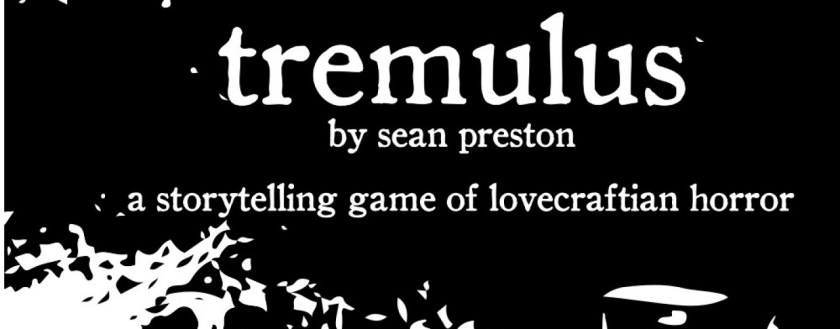
In 2015, I ran a magnificent series of games using the tremulus system, a Lovecraftian Powered by the Apocalypse game that focuses on investigation and creeping horror. Ever since then, I’ve wanted to run it again with the same set up: just me and two players. The intimacy of that setting created a great atmosphere and it has gone down as one of the best things I’ve run/participated in. Here is the actual play I wrote up and originally posted on the tremulus G+ community.

The Protagonists

Malachi Arkton, the Sorcerer, played by Dan Luxenberg –Malachi is a traveling mage who was brought to Ebon Eaves through his own sense of the mystic and the town’s troubled Mayor who seems to be cursed.

Annabelle Leighton, the Philanthropist, played by Ariana Ramos – Annabelle was brought to Ebon Eaves due to her family’s connection to the town. Her great-grandfather was a free man, escaped from the South. Her family later established themselves in Philadelphia and have amassed a fortune which she has brought to Ebon Eaves to build a school for the poor, rural farm population there. She brings Byron, a streetwise ex-con bodyguard and Pennyworth, an erudite driver

Continue reading “Tabletop Actual Play – tremulus”

Movie Review – Always Shine

Always Shine (2016, dir. Sophia Takal)

hero_always-shine-2016

Two friends, Beth and Anna, are headed to Big Sur for a weekend getaway. Both women are actresses in Los Angeles with a big difference: Beth keeps booking bigger and bigger roles while Anna is passed over regularly. Anna believes this is rooted in their personal demeanors. Beth is perfect for the sexy but non-threatening female roles. Anna is “aggressive” by simply being very clear and direct about what she wants. Over the course of this weekend the friendship between these women will be strained to the breaking point with horrific consequences.

It’s no surprise that Always Shine is thematically about women existing in male dominated spaces. Our main characters are archetypal depictions of women in cinema, or in Anna’s case women that are marginalized in cinema. Director Takal shows a ton of skill in layering that theme under the story of this friendship and the psychological breakdown of one character. What could have been didactic and ultimately turned into a philosophical abstraction ends up being a visually engaging psychological thriller that isn’t exploitative.

The challenge in a film like Always Shine is making sure the audience doesn’t view one character as the bad one and the other good one. Beth is your traditional Final Girl and the film opens with her auditioning for the role of such a character in a horror movie. The producers inform her that the role will have “extensive nudity” and Beth is unaware of this fact, her agent didn’t tell her of that detail. Our introduction to Anna is a direct to camera monologue when she picks up her car from the mechanic. A repair was made without her consent and she unloads. Both of these scenes set up how these women are perceived by the men they interact with, but they are also subverted for the rest of the film. In particular as we get to know Anna better, we learn she is not a sweet, kind person. In many ways, she is playing a role to her own advantage.

Mackenzie Davis’ performance as Anna is the core of the film and, like in everything she appears in, she knocks it out of the park. It’s likely Davis experienced the struggles as she was developing her career and likely faces the problem of being offered roles that would force her to take on this behavior that is so antithetical to who she is. There are a number of compelling character scenes between she and Caitlin Fitzgerald who plays Beth that are beyond just awkward but painful. One scene has Anna learning about Beth’s casting as the lead in the horror film from the opening. Anna pushes to do a read through with a hesitant Beth and the scenes plays out like a competition or challenge. Anna is adamant that she’ll show Beth her prowess. The film is intelligent enough to not overtly talk about male perceptions shaping these women, but the subtext is there, buried beneath all the tension.

The structures and the themes of identity working in the film reminded me of Nicolas Roeg’s Performance. In that movie, the traditional macho archetype meets a counterculture sexually liberated almost sorcerer and their persona’s begin to meld and split. Always Shine leaves the final outcome up to the viewer. We see police. We see an ambulance. But one character’s fate is left in question. Will she disappear into the woods, invisible or will she step out and make herself heard?

Movie Review – King Cobra

King Cobra (2016, dir. Justin Kelly)

gay_art3

Sean Lockhart wants to make it in the movies. He intends to become a director and helm great films. He’s taking a rather unorthodox path by first changing his name to Brent Corrigan and then moving in with a man named Stephen. Stephen runs King Cobra, a gay pornography website and Brent is becoming his biggest star. Simultaneously, we’re introduced to Joe and Harlow, a pair of male escorts in a committed relationship. Joe never hesitates to indulge Harlow and provide him with every extravagance. Harlow carries the trauma of abuse from his stepfather, and this had caused Joe to become almost psychotically protective of him. These two pairs of men are on a trajectory towards each other. The events of this story will end in betrayal and murder. This is the story of King Cobra.

The film is based on real events, though director Kelly has taken a lot of liberty with the facts. The real life Sean Lockhart has expressed much disdain over the way the film portrays queer culture. Via Twitter he stated, “I gave them permission to use my name but explicitly made it clear that their story was heinous & not sanctioned. They told me they couldn’t change their screenplay after we entered negotiations.” Director Justin Kelly is a gay man himself and has stated that his interest in the film came from a more true crime angle that happened to feature representation of “different kinds of gay characters.” I find that both men have some very solid ideas and interpretations of the final product. There are some incredibly strong moments, but flaws are still present that degrade what could be a fascinating film.

The two most solid performances, in my opinion, are Christian Slater as Stephen and Keegan Allen of Harlow. Slater walks a very fine line with Stephen as both a lecherous older man getting off on young guys and a very isolated gay man from an older generation who didn’t have a support network for coming out. He is still publicly closeted and tells Brent a painful story about his first experience with another man and how his friends ostracized him after finding out. The film doesn’t come down black or white on the issue of Stephen exploiting  Brent, we are left to decide what their relationship was.

When you first glimpse Keegan Allen, you’ll likely think of Joaquin Phoenix, and there is a strong physical resemblance. Another resemblance is that Allen is arguably the strongest actor in this picture. The character of Harlow has many layers and Allen makes interesting choices about how to play him. There is genuine love from Harlow to Joe and a desire to be monogamous with him. Joe, knowing that their finances are crippling them and keeping this from his partner, forces Harlow to continue meeting with clients. My hope is that we continue to see Keegan Allen in films because I get the sense there are some great performances there.

The most glaring problem with King Cobra seems to be a glaring issue in a lot of films: James Franco. Franco produced this film and chose to play Joe, the manic abusive lover of Harlow. I can’t say I understand a single choice Franco makes when it comes to playing this character but everything he does seems to pull the viewer out of the film. You’ll have a scene that is setting a muted, layered tone and then Franco comes on the screen and it devolves into dark comedy. He plays a complete caricature. The film has a lot of gratuitous simulated gay sex and the sex that appears as part of the porn productions is expectedly smutty but makes sense. Franco’s most explicit sex scene is such a joke I can’t imagine audiences not howling in laughter at his horrible performance.

King Cobra is a true crime film that plays with the idea of being a moody, independent film but falls into but ends up becoming borderline exploitative. There are some interesting performances, but they aren’t given the support needed to become great. There was the opportunity to explore some intriguing themes: the generation gap in the gay community, the American culture’s obsession with appearing wealthy. But every time one of these themes emerges it is just as quickly dropped.