Newbie Wednesday – How To Train Your Dragon


How To Train Your Dragon (2010, dir. Dean DeBlois, Chris Sanders)
Starring Jay Baruchel, America Ferrara, Gerard Butler, Craig Ferguson, Jonah Hill, Christopher Mintz-Plasse, T.J. Miller, Kristen Wiig

In 1981 we got Dragonslayer, which was a step up in the medieval film genre in terms of effects. In 1996 Dragonheart was released, and while its hard to dislike a film with both David Thewlis and Sean Connery, the picture never stuck with me as a re-watchable one. In 2002, the movie was Reign of Fire…and well, lets try to forget that one. The latest dragon-centric film is Pixar Animation’s How To Train Your Dragon, from the writer/director team behind Lilo and Stitch and Mulan. And how does this flick stack up against its fire-breathing brethren?

Hiccup (Baruchel) is the son of a gruff Viking king (Butler) whose village is regularly attacked by a variety of diverse dragons. During one of these attacks, Hiccup witnesses an elusive go down in the forest outside of his village and ventures into the wilderness to find it. The two are confrontational at first, but grow on each other. Simultaneously, Hiccup is being pressured by his father into being a dragonslayer. What is he to do as he begins to understand this creatures better than anyone in his village?

What this movie does best is put you on the back of a dragon. The flying scenes are far and away the best aspect of the picture, many times done from the POV of Hiccup. There’s also an interesting variety of dragons presented in the film, each with quirk that makes them unique and different. The look of the flick is thanks to cinematographer Roger Deakins (“No Country for Old Men”, and pretty much every other Cohen Brothers film ever). I also liked that the film focused on thinking your way through a problem over just rushing into battle. Hiccup’s tendencies to go to books and conduct scientific study pay off and save his father and the entire village.

I liked that the film shied away from previous Dreamworks ventures, which seem to rely so heavily on modern pop culture references. It felt more like a Pixar film in establishing its own universe. However, every character except for Hiccup feels underdeveloped. It would have been nice to get some backstory on the village and how their conflict with the dragons developed. Despite these hiccups (pun intended) in the story, its still one of the better and more intelligent films marketed towards kids.

Shadows in the Cave Digest #03 – March 2010


Features

The Cinematic Small Screen: Comedy, Drama, Science Fiction and Fantasy
The Burton/Depp Collaborations: 1990 – 1999, 2000-2007
Director in Focus: John Sayles – Silver City, Passion Fish
Double Features

Hypothetical Film Festivals

Reviews
DocuMondays
Wild Card Tuesdays
Newbie Wednesdays
Jolly Good Thursdays
Friday Imports
Un prophete (Film of the Month!)
Seventies Saturdays
Maybe Sundays
Blind Date
I’m Here

Next Month: 
– Charlie Chaplin Month!
– A Look at the films of John Waters!


Changes for Next Month: 
– Saturdays become Director in Focus Saturdays 
– Hypothetical Film Festivals become a regular feature on Sundays 
– Jolly Good Thursdays will shift to focus on British actor/director Charlie Chaplin

Maybe Sundays – I’m Here


I’m Here (2010, dir. Spike Jonze)
Starring Andrew Garfield, Sienna Guillory

I’m Here is available to watch at http://www.imheremovie.com/
I would recommend you go here instead: http://www.youtube.com/watch?v=_TQuzRCbpsY

Brief note on the presentation of the film, before I get into my review: The film is sponsored by Absolut Vodka, who decided to offer the film to online audiences in one of the stupidest ways possible. The film has scheduled showings, forcing you to wait in a queue to watch it. There’s no reason why this should be, as plenty of other video media is offered on demand. This seems to have been a move on the marketing department, and who knows how many countless viewers they will lose because of this nonsensical wait time. Onto the review:

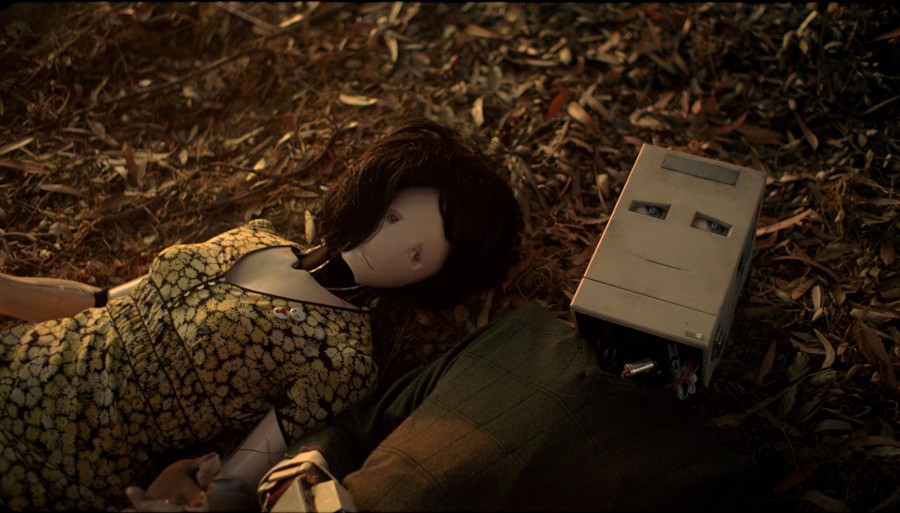
Spike Jonze knows how to work with very little, and create a lot. Here he employs his trademark marriage of low-tech and high tech to create a very fleshed out world in just about 30 minutes. The story is a science fiction one, but a sort of retro-futuristic Los Angeles. Humans and robots live together, the robots appear to be built of those unattractive beige computer cases from the 90s. The only CG employed are in the eyes and mouths of the characters, and that is done in a subtle way.

The story follows Sheldon, a librarian robot who is introverted and nervous, returning to his apartment every evening, plugging into the wall recharger and sitting alone. One day he happens to meet Francesca, a female robot who is driving a car, something robots are not allowed in this world. The two hit it off and a romance develops. During a concert, the crowd gets a little rough and Francesca loses her arm. In an act of love, Sheldon unscrews his own and gives it to her. As their relationship continues, it becomes apparent a larger sacrifice will be made. The film is an interesting mix of heartbreaking and unsettling. A lot of the choices made in this relationship appear to be one sided, and it can be read as an act of unconditional love or of a selfishness. Definitely worth a watch and a beautiful looking film from director Jonze.

Maybe Sundays – Alice in Wonderland (2010)


Alice in Wonderland (2010, dir. Tim Burton)

Starrin Mia Wasikowska, Johnny Depp, Helena Bonham Carter, Anne Hathaway, Crispin Glover, Matt Lucas, Stephen Fry, Michael Sheen, Alan Rickman
So visionary director Tim Burton takes on the classic surreal children’s tale of Alice’s Adventures in Wonderland with Johnny Depp at his side as The Mad Hatter. Sounds like a formula for success, right. Well, if this had been 10 years ago, maybe. However, with Burton’s work output in the 21st Century being less than stellar and lot of the visual tricks used here being old hat from previous films, the picture comes off an a utter bore. And I really didn’t want it to be.
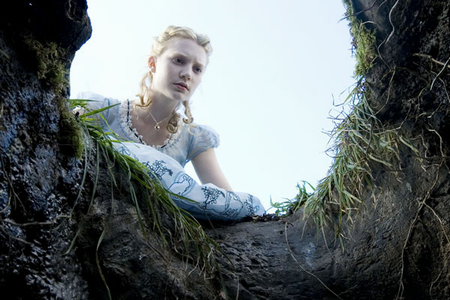
Alice Kingsley is a teenaged girl being married off to a disgusting noble. During the engagement party she runs off and comes across a White Rabbit, whom she follows down a mysterious hole. Alice finds herself in Wonderland and the creatures there recognizing her as a prophesied savior. The two monarchs, Red Queen and White Queen and Alice is needed to defeat the evil Jabberwocky and save the day. The film is a mishmash of elements from Lewis Carroll’s two Alice tales and the 1951 Disney animated feature. And it all adds up to an uninteresting mess.
None of the Wonderland characters feel interesting in the least. Yes, they are strange and meticulously designed, but beyond their quirks they lack anything remotely resembling personality. This shouldn’t be a problem in a film based on a novel that really has no character development in the first place, and is merely a series of absurdity philosophical encounters. But, Burton has chosen to make the film a semi-sequel…or is it a reimagining? I couldn’t figure that out how they fit in with the original story. There are hints that this Alice could be the little girl from the story, but then there is a mention of Alice merely being some sort of title.
This is such a huge disappointment, especially with the exceptional cast gathered by Burton. Instead of giving us some new and interesting look at Wonderland, we get it blandly Burton-ized, with the typical spiral patterns and zany color schemes. Its nice decoration, but a great film it does not make. What the film misses are the more interesting goings on of the real world. I found myself paying more attention during the moments where Alice navigates her engagement party and, when she returns from Wonderland, and sets things straight with the people around her. I want to see a movie about THAT Alice!

Maybe Sundays – The Crazies (2010)


The Crazies (2010, dir. Breck Eisner)
Starring Timothy Olyphant, Radha Mitchell, Danielle Panabaker, Joe Anderson

The Crazies is only a zombie film by default. It’s “monsters” aren’t the walking dead at all, but people infected by viral weapons designed by the United States military. And one could easily debate if the villains in the film are the townsfolk or the emergency response military troops that come to kill them all. Based on a 1973 George Romero cult flick, this film follows the same premise but with some modern tweaks and a lot better character development than the original.
The story begins with Ogden Marsh Sheriff David Dutton attending the opening game of the high school baseball season. A town farmer arrives on the field, behaving strangely and brandishing a shotgun. David to shoot and kill the man when he draws his weapon on the crowd. Over the next day, more cases of similar behavior surface causing David and his doctor wife, Judy to suspect something sinister is at work. In the middle of the night military forces show up in Ogden Marsh, rounding up citizens in makeshift internment camps.
It’s obvious the film is expanding on the anti-government paranoia of the 1970s with a post 9-11 spin. What I picked up on most was that almost every infected townsperson is a familiar face that we’re allowed to pick up some details about before they become a monster in the film. With the military, we only see one soldier’s face. The rest are constantly wearing hazmat suits or full fatigues with gas masks securely planted over their faces. This conceit causes the military to come off as much more of the mysterious evil force than the infected. In fact, the greatest horror of the film is performed by the military in the film’s finale.
Despite this, the film falls into the most cliched of cliches in the horror business. There was an inordinate number of times where we were given a cheap jump scare from someone being touched on the shoulder. And I counted at least twice where a scare was revealed by the camera simply panning to the right to reveal an infected in the room. It’s these easy paint-by-the-numbers techniques that take a film, which could have been interesting and tapped into some interesting zeitgeist, and turn it into a $5 DVD bin flick for Wal-Mart.

Wild Card Tuesday – Gentlemen Broncos


Gentlemen Broncos (2009, dir. Jard Hess)
Starring Michael Angarano, Jemaine Clement, Sam Rockwell, Jennifer Coolidge, Mike White, Halley Feiffer, Hector Jimenez

In 2006, after he had been hired to develop the score for Nacho Libre, singer-songwriter Beck said of director Jared Hess, “No filmmaker since Fellini has had such an eye for amazing characters”. That’s a pretty strong statement to make about a filmmaker who had only released one feature film at the time. And while Nacho Libre left me wanting for the disjointed narrative of Napoleon Dynamite, Gentlemen Broncos has shown me exactly what Beck was seeing.
It may come as no surprise at how much I loved Broncos as it definitely hit me where I live. The film’s protagonist, Benjamin Purvis (Angarano) is a homeschooled, amateur science fiction writer who has developed a novel based on his late father. He attends a young writers conference with a group of fellow homeschooled students from his co-op and meets his idol, Ronald Chevalier (Clement) who proceeds to steal Benjamin’s story and change key details to hide the theft. Simultaneously, Benjamin sells the film rights of his novel to an incredibly amateur filmmaking duo, one of whom has romantic intentions on Ben.
The level of the theatrical grotesque in this film is so incredibly over the top. As bizarre as this world is, it feels so familiar and fleshed out. There are so many rich details and background pieces of minutiae that part of me didn’t want to leave this universe. Added to all of this are dramatized excerpts from both Benjamin and Chevalier’s versions of Yeast Lords (the name of the stolen novel). In both versions Sam Rockwell plays the protagonist and proves once again why he is one of the most talented actors working today. In Benjamin’s version he plays the hero as a gruff, Southern accented redneck and in Chevalier’s is a lisping, albino.
Aside from Rockwell, there were many great performances, in particular Hector Jimenz (also in Nacho Libre). I have no idea what sort of acting choices Jimenez made for his role as Lonnie Donaho, the auteur responsible for making over 80 films (most of them trailers he tells us) but they result in one of the strangest characters I have ever seen on the big screen. The moment I knew Lonnie would be one of my favorite characters to pop up in the film comes early on. He and Tabitha (Fieffer), Benjamin’s love interest, take a seat next to Ben on the bus heading to the writers conference. Tabitha asks Ben to give her a hand massage, and as he does Lonnie proceeds to blow in Tabitha’s ear with a sound resembling a clogged vacuum cleaner.
Jared Hess, and his wife and writing partner Jerusha, have renewed my hope in their work. They come across as a combination of the clean, crisp filmmaking of Wes Anderson and the love of the mundanely bizarre of Tim & Eric. I think Nacho Libre’s flaws came from having a third party intervene and make rewrites to make the film more “palatable” for mainstream audiences. Hess isn’t built to make mainstream cinema and the more freedom he is allowed to pursue his skewed vision of middle America the better.

Shadows in the Cave Digest #02 – February 2010


Features

Robert Altman: Chorus of Voices: 1970-74, 1975-1979, 1980s/1990-92, 1993-2006
The Alien Quadrilogy: The Evolution of Ellen Ripley Part One, Part Two
Director in Focus: John SaylesMatewan, Men With Guns

Reviews
Hypothetical Film Festivals
Coming next month: Cinematic Television, The Burton/Depp Collaborations, and much more
Programming note: I’ll be assigning themes to days of the week starting in March for what sort of film I will watch. It will be as follows:
DocuMondays (documentaries)
Wild Card Tuesdays (whatever suits my tastes)
Newbie Wednesday (new films in theaters or on DVD)
Jolly Good Thursdays (British cinema)
Friday Imports (foreign language cinema)
Seventies Saturdays (1970s American cinema)
Maybe Sundays (I reserve the right to either take a day off from the blog or watch a random flick and post)

Film 2010 #36 – The Loneliness of the Long Distance Runner


The Loneliness of the Long Distance (1962, dir. Tony Richardson)

Starring Tom Courtenay, Michael Redgrave
Film across the world was undergoing a transformation in the early 1960s. It began with the French New Wave movement of directors like Godard and Truffat and spread across Europe. Eventually, it hit England and corresponded with the coming of age of the first group of post-war children. The films produced in this period are referred to as the Angry Young Men, as they focused on teenagers and men in their 20s for whom the drudgery of blue collar life, that their parents so readily accepted, was considered a living death sentence.
This particular film focuses on the life of a Nottingham youth named Colin Smith (Courtenay). The picture opens with Colin being transported with a group of other juvenile delinquents to Ruxton Towers Reformatory. At the same time, the administration of the facility learns a nearby public school (in the States it would be a private school) wants to have their boys compete against Ruxton’s in a track and field event. The governor of the school (Redgrave) eyes Colin with the potential to win the long distance race after a tryout and begins loosening the restraints on the boy to ensure he will feel dedicated to Ruxton when the day of the race arrives.
Throughout the film we’re given glimpses of what led Colin down this path. At Ruxton, he is a humorless and dour young man, but in his life before he possesses a yearning to escape the factory life of Nottingham that kills his father. It becomes apparent that all Colin has been given in life are a series of expectations to live up to. His father’s former employer expects Colin will come work for them. Colin’s mother expects him to get a job once his father dies. The authorities figures in his town expect him to fall into a life of crime. The pressure of these expectations slowly grows inside Colin in both the flashbacks and during his time training for the race.
The most wonderful moments of the film come when the Governor allows Colin to run outside the gates of Ruxton. As soon as Colin is past the gates a soundtrack of period jazz music kicks in and the camera becomes very loose and documentarian in how it captures the runner. These moments of joy when Colin is by himself, simply running till he can’t breathe are played against his confrontations with fellow boys at the reformatory and regular sessions with the nervous and ineffective counselor. The loneliness mentioned in the title ends up playing both a joyous and bittersweet role. The film has two endings in effect, the one where Colin is “victorious” and then a sort of epilogue which causes us to question the cost of that victory.

Film 2010 #35 – Shutter Island


Shutter Island (2010, dir. Martin Scorsese)
Starring Leonardo DiCaprio, Mark Ruffalo, Ben Kingsley, Michelle Williams, Max von Sydow, Emily Mortimer, Patricia Clarkson, Jackie Earle Haley, Elias Koteas

My immediate reaction after seeing the first trailer for Shutter Island was that it would be interesting to see Scorsese tackle a film with horror elements. After thinking about this for a little while longer, I realized he already had in Taxi Driver, a film I think of as an urban horror picture more than anything else. Upon further contemplation, I realized we found similarly paranoid protagonists in many Scorsese pictures: The King of Comedy, Raging Bull, Goodfellas, and of course, The Aviator. This is why Shutter Island, while stylistically a departure for the directing legend, is thematically at home in his body of work.
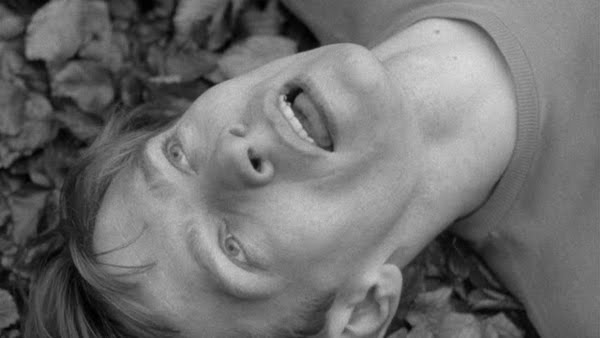
The premise brings U.S. Marshall Teddy Daniels (DiCaprio) to the Ashecliffe Hospital for the Criminally Insane located on Shutter Island. Rachel Solando, a patient at the asylum has vanished so Daniels, and his new partner Chuck Aule (Ruffalo) have come to investigate. Daniels is introduced to the facilities by Dr. John Cawley (Kingsley) and eventually meets the head of the hospital, Dr. Naehring (Sydow), a German who brings back Daniels animosity for the Nazi atrocities he witnessed during World War II. This combined with strange nightmares about Daniels’ late wife intensify his paranoia while on the Island and he begins to formulate what he believes is the real horror going on behind the scenes on Shutter Island.
What hits you first about this film is the score. The music was designed and chosen by long-time friend of Scorsese and former member of The Band, Robbie Robertson and he proves he has an ear for some powerful modernist compositions. There are elements of Bernard Hermann yet never played to the point of absurdity. Because of the strong musical elements they create a balance with the unscored moments. An encounter in a cave among the cliffs of the island goes unscored, despite there being revelations made there that would have received a crescendo of strings in an older picture. It’s those choices of presence and absence that strike the right balance in the film.
At its core, this is simply a variation on the haunted house trope. What sets it apart from a B-movie are the very powerful artistic masterstrokes Scorsese uses. The dream/nightmare sequences Daniels experiences, whether they be in sleep or in the middle of the day, inform the audience with the clues the investigator fails to find in the conscious world. I was particularly intrigued by the cultural paranoias of the day that seeped into the fiber of the film. We have Daniels haunted by the sights of Jews frozen to death at Dachau and his unit subsequent expunging of the camp’s guards in an era where PTSD was not something remotely thought about. In addition, characters mention the fears of atomic annihilation as a result of the Cold War, the idea of Nazi scientist-torturers being granted pardons for service to the US military, and brainwashing techniques of HUAC. This constant atmosphere of not-knowing and being watched makes Shutter a perfect companion piece to The Aviator.
Shutter Island may not end on the most satisfying of notes, but there really is no other way for it to end. Such a story can’t deliver any true sense of justice and still remain true to its film noir and horror roots. From the first time we see Daniels, hunched over a toilet as the ferry rocks around him, it is apparent this character is in bad shape. An odyssey to an island of madness can never make such a condition better.

Film 2010 #34 – The Red Shoes

Since 2005 I have kept a list of every new film I have seen. With this film I have hit the 1000 mark. Before long, I’ll probably be hitting 2000.


The Red Shoes (1948, dir. Michael Powell & Emeric Pressburger)
Starring Anton Walbrook

This was a film long on my list of ones to see and said to have been an inspiration to directors like Steven Spielberg and Francis Ford Coppola. That’s not to say its plot or screenplay is similar to their work, rather the way the directors utilize the camera and art direction to create a lush and amazing world. The story comes from the Hans Christian Andersen fable of a young girl who acquires a pair of magical red slippers that cause her to dance and, unable to stop, she begs an executioner to chop of her feet. He does and gives her a pair of wooden feet, yet she is haunted by the disembodied dancing feet.
Powell and Pressburger were a directorial pair in the United Kingdom, as well respected as Hitchcock or David Lean, yet their work has faded from the larger collective memory in the following years. For The Red Shoes, they took the Andersen fable and set it in contemporary (1940s) Europe. Boris Lermontov runs a prestigious ballet company and encounters two young up and coming artists: Victoria Page, a company ballerina and Julian Craster, a budding composer. Lermontov goes on to commission an adaptation of the The Red Shoes. Around the same time, the company’s prima ballerina announces her engagement which infuriates Lermontov who immediately lets her know she is no longer a part of his works. To replace her, he promotes Victoria Page, and this is where the trouble begins.
Lermontov is dangerously obsessed with his ingenues. His original prima announcing her engagement turns him into a petty, spiteful man who takes glee in letting her go. As similar things begin to develop with Victoria, we see Lermontov’s role as a metaphorical evil wizard take hold. He is jealous of any one who might break a dancer’s devotion to his will alone.
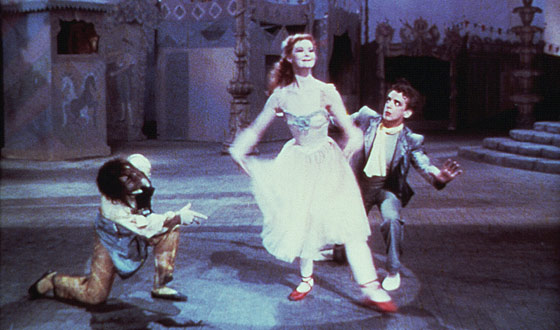
The most spectacular piece of the film is the 17 minute long ballet sequence that comes smack dab in the middle. The first half of the film is about the three individual strands of Lermontov, Craster, and Victoria coming together and the second half is about how the lives of these three are eventually torn apart. And what ties it all up is a visually stunning abbreviation of The Red Shoes ballet that will cause the viewer to ask some questions. From the start of the sequence, it is apparent that this is simply a dress rehearsal, yet then it starts incorporating what might be seen as subconscious thoughts of Victoria (the villain of the ballet flashing into Craster and then Lermontov suddenly), as the sequence continues Victoria moves into impossible landscapes that could in no way actually be on stage. And finally, everything pulls back to reveal the actual performance on opening night. This one sequence both serves to expose subconscious ideas and transition our characters through time.