Movie Review – Doctor Strange

Doctor Strange (2016, dir. Scott Derrickson)

landscape-1459632762-benedict-cumberbatch-doctor-strange

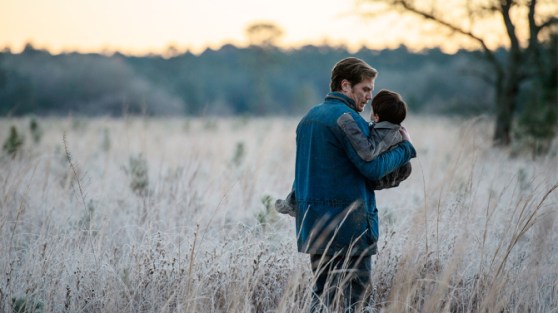
Doctor Stephen Strange is one of the best neurosurgeons on the planet and he definitely knows it. Everything in his life changes when a near fatal car accident shreds the tendons in his hands and takes away his ability to practice his medical skills. Stephen begins searching for a cure and it leads him to a city in the Himalayas where The Ancient One resides. The Ancient One leads an order of mystics who transcend our physical plane to interact with and manipulate the elements of the multiverse. Skeptical at first, Stephen eventually comes around and begins his path to becoming the Sorcerer Supreme. Conflict comes in the form of Caecilius, a former student of the Ancient One who seeks to rupture the reality of our world and unleash Dormammu and his Dark Dimension.

We are fourteen films and nine years into the Marvel Cinematic Universe. While characters considered 1st Tier have already been developed we’re now to those that are lesser known to the general public. Doctor Strange has always occupied a limbo between tiers, sometimes becoming an Avengers level figure and other times fading into slight obscurity. I can’t stay I’ve been a huge fan of the character, but Jason Aaron and Chris Bachalo’s current run on the comic have me interested. The key to the character is to play up the out there, surreal other realms he explores and fights enemies from. In this way, the film understands Strange. It is full to the brim with strong surreal effects and is arguably the most visually appealing Marvel film to date.

Beyond the visual embellishments the plot is fairly thin. This is another origin story and like with most origin stories there is a formula that is followed very closely. Nothing that happens in the film will likely surprise you if you’ve seen any of the others. Character development is fair superficial, especially the relationship between Strange and Rachel McAdams’ nurse. That entire love story side plot felt completely pointless and could have worked better as simply a colleague Strange had wronged and now, seeing the error of his arrogance, sought amends.

There is an attempt at humor throughout and that was one of the most painful parts of the picture. Benedict Cumberbatch as never struck as me as particularly funny (though he was good in Four Lions). Not sure if it’s his timing or the actual joke itself but every single one falls flat. There is a Beyonce joke between he and Wong, the librarian at the monastery that film keeps pushing with the sense that there is something funny about this exchange. There is not. The film is at its best when it takes its subject matter with seriousness and Strange is not a jokey character by nature.

I personally am starting to feel fatigue with many of the superhero films. Warner Brothers have burnt bridges for me with their DC franchise. Marvel has become okay, and I can’t imagine where it goes after the next Avengers film it’s building to. At this point the formula has been so entrenched, I hope future superhero films can break it and go in some new and interesting directions. Not holding out hope, but it would be nice.
Movie Review – The Alchemist’s Cookbook

The Alchemist’s Cookbook (2016, dir. Joel Potrykus)

alchemist

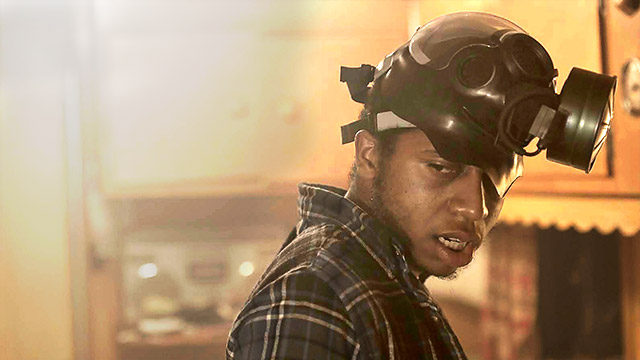
A man named Sean lives in a trailer home deep in the woods outside of Grand Rapids, Michigan. At first glance, it would be easy to mistake his set up as a meth lab, but after further observation, it is revealed he is an amateur alchemist. His only constant companion is Kaspar, his cat, but he does receive erratic visits from Cortez, a cousin, who brings supplies. Cortez is unaware of just what his Sean is up to and that his cousin is close to making contact with demon Belial, whom Sean believes will provide him with incalculable wealth.

It’s hard to classify this film as any one thing. There are touches of drama and of horror and a little comedy. It never settles on one thing, and some reviewers have taken to calling it a “punk” film more than anything else. Director Potrykus has a track record of making films in this off-kilter, low-fi style. I personally don’t connect with much from the punk genre, and that would likely explain why this movie left me frustrated. I can’t see any reason I’ll remember this film.

There is so much here in the ingredients list that should have guaranteed I’d love it. The rural setting, deep in the woods, always an excellent location for horror. I definitely have an affinity for stories about the demonic and humans who are a little too arrogant in their abilities to deal with a summoned entity. There is a sense of danger and tension from the first moments of the film. However, that feels undercut as the tone shifts from chapter to chapter. Or worse yet, the tone goes with a distant documenting of a man pouring substances into various vials without informing the audience of what is going on.

The biggest problem I had with Cookbook was the lack of character development. There is only one real presence on screen, Sean. And with an hour and a half, I ended the film feeling like I still didn’t know much about him. I never needed anything explicit, but some reasons could have been hinted at as to why he was driven to the wilderness and devoted himself to this pursuit of gold. Lots of scenes give us the sense of what this world feels like and Sean’s mannerisms, but never a good sense of motivation. The entire picture seems like a tedious exercise in improv where nothing really bubbles to the surface in the end.

There are great moments throughout, though. Sean and Cortez’s interactions are funny and entertaining, though they mess with the tension. There is a sense of some sort of structure through the chapter breaks and the progression of day into darkness that some key scenes touch on. As a whole, Alchemist’s Cookbook sadly failed to meet my expectations. I was honestly, excited to sit down and watch this one after seeing it’s great trailer. In the end, it feels too insubstantial to recommend and won’t really satisfy any fans of the many genres it touches on.

Roots of Fear: I used to work in a Pill Mill in Florida

pharmacy

“I used to work in a pill mill in Florida Part One” – https://www.reddit.com/r/nosleep/comments/5k78ih/i_used_to_work_at_a_pill_mill_in_florida_ive_saw/

In the last couple months, I started to think about writing more on what makes something horror for me. I think horror can be just as niche a comedy. People’s senses of humor can vary wildly and so can their sense of fear. For some, nature is a terrifying concept. Stories about tornadoes and hurricanes are chilling. I personally don’t click with Man vs. Nature type stories. I feel that the evil needs some form of intelligence for me to be scared of them. Lovecraft’s cosmic horrors live in that space. Large and beyond human comprehension but also thinking and planning. The masked slasher (Jason, Michael Myers, Leatherface) has been a hugely popular horror trope followed by variants (Freddy Krueger most notable). There is an intimacy to that horror. Teens stumbling through dimly lit rooms and the close murder of the blade. But again, that type of horror has never clicked with me. Possibly because of the oversaturation of that genre during my formative years. Jason just isn’t scary anymore. Most of my scares have been coming from literature lately more than film, in particular, short stories.

Continue reading “Roots of Fear: I used to work in a Pill Mill in Florida”

Movie Review – Suicide Squad

Suicide Squad (2016, dir. David Ayer)

maxresdefault

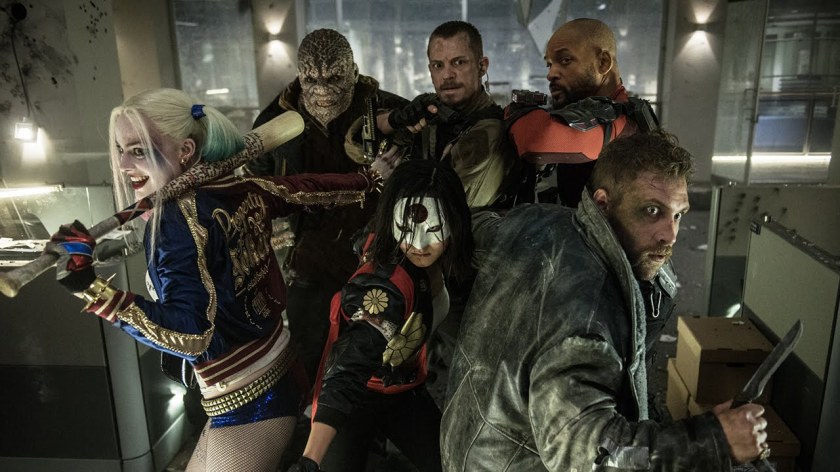
Hey, kids. Did you ever want to know what it would be like to have Hot Topic produce a DC Comics superhero film? Are you tired of all those boring character development scenes in the good superhero films and just want fucking cool music, sexy chicks, and guns? The Suicide Squad is the film for you!

Continuing Warner Brothers apparent need to shit on every IP they own at DC, we are given the story of Task Force X, the Suicide Squad, a collection of lower-tier villains forced into government servitude. Amanda Waller (Viola Davis) is an intelligence officer who brings these supervillains together explaining that it’s a contingency plan in case Superman-level threat were to rear its head. Superman-level threat? Apparently, Harley Quinn, Captain Boomerang, and Deadshot could have taken down Doomsday? Oh well. A big bad villain makes a thing that shoots a beam of light into the sky and then something with the Joker.

The most glaring problem with Suicide Squad is the editing. Holy shit. The first twenty minutes of the film are obviously longer origins vignettes that have been sloppily cobbled together to serve as music video/trailer-esque introductions. The Harley Quinn origin feels like a much more dense side plot, but in a film that already goes just over two hours there is not much room to reasonably fit it in. That is another ongoing problem throughout the entire film: characters are pushed into the movie and we are given little to no reason to care what happens to them. Katana felt like the most egregious of these. As the team departs to deal with the menace, she comes out of nowhere and leaps onto the helicopter. Joel Kinnaman plays Rick Flag and seems to function as an exposition delivery device tells us who she is in about two sentences. Once again I ask, why should I give a damn about what happens to a character I don’t really know anything about and then doesn’t do much for the rest of the film.

Suicide Squad is a movie that is trying to “catch up” with Marvel. A good contrast would be Guardians of the Galaxy which did introduce five protagonists and managed to develop them into pretty well rounded characters. Suicide Squad opts to introduce seven characters on the team, plus The Joker plus the main villain and then expect us to care about what happens. It’s made even more disturbing when the film tries to make us swoon over The Joker and Harley’s relationship. It’s been very well established in the comics that the two have a textbook toxic relationship, not one based in love but abuse. The film believes it is a sub/dom thing possibly? This is a very dangerous route to go down and I’ve already seen a lot of social media where young women are idolizing this thing.

I was asked why Wonder Woman isn’t one of my most anticipated films of 2017. Man of Steel, Batman v Superman, and this movie are pretty much why. Warner Brothers have taken a very strange approach in my opinion to developing this cinematic universe. They have definitely made a lot of money, but I don’t see the films being part of a long lasting legacy. Ten years from now I expect there will be lots of used copies of Suicide Squad filling up second-hand stores.

Movie Review – Nocturnal Animals

Nocturnal Animals (2016, dir. Tom Ford)

nocturnal-animals-amy-adams-image.jpg

Nocturnal Animals is so much and so elusive in letting us know what it is. At a basic level, it is three narratives: The Present, The Past, and The Fiction. All of these narratives are filtered through a single viewpoint, and they tell us much about the effects of love and hate. The story of Nocturnal Animals begins in the Present with Susan Morrow (Amy Adams), a California art gallery owner whose life is a comfortable one, luxurious and successful. She is in her second marriage and with a young adult daughter. What she thought would make her happy has failed to do so. Her daughter is living away and distant while her husband is habitually cheating on her. Into this mix arrives a manuscript from her estranged first husband, Edward Sheffield (Jake Gyllenhaal). The novel is titled Nocturnal Animals, a name he used to call Susan.

Continue reading “Movie Review – Nocturnal Animals”

Movie Review – King Cobra

King Cobra (2016, dir. Justin Kelly)

gay_art3

Sean Lockhart wants to make it in the movies. He intends to become a director and helm great films. He’s taking a rather unorthodox path by first changing his name to Brent Corrigan and then moving in with a man named Stephen. Stephen runs King Cobra, a gay pornography website and Brent is becoming his biggest star. Simultaneously, we’re introduced to Joe and Harlow, a pair of male escorts in a committed relationship. Joe never hesitates to indulge Harlow and provide him with every extravagance. Harlow carries the trauma of abuse from his stepfather, and this had caused Joe to become almost psychotically protective of him. These two pairs of men are on a trajectory towards each other. The events of this story will end in betrayal and murder. This is the story of King Cobra.

The film is based on real events, though director Kelly has taken a lot of liberty with the facts. The real life Sean Lockhart has expressed much disdain over the way the film portrays queer culture. Via Twitter he stated, “I gave them permission to use my name but explicitly made it clear that their story was heinous & not sanctioned. They told me they couldn’t change their screenplay after we entered negotiations.” Director Justin Kelly is a gay man himself and has stated that his interest in the film came from a more true crime angle that happened to feature representation of “different kinds of gay characters.” I find that both men have some very solid ideas and interpretations of the final product. There are some incredibly strong moments, but flaws are still present that degrade what could be a fascinating film.

The two most solid performances, in my opinion, are Christian Slater as Stephen and Keegan Allen of Harlow. Slater walks a very fine line with Stephen as both a lecherous older man getting off on young guys and a very isolated gay man from an older generation who didn’t have a support network for coming out. He is still publicly closeted and tells Brent a painful story about his first experience with another man and how his friends ostracized him after finding out. The film doesn’t come down black or white on the issue of Stephen exploiting  Brent, we are left to decide what their relationship was.

When you first glimpse Keegan Allen, you’ll likely think of Joaquin Phoenix, and there is a strong physical resemblance. Another resemblance is that Allen is arguably the strongest actor in this picture. The character of Harlow has many layers and Allen makes interesting choices about how to play him. There is genuine love from Harlow to Joe and a desire to be monogamous with him. Joe, knowing that their finances are crippling them and keeping this from his partner, forces Harlow to continue meeting with clients. My hope is that we continue to see Keegan Allen in films because I get the sense there are some great performances there.

The most glaring problem with King Cobra seems to be a glaring issue in a lot of films: James Franco. Franco produced this film and chose to play Joe, the manic abusive lover of Harlow. I can’t say I understand a single choice Franco makes when it comes to playing this character but everything he does seems to pull the viewer out of the film. You’ll have a scene that is setting a muted, layered tone and then Franco comes on the screen and it devolves into dark comedy. He plays a complete caricature. The film has a lot of gratuitous simulated gay sex and the sex that appears as part of the porn productions is expectedly smutty but makes sense. Franco’s most explicit sex scene is such a joke I can’t imagine audiences not howling in laughter at his horrible performance.

King Cobra is a true crime film that plays with the idea of being a moody, independent film but falls into but ends up becoming borderline exploitative. There are some interesting performances, but they aren’t given the support needed to become great. There was the opportunity to explore some intriguing themes: the generation gap in the gay community, the American culture’s obsession with appearing wealthy. But every time one of these themes emerges it is just as quickly dropped.


Comic Book Review – House of Penance

House of Penance (2016, Dark Horse Comics)
Writer: Peter J. Tomasi
Artists: David Stewart, Ian Bertram

penanceIn 1884 in San Jose, California, Sarah Winchester began construction on a massive estate with no building plan. Deeply troubled by the deaths of her husband William and daughter Annie, rumors abound that Sarah believes she is cursed and that the strange architecture she demands is part of her deluded thinking of how she will cure herself. This real life story becomes the center of Peter Tomasi’s fictional retelling House of Penance. In this version of events, the Winchester House becomes a magnet for men troubled by killings they have committed with guns, the very things that brought the Winchesters their fortune.

House of Penance is a story that has a very clear moral message it wants to deliver but is written cleverly enough that it can hide that message in a story of personal horror. The story is told from the points of view of Sarah and new arrival Warren Peck. The first time we glimpse Peck he’s murdering Native Americans for the benefit of Westward Expansion while staging the scene to make it appear that a rival tribe killed the family he descended upon. He beds down at the workers’ quarters at the Winchester House but quickly becomes compelled to stay. Sarah experiences visions of tendrils of blood seeping up through the floorboards of the house, the spirits of her family and their company’s victims coming to drag her down to Hell.

The story is paced beautifully, revealing just enough horror in its early chapters to make the reader question Sarah’s sanity but also be convincing enough that we believe there really are demonic forces after her. Her relationship with Peck is the bulk of the story and is explored in depth. I found it to be darkly adversarial at first but soften into a caretaker position. You might stumble upon this mistakenly believing it is a Western, but it is much more a Gothic horror tale. I’m surprised we haven’t had more fiction around the Winchester House as it feels primer for horror exploitation. Though, the novel House of Leaves seems to have been heavily influenced by the non-traditional architecture of the Winchester House. House of Penance has a very similar Grand Guignol finale as the house becomes the site of a mass killing.

The pencil work of Ian Bertram uses a textured woodcut style and plays with the shadows and dark, creepy corners of the house. The way the character’s bodies are presented is also distorted with overly large eyes and grotesque muscle on the workers. Before the explicit horror of the story raises its head we already feel uneasy due to how the world is being presented to us. If you enjoyed Guillermo del Toro’s Crimson Peak or similar fare, there is a lot to like about House of Penance and is a quick read that is worth your time.

Movie Review – The Girl With All the Gifts

The Girl With All the Gifts (2016, dir. Colm McCarthy)

girlwithallthegifts

Zombies. I don’t really get it. They seem to have an endless appeal to a large enough group of people that creators keep coming back to them. They’ve never really scared me which probably has to do with how I see them in that category of conflict of Man vs. Nature which isn’t interesting to me. A few have broken through and managed to interest me: Pontypool, 28 Days Later, Deadgirl. But for the most part, they seem to play out the same tired cliches and tropes.

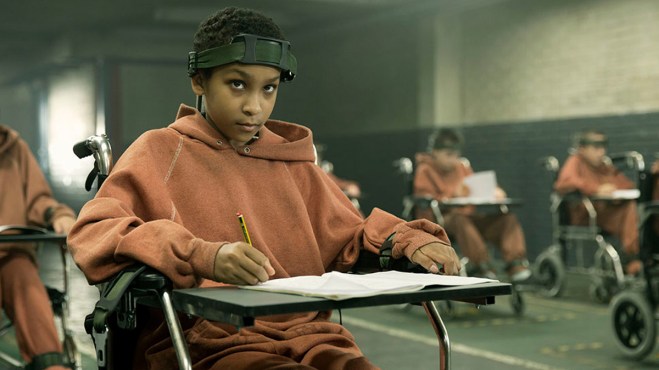
The Girl With All the Gifts (based on the novel by Mike Carey) starts us out in the twilight of man’s fight against a fungal outbreak that has turned humans into ravenous hordes. The film is told through the eyes of Melanie, an 11-year-old girl who, with dozens of other children are kept in a subterranean prison, observed by scientists, and held at gunpoint by paranoid soldiers. As things often do in zombie films, the proceedings get chaotic, and our human characters are on the run. However, they survivors bring Melanie along who isn’t entirely human and whose origins reveal something much bigger about the fungal outbreak.

The overarching theme of the film is about the power of the older generation being lost and handed off to the younger generation. This particular passing of the torch is not one done willingly, and it is easy to see the conflict reflective of generational clashes in our own history. There is also some impressive play with the idea of how one generation processes the behavior of the new as mindless and evil when they simply don’t understand the underlying motives at play. Sadly, these themes are about the only good thing in this film.

The most frustrating aspect of The Girl With All the Gifts is the lack of strong character development. Instead, the script focuses on hitting plot points and moving characters from location to location. There are never enough still enough, quiet moments to develop the relationships between characters, most importantly Melanie to her teacher Ms. Justineau. That relationship feels like it’s meant to be the crux of the entire story and it is so lightly touched upon it feels inconsequential. The film’s ending behaves as though we have a high investment in these two and ends up feeling shallow because the foundations were never laid to evoke the strong emotional response the filmmakers except.

Melanie is played by newcomer Sennia Nanua, and she feels very much like a child actor. Maybe I was spoiled by Royalty Hightower’s naturalistic style in The Fits, but Nanua isn’t as hammy as a stereotypical “Broadway kid, ” but she just doesn’t seem to have a handle on realistically emoting. It never feels like anything that happens in the story lands with weight on her. There is a scene where Melanie has to take a life, nd it should play as dark and heavy, but the performance just feels like an actor doing “actor tears”. The supporting cast has some strong names: Paddy Considine, Gemma Arterton, and Glenn Close. However, even they aren’t given much to do outside hitting plot points to advance the story.

The flaws in this film likely come from the inexperience of the director in feature work. Colm McCarthy has primarily done television work which isn’t necessarily a bad thing but it does come with a lack of interesting cinematography and different type of pacing with character development. The look of The Girl is disappointingly bland. The majority of shots are either medium shots or long shots when there could be some more interesting ways to show this story unfold. The setting of the third act is full of interesting visual potential but never seizes it.

I was very excited to see this film and expected some interesting twists on the tired zombie genre. While there are lots of interesting themes and ideas brought up, nothing is ever developed particularly through the characters.

Movie Review – Sing Street

Sing Street (2016, dir. John Carney)

e95a78d0a8bdfc12dd50023c9d8822ea4a084546

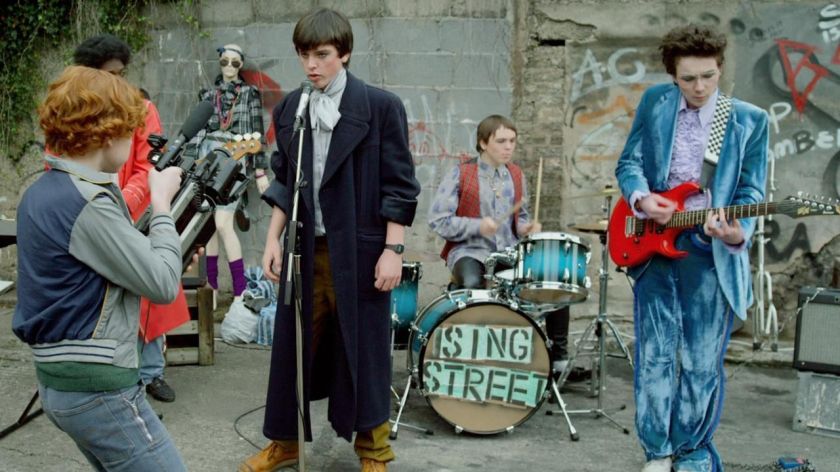
Conor Lawlor is fifteen years old and, with his two siblings, stuck in the middle of his parents’ deteriorating ends up at Synge Street, a free state school run by the Christian Brothers. The school is managed chaos, full of delinquent young men and priests who brutalize their students. Conor meets Raphina, a girl who lives across the street from the school and after seeing a Duran Duran music video for the first time decides he wants to form a band. The group is assembled from the boys he attends school. At the same time, his older brother begins educating Conor on various bands of the day (The Cure, Spandau Ballet), and slowly Conor develops his own sense of songwriting. The endeavor awakens a love of songwriting in him, and the band becomes more than just something to impress a girl, and their relationship becomes more than merely a crush.

By the mid-1980s due to economic stresses, young Irish were immigrating to London in significant numbers. Early in Sing Street, we see a news report covering this and mentioning the fact that many of this young people arrived with little to no money and quickly ended up on the ferry back to Ireland. Conor’s parents’ problems come from both a marriage that is drained of love and the economics issues that have come up. The Catholic Church also looms as an institution that not only oppresses Conor but even his parents. At one point his older brother says, “Two Catholics in a rented flat with a screaming baby who just got married because they wanted to have sex. They didn’t even love each other.” So while the tone of the film is generally upbeat, there is an honesty in the events unfolding.

The style of humor in Sing Street is a mix of dry and playful. I was reminded of the great recent Irish sitcom Moone Boy during a lot of the interactions between the boys in the band. There’s this sense of heightened wit among the children where they come across as wise beyond their years. Other moments have the feel of a Wes Anderson film like Rushmore or Bottle Rocket, that mix of staged scenes and rough energy. The side characters never overtake the main story but are painted with just the right full broad strokes that we have a definitive sense of who they are without the film having to overtly explain.

The music, written by Gary Clark a veteran of the music industry in the 1980s who still writes and produces has a very genuine feel. Each song is directly mimicking a particular band’s style and reflects exactly how a young songwriter would operate, first simulating the music they like as they develop their own sensibilities. I was born in 1981 so much of the music featured in the film I don’t necessarily look back with nostalgia. I certainly enjoy the lighter pop of that era, despite my dark tastes in nearly all other media, and I found the music well done.

Sing Street is a feel good coming of age movie, and I approach this type of film with a lot of trepidation. So often these films depend on a false sense of emotion. They use lazy shorthand to get across the feelings they want to evoke in the audience. Sing Street always manages to keep itself grounded and never tread into those maudlin spaces. Even the film’s “happy ending” leaves the real conclusion for these characters open. The message is that we don’t know what happens when we risk for those higher aspirations, but the risk itself is a victory.