Across the Pond: Misfits

In across the pond I look at television from the U.K. that stands out as amazing programming.


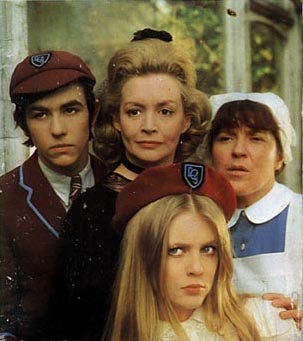
Misfits Series 1 (6 episodes)

One American television series that completely disappointed me was Heroes. The first season was a slow burn, but once it got where it was going it was incredibly good. After its first season though it started a downward spiral that ended with NBC put a bullet in its head halfway through the fourth season. The idea of a television series that works with the superhero concept is one I can get behind completely. When this BBC drama came around I heard about it, but didn’t really rush to watch it. Recently though, I sat down and tore through the six episodes in two days and it has jumped to being one of my favorite shows. It’s a bit teen drama (and British teen dramas are infinitely more racey than American ones) and a bit super hero series. The mix is a wonderful series that can be deathly serious and absolutely hilarious.

Five juvenile delinquents gather at a community center to perform their court-required service hours. While cleaning up trash along the Thames, they see a strange storm quickly gather over the city and begin to rain down massive chunks of ice. A bolt of energy strikes and moments later they appear to be fine. However, they have each gained a special ability they is tied to an aspect of their personality. Kelly, a chav girl from the estates, can read people’s minds (she’s concerned about what people say about her). Simon, a introverted and awkward boy, turns invisible as long as no one is looking at him. Curtis, a former high school track star caught with cocaine, can send his consciousness back in time. Alisha, a coquettish minx, drives any man who touches her bare skin into becoming compelled to have sex with her. And poor Nathan, the mouth of the group appears to have no powers.

These kids wouldn’t ever hang out with each other so the conceit of the community service hours is a perfect way to have a makeshift team. They even have uniforms, bright orange jumpsuits, which they change into when they meet up. Villains come in the form of other Londoners affected by the mysterious storm. Their first enemy is their probation officer, who is transformed into a Hulk-like agent of rage. From there they run into a man who believes he is a dog during a full moon, a girl who cause others’ hair to fall out, and a former nymphet turned svengali of purity. The show definitely mixes humor in, and is able to joke about what is going while still keeping a sense of urgency. The highlight of the season by far was the episode spotlighting Curtis, the time traveler. He is able to go back to the night the police caught him with drugs and tries to change things. Of course he is forced to deal with the large reaching ramifications of his trip back and is forced to make subsequent trips. The way backstory about all the characters is relayed in this episode is amazing, and puts a lot of the time travel storytelling in Heroes to shame.

My favorite character of them all is Nathan, the seemingly powerless member of the bunch. Every episode he attempts to manifest a different power but ultimately fails. There’s even clues early on as to what it will be and its not till the final episode of the season that we discover what that is. Also, in that final episode, Nathan delivers what is possibly one of the funniest rallying speeches I’ve ever heard. In his effort to convince his friends to shake off the mind controlling influences they are under, he champions teenage irresponsibility, claiming that they’re supposed to be getting drunk and shagging all the time. He plans to do so throughout his twenties, and possibly his early thirties. Its a interesting mix of that aforementioned urgency and comedy. If you have the chance, and this sounds even the smallest bit interesting to you, seek it out. It’s one of the most enjoyable comedy-dramas I’ve seen on television in a long time. Series two is scheduled for the end of 2010, with a Christmas special to precede it.
Wild Card Tuesdays – The Living and The Dead


The Living and The Dead (2006, dir. Simon Rumley)
Starring Roger Lloyd-Pack, Leo Bill, Kathy Fahy

It’s very hard for me to write about this film after having just watched it today. It affected me in a deeply emotional way that very few films are able to. After cinema becomes a daily occurrence, you are naturally numbed to the typical emotional tricks of filmmakers. I was aware of this film first as a horror picture. The director, Simon Rumley came out of nowhere with this small picture that made the festival circuits. It never really the mainstream venues, instead traveling to the fringe horror festivals. I am very curious as to how it was received because more than anything this film is a deeply disturbing, yet also sensitive, portrayal of the pain of severe mental illness. The film achieved something very few have in recent years, it made me cry. There is a scene in the last third of the film that is so emotionally devastating I can’t see how anyone could watch it and not break down.

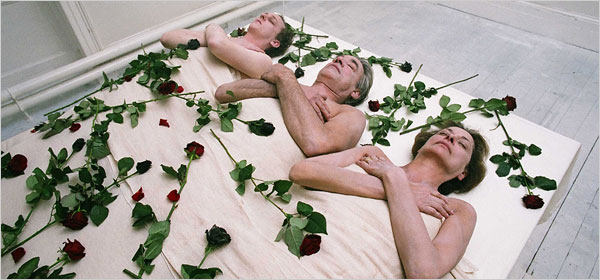
The former Lord Donald Brocklebank must leave his dreary estate in the middle of the English countryside for unknown reasons. His wife, Nancy is suffering from cancer and his son James is severely mentally challenged, requiring daily pills and injections to keep his delusions in check. Donald instructs James that Nurse Mary will round to tend to Nancy. However, James forgets his injections and decides to prove he can be the man of the house by locking Nurse Mary out and trying to tend to mother himself. It’s painful to watch James descend into madness while unknowingly hurting his mother again and again. The film makes a sudden major shift in the narrative about half way through that really cements the idea that we are seeing the story through the mind of a mentally ill person. And the finale is just jolting and ambiguous enough that I believe this film will stay with you for years.

Leo Bill should have received an Academy Award nomination for his portrayal of James. His face is recognizable as that of Darwin in Tarsem Singh’s The Fall, as well as the arranged suitor of Alice in Tim Burton’s recent Alice in Wonderland film. Here is firing on all cylinders, delivering a performance that is so powerful and unrestrained. Even now, just thinking about certain scenes I feel my gut in a knot and heart breaking all over again. James is both terrifying and sympathetic. I thought of the prayer of Christ on the cross, crying out “Forgive them Father, they know not what they do.” That is exactly how we and the other characters in the film inevitably have to view James. His reality is a different plane of existence than ours and he can hurt people while believe he’s simply giving them a hug.

I can’t emphasize enough what a profound piece of cinema this is. While labeled “horror” I would argue that there is no human monster in the film. The monster is mental illness and the shattering pain and emotional trauma we humans are forced to bear. I don’t know if I could ever watch The Living and The Dead again, much in the same way I am unable to revisit Requiem for A Dream. Both movies are so effective in getting across the helpless pain they want to portray that, while we acknowledge them as masterpieces, our psyches are too fragile to confront them again.

Jolly Good Thursdays – Five Minutes of Heaven


Five Minutes of Heaven (2009, dir. Oliver Hirschbiegel)
Starring Liam Neeson, James Nesbitt

There is no collective event as traumatizing and as haunting in the United States as the conflict in Northern Island has affected those people. In 1975, Ireland was under siege by a civil war where neighbor killed neighbor. The IRA killed those who were Protestants and loyal to the British, while the Ulster Volunteer Force (UVF) would kill Catholics who were disloyal to the Empire. These murders were typically carried out by adolescent males, coerced into proving their loyality to their faction by terrorist cell leaders. In many ways, this is a parallel to the Islamic fundamentalist terrorism today; young men too dumb to know better end up dying or killing another. Over time, if they live, the glory fades and they are left with the emptiness of what they believed was a great act of glory.

Alistair Little was 16 when he killed James Griffin, 19. Alistair wanted to prove himself to Ulster and heard about a Protestant friend being hassled by Catholics. He and a group of boys steal a car, get ahold of a gun, and show up on James’ doorstep, shooting the young man dead. Witness to this crime is Joe Griffin, James’ 11 year old brother. Thirty years later, the BBC wants to put together a documentary that culminates in Alistair and Joe meeting. Alistair has served 12 years in prison for burglary and appears to have worked towards getting young men out of the situation he ended up in. Joe has agreed to meet but is both apprehensive and enraged at the prospect of finally confronting his brother’s killer. For the rest of his childhood, Joe was blamed for not doing something to save his brother by their mother, and now the grown man wants to unleash all of this pent up rage on Alistair.

Five Minutes plays out in a very unexpected way, primarily because it’s structured as a four-act play. Each act isn’t contained in a single set but is contained by a certain focus. The first act is the recreation of the murder in 1975, the second act is the build up to the documentary meeting between the two men, and so on. The acting weight is focused squarely on Neeson and Nesbitt and they are overqualified for the job. Nesbitt in particularly is able to see saw his character psychologically, increasing the intensity as the hour of he and Alistair’s meeting grows closer. A large piece of this are internal monologues, Joe simply looking in the mirror of his dressing room, pulling the knife he has brought to exact his revenge and mulling over if he should simply leave or go through with this.

Neeson is equally good but in a different direction. He plays Alistair with subtly, he’s a man who wants his victims to be able to confront him and knows they don’t care if he is sorry or not. As he tells one of the BBC crew, he wants them to step in and keep Joe from hurting himself. As we see later in the film, he is completely willing to let Joe unleash his anger on him. But he’s not just out to give victims their peace, Alistair also wants forgiveness. He’s closed himself up in an estate flat in Belfast, never married and has no children and spends his days either in non-violence support groups or stewing in his home. It is inevitable that these two men are going to meet, but the film lets us wondering under what circumstances will it be and under whose terms.

Jolly Good Thursdays – I Capture the Castle


I Capture the Castle (2003, dir. Tim Fywell)
Starring Romola Garai, Rose Byrne, Henry Thomas, Marc Blucas, Bill Nighy

This is not the sort of story you would expect from Dodie Smith, the same author behind 101 Dalmatians. Instead of a tale aimed towards the younger set, this is a coming of age story set in the mid-1930s. Themes of wealth and love and how the two are intertwined make up the spine of the picture and, what might have been a trite film, is aided by great performances to become something quite a bit better than that. The picture manages to be both an escapist romance and a grounding story of how much love can hurt.

The film opens with the Mortmains’ arrival at an old castle where their author patriarch has relocated them. The events are narrated by middle child Cassandra (Garai), who is overshadowed by their father’s second wife Topaz and Cassandra’s older sister, Rose (Byrne). The castle, which was a magical place when they first came to live there, has become a dank and moldy tomb for the family. Things begin to change when the owners of the castle, American brothers Simon and Neil Cotton arrive to decide what they are going to do with the estate. Rose sees this as her opportunity to marry into money and tries to woo Simon, the elder brother. However, Cassandra is also smitten with Simon and Neil has feelings for Rose.

The Mortmain family is incredibly eccentric and director Fywell is tasked with finding humor in their quirks as well as showing they have consequences. This is particularly highlighted through Mr. Mortmain, a successful author when his family was young, but who has failed to be able to write anything of value since. At first his hang ups and odd behavior come across light, but as the film progresses we see the detrimental effect that have on his entire family. Cassandra is also forced to face the fact that her father’s mental state may be beyond help. That’s quite a heavy weight for our plucky 16 year old protagonist to handle. In a similar fashion, Rose’s vapidity and desperation to find a man are played for laughs at the start, but when she enters into a relationship with a man she doesn’t actually love we can see how a harmless quirk becomes destructive to many people.

The film is not a major cinematic achievement by any means, but it is a very solid and well paced story about eccentric people having to deal with how their behavior effects others. The story is a very mature one, that lets the characters lose themselves in the giddiness of a first love, but also grounds them by not having everything tied up in a neat package. There is hurt and not much closure for our protagonists. In many ways this is a more adult Nicolas Sparks tale, that refrains from maudlin sentiment and allows its characters to have real flaws.

Jolly Good Thursdays – Girly


Mumsy, Nanny, Sonny, and Girly (1969, dir. Freddie Francis)

If you never heard of this film, I can’t fault you. It is an obscure little British horror-comedy that has strong genetic ties to The Addams Family, but more macabre. Full of murder, mayhem, and some very unnerving incestous overtones, Girly (for short) is one of the funniest black comedies I have seen in awhile. In the US we tend to put the crazy killers of our films at the bottom rung of the socio-economic class and basically kick the poor while they’re down. The wonderful thing about the UK is the intense dislike of the aristocracy, even by a lot of the aristocracy themselves. Thus, a film as wonderfully insane as Girly can come about and skewer the 1950s nuclear family unit.

Somewhere on a palatial English countryside estate lives Mumsy, Nanny, Sonny, and Girly. Though Sonny and Girly are obviously in their twenties, they still dress and behave like schoolchildren. Sonny and Girly also have a rather queasy relationship that is hinted at but never made explicit. Also in the mansion live the Friends, homeless men and free love hippies lured to the house and locked up for the sadistic pleasure of the quartet. The introductory friend finds he is unwelcome when he can’t follow the rules Mumsy has set up to run her happy home. As a result he’s decapitated. But into their lives comes New Friend, a gigolo who through a series of gruesome circumstances ends up trapped. Unlike previous Friends, New Friend is a conniver and begins his quest to tear about this happy homicidal home.

Girly was the project of acclaimed cinematographer Freddie Francis, the lens behind such films as Tales of Hoffman, the Gregory Peck Moby Dick, and The Innocents. Francis transitioned into directing in the early 1960s and went on to helm some cult British horror films and established him as filmmaker who brought a lot of visual flair to his pictures. Francis would eventually return to working the camera and was responsible for the cinematography on such films as The Elephant Man, Dune, Glory, and Scorsese’s remake of Cape Fear. Girly was originally a stage play (you can feel the more theatrical moments in the film). The premise of the film is a lampooning of the “traditional” family unit at the hands of the 1960s counter culture.

The film is very fun, dark fare. It’s never truly horrifying, just the kind of violence that gives off a creepy vibe and elicits laughs more than gasps. The middle of the picture meanders a little bit, becoming a bit of a struggle to work through, but the way New Friend begins to tear apart the four members of the family by turning them on each other is enjoyable to watch. Definitely an odd, incredibly obscure picture worth a watch.

Jolly Good Thursdays – Nil By Mouth


Nil By Mouth (1997, dir. Gary Oldman)
Starring Ray Winstone, Kathy Burke, Charlie Creed-Miles, Laila Morse

I didn’t plan it this way, but Nil By Mouth is the perfect co-feature for yesterday’s Harry Brown. Both films take place in the government funded estate housing and focus on some of the harsh and brutal realities of life there. While Brown goes for a more Death Wish, hyper-violent tone, Nil By Mouth is a documentary-like look at the people Harry so eagerly murders. The film’s violence is not constant but comes in explosive and jolting moments. Every thing orbits around a single act of violence that takes place in the middle of the picture.

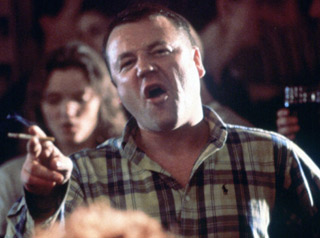
Ray (Winstone) is an ox, a violent brute of a man who is having his second child with Valerie (Burke). He maintains a disinterested relationship with her, going out at night with his mates, ingesting all sorts of drugs, drinking copious amounts of booze, and soliciting women at seedy strip clubs. When Valerie stays out to play pool with friends, Ray explodes. Also living in this war zone is Billy (Creed-Miles), Valerie’s brother and Janet (Morse), Valerie’s mother. Billy is a heroin addict who is constantly borrowing money from his mom and sleeping on a roulette wheel of couches. Janet is a helpless figure, standing back and watching her children’s lives decay and, in Billy’s case, driving him to drug dealers’ houses so he can score.

The most obvious element that carries the film is Ray Winstone. I’ve seen Winstone in films like Sexy Beast and The Proposition and in both of those he plays more of the simmering, muted type. Here he is like a British Jake Lamotta, exploding but never in a showy way, more of a man who has never seen men react anyway other than with violence. There’s a moment in the film when he has a conversation with his best mate Mark and talks about how unloving his father was. This monologue lays it out on the table that these men exist in a cycle of brutality. Why should we expect them to know how to show affection or control their rage when they have never seen a man do so, and when they live in a world where you prove yourself through the violence you inflict on others.

Not to be overshadowed is Kathy Burke as Valerie. Burke knows how to tap into the working class up bringing of her character. Valerie knows that her safety is dependent on Ray’s presence. She overlooks his nightly outings and has a pretty strong suspicion he cheats on her with other women. Their relationship has come to the point where she simply doesn’t care. She is pregnant with their second child and states that she wanted to have another child, but didn’t want to find a different father. There’s no love for Ray, he’s just there. And Ray is with her so he has an anchor point to return to at the end of the night.

The film is soaked in profanity, but that is an accurate depiction of this world and the natural grammar of the place. I was reminded of Mike Leigh’s films about the English working class and how often they are cited as “brutally true to life”. They really have nothing on the grim reality of Oldman’s directorial debut. It’s not an easy film to watch. The accents are thick and require the American viewer to play close attention, and the subject matter is not pretty. However, we have to see the full view of these people so that we don’t slip into the Harry Brown mentality.

Newbie Wednesday – Harry Brown


Harry Brown (2009, dir. Daniel Barber)
Starring Michael Caine, Emily Mortimer, Charlie Creed-Miles, David Bradley, Ben Drew, Jack O’Connell

In the States we call government housing The Projects, in the UK they have the Estates. This is setting of this bleak and tragic story of a man who is alone. The film doesn’t flinch from showing shocking acts of brutality and doesn’t raise up one figure as a champion over another. Harry does what he does, but why? The motives for the killing spree remain vague when you begin to examine things closely. Is it in retribution for his friend? Or is their something much darker going on?

Harry Brown, is ex-marine and pensioner living in the Estates. His wife is living in the hospital stuck in a catatonic state. He has one friend in the world, Leonard, whom he meets at the corner pub for a pint everyday. Leonard is fed up with the way drugs are sold openly and people like himself are harassed by the hoodlums that roam the estates. One morning, Harry wakes up to learn Leonard was found stabbed to death in a pedestrian tunnel. This seems to be the final straw for Harry and he embarks on a crusade to avenge his friend, killing young men where ever he goes.

The film eventually goes down a fairly predictable road with Harry’s action parallel by a police investigation about them. What is more interesting is all the subtext brought to the film, possibly not intentionally. There is a lot of work put into making the world Harry inhabits grimey and flithy and despicable. So we are naturally appalled by the various denizens he encounters. As an audience we are clearly set up to cheer for Harry and boo all those nasty villains (see Gran Torino). However, there is a moment near the end of the film where Harry asks a character to kill him. This immediately caused me to re-evaluate what had gone before. Here’s a man whose wife is gone and has just lost his best friend. He lashes out, presumably because he wants but he then wants to simply die at the end. His entire crusade was a nihilistic one. Harry lost all he loves and now he wants to explode, hitting what ever he can in his path.

If it wasn’t for Michael Caine this would have been a forgettable film. There is something about just his subtle looks that elevates the film. In one scene he sits across from a drug dealer whose girlfriend is overdosing on heroin. The slight glances and looks he makes around the room feed the audience tons of information. While Clint Eastwood seemed one note through Gran Torino, Caine delivers a multi-layered performance. Emily Mortimer is also wonderful as the detective in charge of Caine’s case. By the end, she’s the only virtuous character in the film. She has been devoted to her job and wants to solve the murders. However, we can see the world crumble around her.

Harry Brown definitely wants to be a lofty film, but its very much a continuation of the Death Wish premise. I admit there is some greater emotional depth here. The disappointment for me came from how undeveloped characters are. There is no motive for anyone save Harry and it left me feeling like the picture was very hollow.

Newbie Wednesday – The Imaginarium of Doctor Parnassus


The Imaginarium of Doctor Parnassus (2009, dir. Terry Gilliam)
Starring Christopher Plummer, Heath Ledger, Lily Cole, Andrew Garfield, Verne Troyer, Tom Waits, Johnny Depp, Jude Law, Colin Farrell, Peter Stormare

After filming the first half of this picture, director Gilliam learned the tragic news that Heath Ledger had died due to an accidental drug overdose. Gilliam is no stranger to films having to overcome obstacles before their release. His 1985 picture Brazil was the victim of an unexcited studio and Gilliam had to break the law to get his version of the picture shown. His attempt to make a film version of Don Quixote at the beginning of the century was ultimately scrapped when financial and natural conditions fought against him. With Imaginarium Gilliam found a way that the film could continue without Ledger’s presence and it hinges on the movie’s core theme: Imagination.

The movie opens in modern day London and follows a old time traveling show made up of the ancient sage Doctor Parnassus, his daughter; Valentina, his right hand man; Percy, and the boy in love with Valentina; Anton. Their show is no longer captivating to contemporary audience and during the opening performance a drunk man stumble through a mirror on stage that places him inside his own imagination. Parnassus has been in a centuries old struggle with Mr. Nick, the Devil who is in a competition to see who can collect the most souls before Valentina’s 16th birthday. If Nick wins he takes Valentina from Parnassus. Into this scenario comes an amnesiac man found hanging underneath a bridge. The man slowly but surely takes over creative control of the show explaining he has Parnassus best interests in mind. As the date moves closer to the bet’s end more of this stranger’s secrets are revealed.

The film is better than much of Gilliam’s more recent films and I credit that to his choice of working with co-writer Charles McKeown. McKeown previously worked on the scripts for Brazil and The Adventures of Baron Munchausen which are two of Gilliam’s strongest pictures. The story here can be a bit straining on the brain but its able to keep up with Gilliam’s visuals the whole way through. I also like the use of CG effects here not in an attempt to replicate reality (see Avatar), but to make surreal landscapes feel tangible. In my opinion, that should be the purpose of using CG in films. While I didn’t care for the story of The Lovely Bones is also did an excellent job of created fully realized surreal worlds.

The subtext in the film seems to be Gilliam’s own examination of his profession. Parnassus starts out as a man sequestered in a Tibetan monastery where he and his disciples sit around telling the story of the universe. He makes a deal with the Devil and travels out to make his fortune with these stories, being told he will be immortal if he does. Valentina is a living breathing creation and the idea of turning her over to the Devil is what drives Parnassus to fight for independence. In his desperation he turns to a smooth talker who assures him he will be present the show in the way the doctor wants, but instead we see the integrity of Parnassus slipping away.

Like most of Gilliam’s work this will never appeal to a mainstream audience. He is very much an artist who makes the things that amuse him and its always coincidental if they appeal to anyone else. If you are open to a film that prefers to play rather than dictate and hit plot beats then I think you’ll enjoy this picture.

Newbie Wednesday – Bunny and the Bull

Bunny and the Bull (2009, Paul King)
Starring Edward Hogg, Simon Farnaby, Veronice Echegui, Richard Ayoade, Julian Barrett, Noel Fielding

Note: This film has no planned release date for either theaters or DVD in the US. So, your best bet is to torrent the sucker.

“Come with us now on a journey through time and space”. If you are familiar with the immensely popular British series The Mighty Boosh then those are familiar words to you. The director of that series, Paul King, embarks on his feature film debut, bringing with him some familiar faces in supporting roles as well as the quirky aesthetic sensibilities of his television series.

The premise puts agoraphobic Stephen in the midst a year long hermit period. He is dealing with a trauma that occurred in Europe while he was on holiday with his friend Bunny. The two follow Stephen’s idea of fun by touring the various museums of the continent, but once Bunny takes the wheel things become a lot crazier. They meet waitress Eloisa who is looking for a way back home to Spain, and Bunny decides that once they arrive there, he is going to fight a bull.

The strongest thing this picture has going for it are the inventive visuals. King is definitely a peer to a director like Michel Gondry, in the way he intentionally lets the audience in on the hacked together set pieces. A fast food delivery bag becomes the setting for a flashback in a restaurant. A snow globe becomes the Swiss mountain chateau the men stayed in. A photograph of their train becomes a chain of photos, set against a landscape made of similar snapshots. The Mighty Boosh did the same, and it caused the universe to feel like a timeless fantasy-scape.

The plot on the other hand is not very strong. There’s no real depth to the two main characters, Stephen is a very stereotypical neurotic and Bunny is the typical crazy risk-taker. There’s not attempt to give us more about these characters or attempt to explain their motivations. The rest of the film is populated with set piece characters, such as the dog-milking Polish man, an innkeeper overly fond of her stuffed bear, and a former matador who uses a shopping cart with horns for practice. The film is very pretty to look at, and showcases the cleverness of the director aesthetically, I just hope he can find a richer level of writing for his next film.

Jolly Good Thursdays – Son of Rambow


Son of Rambow (2007, dir.Garth Jennings)
Starring Bil Milner, Will Poulter, Jessica Hynes, Jules Sitruk

I can remember watching Ghostbusters (not the first time, probably the tenth) when I was seven, and afterwards taking an old backpack, a paper towel cardboard tube, and attaching the two with a long piece of a yarn. A shoebox with another piece of yarn attached served as my “ghost trap”. I was always doing these things as a kid. Not having the latest action figures of my favorite comic book or Saturday morning cartoon characters, I would draw and cut out figurines on paper to play with. My desire to tell stories was stronger than the limitations of economy. This is the same love of stories, and being forced to go low tech that informs Garth Jennings’ Son of Rambow.

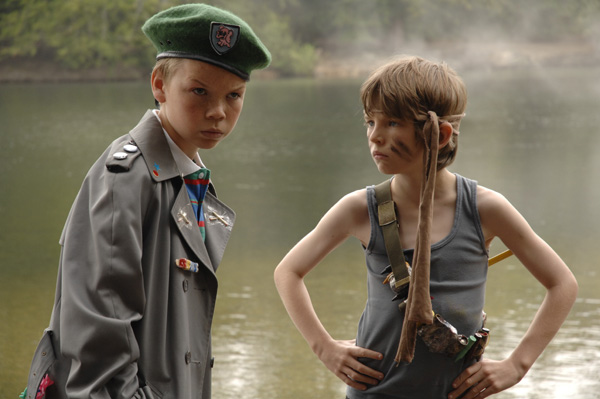
Living in the 1980s, young Wil Proudfoot is the son of a woman involved in a Mennonite-like religious sect. As a result, he is not allowed to view films or television, but has a strong sense of creativity, drawing intricate worlds on the pages of his Bible. Lee is the son of an absent mother, growing up in a nursing home owned by his step-dad, and has an older brother who forces Lee to bootleg movies for him to sell on the street. Lee and Wil meet each other during an incident at school and Wil follows Lee home and glimpses his first film ever: First Blood (the first Rambo film). Wil is smitten with the film and immediately sets about storyboarding his own sequel, Son of Rambow, which he and Lee decide to film together.

Jennings is a well known music video director (he’s worked with Blur and Radiohead) and is best known in film for his adaptation of The Hitchhiker’s Guide to the Galaxy. That less-than-stellar flick bears some similarities in its quality to Son of Rambow. Rambow starts out with a crackling sense of excitement and possibility. Wil’s fantasy sequence right after seeing the film is brilliance; done in line drawings on paper and with the slashing speed lines that accompanies such artwork. There’s some great meta-textual commentary on filmmaking as well. As more kids find out about the production, and particularity with the involvement of hip French exchange student, Lee’s vision as director is co-oped. A brilliant scene where Wil is admitted into the upper upperclassmen’s lounge, which parodies the sort of upscaled celeb parties one would encounter in Hollywood (Coke and pop rocks are used to substitute alcohol and cocaine).

The flick is definitely worth a view, but wans near the end as it tries to make a “lesson” of the story. I would have enjoyed the sense of playfulness at the beginning to continue throughout. It was also wonderful to see Jessica Hynes, best known for co-starring with Simon Pegg in Spaced. If you get the chance, and were a kid who loved to imagine, check this one out.