Hypothetical Film Festival #11 – Ernest Saves the Film Festival

Yes, it’s a film festival dedicated to one of the greatest thespians of the late 20th century: Mr. Jim Varney aka Ernest P. Worrell. KnowhutImean?
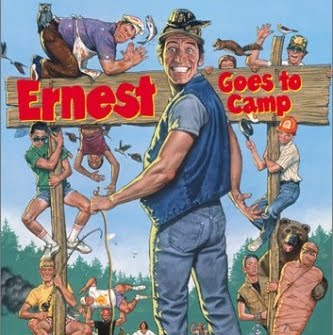


Ernest Goes to Camp (1987, dir. John R. Cherry III)
Starring Jim Varney, John Vernon, Iron Eyes Cody, Gailard Sartain

The Ernest character got his start as a pitchman for various local businesses in the Middle Tennessee and Kentucky areas. Eventually there were a series of straight to video skit compilation films that made way for this first theatrical endeavor. Ernest is a camp handyman, who wants to be a counselor. He gets his chance with a group of juvenile delinquents which leads to a series of slapstick sight gags. Meanwhile, an evil mining corporation wants to buy and shut down the camp to get to a rich vein of the fictional petrocite underneath it. Ernest rallies the juvies together for a big showdown with the corporate head, where our hero displays the Native American combat skills he learned along the way. A great start to the Ernest franchise.
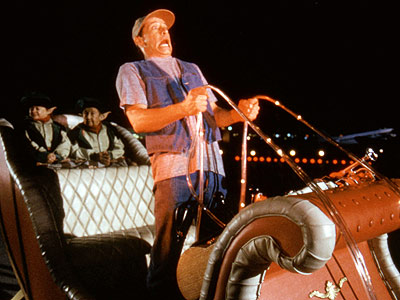


Ernest Saves Christmas (1988, dir. John R. Cherry III)
Starring Jim Varney, Gailard Sartain, Billy Byrge, Douglas Seale, Oliver Clark

Arguably the high point of the entire Ernest franchise. In the same way The Godfather, Part II outshines its predecessor, so too does the first Ernest sequel trump the original. A jack of all trades, Ernest is now a cabbie working in Orlando, Florida who happens to pick up an old man from the airport claiming to be Santa Claus. It appears Santa is in town to name local children’s television host Joe Curruthers as his replacement. Joe of course doesn’t believe and is duped into starring in a Xmas themed film which betrays his ethics as a role model for children. The film actually has a very interesting meta-commentary on what Hollywood producers try to do to children’s films like this one, by interjecting foul language or gory violence to appeal to older audiences. The one thing about the Ernest films is they never sold out on their trademark live action Looney Toons feel.


Ernest Goes To Jail (1990, dir. John R. Cherry III)
Starring Jim Varney, Gailard Sartain, Billy Byrge

This is my personal favorite out of all the Ernest films. Here our protagonist works as a bank janitor who is a double for death row inmate Felix Nash (also played by Varney). Ernest ends up in prison with Nash on the outside with plans to rob the bank. Two things makes this film phenomenal: Gailard Sartain and Billy Byrge as Chuck and Bobby, the Rosencrantz and Guildenstern to Ernest’s doofy Hamlet, and Ernest gaining magnetic superpowers during the jailbreak sequence. The Ernest franchise amped up the similarities to Pee Wee Herman in this film as well, with Ernest owning a home filled with Rube Goldberg-like devices.



Ernest Scared Stupid (1991, dir. John R. Cherry III)
Starring Jim Varney, Eartha Kitt, Billy Byrge

Meant to be a Halloween companion piece, Scared Stupid was shot in the Nashville, Tennessee like all the previous films (except for Saves Christmas). Ernest is a garbageman tasked with cleaning up the land owned by a strange old woman. Through a series of mishaps, Ernest releases a group of trolls that have cursed the land and finds out the old lady is a sorceress. The film’s plot gets a lot more complicated than it deserves to be and makes it one of the weaker entries in the Greater Ernest Oeuvre. It is also hurt by the absence of Gailard Sartain as Chuck, yet keeps Bobby and gives him a new partner. They needn’t have bothered. The series goes downhill from here…



Slam Dunk Ernest (1995, dir. John R. Cherry III)
Starring Jim Varney, Kareem Abdul Jabbar

Two films were released before this one (Rides Again, Goes To School) and they were lackluster. This picture isn’t great compared to the first few films but was one of the last highlights in a dying franchise. Ernest is laundry worker, employed by the Charlotte Hornets, who dreams of becoming a pro-basketball player. He’s visited by an angel (Jabbar) who gives him magic shoes that make Ernest a phenom. Of course Ernest dominates with the shoes, realizes the importance of teamwork and ends up scoring without the magic shoes. Hoorah! This was to be followed by the woefully racist Ernest Goes to Africa and the final Ernest in the Army.
Import Fridays – MicMacs


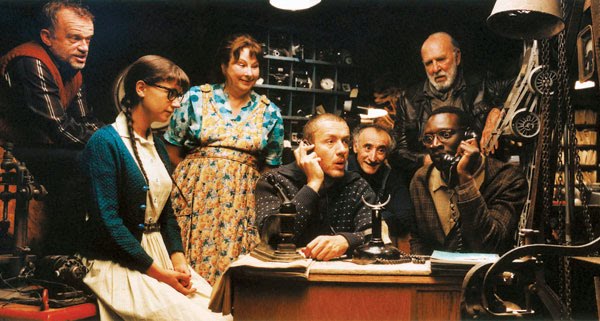
MicMacs/MicMacs a tire largiot (2009, dir. Jean-Pierre Jeunet)
Starring Danny Boon, Andre Dussollier, Nicolas Marie, Yolande Moreau, Julie Ferrier, Omar Sy, Dominique Pinon, Michel Cremades, Marie-Julie Baup, Jean Pierre Marielle

Very few directors working today have as strong a sense of visuals than Jean-Pierre Jeunet. He is as influenced as much by the French New Wave as he by Golden Age Hollywood, and this mash up creates aesthetically clever cinema. But does Jeunet tell interesting stories with well-developed, fleshed out characters? That is a good question.

The story of MicMacs concerns Bazil (Boon) who, as a child, lost his father to a landmine in Afghanistan. Things continue to go downhill for poor Bazil: Mum ends up in a mental hospital, he’s shipped off to an abusive boarding school, escapes, and ends up as a video store clerk as an adult. One night, a shoot out occurs in the front of the store and Bazil takes a bullet in the cranium. After being released from the hospital, Bazil finds his home and job gone but is befriended by Slammer, a homeless man who is part of a collective of eccentrics living in a strange garbage burrow. Bazil also learns the weapons manufacturers responsible for the landmine and bullet respectively. Bazil and his new family embark on a crusade to turn the two men of war against each other through series of elaborate pranks. The film basically takes the revenge pranks pulled on the grocer in Amelie and expands their scope to include human cannonballs and wiretapping.

The film has definite problems. The first is the awkwardness of pairing such a dark subject (war, death, limbs lost to bombs) with Warner Brothers Looney Toons style comedy. It’s definitely a mix that could work, but here it comes off as if Jeunet doesn’t take the concept seriously enough. Another issue I had was with the characters identified as African-French, they all have menial labor jobs or, in the case of Remington the Writer, are objects of comedic relief whose skills are a joke. Jeunet had taken some flack for the “pretty-fying” of France in Amelie and it seems like he’s trying harder this time around, but not much better.

That said, the film is very enjoyable in the same way that the circus or carnival is fun. There’s not much substance but it is fun to look at and will definitely make you laugh. Jeunet has a very clever mind and can devise some schemes that are brilliant. This is not Jeunet’s best, it can be derivative of his previous work at times, but he does take chances and brings some new elements to his art direction. A definite must see if you have the chance this spring/summer.

MicMacs will open in limited release in the US starting May 28th

Charlie Chaplin Month – The Kid

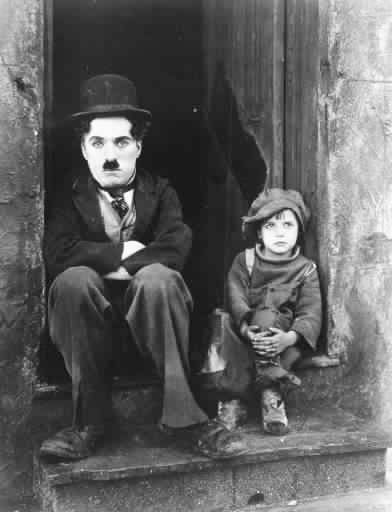
The Kid (1921, dir. Charlie Chaplin)
Starring Charlie Chaplin, Jackie Cooper

The experience of being taken from his mother and placed in a home for destitute children had a profound effect on Charlie Chaplin, and its apparent that those traumatizing childhood experiences had a strong influence on The Kid. Chaplin also seemed to always identify more with the people living at the bottom rung of society’s ladder and that can be seen here as well. At time maudlin and over sentimental, The Kid withstands being simply a mushy film by delivering strong laughs and telling an honest story.

The film opens with a woman newly released from the hospital, having been abandoned by the father. She abandons the child in a parked car and through a series of slapstick circumstances the child ends up in the care of the Little Tramp (Chaplin). The Kid grows up, he and the Tramp embark on a series of neighborhood scams to make ends meet. Eventually, the Kid gets sick and the Tramp must fight to keep his child from being taken from him.

What’s most startling about the film is the abject poverty and dirtiness of the film. These characters truly live in the dankest slums, where violence is a daily and commonplace occurrence. Despite this coldness of the world around them, Chaplin does a wonderful job of conveying the loving nature of the Tramp and the Kid’s household. They are both shown taking care of each other and that’s what makes the scene where the Kid is being taken from the house even more heartbreaking. Some of the plot twists the film takes are ludicrous but they fit with the more earnest tone of that time period.

It’s worth noting that Chaplin had lost a child, who had lived only three days, right before he met little Jackie Cooper and began developing the concept of this film around the young star. It can been seen that Chaplin was working through the issues of his own childhood and his emotions after losing a child of his own. The Kid is not a perfect film, Chaplin made far better, but it does highlight his ability to take short film material and begin to stretch it into longer narratives.

Charlie Chaplin: The Life and Times of a Tramp

Everyone knows the image. Derby, toothbrush mustache, bamboo cane, tattered tramp clothes, the penguin-like waddle. He was the world’s first “movie star” and the first actor to ever be paid a million dollars. His life was an uneven one, to say the least. The American public fell in love with him in the 1910s, only to blacklist him forty years later. He is arguably the great comic actor of all-time, and he has influence comedy on film ever since.

Charlie Chaplin was born in 1889 in London to a couple of music hall entertainers. Both Charlie, Sr. and Hannah Chaplin were singers and actors and influenced Charlie, Jr.’s decision to join the profession. By the age of three though, Charlie Sr. had bolted and Junior had little contact with him after that. Hannah Chaplin was the great tragic figure of the family, having a nervous breakdown in 1895. She, Charlie, and his younger brother, Sydney ended up in Lambeth Workhouse. The boys were moved to a home for orphans and destitute children weeks later. Hannah suffered a second and final complete mental breakdown in 1898 and Cane Hill Lunatic Asylum in Surrey, where Charlie and Sydney paid out 30 shillings a week for her care there. Once established in Hollywood years later, the brothers had Hannah brought to live with them where she spent the remainder of her life.
Charlie’s debut came when, during a rowdy show, Hannah was booed off stage and hit with a thrown bottle. As she sat backstage crying, five year old Charlie came on stage singing the popular song “Jack Jones” and managed to entertain and win over the crowd. In the early 1910s, Charlie toured with the Karno Theater, and worked alongside Arthur Jefferson aka Stan Laurel. Charlie was discovered by film producer/director Mack Sennett whose Keystone Film Company made comedic shorts. In 1914, the Little Tramp character debuted in a short titled Kid Auto Races at Venice. Something about this very simple clown-like character clicked with the viewing public and Chaplin’s popularity rose, causing the shorts to shift their focus from the Keystone Kops to the Little Tramp.
Chaplin’s creation of this character reveals the complex thought process behind his comedy. He wanted the character to contain as many contradictions as possible and wanted to make him appear somewhat ageless in appearance. He wanted the hat to be to small to fit on his head, but the pants and shoes to be comically over-sized. The mustache was an after thought. While the Sennett comedies traditionally focused on broad, exaggerated gestures, Chaplin’s style of pantomime was much more subtle in its humor. Chaplin would improvise little flourish that served to underscore the sweetness of the Tramp in one moment, then suddenly toss a brick at a rival’s head to completely mess with our perceptions of the character.
In 1917, Chaplin left Keystone and signed with Mutual, where he would have tighter creative control of his projects. It was at mutual where he began to expand his films until releasing his first feature, The Kid. In 1919, he co-founded United Artists with Mary Pickford, Douglas Fairbanks, and DW Griffith. Here he directed his first drama, A Woman in Paris and subsequent comedies (The Gold Rush, The Circus). Despite the arrival of sound to cinema, Chaplin continued his silent pictures with City Lights and Modern Times, before finally giving in and making The Great Dictator. Chaplin’s film output would lessen and lessen.
In the upcoming month, I plan on watching the Chaplin films I haven’t seen and reviewing them, as well as brief reviews of ones that I have and doing small articles on various aspects of Chaplin’s life (the women he was involved with, his political beliefs, his life after film). Below is a tentative schedule of when I will be posting reviews his films not seen by myself as of yet:
April 1st – The Kid
April 8th – A Woman in Paris
April 15th – The Circus
April 22nd – The Great Dictator
April 29th – Limelight
His films that I have seen and will be covered in more capsule reviews are: The Gold Rush, City Lights, and Modern Times.

Newbie Wednesday – Bunny and the Bull

Bunny and the Bull (2009, Paul King)
Starring Edward Hogg, Simon Farnaby, Veronice Echegui, Richard Ayoade, Julian Barrett, Noel Fielding

Note: This film has no planned release date for either theaters or DVD in the US. So, your best bet is to torrent the sucker.

“Come with us now on a journey through time and space”. If you are familiar with the immensely popular British series The Mighty Boosh then those are familiar words to you. The director of that series, Paul King, embarks on his feature film debut, bringing with him some familiar faces in supporting roles as well as the quirky aesthetic sensibilities of his television series.

The premise puts agoraphobic Stephen in the midst a year long hermit period. He is dealing with a trauma that occurred in Europe while he was on holiday with his friend Bunny. The two follow Stephen’s idea of fun by touring the various museums of the continent, but once Bunny takes the wheel things become a lot crazier. They meet waitress Eloisa who is looking for a way back home to Spain, and Bunny decides that once they arrive there, he is going to fight a bull.

The strongest thing this picture has going for it are the inventive visuals. King is definitely a peer to a director like Michel Gondry, in the way he intentionally lets the audience in on the hacked together set pieces. A fast food delivery bag becomes the setting for a flashback in a restaurant. A snow globe becomes the Swiss mountain chateau the men stayed in. A photograph of their train becomes a chain of photos, set against a landscape made of similar snapshots. The Mighty Boosh did the same, and it caused the universe to feel like a timeless fantasy-scape.

The plot on the other hand is not very strong. There’s no real depth to the two main characters, Stephen is a very stereotypical neurotic and Bunny is the typical crazy risk-taker. There’s not attempt to give us more about these characters or attempt to explain their motivations. The rest of the film is populated with set piece characters, such as the dog-milking Polish man, an innkeeper overly fond of her stuffed bear, and a former matador who uses a shopping cart with horns for practice. The film is very pretty to look at, and showcases the cleverness of the director aesthetically, I just hope he can find a richer level of writing for his next film.

Jolly Good Thursdays – Son of Rambow


Son of Rambow (2007, dir.Garth Jennings)
Starring Bil Milner, Will Poulter, Jessica Hynes, Jules Sitruk

I can remember watching Ghostbusters (not the first time, probably the tenth) when I was seven, and afterwards taking an old backpack, a paper towel cardboard tube, and attaching the two with a long piece of a yarn. A shoebox with another piece of yarn attached served as my “ghost trap”. I was always doing these things as a kid. Not having the latest action figures of my favorite comic book or Saturday morning cartoon characters, I would draw and cut out figurines on paper to play with. My desire to tell stories was stronger than the limitations of economy. This is the same love of stories, and being forced to go low tech that informs Garth Jennings’ Son of Rambow.

Living in the 1980s, young Wil Proudfoot is the son of a woman involved in a Mennonite-like religious sect. As a result, he is not allowed to view films or television, but has a strong sense of creativity, drawing intricate worlds on the pages of his Bible. Lee is the son of an absent mother, growing up in a nursing home owned by his step-dad, and has an older brother who forces Lee to bootleg movies for him to sell on the street. Lee and Wil meet each other during an incident at school and Wil follows Lee home and glimpses his first film ever: First Blood (the first Rambo film). Wil is smitten with the film and immediately sets about storyboarding his own sequel, Son of Rambow, which he and Lee decide to film together.

Jennings is a well known music video director (he’s worked with Blur and Radiohead) and is best known in film for his adaptation of The Hitchhiker’s Guide to the Galaxy. That less-than-stellar flick bears some similarities in its quality to Son of Rambow. Rambow starts out with a crackling sense of excitement and possibility. Wil’s fantasy sequence right after seeing the film is brilliance; done in line drawings on paper and with the slashing speed lines that accompanies such artwork. There’s some great meta-textual commentary on filmmaking as well. As more kids find out about the production, and particularity with the involvement of hip French exchange student, Lee’s vision as director is co-oped. A brilliant scene where Wil is admitted into the upper upperclassmen’s lounge, which parodies the sort of upscaled celeb parties one would encounter in Hollywood (Coke and pop rocks are used to substitute alcohol and cocaine).

The flick is definitely worth a view, but wans near the end as it tries to make a “lesson” of the story. I would have enjoyed the sense of playfulness at the beginning to continue throughout. It was also wonderful to see Jessica Hynes, best known for co-starring with Simon Pegg in Spaced. If you get the chance, and were a kid who loved to imagine, check this one out.

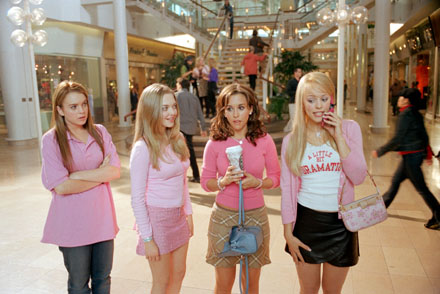
Wild Card Tuesday – Mean Girls


Mean Girls (2004, dir. Mark Waters)
Starring Lindsay Lohan, Rachel McAdams, Lacey Chabert, Amanda Seyfried, Lizzie Caplan, Daniel Franseze, Tina Fey, Tim Meadows, Ana Gastneyer, Neil Flynn

I know what you are thinking, “Why? Why would you watch this?” My excuse is that the screenplay was worked on by Tina Fey, who also plays the main character’s Math teacher, and I gave it a chance based on her pedigree. Well Tina, you didn’t completely disappoint me.

Cady Heron (Lohan) was raised by her parents in Africa, and subsequently homeschooled because of the experience. Now back in the States, Cady is going to a public school for the first time and completely unaware of the highly structured clique system in place. She befriends two of the art kids, Janis and Damian, who encourage her to infiltrate the Plastics (read: popular girls) and ruin the status of queen bee Regina (McAdams). The rest of the film plays out as a mix of typical high school comedy with moments that rise slightly above that.

The female cast was definitely a strong one. Every single one of the key actresses has done a lot of notable work before and since this film. I don’t think I had actually ever seen a Lindsay Lohan film (save A Prairie Home Companion where she played a very small role), but she is (was?) a very good actress. Her performance as Cady feels very genuine and I never saw the acting going on, which happens a lot with younger actors and actresses. For example, Lacy Chabert was very transparently acting and it showed. Rachel McAdams was also very good, especially knowing her from other such different roles. But the stand out, and you had to be watching closely to catch it, was Amanda Seyfried. Her role appears simple: the ditz, but the girl has some great comic timing. Pair that with her recent role in Jennifer’s Body, and I am excited about seeing her in upcoming films (particularly the soon to be released Atom Egoyan picture Chloe).

As good as these actresses were, it didn’t save the film. The parts I laughed the hardest at were the moments centered around the teachers. Tina Fey, Tim Meadows, and the rest of the cast in those teacher roles were awesome, and I found myself wishing the movie was about the faculty. We have so many teen comedies on the market, but a clever flick, scripted by Fey, about high school teachers would be a treat. The film will definitely make you laugh, but its nothing worth more than a single view. And I couldn’t help but wonder that instead of using director Mark Waters (Freaky Friday, Just Like Heaven) they had hired JOHN Waters to helm the picture. Now that would have been a skewering of high school hierarchies.

Director in Focus: John Sayles – Silver City


Silver City (2004, dir. John Sayles)
Starring Chris Cooper, Richard Dreyfus, Danny Huston, Mary Kay Place, Tim Roth, Thora Birch, Maria Bello, Miguel Ferrer, Billy Zane, Michael Murphy, Kris Kristofferson, Daryl Hannah

John Sayles is not shy about his politics, and this film is definitely the work of a bleeding heart liberal. I myself am a fellow bleeding heart so I sympathize with the sentiments of the picture. However, it is a piece of cinema made out of anger and frustration and, while those elements have helped make great art, they cause Silver City to feel overly bitter and despondent, and way too didactic.

The movie opens on the filming a campaign commercial for gubernatorial hopeful Dickie Pilager (Cooper), the dim-witted son of a former governor of Colorado now believing he can win the seat. Sound familiar? Cooper’s performance, obviously modeled on President George W. Bush was very well done and, as much as I like Josh Brolin, made me wish we could have seen Cooper in Oliver Stone’s W.  During the filming of this commercial, as Pilager casts a rod into the crystalline lake in the frame, he pulls up a hand belonging to a body left in the water. Immediately, Pilager’s campaign manager (Dreyfus) thinks someone is setting Pilager up and hires a detective agency to investigate. The investigator is Danny O’Brien (Huston), a former news reporter who is less than enthusiastic at first. As he journeys deeper he becomes obsessed with Pilager’s connection to a multi-corporate mogul Wes Benteen (Kristoffersen).

On paper, this sounds like a great concept. But it fails, and it fails badly. Huston is completely unnatural in the leading role, proving to me he needs to keep to the supporting ones. I can’t figure out if it was the dialogue or actor, but he comes incredibly stiff and forced in his performance. And with Danny O’Brien as the character we are following, it makes the film that much more painful to get through. Cooper and Dreyfus deliver great performances, but aren’t in enough of the movie to make it work. I would have preferred that it had focused on the Pilager character’s campaign more and been a satire of President Bush. Instead, we get a poorly made activist film where metaphors are incredibly shallow.

The film made me feel very conflicted, as every political note it touches I am right there in support of. But it proves that when views are expressed too overtly they bog a film down. The film takes it self too seriously for the majority of the time, and when it does attempt to go light, such as when Daryl Hannah’s tough hippie character is introduced, the humor feels hollow and tainted by Sayles bitterness. Not the best work of this director; he CAN make great films about his political views (Matewan for example).

Next up: Sunshine State and my final thoughts on John Sayles.

Cinematic Television – The Comedies

In the last decade the ante has been upped on both network and cable television. While channels go the cheap route of “reality” tv, they have also worked to develop higher quality scripted series. These higher quality series have a lot more in common with film, than previous television programs. They employ complex cinematography, a higher caliber of acting, and a devotion on the part of viewers to following longform story arcs, not “done in one” stand alone episodes. We’ll be looking at some of these series that have really stood out for me, starting with

The Comedies


Freaks and Geeks (1999-2000, created by Judd Apatow and Paul Feig)
Starring Linda Cardellini, Jason Segal, James Franco, Seth Rogen, Busy Phillips, John Francis Daley, Samm Levine, Martin Starr, Joe Flaherty, Becky Ann Baker

This can be marked as the beginning of the Apatow movement in contemporary comedy. The series was broadcast by a less than enthused NBC, who seemed to go out of their way to air episodes out of order and move the series around the schedule without letting viewers know. The series gained a following when it was reran on Fox Family and then when it was released on DVD in the last few years. The premise follows the Weir sibling, Lindsay (the Freak) and Sam (the Geek) as they go through a year of changes in 1980. Lindsay, a straight-A student and member of the Math-letes, starts hanging out with a group of classic rock loving stoners, and Sam deals with his desire to lose his childish geek image and win the heart of his long time crush. Unlike other nostalgia based programming, there is no maudlin sentiment here. The emotions and resolutions to stories feel honest and real. Characters have parents who are incredibly flawed, and those flaws don’t go away at the end of the episode. One episode in particular deals with a cheating parent, the episode ends on a very ambiguous note. If you haven’t discovered this gem, I highly recommend you hunt it down.


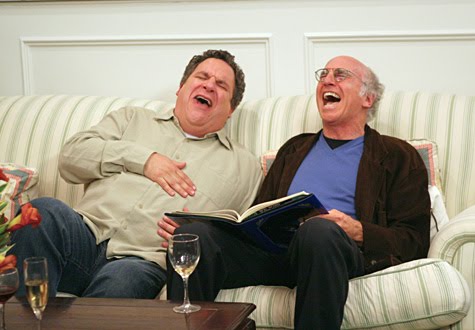
Curb Your Enthusiasm (2000 – present, created by Larry David)
Starring Larry David, Cheryl Hines, Jeff Garlin, Susie Essman
Featuring Richard Lewis, Ted Danson, Mary Steenburgen, Bob Einstein, Shelly Berman, Vivica A. Fox, Wanda Sykes, J.B. Smoove, Paul Dooley, Julia Louis-Dreyfus, Jason Alexander, Jerry Seinfeld, Michael Richards, Kaitlin Olsen, Paul Mazursky, Richard Kind, Ben Stiller, Mel Brooks

If you enjoyed Seinfeld, then Curb Your Enthusiasm will blow your mind. The neurotic basis of George Costanza, Larry David, has created a series in which he plays himself as a buffoon constantly getting into awkward situations based on the misunderstanding of other or, more often than not, David’s own hang ups about minutiae. The series is one of the few to really capture improv comedy working right. A lot of comedies have followed since and don’t seem to have actors of the high level working in them that Curb does. A typical episode of Curb might involve Larry getting into an argument with a wheelchair bound man about using the handicapped toilet stall, followed by him inadvertently insulting a lesbian receptionist about she and her partner’s desire to adopt a Chinese baby. The jokes are never played as mocking these people, but rather comes from David’s desire to see all characters, regardless of their specificities, shown as jerks. He sees that people are more or less jerks when it comes down to it, and how he plays this out is hilarious.


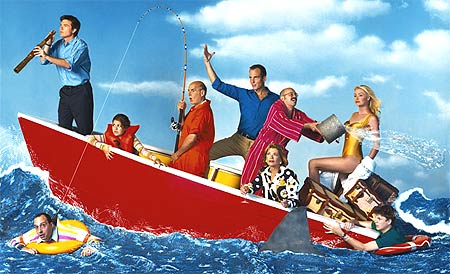
Arrested Development (2003-2006, created by Mitchell Hurwitz)
Starring Jason Bateman, Will Arnett, Portia de Rossi, Tony Hale, Michael Cera, Alia Shawkat, Jessica Walter, Jeffrey Tambor, David Cross, Ron Howard
Featuring Liza Minelli, Ed Begley, Jr., Henry Winkler, Mae Whitman, Judy Greer

There has never been a more complex, layered, and enjoyable comedy on network television than Arrested Development. From the moment it debuted, Fox seemed to have little interest in it, while viewers and critics loved the hell out of this show. The premise is that George Bluth, owner of the Bluth Corporation is arrested for violating trading laws and his son, Michael finds he’s now in charge of the company and the self-absorbed and moronic family around him. Every actor is bringing their A game here, and the casting is spot on. There are no other actors who could play this character so over the top and still be endearing. The series also incorporates a large number of cameos and employs many of the players from HBO’s Mr. Show (Cross was one of the creators of that skit comedy series). Since the cancellation of series, network television comedy has never seemed as promising to me. A featuring film continuing the adventures of the Bluth family is in the works and set to be released next year, here’s hoping it can live up to the series.


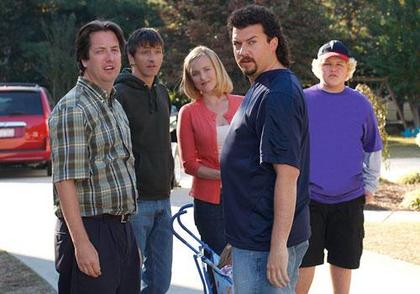
Eastbound and Down (2009 – present, created by Jody Hill)
Starring Danny McBride, Andrew Daly, John Hawkes, Katy Mixon, Ben Best, Jennifer Irwin
Featuring Will Ferrell, Craig Robinson

From the minds behind The Foot Fist Way and Observe & Report, comes this amazing HBO comedy series. Kenny Powers, a blatant parody of ignorant, racist Atlanta Brave John Rocker, is thrown out of Major League Baseball after being caught using steroids. He returns to his hometown in North Carolina where he becomes a substitute PE teacher at the same middle school his high school sweetheart works at. Kenny goes about abusing the hospitality of his brother and family, treating the middle school principal like a jerk, and ingesting an unhealthy amount of drugs. The highlight of the series comes when Kenny deals with local car dealer Ashley Schaeffer (Ferrell) which culminates in an insane pitching demonstration. The entire first season plays out like an extended movie, with a series finale that could serve as a perfect ending.


Bored to Death (2009 – present, created by Jonathan Ames)
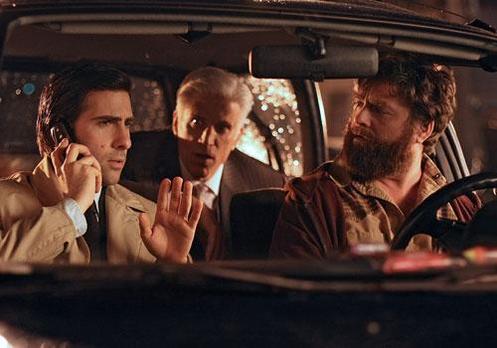
Starring Jason Schwartzman, Zach Galifianakis, Ted Danson
Featuring Olivia Thirlby, Oliver Platt, John Hodgman, Bebe Neuwirth, Jenny Slate

This HBO series is a sort of comedic version of Paul Auster’s City of Glass novel. Schwartzman playing a writer named Jonathan Ames (meta, eh?), loses his girlfriend and out of boredom posts a craiglist ad as an unlicensed private eye. He begins to get cases and finds himself getting caught up in the fun of it. He typically incorporates his indie comic book artist friend (Galifiankis) and pot smoking boss (Danson) on the cases as well. The series has a much more muted sense of comedy than Eastbound and Down, one of the best aspects of HBO’s comedy programming. They do a very good job of balancing multiple styles, yet never lose their quality.

Newbie Wednesday – The Men Who Stare At Goats


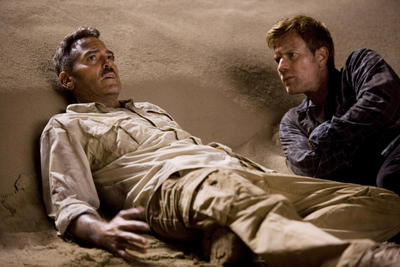
The Men Who Stare at Goats (2009, dir. Grant Heslov)

Starring Ewan McGregor, George Clooney, Jeff Bridges, Kevin Spacey, Stephen Lang
If you remember the jokingly done reports in the media about prisoners of war in Iraq being exposed to Barney the Dinosaur’s “I Love You” song on a loop, then you have already heard of the writing of reporter Bob Wilton. In a mix of fantasy and reality we get this very suspect account of a secret unit of the U.S. Army, in operation since the Vietnam War. Director Heslov doesn’t deliver a film of any great magnitude, it has its moments, and we end up with a very quirky, very uneven comedy.
Bob Wilton is an Ann Arbor, MI reporter who ends up just outside of Iraq as the war is breaking out. Months earlier he interviewed an odd man who claimed to have been a psychic in the employ of the Army. By chance, Wilton runs in Lyn Cassady (Clooney), the man the interviewee claimed had been the best in their unit. Wilton and Lyn begin a strange journey across Iraq that ends with figures from Lyn’s past reappearing and culminating in an LSD fueled finale.
Jeff Bridges plays a ultra hippie, Bill Django, the founder of the New Earth Army, the unit devoted to using peace and love to combat enemy troops. A lot of these ideas won’t seem far fetched if you know anything about the experimentation the military has done on the paranormal for combat purposes. The film even brings up the infamous MKULTRA experiments done by the CIA on soldiers and civilians alike, where psychotropic drugs were added to water without the subjects’ knowledge and their reactions were recorded.
I never found myself laughing during this film, a few grins here and there, but was never really impressed with anything I saw. The film seems to not know what it wants to be: a satire of the army, a satire of the new age movement, a commentary on the absurdity of this current and all war. Because of this lack of a “thesis statement” the film seems to wander aimlessly with no point at the end. Coupled with very amateurish voice over (a big no-no unless you know how to do it right) and an original score that felt cheap, its a film that could easily be missed without regret.