DocuMondays – Tales From the Script


Tales From the Script (2009, dir. Peter Hanson)
Featuring Allison Anders, John August, Shane Black, John Carpenter, Larry Cohen, Frank Darabont, Antwone Fisher, Mick Garris, William Goldman, David Hayter, Zak Penn, Adam Rifkin, Jose Rivera, Paul Schrader, Guinevere Turner

The documentary opens with Bruce Joel Rubin (Ghost, Deep Impact) talking about leaving the studio commissary with a group of executives and one of them telling him his script was the best thing he ever read. Months later, Rubin was in the same commissary, leaving behind the same executives with  new writer and heard them say his script was the best they ever read. This anecdote sets the tone of the rest of the documentary which isn’t so much about screen writing as it is about the relationship between writers and the studios. This relationship is one in which the writer wants to accepted and the studio wants to get that script out of his grubby little hands and make it the movie they want to see.

The film is made up of interviews with a wide swathe of writers from mid-century pictures up to those of the last decade. To frame the segments of the documentary, scenes from popular films that revolve around screenwriters are used (Barton Fink, The Muse). The result is a very inside baseball type film that is definitely never going to appeal to a large audience. To people working in the film industry and movie nerds like myself, the picture is fascinating glimpse into the trials and travails of the Hollywood screenwriter. We get to hear from veterans such as William Goldman (Butch Cassidy, The Princess Bride) and Paul Schrader (Taxi Driver, Affliction) as well as young, but equally prolific writers like David Hayter (X-Men, Watchmen) and John August (Big Fish, The Corpse Bride).

I found it very interesting to hear the voices and see the faces of screenwriters of films I was familiar with. I have to say, most of the films represented here were ones I don’t care for, particularly Bruce Almighty and Click, but the writers definitely fit your expectations of them. One of the most fascinating interviewees was Guinevere Turner. She started out scripting the indie lesbian romantic comedy Go Fish and went on to pen a draft of American Psycho. Turner tells the story of working with Uwe Boll on Bloodrayne and learning that he was letting the actors make edits to her script. While this would drive most writers insane, Turner says she told herself to take deep breaths and that she hated the movie anyway.

The film fails to be a helpful guide to novice writers which is a shame. Goldman has become a sort of god of screenwriting and has numerous books on the topic. There’s some interesting comments on the “postcontent” era of films which might be useful, but overall its just an interesting curio that shows us where films are born.


DocuMondays – Harlan Ellison: Dreams With Sharp Teeth


Harlan Ellison: Dreams With Sharp Teeth (2008, dir. Erik Nelson)
Featuring Harlan Ellison, Robin Williams, Neil Gaiman, Peter David, Ronald D. Moore

One of the first things you learn about Ellison in this documentary is that once he was so pissed with a television executive that he boxed up a dead groundhog and mailed it to the man. Ellison made sure that he paid the cheapest postage possibly so that it would take upwards of a week to reach the man and be sufficiently bloated and rotting. This is tempered with his friend Neil Gaiman saying that Ellison’s entire life’s work is one large piece of performance art. That it is not about his 1000+ short stories or numerous award-winning teleplays, but its about the cultivation of this quick-witted curmudgeonly persona.

For those of you not in the know, Harlan Ellison is an acclaimed author of literature both of the science fiction genre and not. He’s actually famous for calling the “sci-fi” abbreviation a “hideous neologism” that “sounds like crickets fucking”. Needless to say, he is a very opinionated man and any attempt to make a documentary about him is going to be caught up in his fiery and impassioned rantful nature. Ellison was responsible for the classic “City on the Edge of Forever” episode of the original Star Trek, “Demon With a Glass Hand” episode of The Outer Limits (which he sued James Cameron for ripping off to make The Terminator), and for much script work on Babylon 5.

The film focuses on exploring the history and personal philosophy of Ellison. It is near impossible to get the experience of prose across on screen, though the film attempts it by having Ellison recite a few passages from his more famous work against the backdrop of incredibly shitty lava lamp-esque green screen backgrounds. The more interesting pieces are of Ellison expounding on his personal beliefs. He his passionate about writers not being treated like second class citizens by the studios. Ellison tells of how he received a call from woman who told him that on an upcoming Babylon 5 DVD they were wanting to make an extending interview with him a special feature and he agreed, with the stipulation that he receive a paycheck. She replied that everyone else just said yes and did it for free, resulting in a verbal lashing from Ellison about how she and the others in the business side of things wouldn’t work for a second if they weren’t getting paid.

The documentary suffers due to the absence of any counter to Ellison. He is infamous for public spats and lawsuits and it would have given a interesting balance to the film to have a group of people who disliked the man. Instead all we get is fawning praise and admiration from people who grew up reading his work. Ellison’s writing is wonderful, and he is one of the best writers of the late 20th century. The film just hurts from not having those voices to temper Ellison’s oft loud and bombastic one.

DocuMondays – Kurt and Courtney


Kurt and Courtney (1998, dir. Nick Broomfield)
Featuring Kurt Cobain, Courtney Love, and a cast of thousands…of junkies

I was thirteen when Kurt Cobain killed himself, and honestly the front man for Nirvana existed on my periphery. The whole grunge scene has never been a music genre I enjoyed, I’m more of a 90s BritPop fan (Oasis, Blur, The Verve). But I can understand why the movement was so big, as it was a big deviation from the musical norms of the time. This docu, by Brit filmmaker Broomfield seeks to stir up some of the conspiracy theories surrounding Cobain’s death and in the end isn’t really about Kurt or Courtney, but about famewhoredom.

What stands out most about the film is the shoddiness. Made on the cheap, the documentary is narrated by Broomfield who doesn’t do much to play the neutral observer, but pretty much interjects his personal opinions throughout. That doesn’t make the film any less fascinating though, especially with its parade of “friends” of the Cobains. In particular, one young woman who takes Broomfield to a club where Kurt performed during his early days, and whom talks with expertise about seeing the Cobain couple shoot heroin. She promises Broomfield photographic evidence, and when he returns to her apartment later she is anxious and befuddled and has a million excuses as to why she hasn’t been able to provide the photos. The woman is incredibly reminiscent of how Courtney Love is described throughout the documentary.

Broomfield pursues some wild leads, including the claim by S&M band member El Duce that Courtney offered him $50,000 to kill Kurt and “make it look like a suicide”. A less reliable source you couldn’t ask for. There’s Courtney’s former private investigator who now has “scientific” evidence that the amount of heroin in Kurt’s blood made it impossible for him to handle the shotgun. However, Broomfield provides actual scientific evidence proving that it is possible, to which the investigator simply ignores. The most awful of Broomfield’s interviewees is Courtney’s father, a man writing and publishing books condemning his daughter for the murder of Kurt in what he explains as a way to keep in touch with his daughter.

Broomfield reasonably comes to the conclusion in the film’s epilogue that Kurt most likely did commit suicide and that Courtney didn’t pay anyone to kill him. What the documentary revealed to me was that at the end of the day both people came from incredibly messed up homes where a strong parental presence was absent. Kurt seems like a very personable, intelligent guy in some of the interview archival footage, and Courtney seems like a sad woman who made a habit of latching onto local musicians in the hope of grooming them into the next Sid Vicious, as a compliment to her Nancy Spungeon. The person you feel the saddest for is poor Frances, their daughter, whose childhood couldn’t have been an easy one.

Kurt and Courtney is currently available to view on Hulu.com

DocuMondays – The Nomi Song


The Nomi Song (2004, dir. Andrew Horn)

In 1963, author Walter Tevis wrote the novel The Man Who Fell to Earth, and 13 years later David Bowie starred in the film adaptation. Little did anyone realize that the premise of the story: an alien being appears out of nowhere and goes on to achieve fame before dying prematurely was to be copied by a fellow Earthling who would lose his identity in the alien persona. Nomi’s story was much like the operas he loved, very beautiful at its heights, but destined to end in tragedy.

Born Klaus Sperber in Bavaria in 1944, the film really only focuses on his days in New York City in the late 1970s when his career as a New Wave artist occurred and ultimately ended in death. There is wonderful archival footage provided, albeit very low quality, but have footage of performances in the East Village at its cultural height is a treat. The Nomi persona came from the mind of Klaus who combined elements of his native German cabaret, classical opera, Japanese kabuki makeup, and retro 50s futurism. This melange of concepts worked together perfectly, and his set lists would consist of 1930s pop songs, 1960s pop, and his own otherworldly inspired tunes. But what truly made him such a unique act was the mastery of his voice, singing in both a tenor and counter-tenor/falsetto.

The man behind the cleverly designed persona was a conflicting mix and seemed to become much colder and distant as he became more popular. Nomi possessed an androgyny that one interviewee describes as more than sexual, but a removal from normal human emotion. He truly behaved like the alien or robot he pretended to be. There are candid moments caught on film when that fades away. On particular scene involves his appearance in a local access music show in NYC where, instead of singing, he showed off his second talent, making cakes and pies. There are also stories from his back up band and friends of how he hungered for fame, at his heart he wanted to be an opera diva.

Nomi also hungered for companionship, but even his persona was viewed as outsider one to the gay community in the late 1970s. They loved what he did but it seemed that his alien nature made it hard for any man to find him sexually attractive. Friends report in the documentary about his proclivity to go “cruising” and they warned him about the potential for disease by doing this. In the early 1980s, after beginning to compromise his work to be able to put out a marketable album, Nomi discovered strange lesions on his arm and was taking an increasing amount of antibiotics to stay healthy. He was eventually diagnosed with what was called at the time “gay cancer”, more commonly known as AIDs. His final months were sad, as he had turned his back on bandmates earlier and sought out any one who would show him compassion.

While the documentary does an excellent job of telling the story of Nomi’s musical career. However, I found myself wanting to know more about Klaus Sperber and how this young man from Germany developed this psychological mindset. What was the appeal of the idea of retreating into the alien persona? It seems that a lack of companionship fueled but how did it begin. This is an excellent documentary and can be viewed for free on Hulu.

The Nomi Song (Hulu)

DocuMondays – Examined Life


Examined Life (2009, dir. Astra Taylor)
Featuring Judith Butler, Cornel West, Slavoj Zizek, Kwame Anthony Appiah, Michael Hardt, Martha Nussbaum, Avitall Ronell, Peter Singer, Sunaura Taylor

Fans of Michael Bay’s work will no doubt be rushing out to see this one. That was sarcasm. Canadian-American filmmaker Astra Taylor has assembled 8 philosophers and given them ten minutes a piece to muse on some aspect of existence. This could have been pretentious drivel, but Taylor is able to make herself the subject of the film early on in an effort to point out that such an endeavor is imperfect and we should simply sit back and enjoy the mistake. While walking through a park with NYU literature professor Avital Ronell, the subject becomes the interviewer, asking Taylor what the goal of all this is. Taylor responds that philosophy is such an oral exercise, yet it is communicated primarily in printed words, where there is time and space for it to be stretched out and examined. Taylor states she wanted to see if something similar might be accomplished on film, where the philosophers can speak.

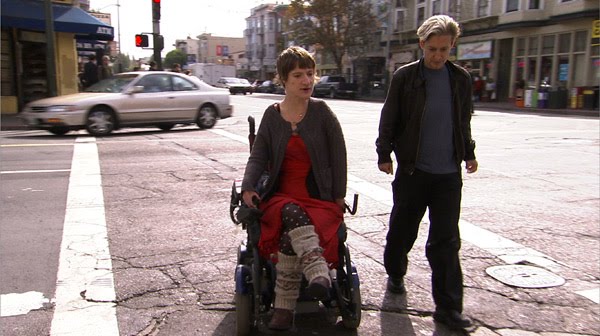
The three standouts for me were Judith Butler, Slavoj Zizek, and Cornel West. Cornel West has had vast experience as a media personality so he has the charisma and verbage to make what could have been a dry seminar into a witty musing on the nature of democracy and authority. Judith Butler is also very interesting, with her segment involving a discussion between Taylor sister, Sunastra, who is a painter and disability advocate. Their talk hinges on the idea of “going for a walk”, and what that means for a wheelchair bound person such as Sunastra. This evolves into the nature of being disabled in a contemporary context and then to an exploration of what the manner in which people walk tells us, and how human behavior is regulated by social expectations.

The best was Slavok Zizjek, a Croatian philosopher whose A Pervert’s Guide to Cinema is a great documentary introduction to film criticism. Zizek delivers his dialogue from a landfill somewhere in New York. He talks about the conflict between humanity and nature, and the trend in some groups to desire a “return to nature”. His argument against this is that Nature is simply an ongoing series of violent biological interactions. He cites oil being such a large part of contemporary life, and how we never contemplate the sheer level of violence that had to occur to destroy so much living matter to produce the oil in the earth. The conclusion of this talk is that it is in humanity’s best interest to create further and further artificial environments that it can control, and that this will involve a redefining of beauty from a pastoral standard to one in which hills of garbage can be found to have a pleasing aesthetic.

The documentary is obviously not for someone needing an escapist film, yet it is not a film for someone who has attained a degree in philosophy. I found it fairly apparent that Taylor is trying to reach out to the contemporary individual who has an interest in continuing their education and not moving through life drone-like. The film is full of idea candy, some interesting questions to contemplate and savor after seeing the picture.

DocuMondays – Young @ Heart


Young @ Heart (2007, dir.Stephen Walker)

The film opens with a jarring scene: a music video featuring a group of senior citizens performing The Ramones’ “I Wanna Be Sedated”. The first reaction is one of amusement, it is “adorable” that these “little old people” are singing a punk rock song. However, once the lyrics sink in, the simple “aw, how cute” fades away and there is a profound expression that is created when these words come from those mouths:

“Twenty-twenty-twenty four hours to go….
Just put me in a wheelchair, get me on a plane
Hurry hurry hurry before I go insane
I can’t control my fingers I can’t control my brain”

There’s something very honest and appropriate about a group of aged faces yelling out these lyrics. It seems more appropriate for them, than a group of young buck musicians. This is what the 2007 documentary Young @ Heart does so well, it balances the “cute, old people” moments with a rich and meaningful exploration of aging and confronting our mortality. 
The heart behind the Young @ Heart Chorus is Bob Cilman, a truly extraordinary person. Bob had dedicated hours of work to help organize and put on performances with the elderly, and he doesn’t coddle them. When his two featured performers have trouble with James Brown’s “I Feel Good”, Bob doesn’t speak to them in hushed tones. He shouts at them, he gets angry and frustrated, and eventually decides to just work on another song. It can appear mean, but Bob has such a high level of respect and such lofty expectations for this group he can’t help but be intense about it. And those expectations pay off a hundredfold.
The performers bring a lot of love into their performances, and the film captures a very tumultuous year for them. Long-time and dedicated performer Bob Salvini takes ill and eventually dies in the middle of the group’s performance season. A profound moment occurs when, during their concert, Fred Knittle performs Coldplay’s “Fix You”, a song he was meant to share with Salvini. The lyrics reflect the feelings of the the performers and Joe’s family who watch in the audience:
“And the tears come streaming down your face
When you lose something you can’t replace
When you love someone, but it goes to waste
Could it be worse?

Lights will guide you home
And ignite your bones
And I will try to fix you”

The documentary is deeply moving. In another scene the group performers for prisoners at a correctional facility. The way the camera shoots the faces of the chorus singing “Forever Young”, then cutting to the faces of criminals having to look down or cover their faces because of the tears welling in their eyes makes it impossible for the audience to not experience the same sense of compassion. Don’t discount this film as made for the old, or purely an attempt to exploit the elderly. This is a film made for the young to discover the depth and wisdom of their elders. This is one to be hunted down as soon as possible.

Fred Knittle performs Coldplay’s “Fix You”

The Young @ Heart Chorus performs “Forever Young”

DocuMondays – What Would Jesus Buy?


What Would Jesus Buy? (2007, dir. Rob VanAlkemade)

Starring Reverend Billy and the Church of Stop Shopping Gospel Choir
There’s a huge problem going on in America and it is known as the Shopocalypse, can I get a Change-alujah?! This is the message being preached by faux-preacher/political theater activist Reverend Billy Talen. Now, with his Church of Stop Shopping, he is touring the country promoting the idea of thoughtful consumerism, wherein we make choices based on where products were made and their actual usefulness. During this outing, the group traveled from the East Coast to Disney Land over the Christmas Holiday spreading their message.
I loved much of the the concept of this documentary, however, it has a problem I find common in issue films of this nature. It presents the problem very well, and I am on board with that, but it never really offers a strong solution and seems to wander too much. The filmmaker seems unsatisfied with simply focusing on Reverend Billy or actually taking piece of his “sermons” and expanding on them Super Size Me Style. In that film, Morgan Spurlock would take an idea (children’s nutrition, usage of sugar) have his bit relating to it in his experiment and then expand upon it with interview of experts and people suffering from the after effects of a process food product. There are moments that come close to that here, but ultimately fall flat.
The film hits the targets you would expect it to: Wal-Mart, Disney, Starbucks. And the bizarre sermons are quite humorous. What the film needed was a strong grounding in anti-consumption message with statistics. It needed to hit three areas strongly: Pollution, Conditions in Third World Countries, and Long-Term Economic effects of spending. The director grazes these ideas so briefly that he shouldn’t have even bothered. It’s interesting how violent authorities become when Reverend Billy and his crew start talking about people ending their unchecked spending. Before anyone is aware of their message, most people seem confused and bit amused. Once the sermons about not giving into the Want impulses drilled into your brains, the security guards and police show up and become quite rough.
Because of the title, I think the film should have centered on rabid consumption juxtaposed against the teachings of Jesus. Once, he’s mentioned in a very interesting way by a question of when was the only time Jesus became violent. The answer being in the Temple when he saw the money changers and lenders. I found it interesting that I had never contemplated his one act of aggression coming towards others in relation to people seeking to profit off of others and using the religion to do so. What Would Jesus Buy? is an interesting film, but remains constantly on the surface and never tries to breakthrough.

DocuMondays – Elia Kazan: A Director’s Journey


Elia Kazan: A Director’s Journey (1995, dir. Richard Shickel)

Narrated by Eli Wallach
The career of Elia Kazan is one of the most impressive of any American filmmaker, but also tainted by involvement in the McCarthy hearings and much controversy caused by his work. Even Kazan’s detractors find it hard to discount the amazing body of work he produced though. Kazan is a real story of an immigrant coming this country and making their way, while never compromising their personal convictions.
Kazan was born in 1909 to Greek immigrants in Turkey, who emigrated to the United States in 1913. The documentary doesn’t spend much time talking about Kazan’s childhood, instead jumping to his career as an actor and director of the stage in New York. Kazan was part of communal theater group who focused on work of social importance. Melodrama was discarded in favor of tackling leftist issues, particularly those related to the working class. These techniques and themes would carry over into Kazan’s film work years later. Once he was picked up as a mainstream Broadway director, Kazan’s star really shone, particularly when he won a Tony for the original production of Arthur Miller’s Death of a Salesman.
Because of Kazan’s deep friendship with Tennessee Williams he was a natural to bring A Streetcar Named Desire to the screen. In the documentary, Kazan relates a tale of how Williams had a bit of a crush on Marlon Brando, causing him not to worry all that much when critics focused on Stanley Kowalski so much, and not the larger conflict between Stanley and Blanche for Stella. This film and many others had a trademark jazz score and very inventive camera work that reflected his protagonists’ dementia. Kazan was also gifted at discovering great talents. Among his finds were Marlon Brando, James Dean, Karl Malden, Lee Remick, and Andy Griffith. Kazan explains his method of getting to know an actor by meeting the people important in their lives, spending time with them, going out to dinner with them, and basically figuring out who they are a person because that is what they are going to bring to their performance.
The part of Kazan’s career that causes the most dissonance for people was his involvement in the HUAC proceedings. Kazan named names of fellow actor and performers who had been members of the Communist Party with him. As a result many of them were blacklisted and unable to find work for years. This stood out as strange as Kazan was never anything but up front about his own leftist beliefs. Years later he stated his reason being that he was tired of the socialist movement in America hiding, and decided it was now or never for them to come out, even if it was against their will. He didn’t do this believing there would be long term harm, but that America would see that socialists weren’t scary bogey men. While aiding Joseph McCarthy and his communist witch hunt may have not been the best idea, it is understandable in a way.
Kazan’s film career ended officially in 1976, but in reality his light had dimmed about a decade earlier. Hollywood became focused on younger, iconoclastic directors of the late 60s, and the director is very understanding of this. He states that it is a natural cycle of the filmmaking art to look for freshness and he had made the statements he wanted to make. This is a great documentary that takes its story straight from the subject’s mouth and will get you excited about seeing the masterpieces of Elia Kazan.

DocuMondays – Beautiful Losers


Beautiful Losers (2008, dir. Aaron Rose, Joshua Leonard)

Starring Shepherd Fairey, Harmony Korine, Mike Mills, Jo Jackson, Chris Johansen, Geoff McFetridge, Margaret Kilgallen, Thomas Campbell, Barry McGee, Ed Templeton
Artists have always precariously walked the line between commerce and staying true their vision, and culturally we consider those who are able to commoditize their work to have succeeded. The reverse of this is that elements of strictly commercial art have been adopted by artists who have no interest in marketing iconography. My personal understanding of art is probably summed up as “I like what I like”. And the art and artists featured in this film I like.
The documentary chronicles the work of artists who came up in director Aaron Rose’s Alleged Art Gallery in Manhattan during the 1990s. The vast majority of the personalities profiled here came out of the skateboard or punk scenes and ,when you look at the methodology of their art, it makes sense. Pop art has been the strongest influence in the work of these now fortysomethings, in particular retro advertisement art. Painter Jo Jackson states that she loves old advertisements for products that are now obsolete because the seductive properties of the capitalism behind it has died.
The frustration of many artists in this documentary is with how quickly their work was gobbled up by a system that looks to make everything a commodity. There were stickers and buttons being sold at Hot Topic adorned with their work and they admit it felt like having a piece of oneself taken. On the other side, graphic artist Geoff McFetridge was responsible for a Pepsi One advertising campaign and admits he was happy to do it, but also fearful of how the artistic community around him would react. Their reaction was very positive and Geoff hinges this on the fact that he never compromised what made his work his.
The male artists featured, particularly those from the skateboarding community, are constantly wavering the line between their adolescence and adulthood. A major turning point for a lot of them came during an extended stay and series of shows in Tokyo that ended when Margaret Kilgallen, painter and wife of Barry McGee, learned she was pregnant and almost simultaneously that she had cancer. Kilgallen gave birth to her daughter and about two weeks later succumbed to the cancer. The film focuses on this as the moment where a lot of the artists’ personal visions became clear and the air of “punk” lessened a bit. This became a Do It Yourself mentality that is a hallmark of contemporary youth culture today.

Film 2010 #12 – My Winnipeg


My Winnipeg (2007, dir. Guy Maddin)

If you aren’t familiar with Guy Maddin’s style of film making, then viewing one of his pictures can be a very jolting experience. Narrative is secondary to a more stream of consciousness style of storytelling. I’ve been very familiar with Maddin’s work, starting with Twilight of the Ice Nymphs, and this oddity of cinema lead me to watch Tales of the Gimli Hospital, Careful, Dracula: Pages from a Virgin’s Diary, and The Saddest Music in the World.

Maddin has an affinity for German expressionist and Soviet propaganda films from the early days of cinema. As a result, he typically makes black and white pictures that utilize the actual technology of the time period he attempts to recreate. In My Winnipeg, Maddin uses rear-projection and obvious sound stages to create a film that will be unlike anything you see in the theaters. The premise is that Maddin is attempting to psychologically break free from his frigid hometown of Winnipeg, Manitoba. The best way he decides upon doing this is to recreate moments from his childhood, focused around his cold and controlling mother.

Interwoven with these recreations are bizarre, Winnipeg legends. Maddin tells us about the First Nation (would be Native Americans for us) belief that beneath the forks of the rivers that converge in Winnipeg, are a second “forks beneath the forks” that are mystical in nature. This image of a parallel existing underneath what can be seen is crucial to understand what Maddin is doing in this film. All of his anecdotes about Winnipeg involve the idea of a darker side of things, and the world of myth and fable.

Many of Maddin’s claims about Winnipeg are suspect (10 times the number of sleepwalkers than any other city, a city hall built as part of an occult Mason rite) but they act as conduits into the subconscious and representations of the unseen nature of things. The fact that this entire film is a one long poem taking place in the mind of Maddin plays into the examination of a seedy underbelly to things. The film is also able to evoke strong emotion, particularly when Maddin laments the destruction of the city’s professional hockey stadium, a temple to him as he grew up.

What started as a commission by the city of Winnipeg to make a documentary of their city, evolved into an amazing exploration into one man’s psyche. Maddin is a director more interested in making what he likes to see and, if an audience happens to enjoy it, that is simply an added bonus. What Maddin creates as an end result is very similar to the film art created by David Lynch. This is not cohesive story with beginning/middle/end, but is an expression of the artist’s mood.