Charlie Chaplin Month – The Great Dictator


The Great Dictator (1940)
Starring Charlie Chaplin, Paulette Goddard, Reginald Gardiner

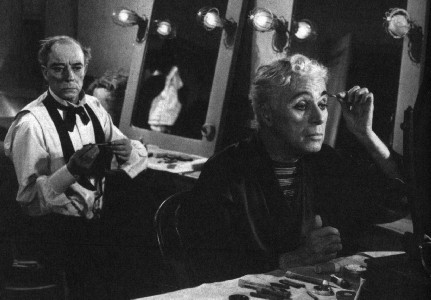
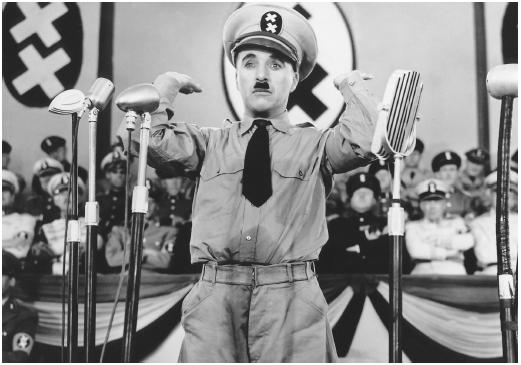
The comparison was all because of the toothbrush mustache. That little flourish is what linked Charlie Chaplin and Adolf Hitler at the time. Chaplin was disgusted by Hitler, and the way the American and British governments tried to keep him happy or ignore what he was doing at the time. It was also noted that Hitler was jealous of Chaplin’s popularity during a Berlin visit the actor made. To further rub it in, Chaplin wrote, directed and produced The Great Dictator, a send up of the Nazi actions in the build up to World War II.

The Little Tramp is now a Jew living in the fictional nation of Tomainia, fighting against the Americans in World War I. He’s clunked on the head and ends up in a military hospital unaware that on the outside dictator Adenoid Hynkel has come to power and is blaming the Jews of his nation for the post-War depression. The Tramp is eventually released from the hospital and is disheartend by the world he discovers on the outside. He eventually falls in love with fellow resident of the ghetto, Hannah and is spared execution by a Tomainian whose life he saved in the War. All along the way the film bounces back and forth with the Hitler parody of Hynkel, leading up to a Prince and the Pauper-esque role reversal.

This was probably the least funny of all Chaplin’s films I have seen, and most definitely the longest, hitting the two hour mark. I can see the challenge Chaplin would have making this picture, because he wants to make a comedy but he also wants to skewer Hitler and convey some sense of the pain being inflicted on the Jewish people. Later Chaplin admitted if he had known the extent of the treatment of the Jews and in particular the Holocaust he would have never made this film. Interestingly, the Jewish community was very welcoming to the film and its portrayal of their people despite Chaplin’s injection of comedy into the proceedings. The jokes in the film never create the sense of hilarity of early works because they typically involve the Little Tramp being brutalized by Tomainan storm troopers.

The film has a lot of heart and that hurts its comedy in comparison to the earlier films. The chief redeeming moment is one where Chaplin is playing the Tramp and completely drops the persona and it is Chaplin speaking. He conveys his concerns with the direction of humanity and reaffirms his belief that we are capable of so much more. While definitely harmful to the picture as a film, it is a very strong and well thought out political statement.

Seventies Saturdays – Little Big Man


Little Big Man (1970, dir. Arthur Penn)
Starring Dustin Hoffman, Faye Dunaway, Chief Dan George, Martin Balsam, Richard Mulligan

At the height of the conflict in Vietnam, American filmmakers were ensconced in counter-cultural material. The 1970s were also a renaissance period in American cinema as well, influenced particularly by the French New Wave of the 1960s. Both social and aesthetic revisionism is at the heart of Arthur Penn’s adaptation of this novel, which results in a film that is both clever and funny, and at other times muddy and unsure of itself.

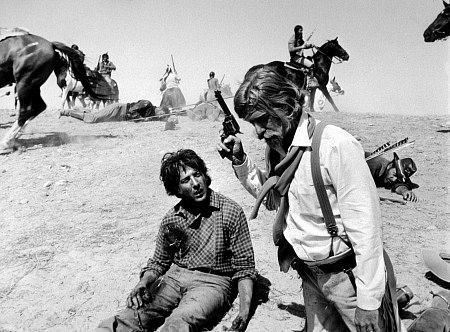
As a young boy, Jack Crabb’s family are massacred by Indians, however he and his sister are rescued by the friendly Cheyenne. Jack grows up amongst the Indians and eventually is pulled into the white man’s world, where is to be properly educated in good Christian morals. For the rest of Crabb’s life he goes back and forth, between being a “civilized white man’ and a “savage Cheynne”. A sort of Western Expansionism Forrest Gump, Crabb runs across historical figures like Wild Bill Hickok and General Custer, the latter of whom he serves under three separate times.

Penn allows the Cheyenne to speak in plain English, but within the rules of the film, its their native tongue translated so that we may hear. This was a big change in film at the time, as Indians had been portrayed as speaking in broken English and using tired, clichéd phrases. However, the film does fall into some common cliches of another kind when dealing with the tribe’s single homosexual member, who’s portrayed as a limp-wristed effeminate dandy. It would have been more interesting to have a common brave amongst the tribe end up being attracted to his fellow warriors.

The film is infused with a biting sense of humor, and definitely plays up the common myths of the frontier for laughs. General Custer, historically known for being pompous and grandiose, is played wonderfully by Richard Mulligan. Dustin Hoffman does a very convincing job as Jack Crabb, and shines particularly in the physical comedy gags. At one point he operates as a gunslinger (The Soda Pop Kid), and has a nervous encounter with Wild Bill, which highlights the small stature of Crabb. It’s a very fun film, that rushes over so much, and that it keeps it from becoming a true classic.

Seventies Saturdays – The Great White Hope

The Great White Hope (1970, dir. Martin Ritt)
Starring James Earl Jones, Jane Alexander, Lou Gilbert, Joey Fluellen

Based on the Pulitzer Prize winning play, The Great White Hope is a “names changed” version of the career of Jack Johnson, an African-American boxer during the early 20th century. Johnson was the first black heavyweight boxing champion and was known for patiently waiting for his opponent to slip up, then barraging him with a series of incapacitating blows. Johnson was a figure of great controversy, not just because he was a threat to the white male ego in the boxing ring, but because all of the women he became seriously involved with were white. Johnson showed little sense of humility about his dealings and was one of the first public figures to really use controversy as a way to promote his own celebrity.

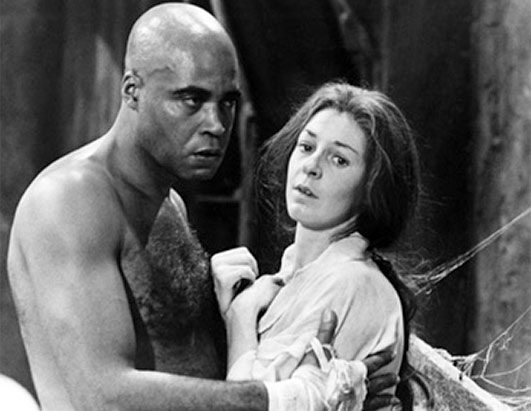
In the film, Jack Jefferson (Jones) has just defeated the heavyweight champion and is celebrating this achievement with much bravado. The African-American community is divided about Jefferson though. While those around him immediately after the fight revel with him and dance in the streets, there are others who see Jefferson has creating negative image for their people because of his brazeness. Another group see Jefferson as being nothing but an “uncle tom” by consorting with white women and embracing what they see as a white way of life. Jefferson has an interesting take on all of this. In a scene early on, after he is weighed in before the big bout, an older black gentleman mentions that the young men will be inspired and “proud to be colored” when Jefferson wins. The boxer replies that they should already be proud and his winning or losing should have nothing to do with it. An interesting idea when thinking about the role of athletes as “role models” in contemporary society.

Jefferson and his fiancee, Eleanor’s relationship is played very well, but we don’t get enough background to understand how they came together. They are very much in love, but we’re never shown how, despite the social stigma of their relationship, they would defy it and stay together. The film also has some problems with how broadly a lot of characters are played. The white establishment villains literally “bwahahaha” at one point in the final scenes, and it would have been interesting to see them played with more internal conflict. Jane Alexander’s performance as Eleanor is also ruined by the pointless turn her character is forced to take, mainly to serve as momentum to move Jefferson forward to the finale. The one standout performance is James Earl Jones as Jefferson; he plays the character as incredibly multi-layered. Jefferson is charming and intelligent, but also selfish and arrogant. He loves Eleanor deeply but is resentful when he realizes she’ll never understand the limitations put on him.

Wild Card Tuesday – Hunger


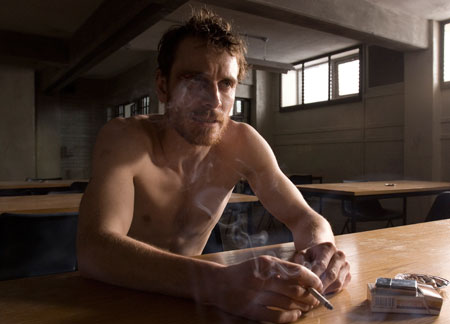
Hunger (2008, dir. Steve McQueen)

Starring Michael Fassbender, Liam Cunningham
The fight between Catholic and Protestant sides in Northern Ireland has devastated that country since the late 1960s. Each side has visited monolithic brutality on the other in of the greatest displays of community inflicting such cruelty on itself. But the cruelty that was the worst, was that of employees of the British empire on IRA members imprisoned in facilities across the country. Director Steve McQueen never give support for the terrorist actions of the IRA, but advocates that all prisoners, regardless of their crimes, deserve humane treatment.
The film’s focus is real life IRA soldier Bobby Sands (Fassbender). While the film doesn’t explicitly cover his activities with the IRA, he was no saint. He helped ferry weapons for the movement and was involved in the bombing of a furniture store in 1976. The film chooses to portray Sands as a figure unwilling to budge an inch for the brutal authority crashing down around his head. In this effort he has allowed himself to become dehumanized. Simply put, he has been caged and treated like an animal, so he will behave like one. Sands smears the walls of his cell with his own feces, allows the daily meals to rot and mold in a corner, and funnels his bed pan (synchronized with the other prisoners) out into the hallway. Is it vile? Yes. But there something innate within us that despise authority that wishes to break us, so it comes off as bizarrely admirable.
Bobby’s most memorable, and final, triumph came when he began a hunger strike in 1981 which took his life after several painful months of starvation. Michael Fassbender destroyed his body through malnutrition to take on the gaunt, sunken appearance of a Holocaust victim. He become the specter of death with additional help from an incredibly talented makeup department. His back is covered in open sores, he’s unable to urinate for the prison doctor’s physical, and he stains his sheets with black, acrid blood. The moments before Sands passes are truly powerful. The film moves into his consciousness as hallucinations of his younger self appear and his mind travels back to long distance race where he and both Prot and Catholic youths ran together, in fields of golden amber. Director McQueen doesn’t want you to take the IRA’s side, he wants you to realize how irrelevant any side is, and simply see a man dying.
The aesthetic choice made by McQueen are magnificent. For the first 30 minutes of the film there is little or no dialogue. Only 50 minutes in is there an actual conversation between two people for extended amount of time. Here Sands and a priest from his community debate the point of standing in defiance of authority. The priest tells Sands he must submit to the uniform being enforced on the prisoners and Sands simply won’t budge. Once again, neither side wins in the debate. They simply come to the conclusion that neither of them will change their ideas about it. Hunger is one of the best examples of director using the language of cinema to tell a visceral and moving story. There is no maudlin sentimentality, yet there is a deep emotional core. Not for those lacking a strong constitution, but one of the most amazing British films I’ve ever seen.

Import Fridays – The White Ribbon


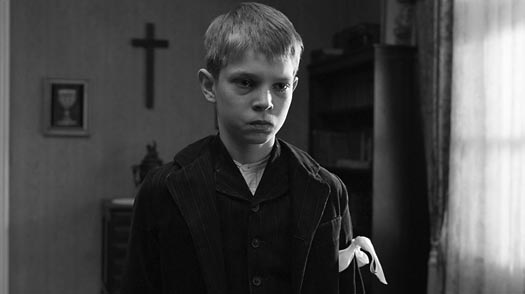
The White Ribbon (2009, dir. Michael Haneke)

Cruel parents create cruel children. That is the moral of Austrian director Michael Haneke’s latest film, The White Ribbon. The object of the title is a device used as part of a technique implemented by the village minister to remind his children of purity. It’s no coincidence that children in a German village, whom will be adults when the rise of the Nazi party occurs, are shown wearing white armbands symbolizing purity. Haneke is not at work to simply tell the story of the psychological birth of the Nazi movement, rather he want to study and dissect what motivates terrorists and those who kill from a nationalist motivation.
In a small northern German village, about a year before World War I begins, a series of premeditated attacks occur. What sets things off is when the village doctor is thrown from his horse as the result of an near invisible wire strung across his property. Authorities find the wire vanishes over night and no one saw anybody tie it up there. The film is very fragmented and jumping from household to household, focusing on the interactions of parents and children. Like most Haneke films, he keeps things very ambiguous. He knows what to state outright and what to hint at.
Someone burns down a barn. A child is murdered. Another child is beaten severely and strung up in the town’s sawmill. I was reminded of Haneke’s 2005 picture, Cache, where the protagonist is presented with a mystery of someone filming the exterior of his flat for hours and hours, then mailing him the tape. Haneke cultivates mystery, presents us with plausible suspects, and then ends the film. A very similar technique is used here, so if you are someone who likes things wrapped neatly, this isn’t a film for you. However, if you enjoy philosophically contemplating the nature of evil and acts of tragedy visited on seemingly normal, undeserving people this is a fascinating picture.
German society at this time lives and dies on hierarchy and adherence to strict religious and moral tenets. In life you serve the land baron and thresh his fields, you go to church, and you never step out of place. So, for such chaotic acts to begin in the village is a cause for the erosion of propriety. As Haneke peers under the roofs of the villagers we quickly see no one submits to this system out of honest belief, they submit because they are beaten into it. What Haneke has done is make a film much less about the specifics of German society and about our own contemporary global culture of cruelty.

Film 2010 #32 – Ragtime


Ragtime (1981, dir. Milos Forman)

Starring Elizabeth McGovern, Mary Steenburgen, Brad Dourif, James Cagney, Mandy Patinkin, Norman Mailer, Moses Gunn, Debbie Allen, Donald O’Conner, Howard Rollins Jr.
I first became familiar with the story of Ragtime from the 1996 Broadway musical, script written by the talented Terrence McNally and based on the novel by E.L. Doctrow. The story (in all mediums) is an attempt to create a slice of life in America right before World War I broke out. Milos Forman was an interesting choice to helm this project; he doesn’t really take on historical epics, instead when he does period pieces he chooses to focus on specific individuals and analyze them down to the grain. In Ragtime, we get broad painted strokes that only give us glimpses.
The interwoven plots contain a mix of fictional characters given vague names like Father, Mother, Younger Brother and historical figures like Booker T. Washington, Harry Houdini, and Evelyn Nesbit (the focal point of what was called the Scandal of the Century at the time). The novel and musical version contain even more historical figures including Henry Ford, J.P. Morgan, Admiral Peary, and Emma Goldman, but I assume they were cut for the sake of time.
In the core plot of the film an upper middle class family in New Rochelle, New York discovers an African-American infant crying in their garden. The police bring a young woman to their house who admits the child is hers and that the father abandoned them. Mother decides to take Sarah, the girl into their home against the wishes of Father. Eventually, piano player Coalhouse Walker, Jr. arrives on their doorstep revealed to be the father of the child and stating that now that he has a job he is willing to ready to provide for his family. However, tragedy occurs that sets the characters down a path where they witness a change in the entire world. Alongside this plot, Mother’s Younger Brother falls in love with former dance hall girl Evelyn Nesbit and is played for a fool. There’s also Tateh, a Jewish immigrant talented in making silhouettes who eventually makes it big as an early silent filmmaker.
The film presents the world of New York in 1917 with amazing accuracy. Clothing and vehicles and set dressing are spot on and anachronisms are non-existent. However, the broad nature of the film left me feeling indifferent about every character on screen. Every thing feels like it is played towards cliche rather than reality. Part of me feels that uber-producer Dino de Laurentiis played a part in the films broad, flat nature. It’s an interesting film, most notable for the costume design and art direction, but definitely a weaker entry into Milos Forman’s work.

Film 2010 #30 – The Secret of Kells


The Secret of Kells (2009, dir. Tomm Moore, Nora Twomey)

Starring Brendan Gleeson, Mick Lally
When the 2010 Oscar Nominations were announced I’m sure I wasn’t the only one who wondered “What the hell is The Secret of Kells?” Well, it’s an independently produced Irish film that played for a week in L.A. to qualify for the Academy Awards. The nomination will definitely garner attention for the film when it receives an expansion on American screens on March 12th, but is the picture deserving of the nom? A million times yes, and while Up will probably win because of its notoriety and box office, The Secret of Kells brings a style drastically different from the Disney formula that dominates American animation.
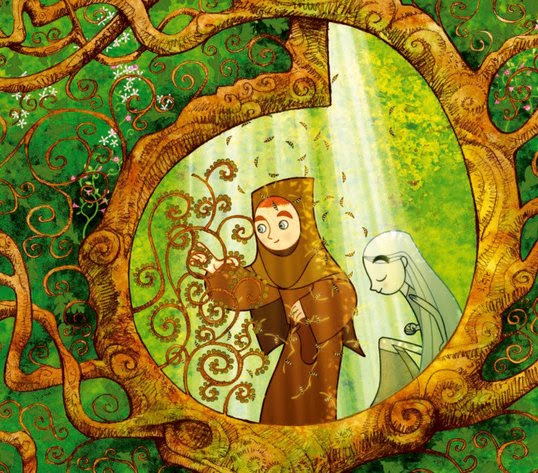
The story of The Secret of Kells is based in the history of Ireland circa 1006 A.D. The Vikings are massacring and raiding any village them come across in the hopes of amassing gold. The Abbey of Kells has become a sanctuary for many monks whose island homes have been burnt to the ground. Now, surrounded by the deep forest, they have gone back to creating gloriously intricate illuminated texts while the Abbot Cellach works to finish the wall before the Vikings arrive. Cellach’s nephew, Brendan befriends Brother Aidan, the monk who has been working on the Book of Iona, believed to be the most beautiful illuminated manuscript ever made. Aidan enlists Brendan’s help in gathering the supplies needed to finish the text by gathering inkberries for him in the forest. Brendan sneaks away, meeting the fairy Aisling, who introduces him to the wonders of the world outside the walls of the abbey.
The intricacies of the animated work in this film are astonishing. From the moment of the prologue, narrated by Aisling, there is no doubt that the love put into the picture is remarkable. The clever reasoning behind the level of detail is a direct nod to the craftsmanship put into illuminated manuscripts by monks. The same swirls, flourishes, and Celtic crosses seen in the texts can be found hidden amongst the gnarled roots of trees and clusters of leaves and flowers. The subtext here is that Brendan can only rise to the level of his hero, Aidan, by journeying beyond the walls of his limited experience. Someone like Aidan has been able to create such a beautiful piece of art because he has confronted his fears and conquered them.
While Brendan’s story does follow closely to the accepted hero’s journey archetype, there are many story beats that separate this film’s plot from others. The unblinking look at violence at this period of time and this part of the world is very much there. When the Vikings rear their ugly heads it is apparent that they leave few alive in their wake. There is also tragedy of other sorts in the film’s climactic sequence involving the unfinished abbey and its weak scaffolding. But the subtext throughout is telling us fear will be your end. Running frightened and unthinkingly at the sight of your fear leads you into destruction, but those characters who use their wits and remain calm are able to escape.
My own personal opinion is that the originality of content and artistic achievement of The Secret of Kells earns it the Best Animated Feature. However, the Academy Awards is usually more reflective of a mix between artistic elements and public awareness, meaning Up is the most likely candidate. Not to take away from Pixar, they would probably argue in favor of Kells as well, but I am excited for this film to reach a wider audience and gain more enthusiasm like mine.