Movie Review – Tetsuo the Iron Man

Tetsuo the Iron Man (1989, dir. Shinya Tsukamoto)

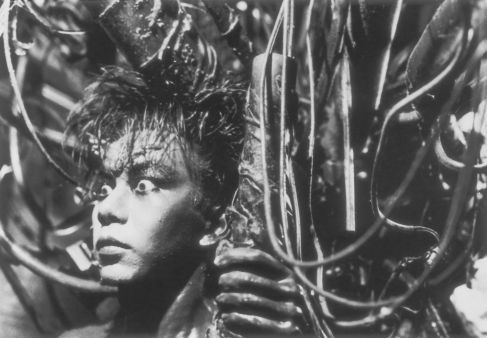
tet1

A mysterious man lives in a junkyard and fetishizes metal to the point that he cut open his body to insert iron rods and wires into it. He’s struck by a car and apparently killed. A salaryman (Japanese corporate drone) is haunted by strange techno-nightmares, even attacked in the subway by a woman transformed by a piece of metallic effluvia. Where this film goes and mood it evokes is truly unpredictable and very much of its time.

Tetsuo is a techno-horror film akin to David Lynch forming a death metal punk band. The energy in the picture is non-stop, grabs the viewer by the shoulders and violently tosses them around until they can’t take it anymore. In the 1980s, body horror was a growing sub-genre thanks to the likes of David Cronenberg and Clive Barker. The way a human body could betray its nature was of increasing interest as medical science evolved a breakneck pace, the AIDS epidemic slashed across humanity, and urban spaces became increasingly smother in pollution. Self-mutilation wasn’t a new concept and many cultures still practice scrying script into the skin or slicing off bits of their reproductive organs as a sacred ritual. The addition of technology into the mix is what took the exploration of these ideas in a new direction.

Tetsuo is a ghost story at its heart. One man wrongs another man, and the wronged man comes back to haunt him. Very simple, on the surface. A significant factor in what is happening in Tetsuo is the transformation of the Japanese culture at the time. Westernization was flooding Japanese culture, and traditional Japanese life was uprooted. Technology and industrialization were the greatest representation of that takeover and the unnamed man has become so absorbed in this new world of wires that he attempting to physically merge with it. The merger of the Fetishist and the Salaryman in the finale is sparked by their discovery of the New World, a possible future landscape where the planet is devoid of all natural life and now a techno-organic construct. The decision to close out the film with the words “Game Over” rather than “The End” is also a telling detail in reflection on the relationship that developed between Western culture and Japan through the medium of video games.

Tetsuo is a rough film to get through. It’s has zero interest in traditional narrative conceits and from the very opening it makes sure you know that. The film is almost virtually hyperlinked within itself as the narrative jumps around to fill in backstory, hint at the future, and provide the minimal information needed to understand it. The soundtrack is designed to shred your sense and it truly evokes the sense of being overtaken by some faceless industrial presence.

Best Audio Horror on YouTube #1

social_media_icons_blot_icons_set_512x512_0004_youtube

In the last five years, I have come across and explored a very vibrant and active creative community on the Internet: The writers of creepypasta and r/nosleep. The are some masterpieces of horror being posted online and I truly believe the future of the genre rests in the online medium. In addition to the writing are the incredibly talented voice actors who choose some of the best horror stories and make high-quality readings of the work. This month I will post a lot of these readings with plans to make it a regular monthly or bi-weekly feature of the blog. I hope you find some great listens for this spooky month.

The Museum

https://www.youtube.com/watch?v=qp0pl3caaf0

The Showers (One of my all-time personal favorites)

NormalPornforNormalPeople.com

https://www.youtube.com/watch?v=T0FpBak2plI

The Other Internet

https://www.youtube.com/watch?v=wsIWEoUR-CM

NoEndHouse Part 1

Room Zero

The Disappearance of Ashley, Kansas (an audio version of found footage)

Hypothetical Film Festival: Family Nightmares

Hypothetical Film Festivals place five to six films together that share some thematic element.

Hypothetical Film Festival: Family Nightmares

Families can be terrifying things. They have histories shaded in darkness and can know your most intimate secrets. Sometimes it’s hard to decide whether being inside a family is more disturbing than viewing one from the outside.


parents

Parents (1989, dir. Bob Balaban)

Bob Balaban is known to most of us a beloved character actor with a penchant for dry, Buster Keaton-esque reactions. You’ve seen him as the narrator in Moonrise Kingdom or multiple Christopher Guest mockumentaries. Less well known is his first foray into feature film directing, Parents. Starring Randy Quaid and Mary Beth Hurt as the titular parents, the film focuses on their son’s slow burn discovery of a horrific secret they’ve been hiding from him. Set in the 1950s the film plays with the conventions of the nuclear family unit and is a genuinely dark and horrifying film. Balaban’s use of slow motion and twisted camera angles ease the movie into a deeply disturbing place.


visitor-q

Visitor Q (2002, dir. Takashi Miike)

There are few families on this list as fucked up as the Yamazakis. Father, mother, son, and daughter, they are one depraved, twisted mess after another. I won’t go into the details here, but suffice to say from the opening scene you should be unsettled. Director Miike drops Visitor Q into the mix, a stranger who seems intent on forcing this family to come back together but not giving up their utterly disturbing behaviors. Murder, drug use, incest, these are just a few of the messed up things that go down in this film. If you’ve ever seen a Miike film it won’t come as a surprise, but if you haven’t…well you are in for quite an experience.


home-movie

Home Movie (2008, dir. Christopher Denham)

Pastor David Poe and his wife Clare have just moved, with their son and daughter, to a quaint home in the New England woods. Based on the director’s experience as a child filming his family’s life, Home Movie uses the found footage trope to explore multiple perspectives of parents dealing with children seemingly possessed by pure evil. Nothing supernatural ever happens, and it appears that we’re dealing with children who have suddenly become sociopathic. The sense of dread the film builds is very profound and primal, and the horror of what the children have been up to in secret is slowly laid out for the audience. The final chilling moments of the film descend into pure visceral horror and leave the viewer with lots of questions and lots of things to think about.


thewoman

The Woman (2011, dir. Lucky McKee)

If you watch one film on this list, make it The Woman. It’s based on a novel by Jack Ketchum who if you know anything about him already know this is a very dark, disturbing film. An unnamed woman, the last of a clan of violent humans, somehow untouched by civilization and kept feral, ends up in the custody of Chris Cleek and his family. Chris is one of the scariest film villains I have ever witnessed on screen, so sure of his moral and divine right to control those around him. Pollyanna McIntosh plays The Woman and delivers such a raw, vicious performance that it will linger in your mind for years as it has with me. Where this film goes and the secrets it reveals about this family are more disturbing than any Texas Chainsaw Massacre you can dream up. What family members do to one another is often beyond even our worst nightmares.


here-comes-the-devil-babysitter-eyes-demons

Here Comes the Devil (2012, dir. Adrian Garcia Bogliano)

A family takes a trip near the outskirts of Tijuana and lose their preteen son and daughter in the hills. Hours later, the police deliver the two children home. The parents are so relieved and move on with their lives. However, something is very very wrong with the kids. They don’t eat anymore, they don’t sleep, and their babysitter sees something…something so terrible she cannot give it words, the night she watches them. But parents can’t abandon and give up on their children. Here Comes the Devil explores the lengths to which parents will go to protect their children and how they will destroy others rather than confront the evil sitting across the kitchen table from them.

Movie Review – The Neon Demon

The Neon Demon (2016, dir. Nicolas Winding Refn)

The-Neon-Demon-pic

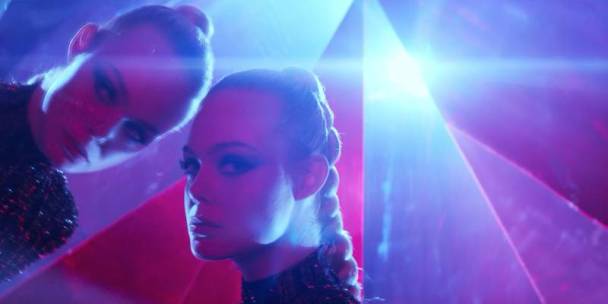
Jessie (Elle Fanning) is a fresh-faced Midwesterner just off the bus in Los Angeles. She is making the rounds to become a fashion model and meets Ruby (Jena Malone) along the way. Ruby seems very struck with Jessie, who possesses an otherworldly beauty and brings her into the world of professional modeling. Jessie is also dealing with a potential new romance with an amateur photographer and the leering of a nightmarish hotel clerk.

The Neon Demon is a film about superficiality that thinks it has something profound to say about the nature of beauty but merely ends up being just as vapid as the target of its philosophizing. It is an exquisite film, no doubt, with some gorgeous and iconic cinematography done by Natasha Brier. Throughout the movie, there are great posed shots (a mountain lion snarling on a hotel bed, models bathed in blood-red neon lights, figures emerging or receding into the shadows). But it all adds up to nothing. There is an attempt to monologize some meaning into the story in the third act through an overwrought speech by Jessie, which comes across more as director Refn thinking he’s smart but is more embarrassingly sophomoric in his philosophy.

If you can separate the paper thin story from the film, then The Neon Demon is a very sumptuous visual feast. Refn doesn’t try to hide from his obvious influences; mainly the Dario Argento made Giallo films of the 1970s and early 1980s. The story’s framework is a nod to Suspiria, with a coven of witches and a naive ingenue unaware of the horrors that await her. Thematically, the movie touches on the same ideas as recent pictures like Black Swan, Starry Eyes, and Sleeping Beauty. However, those films explore the themes in much more interesting ways. Starry Eyes, in particular, seems like an apt comparison to The Neon Demon and while it’s visuals are not as stunning, it tells a much more meaningful story.

It’s hard to judge the acting of the cast because they either weren’t given much material to work with or were directing to be one dimensional and uninteresting. The few bright spots come in brief appearances by Christina Hendricks as a modeling agency rep and Keanu Reeves as the previously mentioned creep of a hotel clerk. It would have been nice to spend more time with those characters because they seemed to have deeper roots in this hellish version of Los Angeles and could have proven an intriguing counterpoint to Jessie’s blankness.

Refn has been a very polarizing director with his last film; Only God Forgives being very divisive among critics and fans. I’d argue that it is a better film than The Neon Demon simply because characters behave consistently, and they have a complete, coherent arc. Only God Forgives also has striking visuals and compelling Cliff Martinez score, just like The Neon Demon. The behavior of the characters in The Neon Demon is baffling because from scene to scene the actors seem to be told to play entirely different characters. As a tone piece the movie succeeds, but as a cohesive film with characters, plot, and themes it is as frivolous as cotton candy.

Movie Review – I Am Not a Serial Killer

I Am Not a Serial Killer (2016, dir. Billy O’Brien)

not a serial killer

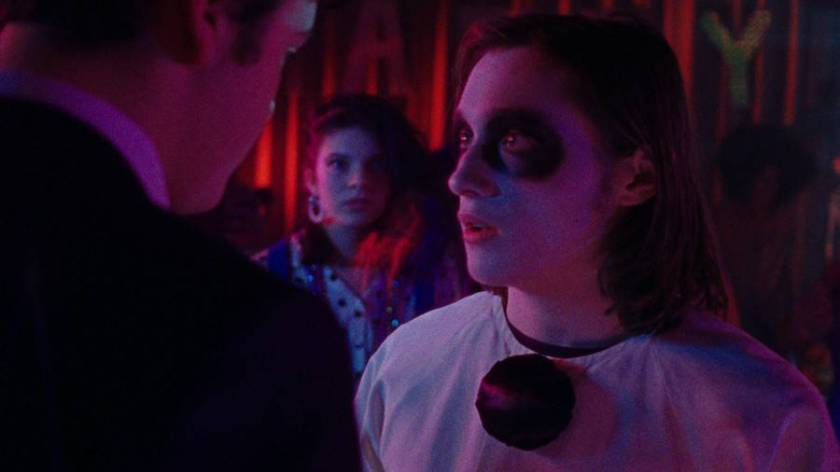
John Wayne Cleaver (Max Records), a teenager with sociopathic tendencies, lives in a bleak Midwestern town, seemingly under a permanent blanket of snow. Against this wintery landscape, a series of killings begin. Cleaver gets a front row seat to examine the corpses due to his family’s prominence as the only mortuary in town. He quickly discovers each body is missing an internal organ or body part. The bodies also appear to have been cut apart with a chainsaw or toothed blade. And there’s that sizzling black oil at all the crime scenes. Cleaver struggles to control his own compulsions to hurt school bullies and the need to connect with others while trying to figure out whose sinister hand is behind the killings.

I did not expect what I got from this film. I knew going in from the atmospheric trailers that it was going to be moody and dark. There is plenty of gore due to the mortuary being a key location. We never see victim’s faces until more than halfway through the film. In many ways, this is from the perspective of Cleaver. He sees the bodies as simply hunks of meat at the beginning, parts of a mystery he wants to uncover. When the victims become people he personally knows the weight of the crimes set in.

Despite this darkness pervading the film, there is humor and softer moments. Cleaver frequently visits his psychiatrist, Dr. Neblin. Instead of Cleaver lying on a couch and unloading his feelings, the two meet in outdoor locations having sessions in a park or on a rooftop while birdwatching. The doctor comes across a very human and truly working to show empathy to the young man while attempting to stoke the fires of empathy in his patient. The family dynamics between Cleaver, his mother, aunt, and older sister feel very genuine with lots of tension around the holidays that the film knows it doesn’t have to get expository about.

The look of the film is grainy and textured. Handheld shots in moments of extreme horror and tension add to the despairing atmosphere of the crimes. It’s clear that slasher horror of the 70s and early 80s influenced the tone and visuals of the picture in all the most positive ways. The movie is also confident in letting itself wander through landscapes. There’s not hurry to wrap up the story. Instead story elements are allowed to simmer and we get some wonderful performances from young Max Records. His most notable role thus far has been as the lead in Spike Jonze’s Where the Wild Things Are. It’s apparent that he understands emotion and subtlety and gives a very honest performance of a very troubled character. Cleaver is never presented as angsty, he’s contemplative and seeks understanding of his condition, even if it means communing with a killer.

There is a major twist halfway through the film that is not presented in any of the trailers I saw and should be avoided at all costs. The shock of what the film becomes in that moment was one of the best elements of the picture. The director manages to take elements that could be eye-rollingly ludicrous and add some emotional weight. If you are looking for a horror film that lives in the “real world” I Am Not a Serial Killer will do the trick.

Pop Culture BC Review #1 – A Head Full of Ghosts

A Head Full of Ghosts by Paul Tremblay
Published by Harpercollins, 2015

a head full of ghosts

The strongest feeling I had reaching the conclusion was a sense of sadness for the main character. I don’t see how anyone could feel anything but that for Merry Barrett. She will never have closure because she is the only one left alive and obviously doubts her own interpretation of what happened to her family. This is the aspect of A Head Full of Ghosts that elevates it to that premiere level of horror in my personal opinion. It is comfortable with ambiguity and it uses that lack of information/understanding to make its horror tragic yet still frightening.

A Head Full of Ghosts doesn’t shy away from its influences. In fact, portions of the text outright name drop books, films, and authors to make it clear that Tremblay acknowledges these antecedents but works to present a narrative that plays with their tropes. By bringing in elements such as the reality tv show, the fractured point of view of a child, and a modern fan blog he tells a familiar story from a seemingly varying number of perspectives. When we reach the halfway point and learn adult Merry is the author of the The Last Final Girl blog we realize the author is saying that a single person’s point of view can be more complex than originally thought. And it also brings us back to the title of the text, A Head Full of Ghosts and how it doesn’t simply apply to the plight of Marjorie Barrett.

Tremblay has publicly stated that the novel is meant to be open for a multitude of interpretations. The big question when you reach the end is of course “Was Marjorie really possessed?” By not including direct transcripts of The Possession reality series, only having their events filtered through The Last Final Girl blog and Merry’s memories, we are forced to crane our neck around bedroom door frames in an attempt to see what truly went on in that house.

The most terrifying moment for me in the book was the encounter between Merry and Marjorie in the basement. The production crew for The Possession had just moved into the Barrett home and was setting up. Merry ends up down there looking for snacks if I recall correctly. The two engage in a conversation about their father’s understanding of Marjorie’s condition, specifically how he, through the guidance of his priest, believes his daughter is possessed by Satan. Marjorie laughingly rebuffs this notion but goes on to say that she *is* possessed.

“Ideas. I’m possessed by ideas. Ideas that are as old as humanity, maybe older, right? Maybe those ideas were out there just floating around before us, just waiting to be thought up. Maybe we don’t think them, we pluck them out from another dimension, or another mind.” Marjorie seemed so pleased with herself, and I wondered if this was something new she just thought up or something she’d told someone before.

Tremblay has contributed to the modern Lovecraftian horror scene. My first read of his work came in The Children of Old Leech, a tribute anthology to Laird Barron. In that collection is Tremblay’s short Notes for “The Barn in the Wild”. This particular quote from Marjorie struck me as a very Lovecraftian in its existential nature. That sort of cosmic horror is often about horrors that transcend our notions of good and evil as well as existing before our concept of time began. Later in the text, Marjorie makes mention of a minor Lovecraftian demon and this is taken as her doing research online behind the backs of the production crew and clergy. It should be noted that Notes for “The Barn in the Wild” is also a found narrative short story presented as fragments of a “discovered” journal, yet another narrative construct whose validity comes into question.

There’s just as much presented in A Head Full of Ghosts that can lead the reader to believe Marjorie is deteriorating from paranoid schizophrenia or some other similar mental illness. Again, we only hear the story from the point of view of someone who was a child and the younger sibling of Marjorie. Many mentions are dropped that Merry was in no way fully aware of what was going on in her own home fifteen years ago. It’s no surprise to anyone who has read the novel that the biggest shock comes in the third act when we learn through a very casual, distant mention that Merry’s father, mother, and sister all died of poisoning that is publicly contributed to the father. Merry’s memories of the events leading up to that moment are some of the most chilling parts of the book. It’s very telling that in how she remembers the poisoning she is the one who taints the food. Moments later she discusses the trouble she’s had remembering her aunt entering the home and saving her after she lays there with the dead bodies for weeks. But then Merry admits that’s not what happened and she was told in retrospect police entered the home to save her.

This is where we are left, with Merry unable to know what really happened. We have just enough pieces of the story to fashion a narrative but not enough to understand what it meant. Great horror understands that it’s not a monster or scary house or the Devil that wrenches at our soul and tears up our eyes. Horror comes from a place of very raw truth when we confront our powerlessness. Childhood trauma can bring the toughest tough guy to their knees. That is horrifying. So many people seek out professional help to bring closure to those scarring moments of their pasts, but never truly move past them, only learn how to manage their emotions in relation to them. A Head Full of Ghosts posits “What if you were completely unable to move on?”. Whether it be heredity or demons, what if you were damned to spend the rest of your life both haunted by your childhood yet unable to fashion a working understanding of what it meant?


Discussion Questions

What was Merry hoping to achieve through her blog deconstructing The Possession?

How do you interpret the exorcism scene? What really happened? What was imagined by Merry in her memory?

What did Marjorie seek to gain from Merry attending the exorcism?

Are childhood memories simply a sense memory fabrication or is there factual truth within them?

The Childhood of a Leader (2016, dir. Brady Corbet)

priests-childhood-leader

By the final dizzying moments of The Childhood of a Leader, I was completely overwhelmed in a satisfying way. The film takes place in the temporary rural home of an American diplomat stationed in the French countryside at the close of World War I. His wife and child, Prescott, waste away the days with French lessons, performances at the local church, and malaise. Prescott has a series of tantrums with the film structuring this three fits as its chapters, with an epilogue that brings everything together decades later.

The film is the directorial debut of longtime child and indie actor, Brady Corbet. It is very apparent that Corbet’s work under directors like Michael Haneke and Olivier Assayas has been a masterclass in filmmaking. This is one of the strongest debut films I’ve ever seen. The cinematography is astounding, the performances are subtle but carry much weight, and every single aspect of the film is crafted with care. Add to this the nerve shattering score by veteran composer Scott Walker and you have a film that brings together a number of genres but defies to be defined by any of them. This is a horror film set in an alternate history of our world…or is it the mix of the real and the deluded visions of a troubled young boy?

It’s hard to pin down The Childhood of a Leader. The film keeps itself enigmatic to encourage the viewer to explore and think about what’s happening on screen. The two ways I saw to read the film during this viewing were as the literal story of a young boy at the center of world history who would rise to power one day. There’s also the idea that we’re dealing metaphor. The American Father, The French Mother, The English Reporter. All three seem oblivious to this ranting, tantrum-ing, seething child until it’s too late. With each tantrum, he increases his hostility and potential to do harm to those around him.

From the opening moments of the film to its conclusion, there is an unsettling tension building. Walker’s score for the film plays a major role in building that, but its juxtaposition to the dim visuals on screen following Prescott from behind as he runs through the woods, roams the empty halls of his house or wanders naked into the middle of his father’s meeting with important policy makers is what keeps the film at the edge. We never descend into complete horror until the final moments, but every second up to that point is fraught with terror. Highly recommended and with much potential to reveal more with subsequent viewings.

https://www.youtube.com/watch?v=UnO78-d4Ybo

Pop Culture BC -August 2016

51RuP7pBWFL._SX329_BO1,204,203,200_

I have so many books I need to read. And I do read them. But it often becomes a very solitary experience, as reading so often is. I decided that at least one book I read a month will be a communal thing which led me to start the Pop Culture Book Club.

For the month of August, our book will be A Head Full of Ghosts by Paul Tremblay. I’m familiar with Tremblay from a few horror short stories he’s written. His work would definitely fall in the space between Lovecraftian horror and weird fiction. I do not know a lot about A Head Full of Ghosts, other than it’s been compared favorably to the novels House of Leaves and The Haunting of Hill House.

In the last week of August, I will post my review of the novel along with 3-4 discussion questions to provide a jumping off point if needed. I hope you join me on this endeavor!

Purchase a physical or digital copy of the book here!

The Purge: Anarchy (2014, dir. James DeMonaco)

the-purge-anarchy-default-1920

Whenever I’m playing through a video game and it suddenly forces me to engage in an escort mission, bringing a character I can’t control from point A to point B and keeping them alive, I will groan and slog my way through it. The Purge: Anarchy is a video game escort mission as a feature length film. I have not seen the first Purge film but was told it was unnecessary viewing and that this second film would fill me in. That was true, they deliver a lot of first act exposition to explain what is going on.

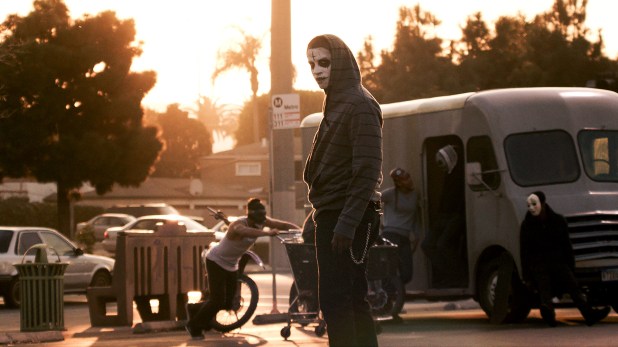
The film tells the story of the night of the sixth Purge. The Purge is an annual event instituted by an upstart extreme Libertarian political party as a way to help people release their rage. For twelve hours, all crimes are legal and the use of most weapons in committing these crimes is permitted. In Anarchy, we have an unnamed man (Frank Grillo) embarking on a mission of revenge. On his way, he makes the decision to help out a mother and her daughter and his Purge night takes an extreme divergence from his plans. A couple more characters join up with the group and they make their way across Los Angeles trying to survive the slaughter and mayhem around them.

It was probably not a good idea to make this my very next film after Green Room because the former definitely highlights the huge problems with the latter. Read my review of Green Room here. The Purge: Anarchy has five protagonists and none of them die until the last 15 minutes of the film and then it is only one. If the goal of the film is to make me feel that the event is the most dangerous and insane thing I could go through then it fails big time. Green Room kills off the most well prepared and confident character in a snap of your fingers. Here we have Frank Grillo essentially playing The Punisher and making it to the end and, spoiler, he’s the main protagonist of the third one currently in theaters. The film undercuts any sense of true fatality by keeping its main character alive the entire film.

Then we get to the metaphor of the film, and by god, it’s pretty hard to miss because they have shaped it in the form of a Mack truck. When I was in college, I stumbled across the film Mississippi Burning about the murder of three civil rights activists and directed by Alan Parker. I was astonished at how on the nose and disingenuous the message of the film felt. They kept beating you over the head with “Racism is bad”. Yes, I know that. But what interesting avenues in regards to racism do you plan to explore? Oh, none. Ok. Then why make this movie? But at least Parker’s film had a cogent message. I can’t tell you what Purge: Anarchy was attempting to say about anything. I suspect writer/director James DeMonaco is a little confused himself.

The first guess you might have is a message about Americans and their addiction to guns and the violence in our culture. Well, we have an allegedly anti-Purge group led by Carmelo (the always awesome Anthony K. Williams) telling us that the Purge concentrates its violence on the poor and minorities. Okay, a little on the nose, but let’s go with it. However, in the third act Carmelo and his group show up at a warehouse where One Percenters are hunting people down and state “It’s our time to Purge”. And the film portrays this as good and justified. I don’t think messages can get more mixed than that. They’re moments where we find young black men rounding up people from their own communities and selling them to the rich. We have two battling sisters who end up spilling blood over their shared love, one of the sister’s husbands. There’s a dude in an American flag baseball cap traveling around in a semi-truck with a personal army and mowing people down with a minigun. But the film never manages to compose a semi-cohesive point about any single thing it brings up. They’re bits of fictional media sprinkled throughout that build up the world but I never saw an underlying statement to any of it.

Even without a coherent thesis, the film could have done something stylistically interesting. The cinematography is sloppy and derivative. The pacing is dull and it becomes a movie where you are checking the time to see how much is left. If they had gone the route of Pulp Fiction-esque anthology that could have been interesting, playing with time and narrative order. They could have had the main character in one story as mere cameos in another. There were some points where we could have delved deeper into the racial impacts of the Purge but the film never has the guts to. I think having a late 40s white male director is going to keep the film from exploring those elements in any interesting way. I thought of a very different film, Lawrence Kasdan’s Grand Canyon (1990), that wanted to say something about race relations and came off as one the most insultingly dumb movies I’ve ever seen. This is sort of like Grand Canyon but with more guns, and even then I never felt the flinching and queasy sense of danger I got from Green Room.

The only moment in the film that got me truly interested were the final moments between Grillo and his target. There could have been some amazing themes explored there, some really complex and challenging performances. But then it just whimpers out and we cut away. The resolution is implied but I frankly would have rather seen a one room film set on the night of The Purge about Grillo and his target. Explore how people use the Purge to enact revenge and explore the psychological effects on those who do purge. The film just ends up being less than the sum of its parts. It didn’t make me interested in watching the newest film. Even looking at it as an ultra-violent escapist film you have to note it took the whole movie for even one of the five main characters to die! It just feels like a very surface level dip into sociology that other films have explored in more interesting ways.

Green Room (2016, dir. Jeremy Saulnier)

a24 visions

green room

There’s something dangerous about the woods. Yeah, the city is dangerous, but there’s something worse about the woods. You’re so far away from help. You’re isolated. The woods are cold and indifferent. So when the members of punk band The Ain’t Rights roll into the parking lot of neo-Nazi club plunked right down in the Oregonian forest there’s sinking feeling that hits your gut. I am ashamed to say I have not dedicated the time to watch Jeremy Saulnier’s previous picture Blue Ruin after hearing great things. Having seen Green Room, I must see this older film.

Green Room tells the story of a punk band that stumbles upon something they shouldn’t see in the back of a club. As mentioned before, neo-Nazis own the club and the band quickly become prisoners and involved in a brutal and violent standoff. Saying more would spoil the suspense of the film. The tension is built up beautifully through the moody ambient music of Brooke & Will Blair and the washed out cinematography of Sean Porter. Scenes are painted with pale green and blue ambiance and the tense drone that builds in the score. Right before all hell breaks lose all these elements come together and then explode into a nightmare.

The violence in Green Room reminded me a lot of Simon Rumley’s Red, White, & Blue. Harm to human beings is presented as realistically as possible, taking into account what actually happens to a body when hit with these sorts of traumas. There are many moments where you have to look away and the film doesn’t pull punches about who gets hurt and killed either. These are a group of young adults who aren’t trained to fight for their lives and they make the sorts of mistakes and show ineptitude with weapons that they truly would. I also loved the confidence of a couple characters going into extremely bad situations. That confidence is dealt with appropriately.

The acting is done very well with Patrick Stewart and the late Anton Yelchin heading up the cast. Stewart gives a great muted performance as the patriarch of this skinhead operation. He handles the band with just the right amount of calmness at the start, escalates as each side gets in their hits. Yelchin does a fine performance and is going for something very muted, unsure, and contemplative. You can’t watch his work now and not reflect on what we’ve lost. In the same way that seeing James Dean in Giant and East of Eden made me sad there weren’t films spanning decades featuring this actor, I feel the same way about Yelchin. I don’t believe we had truly seen his best work and films like Green Room show hints of that.

The supporting cast is excellent. Imogen Poots plays a local who ends up locked up with the band and brings a lot of physicality to the role that sold it. Her look and demeanor feel so real. The rest of the band does a great job, but it is the other neo-Nazis that are truly terrifying. Macon Blair plays Tad, the manager of the club and shows a lot of nuance. He’s not comfortable dealing with dead bodies and there’s a lot of unspoken and hinted at history that make him intriguing. Eric Edelstein plays an incredibly menacing skinhead that gets locked up in the room with the band. The stand out, though he is only on screen for a handful of minutes, would be Brent Werzner as Werm. He comes across a complete and total sociopath in his short screen time and is one of those people you pray to god you never meet in real life.

Green Room is a brutal story. But is is a very well told one. The narrative choices that are made help ratchet up the tension. Almost every moment of the film will leave you feeling the queasy, uneasiness, truly having no idea what horror is happening next. And this is definitely a horror film, not about the supernatural and not about a mindless slasher, but a horror story that preys on our fears of the big evil in the woods. This is what happens when you leave civilization and enter the realm of a vicious beast.