Asian Cinema Month – Thirst


Thirst (2009, dir. Chan-wook Park)
Starring Kang-ho Song, Ok-bin Kim, Hae-sook Kim, Ha-Kyun Shin

What if Double Indemnity was a vampire flick? That’s part of the premise going on in this visually startling South Korean horror flick. I’ve only seen one other Chan-wook Park film (Oldboy) and now after Thirst, I know I need to see more. No other country in the South Asian region produces films that excite me as strongly as South Korea. Unlike their neighbors, South Korea seems to find a perfect balance between the craftsmanship or artsier fare and the dynamic storytelling of Hollywood films. So how does this vampire noir stack up?

Father Sang-hyun is living in a world infected by the Emmanuel virus, a plague that behaves like a sort of super leprosy, affecting only men. Sang has grown tired of seeing the patients of his Catholic hospice dying and volunteers to be a guinea pig for vaccine tests. He ends up being the only one of 500 test subjects to survive, after receiving a life saving blood transfusion. Sang returns to his parish only to be greeted by a throngs of devotees believing him to be some sort of savior. Sang has doubts but nevertheless comes to the hospital bed of a cancer patient. As fate might have it, the patient is Sang’s childhood friend Kang-woo, who is married to Tae-ju, a girl they both fancied years ago. Along with this, Sang has developed an unnatural thirst as a result of the transfusion, he now craves blood. First, he gets it from a coma patient in his hospice but the hunger grows stronger and after ending up in a illicit relationship with Tae-ju it is obvious things will not end well.

The first thing you’ll notice about this feature is the strength of the visuals. No matter what anyone thinks of the quality of story and character development, you have to give up for some crazy and inventive camera play. In many ways Park is disciple of the Tarantino-aesthetic. The camera will maneuver in ways that are not physically possible, yet Park is able to hide the CG trickery in a way that never takes you out of the film. Thirst is also not short on gore, but more in the sound department than visual. When Sang suckles on an IV or an open wound, the noise of his slurping swallows up the screen. There is a lot of blood and some moderate subtle gore, but it will be the sounds that linger with you.

The two main characters, Sang and Tae-ju are perfect counterbalances to each other, a sort of Korean Macbeth and Lady Macbeth. Sang is contemplative and worried about his condition while Tae-ju is desperate and manic about exploiting his vampirism for her own gain. The film balances its horror with some comedy and the mix of the two is very disturbing. A great piece of counter-programming to Twilight and would be an awesome double feature with Let the Right One In.
Jolly Good Thursdays – Girly


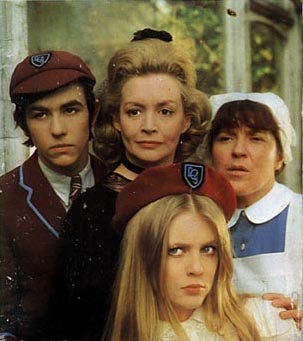
Mumsy, Nanny, Sonny, and Girly (1969, dir. Freddie Francis)

If you never heard of this film, I can’t fault you. It is an obscure little British horror-comedy that has strong genetic ties to The Addams Family, but more macabre. Full of murder, mayhem, and some very unnerving incestous overtones, Girly (for short) is one of the funniest black comedies I have seen in awhile. In the US we tend to put the crazy killers of our films at the bottom rung of the socio-economic class and basically kick the poor while they’re down. The wonderful thing about the UK is the intense dislike of the aristocracy, even by a lot of the aristocracy themselves. Thus, a film as wonderfully insane as Girly can come about and skewer the 1950s nuclear family unit.

Somewhere on a palatial English countryside estate lives Mumsy, Nanny, Sonny, and Girly. Though Sonny and Girly are obviously in their twenties, they still dress and behave like schoolchildren. Sonny and Girly also have a rather queasy relationship that is hinted at but never made explicit. Also in the mansion live the Friends, homeless men and free love hippies lured to the house and locked up for the sadistic pleasure of the quartet. The introductory friend finds he is unwelcome when he can’t follow the rules Mumsy has set up to run her happy home. As a result he’s decapitated. But into their lives comes New Friend, a gigolo who through a series of gruesome circumstances ends up trapped. Unlike previous Friends, New Friend is a conniver and begins his quest to tear about this happy homicidal home.

Girly was the project of acclaimed cinematographer Freddie Francis, the lens behind such films as Tales of Hoffman, the Gregory Peck Moby Dick, and The Innocents. Francis transitioned into directing in the early 1960s and went on to helm some cult British horror films and established him as filmmaker who brought a lot of visual flair to his pictures. Francis would eventually return to working the camera and was responsible for the cinematography on such films as The Elephant Man, Dune, Glory, and Scorsese’s remake of Cape Fear. Girly was originally a stage play (you can feel the more theatrical moments in the film). The premise of the film is a lampooning of the “traditional” family unit at the hands of the 1960s counter culture.

The film is very fun, dark fare. It’s never truly horrifying, just the kind of violence that gives off a creepy vibe and elicits laughs more than gasps. The middle of the picture meanders a little bit, becoming a bit of a struggle to work through, but the way New Friend begins to tear apart the four members of the family by turning them on each other is enjoyable to watch. Definitely an odd, incredibly obscure picture worth a watch.

Hypothetical Film Festival – Best Horror Remakes Evrrrrrrrrrrr!

With the remake of Wes Craven’s A Nightmare on Elm Street there is yet another horror film being “re-imagined” in theaters. But remaking horror flicks has been a mainstream trend since the 1960s and Hammer Studios buying up the Universal monsters. Here’s a film festival devoted to movies I think are the best among horror remakes.


Nosferatu the Vampyre (1979, dir. Werner Herzog)
Starring Klaus Kinski, Isabelle Adjani, Bruno Ganz

Acclaimed German filmmaker Herzog decided to remake F.W. Murnau’s vampire film, believing it to be the best film ever produced by a German director. The original silent Nosferatu was made as a result of the inability to get the right to the Dracula novel. Murnau makes a few tweaks, such a dehumanizing the title vampire lord even more. When Herzog’s version came long Dracula was now in the public domain so he was able to absorb more elements of it into the story. Certain scenes are exact recreations of the original silent picture but Herzog also develops the title vampire’s personality further, causing him to become a sad, pathetic figure more than a completely menacing inhuman monster. Also, there are few actors who were as prepared to play a ghoul as Klaus Kinski.


The Thing (1981, dir. John Carpenter)
Starring Kurt Russell, Keith David, Wilford Brimley, Richard Dysart, Richard Masur

The original The Thing From Another World (1951) was directed by genre jumping master filmmaker Howard Hawks and reflected a post-Hiroshima fear of science. Carpenter’s remake was much more faithful to the source novel and included the element of the alien’s ability to mimic the cellular structure and appearance of living matter. Kurt Russell plays a member of an Antarctic science crew who encounter a husky running loose and its Norwegian science expedition owners trying to kill it. They learn quickly that the dog is a microbacterial alien species bent on wiping out all life on earth to appease its evolutionary directive. The film has some of gnarliest special effects ever put to film and creates a pitch perfect tone of paranoia.


Little Shop of Horrors (1986, dir. Frank Oz)
Starring Rick Moranis, Steve Martin, Ellen Greene, Vincent Gardenia, Levi Stubbs

Director/producer Roger Corman is known by the loving term of “shlockmeister”, meaning he makes cheap, exploitative genre pictures that have total cult followings. His 1960 flick The Little Shop of Horrors was turned in to a stage musical in the 1980s and that was how we got this wonderful horror-musical-comedy. Moranis is Seymour, a plant store employee who discovers a strange plant that feeds on blood and flesh. He’s able to satiate with pin prick from his finger until the creature grows larger and he must resort to murder. The picture balances the right level of black comedy with a satirical commentary on early 1960’s America. Ellen Green is definitely the musical highlight of the film, reprising her role on the stage as Audrey. The special effects for the evil man-eating plant Audrey II are also wonderful, particularly its final “adult” form.


Evil Dead II (1987, dir. Sam Raimi)
Starring Bruce Campbell, Ted Raimi

In 1981, Sam Raimi released cult favorite The Evil Dead and it opened doors for him to work on some slightly higher budget crime pictures. As the 80s came to close he accrued enough funding to remake this first great film. I know I was confused when I started watching this and realized it functioned as both a remake and a sequel to the first picture. The events of the original movie are retold in the first 20 mins while a new parallel story involving archaeologists is introduced. But all you really need to know about this one is that it has Bruce Campbell in it. And he gets a chainsaw hand. I mean the entire Spider-Man trilogy has nothing on that. This picture ends on a cliffhanger that leads into 1993’s Army of Darkness.


The Ring (2002, dir. Gore Verbinski)
Starring Naomi Watts, Daveigh Chase, Brian Cox, Amber Tamblyn

This remake is much better than its 1998 Japanese original. Here the city and atmosphere of Seattle are used to perfection without ever naming the city or making a spectacle of its skyline. Instead, the soaked, rainy, bleak tone of the region underscores the looming horror. A videotape is passed around and comes with the warning that anyone who watches it will die seven days later. It ends up in the hands of a Ruth, a woman working in the media. She watches the tape and is now in a race against time to figure out the origins of this phenomenon and possibly how to stop it. The picture is full of incredibly disturbing imagery and is able to use CG effects without feeling like we’re staring at a green screen. It also has one of the best twist endings and earns every second of it. They rarely make horror this enjoyable these days.

Wild Card Tuesday – A Nightmare on Elm Street (1984)


A Nightmare on Elm Street (1984, dir. Wes Craven)
Starring Heather Langenkamp, Robert Englund, Johnny Depp, Ronee Blakely

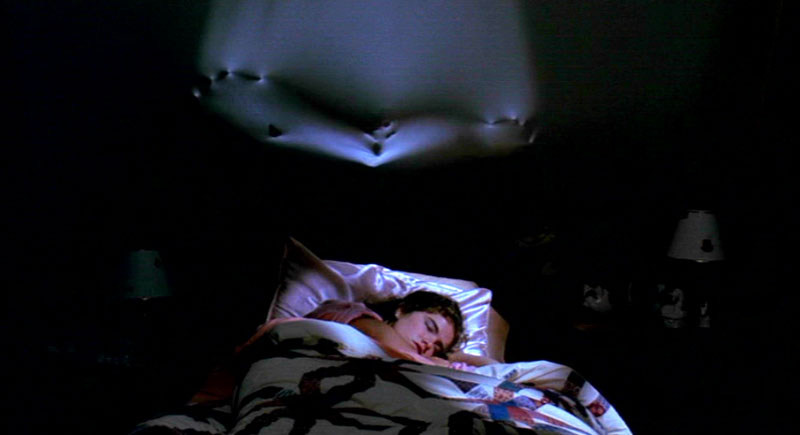
I remember the first time I ever heard about Freddy Krueger. I was 8 or 9 year old and sitting in my backyard in Smyrna where a neighbor kid was describing the R-rated horror films his parents had let him watch. Nothing stood out about Freddy that was too frightening to me, I do remember the description of the glove sounding creepy. Now it is twenty years later and I am finally seeing the film that was described to me all those years ago. So how does Wes Craven’s 1980s horror classic stack up?

It takes barely any time for us to jump right into the thick of the plot. Nancy and her friends, Tina, Glen, and Rod are all suffering from nightmares about the same evil figure. He’s a man with a burnt face, in a fedora and striped sweater who wears a glove with blades on each finger. All four spend the night at Tina’s house and their slumber is interrupted by Tina’s brutal disemboweling by an invisible force. Tina’s thug boyfriend Rod is the only suspect and ends up in jail. But Nancy thinks otherwise and has her own face to face encounter with the man who calls himself Freddy. Nancy chooses to forgo sleep as she searches for answers about why this man has targeted her and her friends. But how long can she go without giving in to her exhaustion?

One of the things I noticed right away was how muted Freddy was. I was so used to the personality later films had developed of him as a wisecracking murderer that it was off putting to see him only have a few pieces of dialogue in the picture. Craven also chooses to keep Krueger’s face in the shadows most of the time and the make up effects are fairly simply, just a face damaged by fire and turned to scar tissue. I could also see the novelty of how Freddy kills. Figures like Jason and Michael Meyers are fairly one note. They stalk you and stab you. The added twist that you are in danger in your dreams does come across as a greater threat. There’s no authorities to go to that can save you in this instance.

Overall, the film doesn’t feel very frightening. I think having so many of its scenes used in specials detailing iconic horror and the Freddy Krueger character having been milked for all of its worth harms the ability of the film to still be affecting. I really liked Heather Langenkamp as Nancy, she felt like a real teenage girl who wasn’t a huge breasted pin up. The normality of Nancy definitely made her a much more sympathetic character than your typical horror scream queen. The acting was weak for the most part but the film is based on the premise that you will see gruesome kills, not great performances.

I was left with the desire to go back in time and see this film in the theater with an audience who was unaware of what they were getting. I have a feeling it would have been extremely fun. Now horror has become so clichéd and trite that its hard to have that jump in your seat experience anymore. Hoping the remake of Nightmare can find some way to reintroduce Freddy and give us surprises rather than a retread.

Director in Focus: Brian DePalma – Dressed to Kill


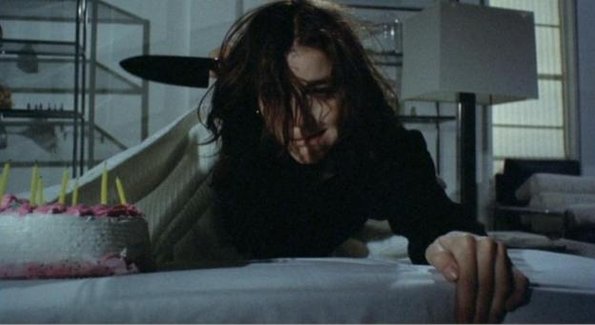
Dressed to Kill (1980)
Starring Angie Dickinson, Michael Caine, Nancy Allen, Dennis Franz, Keith Gordon

I have said it many times about de Palma already, but the man was obsessed with emulating Hitchcock. Here in his blatant nod to Psycho, we have a film that stays above water simply because of its stylistic flourishes. While much more entertaining and better at keeping my attention than Obsession, it lacks some of the depth of a picture like Sisters or Carrie. And there are moments that trend uncomfortably into homophobic territory as well as scenes that could be interpreted as heavily misogynistic. While I don’t think De Palma hates women (they feature heavily in all the features I’ve seen so far), I do think is highly attuned to the traditional portrayal of women in cinema as constant victims.

The film opens with a heavily “porn-y” shower scene featuring Angie Dickinson as Kate Miller. The heavily erotic scene ends up being a dream sequence and we learn Kate is a housewife who frequents the office of Dr. Robert Elliott (Caine), a psychiatrist attempting to help her through her psycho-sexual hang ups. After a visit which ends in Kate attempting to seduce Elliott, she travels to a local museum where she and a stranger flirt and end up in bed together. It’s at his point a catalytic murder occurs that brings a high priced call girl (Allen) and Kate’s son (Gordon) into the film. At the same time, Elliott is receiving threatening phone calls from a transsexual patient who is threatening to murder. All of these elements intertwine into a very over the top psycho thriller.

While there is a lot lacking in the structure of the film’s story, it can never be said that De Palma is incapable of filming a tightly crafted scene. The pursuit and withdraw flirtation scene in the art museum is a perfect example of how the director can create a scene without a single line of dialogue that tells the a complete story. The scene continues into a discovery Kate makes that sends her running from her lover’s apartment and once again contains zero dialogue. The movie is filmed through a sensual haze and has some moments that stand out from others, such a scene late in the film that takes place in a mental asylum. The lighting is a schizophrenic blue that seems to accentuate the twisted nature of what takes place there.

Yet, the film is more a style over substance endeavor. Nancy Allen lacks the skill to make her role sympathetic or interesting. Her line delivery can be truly excruciating at times. But she was sleeping with the director (they were married) at the time so how she got the role was by default. Michael Caine keeps things stoic and nonreactive throughout the film and because that is part of the character its hard to say if this was a poor performance or not. Angie Dickinson is definitely the standout in the picture, and her role consists of very little dialogue. She is a picture of class and is able to provide the perfect amount of information without speaking a word.

Dressed to Kill was certainly entertaining and is viewed best as a campy thriller in the vein of Hitchcock. It wouldn’t surprise me in the least if most people guess the film’s twist fairly early on. The story is fairly transparent and de Palma does cheat a little in an effort to cover it up.

Next up: Blow Out

Wild Card Tuesday – Dead Silence


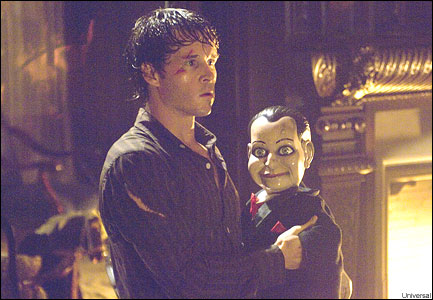
Dead Silence (2007, dir. James Wan)
Starring Ryan Kwanten, Amber Valetta, Donnie Wahlberg

There is just something frightening about facsimiles of humans (i.e. dolls, dummies, mannequins). They have been fodder for horror since the 1920s when both Lon Chaney and Erich von Stroheim played ventriloquists using their wooden cohorts for nefarious purposes. This film seeks to find itself amongst the best of this style of horror and is helmed by the creative team behind the Saw franchise. It begins with a promising opening sequence that evokes a strong atmosphere, but eventually falls into the same chasms contemporary horror can’t seem to help but seek out. A lot style and technique over any substance.

Jamie receives a package at his apartment with a ventriloquist’s dummy inside. He leaves the house to pick up some food and while he is gone the dummy appears to murder his wife, taking her tongue. The police of course suspect Jamie is behind it and a detective is assigned to follow Jamie. Our protagonist returns to his hometown of Raven’s Fair, which happens to have a ventriloquist-related curse behind it. It seems a Depression era performer named Mary Shaw was murdering children and the townspeople assembled a mob who killed her and cut her tongue out. Now her ghost, through the dummies is killing off the members of Jamie’s family as revenge.

James Wan is not a bad cinematographer. Using the best cameras available today and tight editing he generates the perfect amount of atmosphere. The set design is top notch and I especially liked the set piece of he Guignol Theater set in the face of a cliff, alongside a lake. Even the dummies presented throughout the film are very effective. Everything came off with the tone of a great, over the top William Castle horror flick. However, the rest of the film is horrendously terrible.

Wan falls back on the same cliche scares again and again. If you have watched even a minimal amount of horror films in the last decade you could easily write the rest of the script after the first 20 minutes of the picture. There seemed to be a plethora of evil things underneath sheets and dummies menacingly turning their eyes to stare at a potential victim. The attempt to add quirks to characters extends no further than having Donnie Wahlberg’s character act like an obsessive facial hair trimmer. And the final “shocking” reveal of the picture has so many plotholes you can see straight through it. The movie ends up being yet another contemporary horror film to be thrown into the $5 bin at Wal-Mart.

Director in Focus: Brian DePalma – Sisters


Sisters (1973)
Starring Margot Kidder, Jennifer Salt, Charles Durning, William Finley

Sisters is director De Palma standing up and yelling, “I love Hitchcock!”. He got Bernard Hermann, Hitch’s composer and most famous for the the slashing string crescendo of Psycho, he gives us murder enigmatically glimpsed from an apartment window, he gives us crazy camera tricks such as split screen wherein figures meet between both views, and many more flourishes that express his admiration for the great suspense director that Hitchcock was. And this film is as disturbing, if not more than Hitch at his most macabre.

The film uses a Hitchcock bait and switch technique of making us believe one character is our protagonist only to kill them off about 20-30 mins into the film. The focus of the story is Dominique (Kidder), a French-Canadian model who is plagued by a possessive ex-husband. Her current date, Phillip, a gentleman she met while working on a game show, escorts her home and helps her ditch the ex-husband. Phillip spends the night and goes out to pick up some medication for Dominique. It’s at this point the film goes into psycho overdrive and it is so much damn fun. A neighbor, reporter Grace Collier sees a murder take place through her window and into Dominique’s. The police show up and there’s no blood or body.

What makes the picture so much fun is how unashamedly de Palma is referencing Hitchcock’s work. A murder clean up scene is straight out of the overlooked Hitchcock picture Rope and the way the director plays the idea can’t help but get your adrenaline going. Jennifer Salt as Grace plays the traditional Hitchcock style protagonist perfectly. She is determined and focused, despite the skepticism of others around her. She even gets a Grace Kelly (a la Rear Window) in the form of Charles Durning. Durning plays a P.I. hired by her editor to help gather facts for her story.

Alongside all the blatant Hitchcock imagery, there’s some interesting subtext about women and their subjugation. Both Danielle and Grace are victims of being forced into a particular societal role. Danielle’s is much more external, while Grace’s is a psychological one. Having that subtext in mind makes Grace’s final scene in the film even more chilling, as it appears she has been defeated. The film ends in a strangely ambiguous way, referencing its opening game show sequence titled “Peeping Tom”, a nod to both the Michael Powell film and the act of voyeurism in general. The finale features a character watching, and waiting, with the solution to our mystery hanging up in the air with it.

Director in Focus: Brian DePalma – Carrie

Some pre-conceived notions about Brian DePalma: Before I get into the review of this first picture in the DePalma series, I will address some ideas I have about this director. Of Mr. DePalma’s films I have seen are Phantom of the Paradise, Raising Cain, Mission: Impossible, and Mission to Mars. I wouldn’t say DePalma is a director I actively dislike, I just have never been overly impressed with him. Without further ado, my first review:


Carrie (1976)
Starring Sissy Spacek, Amy Irving, Piper Laurie, Betty Buckley, Nancy Allen, John Travolta, William Katt, Edie McClure, PJ Soles

I was homeschooled through my entire elementary, middle, and high school grades. So, I was never subject to the sort of direct bullying I’ve seen in countless films and television shows. I definitely was raised in a sporadically religious home and was a quiet kid, so I felt some connections to the character of Carrie White. My ideas about this film from its osmosis into popular culture was that Carrie is a “weirdo” character. I found myself pleasantly surprised by the depth actually brought to her in the film.

In the town of Bates (named after Hitchcock’s nefarious Norman), is the home to quiet and shy Carrie White (Spacek). In the opening of the picture, Carrie experiences her first period while in the girls’ showers at school. Her mother (Laurie), has kept Carrie completely ignorant of her own sexuality and Carrie immediately thinks she is dying. The other girls mock her, tossing tampons at the poor girl as she cowers. Miss Collins (Buckley), the PE teacher chastises the girl and comforts Carrie. As punishment, the girls are forced into an afterschool PE detention, which causes popular girl Chris (Allen) to harbor resentment towards Carrie. Conversely, Sue (Irving) feels bad about the incident and convinces her boyfriend to ask Carrie to the prom. If you are aware of the way this film has been parodied since, then you know how things turn out.

The picture has not aged too well. The majority of the music, particularly a lot of light-hearted montage scenes feel incredibly cringe-inducing. Piper Laurie, who plays Carrie’s mother, is an actress who hasn’t met a piece of scenery she hasn’t enjoyed chewing and that’s fun for the most part. I was reminded of author Stephen King’s cliched zealous fanatic archetype that seems to crop its head in almost all his work. However, I can definitely see how a lot of the high school movie tropes were borne out of this film. Nancy Allen as the uber-bitch Chris does an excellent job and Amy Irving as Sue comes across very genuine.

Where the film won me over was the famous prom scene. Wow! The tension that DePalma is able to create in the moments before poor Carrie is pushed over the edge are breathtaking. He is most definitely a skilled editor, knowing how long to stay on a shot before cutting to a reaction or image related to the previous shot. It’s like a cinematic Rube Goldberg device where every little piece click and leads to the next perfectly. The music here is an homage to the work of Hitchcock’s composer, Bernard Hermann. Hermann died before he could compose the score for Carrie so it was brilliant to make it a reference to his previous works, especially Psycho; four notes of that film’s score are heard repeatedly through the film.

I was most impressed with the portrayal of Carrie White. She was not the “weirdo” or “freak” you might see portrayed in derivative films made since. Carrie shows resentment and anger towards her mother about not being told about her sexuality. She isn’t completely naive and shows reasoned skepticism when invited to the prom. And Spacek’s choices in acting, particularly in her scenes with actor William Katt at the prom are exceptional. I found this to be a great start to my exploration of this director’s films. It wasn’t perfect, but it showed a wonderful sense of pace and restraint that a lot of contemporary horror films could learn from.

Maybe Sundays – The Crazies (2010)


The Crazies (2010, dir. Breck Eisner)
Starring Timothy Olyphant, Radha Mitchell, Danielle Panabaker, Joe Anderson

The Crazies is only a zombie film by default. It’s “monsters” aren’t the walking dead at all, but people infected by viral weapons designed by the United States military. And one could easily debate if the villains in the film are the townsfolk or the emergency response military troops that come to kill them all. Based on a 1973 George Romero cult flick, this film follows the same premise but with some modern tweaks and a lot better character development than the original.
The story begins with Ogden Marsh Sheriff David Dutton attending the opening game of the high school baseball season. A town farmer arrives on the field, behaving strangely and brandishing a shotgun. David to shoot and kill the man when he draws his weapon on the crowd. Over the next day, more cases of similar behavior surface causing David and his doctor wife, Judy to suspect something sinister is at work. In the middle of the night military forces show up in Ogden Marsh, rounding up citizens in makeshift internment camps.
It’s obvious the film is expanding on the anti-government paranoia of the 1970s with a post 9-11 spin. What I picked up on most was that almost every infected townsperson is a familiar face that we’re allowed to pick up some details about before they become a monster in the film. With the military, we only see one soldier’s face. The rest are constantly wearing hazmat suits or full fatigues with gas masks securely planted over their faces. This conceit causes the military to come off as much more of the mysterious evil force than the infected. In fact, the greatest horror of the film is performed by the military in the film’s finale.
Despite this, the film falls into the most cliched of cliches in the horror business. There was an inordinate number of times where we were given a cheap jump scare from someone being touched on the shoulder. And I counted at least twice where a scare was revealed by the camera simply panning to the right to reveal an infected in the room. It’s these easy paint-by-the-numbers techniques that take a film, which could have been interesting and tapped into some interesting zeitgeist, and turn it into a $5 DVD bin flick for Wal-Mart.

Film 2010 #35 – Shutter Island


Shutter Island (2010, dir. Martin Scorsese)
Starring Leonardo DiCaprio, Mark Ruffalo, Ben Kingsley, Michelle Williams, Max von Sydow, Emily Mortimer, Patricia Clarkson, Jackie Earle Haley, Elias Koteas

My immediate reaction after seeing the first trailer for Shutter Island was that it would be interesting to see Scorsese tackle a film with horror elements. After thinking about this for a little while longer, I realized he already had in Taxi Driver, a film I think of as an urban horror picture more than anything else. Upon further contemplation, I realized we found similarly paranoid protagonists in many Scorsese pictures: The King of Comedy, Raging Bull, Goodfellas, and of course, The Aviator. This is why Shutter Island, while stylistically a departure for the directing legend, is thematically at home in his body of work.
The premise brings U.S. Marshall Teddy Daniels (DiCaprio) to the Ashecliffe Hospital for the Criminally Insane located on Shutter Island. Rachel Solando, a patient at the asylum has vanished so Daniels, and his new partner Chuck Aule (Ruffalo) have come to investigate. Daniels is introduced to the facilities by Dr. John Cawley (Kingsley) and eventually meets the head of the hospital, Dr. Naehring (Sydow), a German who brings back Daniels animosity for the Nazi atrocities he witnessed during World War II. This combined with strange nightmares about Daniels’ late wife intensify his paranoia while on the Island and he begins to formulate what he believes is the real horror going on behind the scenes on Shutter Island.
What hits you first about this film is the score. The music was designed and chosen by long-time friend of Scorsese and former member of The Band, Robbie Robertson and he proves he has an ear for some powerful modernist compositions. There are elements of Bernard Hermann yet never played to the point of absurdity. Because of the strong musical elements they create a balance with the unscored moments. An encounter in a cave among the cliffs of the island goes unscored, despite there being revelations made there that would have received a crescendo of strings in an older picture. It’s those choices of presence and absence that strike the right balance in the film.
At its core, this is simply a variation on the haunted house trope. What sets it apart from a B-movie are the very powerful artistic masterstrokes Scorsese uses. The dream/nightmare sequences Daniels experiences, whether they be in sleep or in the middle of the day, inform the audience with the clues the investigator fails to find in the conscious world. I was particularly intrigued by the cultural paranoias of the day that seeped into the fiber of the film. We have Daniels haunted by the sights of Jews frozen to death at Dachau and his unit subsequent expunging of the camp’s guards in an era where PTSD was not something remotely thought about. In addition, characters mention the fears of atomic annihilation as a result of the Cold War, the idea of Nazi scientist-torturers being granted pardons for service to the US military, and brainwashing techniques of HUAC. This constant atmosphere of not-knowing and being watched makes Shutter a perfect companion piece to The Aviator.
Shutter Island may not end on the most satisfying of notes, but there really is no other way for it to end. Such a story can’t deliver any true sense of justice and still remain true to its film noir and horror roots. From the first time we see Daniels, hunched over a toilet as the ferry rocks around him, it is apparent this character is in bad shape. An odyssey to an island of madness can never make such a condition better.