Wild Card Tuesday – Hunger


Hunger (2008, dir. Steve McQueen)

Starring Michael Fassbender, Liam Cunningham
The fight between Catholic and Protestant sides in Northern Ireland has devastated that country since the late 1960s. Each side has visited monolithic brutality on the other in of the greatest displays of community inflicting such cruelty on itself. But the cruelty that was the worst, was that of employees of the British empire on IRA members imprisoned in facilities across the country. Director Steve McQueen never give support for the terrorist actions of the IRA, but advocates that all prisoners, regardless of their crimes, deserve humane treatment.
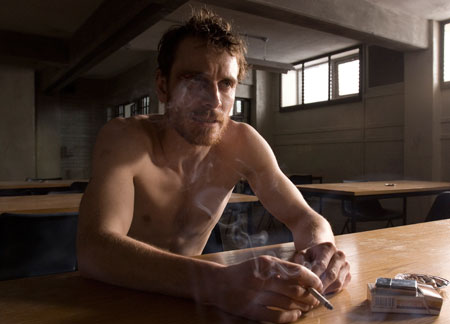
The film’s focus is real life IRA soldier Bobby Sands (Fassbender). While the film doesn’t explicitly cover his activities with the IRA, he was no saint. He helped ferry weapons for the movement and was involved in the bombing of a furniture store in 1976. The film chooses to portray Sands as a figure unwilling to budge an inch for the brutal authority crashing down around his head. In this effort he has allowed himself to become dehumanized. Simply put, he has been caged and treated like an animal, so he will behave like one. Sands smears the walls of his cell with his own feces, allows the daily meals to rot and mold in a corner, and funnels his bed pan (synchronized with the other prisoners) out into the hallway. Is it vile? Yes. But there something innate within us that despise authority that wishes to break us, so it comes off as bizarrely admirable.
Bobby’s most memorable, and final, triumph came when he began a hunger strike in 1981 which took his life after several painful months of starvation. Michael Fassbender destroyed his body through malnutrition to take on the gaunt, sunken appearance of a Holocaust victim. He become the specter of death with additional help from an incredibly talented makeup department. His back is covered in open sores, he’s unable to urinate for the prison doctor’s physical, and he stains his sheets with black, acrid blood. The moments before Sands passes are truly powerful. The film moves into his consciousness as hallucinations of his younger self appear and his mind travels back to long distance race where he and both Prot and Catholic youths ran together, in fields of golden amber. Director McQueen doesn’t want you to take the IRA’s side, he wants you to realize how irrelevant any side is, and simply see a man dying.
The aesthetic choice made by McQueen are magnificent. For the first 30 minutes of the film there is little or no dialogue. Only 50 minutes in is there an actual conversation between two people for extended amount of time. Here Sands and a priest from his community debate the point of standing in defiance of authority. The priest tells Sands he must submit to the uniform being enforced on the prisoners and Sands simply won’t budge. Once again, neither side wins in the debate. They simply come to the conclusion that neither of them will change their ideas about it. Hunger is one of the best examples of director using the language of cinema to tell a visceral and moving story. There is no maudlin sentimentality, yet there is a deep emotional core. Not for those lacking a strong constitution, but one of the most amazing British films I’ve ever seen.
Film 2010 #30 – The Secret of Kells


The Secret of Kells (2009, dir. Tomm Moore, Nora Twomey)

Starring Brendan Gleeson, Mick Lally
When the 2010 Oscar Nominations were announced I’m sure I wasn’t the only one who wondered “What the hell is The Secret of Kells?” Well, it’s an independently produced Irish film that played for a week in L.A. to qualify for the Academy Awards. The nomination will definitely garner attention for the film when it receives an expansion on American screens on March 12th, but is the picture deserving of the nom? A million times yes, and while Up will probably win because of its notoriety and box office, The Secret of Kells brings a style drastically different from the Disney formula that dominates American animation.
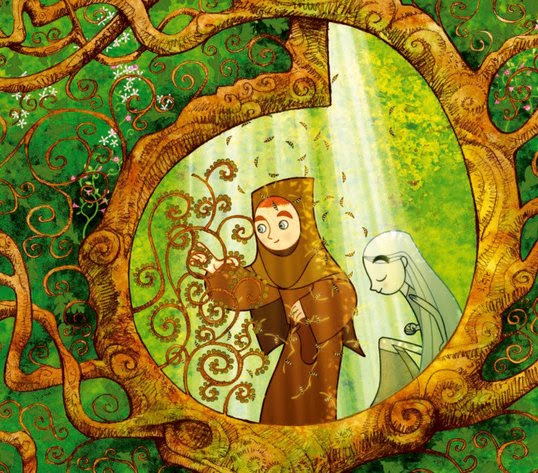
The story of The Secret of Kells is based in the history of Ireland circa 1006 A.D. The Vikings are massacring and raiding any village them come across in the hopes of amassing gold. The Abbey of Kells has become a sanctuary for many monks whose island homes have been burnt to the ground. Now, surrounded by the deep forest, they have gone back to creating gloriously intricate illuminated texts while the Abbot Cellach works to finish the wall before the Vikings arrive. Cellach’s nephew, Brendan befriends Brother Aidan, the monk who has been working on the Book of Iona, believed to be the most beautiful illuminated manuscript ever made. Aidan enlists Brendan’s help in gathering the supplies needed to finish the text by gathering inkberries for him in the forest. Brendan sneaks away, meeting the fairy Aisling, who introduces him to the wonders of the world outside the walls of the abbey.
The intricacies of the animated work in this film are astonishing. From the moment of the prologue, narrated by Aisling, there is no doubt that the love put into the picture is remarkable. The clever reasoning behind the level of detail is a direct nod to the craftsmanship put into illuminated manuscripts by monks. The same swirls, flourishes, and Celtic crosses seen in the texts can be found hidden amongst the gnarled roots of trees and clusters of leaves and flowers. The subtext here is that Brendan can only rise to the level of his hero, Aidan, by journeying beyond the walls of his limited experience. Someone like Aidan has been able to create such a beautiful piece of art because he has confronted his fears and conquered them.
While Brendan’s story does follow closely to the accepted hero’s journey archetype, there are many story beats that separate this film’s plot from others. The unblinking look at violence at this period of time and this part of the world is very much there. When the Vikings rear their ugly heads it is apparent that they leave few alive in their wake. There is also tragedy of other sorts in the film’s climactic sequence involving the unfinished abbey and its weak scaffolding. But the subtext throughout is telling us fear will be your end. Running frightened and unthinkingly at the sight of your fear leads you into destruction, but those characters who use their wits and remain calm are able to escape.
My own personal opinion is that the originality of content and artistic achievement of The Secret of Kells earns it the Best Animated Feature. However, the Academy Awards is usually more reflective of a mix between artistic elements and public awareness, meaning Up is the most likely candidate. Not to take away from Pixar, they would probably argue in favor of Kells as well, but I am excited for this film to reach a wider audience and gain more enthusiasm like mine.