I Am The Pretty Thing That Lives In the House (2016, dir. Osgood Perkins)
Horror is a genre that has grown nearer and dearer to my heart since I was a child watching the edited for television version of The Shining and reading kiddie anthologies from the public library. With time, I feel my taste has been refined, initially being genuinely scared of schlock like The House on Haunted Hill 1999 remake and now finding most mainstream jump scare driving horror sleep inducing. I’ve settled into a love of creeping horror, slow burning crawls toward the inevitable oblivion at the hands of what waits in the shadows. What truly feels like horror to me is that existential dread, the realization that you are powerless against horrors that have reached a level of forces of nature. A fated doomed is one of the worst horrors an individual could come across, learning that no matter what course of actions you took you were going to come head to head with the destruction of your life.
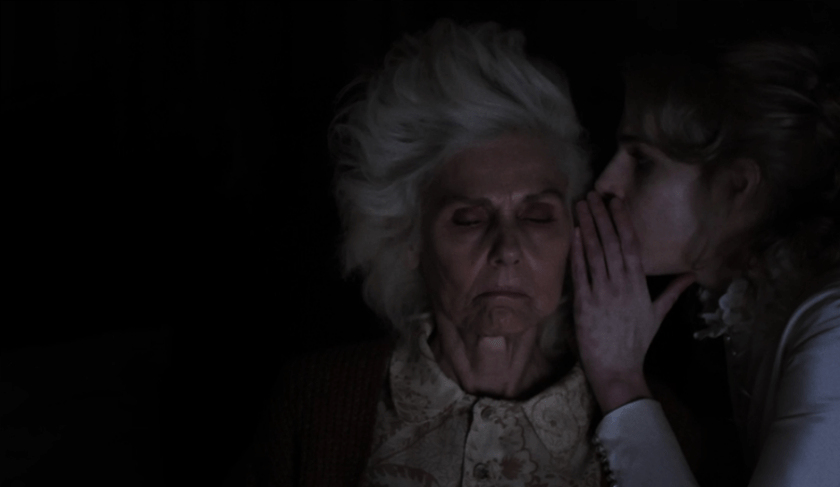
Lily has taken a job as the hospice nurse to the ailing Iris Blum, the author of mass market horror fiction. The house Ms. Blum inhabits has a dark history, the original owner and his wife vanished just after they were wed. From the outset of the story, Lily lets us know she will die within a year of working for Ms. Blum. Lily’s narration is intentionally anachronistic and flows in and out of readings of Blum’s The Lady in the Walls novel. This fluidity of time and the sense that we are not in a fixed location in time is essential to understand what is/has happened to Lily.
I Am The Pretty Thing is the second of director Perkins’ films I’ve seen in the last couple weeks. I previously reviewed The Blackcoat’s Daughter and would say I enjoyed it more than Pretty Thing. However, Pretty Thing is one of the most richly literary horror films I’ve ever seen. I recalled The Turn of the Screw as I watched it and the adaptation, The Innocents starring Deborah Kerr as a governess in very similar shows as Lily. There is not an interest in jump scares as there is in ratcheting up tension or exploring a more ethereal horror.
Perkins, son of the late actor Anthony Perkins, is very aware of the tropes at work in this film and his father’s iconic picture Psycho. However, there is an elegance to the horror that Psycho pushed to the side for shock value. Nothing ever feels like a shock in Pretty Thing, more a dreadfully expected outcome. There is a coldness to the proceedings; Perkins takes a very neutral observational tone. Lily’s narration, while intimate, is absent the sense of emotion, which makes sense as she is reflecting back from death at the circumstances at the end of her death. The way the threads of Lily, Ms. Blum, and the mysterious ghost that haunts the house are brought together for the climax is incredibly clever and is an example of how beautiful horror can be at moments.
I Am the Pretty Thing demands the patience of the viewer, so if you are a fan of fast-paced, instant gratification horror, then I don’t think you would find much to enjoy here. However, I would encourage anyone who seeks out horror as a truly emotional disturbing experience to sit down and view this film as soon as possible. Much like The Blackcoat’s Daughter, the film itself is a haunting, leaving questions open but answers implied, enough to force the viewer to live with for some time after.
The Adventures of Sherlock Holmes’ Smarter Brother (1975, dir. Gene Wilder)
England’s foreign secretary has a critical document stolen from his home. There’s only one person who can track it down, Sherlock Holmes, with his assistant Watson of course. However, Sherlock knows this case will be a bit more complicated than his typical work and assigns it to his oft-overlooked little brother, Sigerson (Gene Wilder). Sigerson teams with Scotland Yard’s records clerk Orville Sacker (Marty Feldman) to uncover the circumstances behind the theft. The trail appears to lead to Bessie Bellwood (Madeline Khan) who claims the foreign secretary is her father. Also involved and lurking in the shadows in the infamous Professor Moriarty (Leo McKern).
Coming off the massive success of Young Frankenstein, Wilder was able to write and direct Smarter Brother. He brought Marty Feldman and Madeline Khan back into the mix, and it’s pretty obvious there’s an attempt to recreate the magic of Mel Brook’s Young Frankenstein. The film most definitely does not achieve that, but it isn’t a complete failure. There are some genuine laughs, and the plot structure holds up well. The comedy informs the plot which in turns let’s many jokes hit well. The problems arise in the form of the comedic tone. The script doesn’t quite know if it wants to be a farce of Sherlock Holmes stories or a simple comedy-adventure. There are moments with exaggerated sight gags, but then more subtle wordplay humor. The comedy rules of the universe aren’t established as clearly as Young Frankenstein does in its opening moments.
Wilder is hitting his mark quite well; he has the charming personality with the moments of ridiculous outburst. He has a couple of set pieces that involve stunts on top of horse carriages and some good sword fighting. You can see the seeds of a film like Silver Streak being sewn with Wilder’s interest in living out the dashing hero trope. I was particularly impressed with Marty Feldman’s acting. I don’t have a considerable knowledge of his work beyond Young Frankenstein, but I didn’t expect the sort of quiet, sly character we get. The dynamic between Wilder and Feldman is developed further here with Feldman’s Sacker being the smarter of the pair and playing his quiet intelligence off of Wilder’s arrogant Sigerson. Madeline Khan delivers yet another force of nature comedic performance. While we have many strong female comedic actresses today, I don’t know too many who just have the sheer power that Khan brings again and again to every film. She seems like she was a very fearless actress who understood what made comedy funny at its core more than most.
Helping from the sidelines are McKern as a Moriarty with a strange nervous tic, Dom DeLuise as Gambetti the loud and boorish opera singer, and Roy Kinnear (Veruca Salt’s dad from Willy Wonka) as Moriarty’s always shat upon right hand. Everyone does well with what they are given, but like I said it doesn’t reach near the comedy heights as Young Frankenstein. One set piece does stand out as some brilliant writing from Wilder, a staging of Verdi’s opera Un Ballo in Maschera, translated into English by DeLuise’s Gambetti. The lines are sung in a very casual, informal, almost slang version of English undercutting the rich production design. “Let’s drink some sexy wine” becomes one of the key lines of the performance.
As far as the less notable Wilder films I’ve explored, this stands out as one of the better works. This gives me hope for The World’s Greatest Love, The Woman in Red, and Haunted Honeymoon, all directed by the man. Wilder’s next picture would be Silver Streak, but that would be followed up by The World’s Greatest Lover which has him playing an actor during the silent film era. And we’ll look at that, next time.
In a matter of days, the next President of the United States will be decided. During this tumultuous time, it can be fun and educating to look at how films have portrayed candidates, elections, media, and the government. Here’s a line-up that spans the spectrum between serious social drama to goofball satire.
The Candidate (1972, dir. Michael Ritchie)
While based on a 1970s election campaign, the ideas and political machinations present in The Candidate still feel very fresh. Peter Boyle plays an election strategist who is tasked with finding a Democratic candidate to go up against a seemingly unbeatable Republican senator in California. He find the candidate in Bill McKay (Robert Redford) a community activist who is the son of a former California governor. McKay is reticent to run but is eventually convinced that he can help his causes better in a position as senator. What follows is a tug of war between idealism and the cold machine of politics. Director Michael Ritchie handles the content with a very adult, intelligent eye and produces an excellent film about American politics.
Bob Roberts (1992, dir. Tim Robbins)
On the total opposite end of the spectrum when comes to tone is Bob Roberts, Tim Robbin’s passion project mockumentary about conservative Republican folk singer who becomes a populist success on his campaign to become a senator. Supporting Robbins as the titular Roberts are Gore Vidal, Giancarlo Esposito, Alan Rickman, and many more familiar faces that pop for a cameo. The film operates as both a political version of This Is Spinal Tap and genuinely (and these days realistically) terrifying examination of the campaigning machine.
Anytown, USA (2005, dir. Kristian Fraga)
The scene is Bogota, New Jersey, and the conflict is over who will be the mayor. Three candidates are clashing over the position: Republican Steve Lonegan, Democrat Fred Pesce, and independent Dave Musikant. The impetus of the dirty campaign is the cutting of funds to high school football team. The lengthy public fights and arguments are full of the story of fascinating and unexpected twists you find in great small town stories: both the Republican and Democratic candidates are legally blind, the independent candidate hires the former campaign manager of Jesse Ventura, Pesce becomes violently ill near the end of the campaign. The documentary operates as both the quirky story of a small town election and a dissection of the way modern politics divides neighbors.
The Times of Harvey Milk (1984, dir. Rob Epstein)
I first saw this documentary during a rough time in my life. Out of college, unemployed, sleeping on a friend’s couch. I flipped through the channels and came to the Sundance Channel and was pulled deep into the story of Harvey Milk. The first openly gay elected official in California, Milk was one of the last great McGovern era idealist politicians. I learned about how his public face helped push for the acceptance of LGBT Americans in all walks of life. And when the doc reached the inevitable moments of the end of Milk’s life it is heartbreaking. The interviews with the activists and co-workers who Milk meant so much to made me cry so hard that afternoon. He is one of our modern American heroes.
In the Loop (2009, dir. Armando Iannucci)
Most Americans likely know Iannucci’s work in the biting and fantastic comedy Veep. However, he started taking apart the inner workings of government and politics on the BBC’s The Thick of It. In the Loop serves as a film spin-off of that series. It features the current Doctor Who star Peter Capaldi as the foul-mouth Director of Communications for the Prime Minister. Almost, but not quite, stealing the show from Capaldi is Tom Hollander as the completely inept Minister for International Development who almost sets off an international incident when speaking off the cuff during a television interview. In the Loop is one of those comedies with jokes whizzing by so fast you’ll discover a deep vein of humor with every viewing.
Being There (1981, dir. Hal Ashby)
Based on the slim novel by Jerzy Kosinski and directed by Hal Ashby, Being There feels like a mix of Wes Anderson and Armando Iannucci’s irreverent political comedy. The jokes are mostly subtle but build to one majorly stunning ending. Chance the Gardener (Peter Sellers) is possibly the bastard son of a reclusive D.C. millionaire and he’s never left the walls of the property in the heart of the city. The owner dies and Chance is tossed out onto the street where, after a case of mistaken identity, he’s believed to be a political mastermind. Even the President seeks out Chance’s advice. There is a less than covert taking down of government and organized religion going on, which is made very apparent by the final shot. One of the best films about politics and Mr. Sellers’ final work.
A Face in the Crowd (1957, dir. Elia Kazan)
If you only know Andy Griffith from his early 1960s sitcom then you are in for a huge shock. Griffith plays Lonesome Rhodes, who starts out as a drifter and criminal but also possess an ability to coerce and convince others. A radio producer discovers Rhodes and decides to use his charisma to gather a large populist following through political broadcasts. Rhodes quickly becomes drunk on the power and gains a dangerous level of national influence. He ends up as a tool for corporate peddling, tying their economic interests to the fears of his listeners. This might be the single most prescient film about media and politics ever made. If you ever wanted to learn what goes on inside the minds of men like Rush Limbaugh and Alex Jones, here you go. The film also features the criminally underrated actress, Patricia Neal who plays the love interest and adversary to Lonesome.
Start the Revolution Without Me (1970, dir. Bud Yorkin)
There was a certain genre of film in the late 1960s and early 1970s that eschewed plot for zany, madcap romps. This can be seen in films like the original Casino Royale, The Magic Christian, and to some extent, It’s a Mad, Mad, Mad World. These are those decent budget films that just blow the roof off and have little to no narrative coherence. I can’t say with certainty, but I believe the writings of authors like Terry Southern and Tom Wolfe, the exploits of Ken Kesey’s Merry Pranksters, and the over “swinging” nature of the 1960s fed into this anarchic strain of filmmaking. Another film that I believe had a strong influence on this particular picture was the 1963 picaresque Tom Jones, an adaptation of the novel and similar, albeit less farcical skewering of 19th European society and culture.
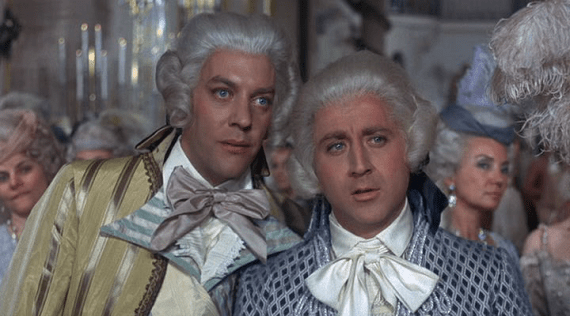
Start the Revolution begins with Orson Welles standing at a picturesque estate and detailing the events that led to the splitting two sets of identical twins between a common peasant and the Duke de Sisi of Corsica. The two sets of twins (one of each played by Donald Sutherland and Gene Wilder) end up leading very different lives. Claude and Charles become reluctant members of the French Revolution while Philippe and Pierre are spoiled degenerate aristocrats. Through a series of ridiculous circumstances the twins switch roles with the peasants mistaken for their royal counterparts and bedding down in Versailles while the Corsican brothers are pushed into the midst of the revolution.
The premise isn’t an entirely original one with twins switching places and being mismatched, and there is a lot of fun story potential when you add in the setting. However, the humor never stretches beyond a certain hackneyed level of writing. The jokes are very obvious and not too clever with some bright spots. A royal dance at the palace highlights the treacherous nature of the royal court as everyone is exchanging notes about whom each other should discreetly assassinate or poison. The other rare moments of brilliance come from Gene Wilder’s portrayal of the utterly demented Corsican brother Philippe. It’s one of those performances where he amps up the manic rage, and it works well in the first act of the film until the focus shifts more heavily to the peasant brothers.
In the context of Wilder’s career, Start the Revolution comes very early on. At this point, he’d made his big screen debut in Bonnie and Clyde and The Producers. His performance in the latter film is what likely got him this part as his performance highlights the emotional outbursts Leo Bloom showcased. The same year he co-starred with Margot Kidder in the light comedy Quackser Fortune Has a Cousin the Bronx (a film that appears to be nigh impossible to find). In both Start the Revolution and Quackser, Wilder attempts English and Irish accents which do not work. With this being the early part of his career he was still searching for the types of roles he would feel comfortable with. He was intelligent enough to know accents were not his strong suit.
Wilder would go on to star as Willy Wonka in 1971, followed by a breakout role in Woody Allen’s Everything You Wanted To Know About Sex (But Were Afraid to Ask). A re-teaming with his Producers’ co-star Zero Mostel in Eugene Ionesco’s Rhinoceros came next. The high point of his career (Blazing Saddles and Young Frankenstein) took him from obscurity to stardom, with The Little Prince tossed in for good measure. This brings us to the film we’ll look at tomorrow: The Adventures of Sherlock Holmes’ Smarter Brother.
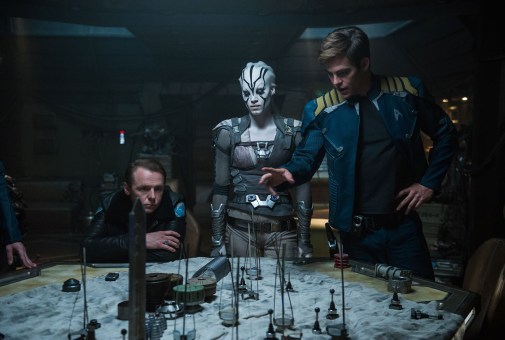
Three years into the five-year mission to seek out new worlds and civilizations we find Captain James T. Kirk incredibly bored and feeling useless. Commander Spock learns his future self; Ambassador Spock has died, leaving him to confront both the mortality of himself and the Vulcan people. It’s a very reflective time for the crew of the Enterprise as they dock at the starbase Yorktown. Things pick up when the captain of a lost alien vessel shows up and asks for help, traveling through a nearby nebula, to retrieve her vessel. Kirk jumps at the chance but quickly finds there is a more evil plan at work.
I’ve been moderately pleased with the rebooted Star Trek franchise. I was never a full-blown Trekkie, but I owned the oversized Star Trek Encyclopedia when I was a kid (I’ve always been a sucker for reference tomes about fictional worlds). I was in no way tied to the original concepts with severe loyalty, so I was excited to see something a little fresher. While 2009’s Star Trek was a hell of a lot of fun, I bristled at the clunkiness of Into Darkness. It so desperately wanted to evoke The Wrath of Khan, but it didn’t have the years of character development that invested us in that film. Plus, it undercut its significant emotional loss with the ending. I was very moderate in my expectations for the film. Knowing Simon Pegg had a hand in the script gave me some assurance that it was in good hands.
Star Trek Beyond feels like a great episode of The Original Series and is takes a standard series trope and remixes it. Idris Elba does an excellent job as the mysterious villain Krall and the adventure moves along at a nice steady pace. The character beats for our main cast feel very much like the original films, our two main players facing existential crises against the backdrop of a threat to the Federation. There were some visuals and the main baddie’s weapon that reminded me of Star Trek Nemesis, but not enough to ruin the film.
This is not a deeply intellectual film, but the Star Trek movies, when they were good, never were. The films are at their best when they balance intelligence concepts with high adventure in space. The very first Star Trek movie tried too hard to be on the same level as 2001: A Space Odyssey and ends up incredibly boring. The Wrath of Khan established the idea that starship combat could be a fun spectacle added to the series. Star Trek Beyond is mostly definitely a modern film, but one element I loved immensely is that it doesn’t feel like a part of a franchise that the studio is trying to milk. Star Trek Beyond is a single story, beginning, middle, and end. No hints at the next part or spin-offs. And these days that is very refreshing.
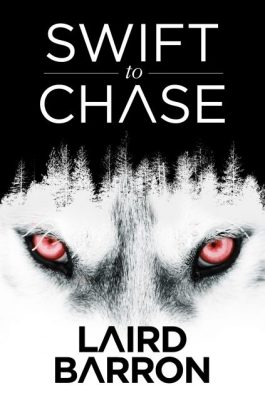
This month’s book will be Swift to Chase by Laird Barron. Barron is a horror author responsible for the short story collections Occultation, The Imago Sequence, and The Beautiful Thing That Awaits Us All. I have not tried to hide the fact that I am an immense fan of Barron’s work, particularly The Beautiful Thing collection which includes some of the most frightening short stories I have ever read. This most recent collection has been receiving very high praise and I can’t wait to dig into it with you.
“This book will go down as one of the best horror story collections of the decade. This I promise you.” – Max Booth III, Litreactor.com “Swift to Chase is the best collection of short fiction that Barron has put together so far, and likely to be among the top such books to be produced in our current decade.” Shane Douglas Keene, This Is Horror.
Bubblegumshoe is the work of Emily Care Boss, Kenneth Hite, and Lisa Steele. The game was published by Evil Hat Productions in 2016 and is a variation of Robin Laws’ Gumshoe system. Where Gumshoe has been used to tell mysteries based around Lovecraftian horror (Trail of Cthulhu), space opera (Ashen Stars), vampire spies (Night’s Black Agents), among others, Bubblegumshoe explores the genre of mysteries like The Hardy Boys, Veronica Mars, and Nancy Drew. The text describes the default setting as: “High schoolers solving mysteries in a modern American small-town setting.” The expectations of the game are that your characters will all be teenagers who are Sleuths. Players spend from a pool determined by the number of total players in a game to develop a list of Investigative, Interpersonal, and General Abilities that will aid them in finding clues and solving mysteries. The type of mysteries could be anything from investigating a murder to figuring out who cheated in the homecoming queen voting. As long as it makes sense in the setting and would be something your teenage sleuth would reasonably investigate then it works. I have read a few of the Gumshoe books and, while I have always felt there was a strong personal appeal there, I’ve never actually sat down to play or run them for my group. When I heard about the development of Bubblegumshoe, it sparked my interest because of the type of stories it encouraged. I have typically clung close to the Powered by the Apocalypse system as my choice to run and play in, but I frequently think about dipping my toes in some other gaming waters. I was lucky enough to be gifted a copy of Bubblegumshoe at Origins 2016 and decided to make it the focus of my first character creation article. Having the framework in mind, I decided I needed to have a setting for a game to determine what sort of character to create. The book comes with eight pre-made settings to work as examples so, using my trust d8 I rolled and ended up with Strangehill Scout Troop 211. The concept behind this setting is a scout troop of both girls and boys who are doing ordinary scouting things but also solving mysteries in their community. The tone is light-hearted and all about being good people and helping. Scouts in this setting start with two stats: Cool 5 and Throwdown 4 representing extremely high abilities to handle tense situations and navigate socially combative situations. Unlike standard Gumshoe builds, these characters have Badges which operate as Skill packages. To start, every scout has the First Aid and Community History badges. First Aid is composed of First Aid 4, Cool 3, Reassurance 3. Community History is Computers 2, Negotiation 3, Town Lore 3. From here, I have two more Badges to choose from and 15 build points to spend to buy more abilities or bump up what I already have. Before I started purchasing more abilities or stating myself up, I needed to take a moment and figure out who this scout would be. I used an incredibly comprehensive random name generator, and I clicked through names looking for something that jumped out to me as interesting, ending up with “Alyse Leung.” Alyse,13, has been adopted by her aunt, Rachel (maternal side), who works in a local automotive factory. Rachel is a single parent who enrolled Alyse in the scout troop mostly out of a need for some form of after school care. As a new kid, Alyse hasn’t made many friends, and the scout troop is her only real positive social experience. Alyse is a latchkey kid most days and has to fend for herself until Aunt Rachel gets home, and even then her caretaker is so tired the young girl is expected to continue caring for herself. Now that I knew a bit about who Alyse is, I could determine what Badges she has learned in her time with the troop so far. Cuisine is a given because she makes most meals for herself and she would like to make them tasty. She’s even started getting compliments from Aunt Rachel about how good the food is. This gives Alyse BS Detector 2, Cooking 2, Pop Culture 2. Cooking is “capped” meaning no more points can be spent on it. I like to think BS Detector signifies Alyse’s ability to tell when someone genuinely likes what she has prepared. For her second Badge I chose Sports, the idea being that before the tragic death of her parents, Alyse played soccer for many years. Her father was super competitive about it and got Alyse to take it pretty seriously. She still plays at school and the park “for fun” but in her head, it is always a big competition. The Sports badge gives Alyse Athletics 5, Intimidation 3, Notice 2. Now with 15 build points, I need to decide what abilities to purchase and which to bump up. Because she is a pretty studious kid, I figured Research 2 would make sense. These points are also used to create pools for relationships so I do want to hang on to some, or I won’t have much luck interacting directly with people who are important to me. With 13 points left I will set aside 5 for her Aunt Rachel. That leaves 8, so I want to beef up my BS Detector a bit to 4. I think Alyse has dealt with a lot of adults trying to shield her from the tragedy of her parents’ death. As a result, she listens carefully to what people say to determine if they talk to her like an adult or pander. In turn, this leads me to decide that Notice should be bumped to 4 as well. Alyse is a quiet, observant kid who picks up on little details the other kids quickly rush by. That leaves 4 Build points that I would choose to save for any relationships that might come up. Before I can see Alyse as a playable character, I’d like to use a couple of metrics to understand where her mind is at and what she wants in life. The three I’d like to use are Abraham Maslow’s Hierarchy of Needs, Carl Jung and Isabel Briggs Myers’ personality type theory test, and Stephen Covey’s Maturity Continuum. From what I have written about Alyse and my thinking about her she hovers somewhere between the second and third levels of the Hierarchy of Needs, Safety Needs & Love and Belonging. Her parents’ death has left her with trauma, but I don’t think it has manifested itself fully yet. She’s pushed past some of it out her tough nature, thanks to dad and the soccer career. As the new kid in town, she is deeply in need of friendship and isn’t getting the emotional support she needs from her aunt. After taking an online version of the Myers-Briggs Personality Assessment, Alyse came out as INTJ meaning Introvert Intuitive Thinking Judging. This makes Alyse a very analytic person who likes to work alone rather than big groups, which should make the scout troop fascinating. Alyse enjoys working on earning badges at home and then presenting her accomplishments, but anything that forces her into a team setting will cause friction. Alyse knows her abilities and is a hell of a good researcher. Having this fact cause me spend two more of those Build Points on Research. Now we take a look at Covey’s Maturity Continuum. Of the Seven Habits, I think is solidly nearing the stage of Independence, meaning she’s mastering the first three Habits: Be Proactive, Begin With the End in Mind and Put First Things First. I still think there are some hurdles to overcome with the self-doubt she has and the lingering trauma from her parents’ death. She is going to be very far from approaching Interdependence because of some of the pesky aspects of being an INTJ. For Alyse, learning to work with the fellow scouts of the Strangehill Troop will be her greatest lesson. So to finish out the character creation I need to choose Alyse’s socio-economic class, clique, drive, and story arc. For class, I think she is very working class now because of Aunt Rachel’s situation but came from middle class. Her clique would be nerds or nerdy-jocks, not “meatheads” but more studious soccer player types. Her Drive is definitely “Justice for the Weak” based on the loss of her parents. Finally, she has a Story Arc of “Find Closure about Parents.” Alyse’s ability to come to a healthy place talking about her parents and expressing her emotions, particularly with Aunt Rachel who has also been pretty closed off, will lead her to a healthier and happier life.
Lois Cairns is an ex-film critic/ex-film professor who seems to be mired in a permanent funk. Her only son is on the extreme end of the autism spectrum and her mother and husband seem to have more love for the child than she. Feeling hopeless personally and professionally, Lois stumbles across an experimental film made by a wealthy Toronto art scenester that incorporates some fascinating found footage. Doing a little background work leads Lois to discover the secret film career of Mrs. Whitcomb, a turn of the century philanthropist who threw the majority of her husband’s wealth into the work of an unscrupulous medium. A side project appeared to be the filming and re-filming of an obscure Eastern European fable about Lady Midday, an angelic entity that tormented those who refused to toil in the fields. As Lois investigates further, she uncovers dark truths about Mrs. Whitcomb and the story of Lady Midday.
Experimental Film does a lot of world-building, almost 80 percent of the text is world building. Told from the first person point of view of Lois Cairns, the reader is educated on a large number of the topics, the main one being the Toronto academic film scene, and in some instance, the way film is funded by the state in Canada. There was a point around halfway through the novel that I began to feel fatigued from the amount of digressions being taken from the mystery of the story. Any time a supporting character is introduced, we’re given multiple pages of prefacing about who this character is in the larger film scene, rumors and relationships in Toronto that may or may not have any weight in the larger narrative, and just lots and lots of details. You often get lost in the details that the path of the overarching story becomes lost.
The horror that the story is leading is a very original one, but its reveal is a rough sequence in the novel. Lois and a side character are in a literal race against time to prevent the “gateway” from being opened that will allow the entity to kill again. It plays out as the type of confrontation I do not seek out in my horror fiction, a little too direct and too on the nose. The direct battle leads to a disappointing resolution and happy ending that I believe undercuts the entire horror of the piece.
There are excellent ideas here and a few scenes that are captivating, but the overall piece was disappointing. I was all right with Lois being a less than admirable character; I enjoy characters that are rough around the edges. Where the novel falls apart is with its constant digressions, losing the very delicate tension and atmosphere that great creeping horror needs to build.
Discussion Questions:
Experimental Film poses the idea that film can be a form of haunting. As the back catalog of film, both professional and amateur grows in our culture, how do you think this phenomenon could be used effectively in horror fiction and media?
Lois Cairns is a protagonist who does not embody the benevolent, virtuous figure we see in a lot of popular fiction. She doesn’t adhere to traditional maternal expectations and is unapologetic for it, finding a way of communicating with her son that works for them both. How do you feel about unsympathetic characters in fiction? What about them helps you connect with their character or do you feel yourself disconnected?
To finish up the month I am posting two of the best r/nosleep horror stories to have been written so far: Penpal and Borrasca. These are novel length stories so curl up in the dark and left yourself be carried away.
The Junior Elite stood in the lab of Magnificent Man, Xion unconscious on the floor and robot-butler Symba having gone full berserk mode. Black Hoodie, with support, hacked into Symba and forced an emergency shutdown. Symba was locked up, and Xion explained that as he was constructing a possible gateway to bring back The Elite, a presence entered our dimension and possessed Symba. Xion is convinced that the Elite are lost and wants to take apart the gateway his was building before something worse passes through.
At the same time, local Halcyon news is reporting the team’s visit to the Eon Institute as an illegal break-in and framing is as youth gone wild in the absence of their adult authority figures. Magnificent Lad is fed up with this, as it adds to his internal frustration over his search for his parents, so he rockets off to the site of the live news story. He shows up attempting to plead his case. Earlier, Gen. Juliet Mayhem of AEGIS cryptically warned him that certain forces would seek to weaken The Junior Elite through public perception. Mag Lad begins explaining what is going on when a powerful force bolts from the sky and carries the hero off in a bear hug.
Apollonia, member of The Elite
On the television, the rest of the team sees Apollonia is the culprit. Apollonia is the alien queen, exiled to Earth and was one of the lost members of The Elite. She’s apparently under strict mind control. Kid Atomic gathers the team onto his Warthog, and they fly off to help Mag Lad. A battle ensues and using an extension of Black Hoodie’s psychic powers they wrest control of Apollonia’s mind back. The heroine is grateful to be free of the control and explains that she believes The Elite are lost to the Dark Dimension, now in the thrall of an omnipotent entity called Golgotha.
Gen. Mayhem gives Kid Atomic a lead, letting him know the mysterious overpowered weapons Professor Dark and his crew were wielding came from a lieutenant in the Fortunato crime family, Rocco di Chiara. The Junior Elite arrive at Di Chiara’s front, an Italian tailor’s shop in the Little Sicily district. They try to talk their way in with the elderly Italian tailor, but he catches on and unleashes the shop’s hyper hi-tech security system. Busting their way through the blast door and past the energy cannons and find a shipping center in the back where made men are prepping weapons for distribution throughout the city. Rocco shows up with some more men, armed with the interdimensional weapons and fires on the team as they try to escape, disrupting Silver Arm’s energy construct. The team plummets and Mag Lad barrels into Rocco, creating a crater in the street that brings the villain subterranean. Rocco gets off a lucky shot, incapacitating Mag Lad and he and his men escape.
Rocco Di Chiara, ruthless member of the Fortunato crime family
Meanwhile, back in the Magnificent Island laboratory, Xion is busy dismantling the interdimensional gateway when a twisted, talon-like hand bursts forth and grab’s his, crushing the bones like paper….
Issue 4
Xion is missing, and the Mag Island lab is in disarray. The team got beaten badly by Rocco Di Chiara and his men and now Gen. Mayhem has shown up to tell them it’s time to give up the search for The Elite. Apollonia sides with Gen. Mayhem but the Junior Elite defiantly say they will find their mentors with or without their help. Kid Atomic begins searching for Xion and discovers traces of his blood on the floor, Gravinian blood, which is extremely rare to see because of their species’ impervious skin. There are also traces of interdimensional energy, energy from the Dark Dimension in the lab. The Sphinx uses her postcog powers to see a half a dozen alien soldiers emerge from the gateway and leave Xion a bloody mess. Once they were done with him, they spread out through Mag Island.
A check of the island’s security feed finds them in the hangar bay attempting to commandeer a Gravinian shuttlecraft. Black Hoodie hacks the island’s security systems and uses the Warthog’s atomic ray to make quick work of the alien cyborgs. They rush to hangar bay to make sure it’s secured, just in time to witness explosions going off on the AEGIS city skyship that was over Halcyon. Apparently, sleeper agents belonging to the cult of Golgotha were onboard and are bringing the ship down over the city to perform a mass blood sacrifice to their god. Mag Lad calls on some guardian drones that patrol Mag Island and they rocket off to steer the crashing ship to the waters off the coast. Kid Atomic, Silver Arm, and The Phoenix rode in the Warthog while Black Hoodie and The Sphinx took the Gravinian shuttle.
The soldiers of the Dark Dimension
The crashing ship was dropped roughly in the bay, but the sleeper agents began a weaponized assault on the AEGIS agents who were losing ground due to still being in shock from the surprise attack. Silver Arms extends his constructs as tendrils to wrest the weapons from the sleepers but the air is cracked by a sonic boom and Magnificent Man comes flying down. However, he is transformed, turned into a twisted shadow version of himself. Acting quickly, Silver Arm unleashed a giant winged dire wolf that swallows Mag Man and hurtles into space to take the ultra-powered hero out of the action. The tide turns between AEGIS and the Golgothans, which allows the Junior Elite to pursue the wolf and Mag Man.
They find Mag Man shredding the wolf construct and then turning his rage back towards Silver Arm. Black Hoodie, her powers boosted with help from Kid Atomic, grabs Mag Man’s mind and lets Mag Lad speak to his father in an attempt to bring him back. Cracks form in the demonic hold, but Mag Man crashes himself into the moon as his mind and body go to war. Mag Lad talks his dad through it and destroys a device that seems to be phasing his father back and forth between this world and the dark dimension. When the device is damaged, Mag Man is back, but his powers are gone.
Gehenna, devotee of Golgotha
Returning to Halcyon, the Junior Elite finds a rift in space and time over the Eon Institute flooding more of the alien soldiers through. Also returning to action are Apollonia, Doctor Atomic temporarily recovered from his PTSD, and Mag Man piloting the Gravinan shuttle. They rush to Eon and muscle their way past Dr. Conway Claremont who wants to preserve the gateway in his lab. Waiting for the Junior Elite at the gateway is Gehenna, Golgotha’s second, with her pet, the twisted demonic version of adult Silver Arm. The Sphinx gazes back and sees the Gehenna uses a control rod to force adult Silver Arm to bend to her will. Junior Silver Arm unleashes his dire wolf construct again who pins Gehenna to the wall. The Phoenix wrests the control rod but she and her twins’ power go haywire due to the presence of the gateway. Multiple rifts in both time and reality are torn open. Through one of them, the team can see the young Phantom Spider, the man who would grow up to the guidance counselor at the high school. He can apparently see them and steps through the rift only to be killed by the manipulated adult Silver Arm. This pushes the team to return Gehenna and her soldiers through the rift and then destroying the gateway.
In the wake of this battle, a few things becomes apparent to The Junior Elite:
Adult Silver Arm, like Mag Man, has lost his powers, the silver arm sloughing off as an inert shell
Magnificent Woman and Vanity Fair are still lost
Phoenix and The Sphinx encounter a being that exists outside of time and tells them the death of their mentor, Phantom Spider, outside the normal path of time is being added to a list of charges past, present, and future. He warns that one day they will be prosecuted for these time crimes, but for now, they are safe.



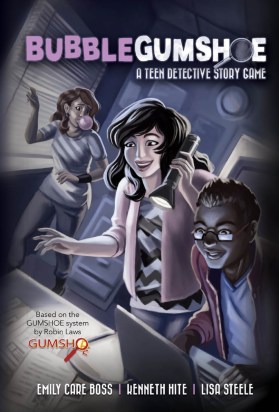 Bubblegumshoe is the work of Emily Care Boss, Kenneth Hite, and Lisa Steele. The game was published by Evil Hat Productions in 2016 and is a variation of Robin Laws’ Gumshoe system. Where Gumshoe has been used to tell mysteries based around Lovecraftian horror (Trail of Cthulhu), space opera (Ashen Stars), vampire spies (Night’s Black Agents), among others, Bubblegumshoe explores the genre of mysteries like The Hardy Boys, Veronica Mars, and Nancy Drew. The text describes the default setting as: “High schoolers solving mysteries in a modern American small-town setting.”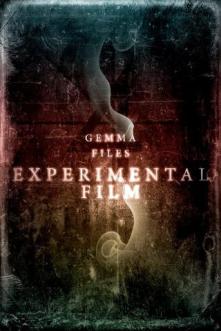





 PopCult Reviews