Movie Review – Nina Forever

Nina Forever (2015, dir. Ben & Chris Blaine)
960

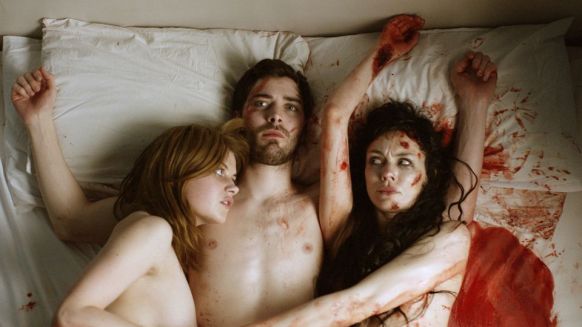
Holly is in love with Rob. They both work at a local grocery store, and she learns he recently tried to kill himself out of the pain and guilt he still feels from his girlfriend, Nina’s death a couple of years ago. Holly is attracted to the angsty darkness of Rob, and the two find themselves hooking up in Rob’s bed a few days later. They don’t seem to notice the large, bloody stain forming on the sheets but take note when the specter of Nina manifests in the bed. From there we get a unique take on dealing with past relationships while attempting to forge a new one.

Nina Forever could have easily become a farce, but there is a concerted effort to maintain a tone that acknowledges the absurdity but takes the relationships of the three characters very seriously. The concept: a new lover haunted by their love’s old dead partner is not an entirely new idea. It’s been the subject of many romantic comedies, but this story doesn’t take the route you might expect. There is the proper reaction from the two leads to Nina’s arrival, shock and disgust, but after a few days, they begin to accept her. This moment is where the film gets truly interesting in the way it explores the haunting.

Holly becomes incredibly proactive in making Nina a part of she and Rob’s relationship, believing this will heal Rob’s pain and allow Nina to pass on. Her first attempt is to make the best of Nina interrupting she and Rob’s lovemaking by incorporating Nina. The ghost informs her that the only thing she feels is the persistent pain of her injuries from the car accident that killed her. Holly is a very persistent character while Nina seems only concerned with ensuring that Rob remains her property.

I particularly liked the incorporation of Nina’s parents into the narrative. Rob has grown even closer to them in the wake of her death, but his relationship with each is very particular. Nina’s father acts as almost a guiding father figure to Rob encouraging him to return to his Master’s degree in mathematics while sharing his amateur attempts at novel writing. Nina’s mother has a much more intimate relationship with Rob, while not sexual, there is this ever present tension when they speak.

One of the core themes of the film is Holly’s frustration with how others perceive her. One of the first scenes of the film is her boyfriend breaking up with her citing Holly as being “Just so nice.” She is determined after this to embrace her dark side and make sure Rob knows how dark she is. The film never plays this up for laughs and lets us see Holly struggle with shaping her self-perceptions. Where her character ends up may be surprising for the viewer, and it’s played for an interesting contrast with how Rob closes out the narrative.

Nina Forever is a nicely done, independent horror drama. It has plenty of gore for the fans of that, but it also has an engaging and thoughtful storyline. Characters feel fully dimensional, and the directors trust us to disseminate information about them through off the cuff remarks and little glimpses of moments. This is not a feel-good movie where love conquers all. The Blaine Brothers are telling a story about a relationship, and it’s a very honest story that brings us to an inevitable conclusion.

Hypothetical Film Festival: All of Them Witches!

I’ve thought there was something intriguing about witches. I’m not talking about the nature-worshipping Wiccan kind, but the obscene primal worshippers of ancient dark gods. Few films provide us with great, scary witches. Instead, we get the Wicked Witch of the West archetype or Willow from Buffy; not there is anything wrong with those. This list showcases some scary, creepy, terrifying witches.


The Lords of Salem (2012, dir. Rob Zombie)

_MG_2533.cr2


I’m not a huge fan of Mr. Zombie’s film work. House of 1000 Corpses was grotesque in all the wrong ways, and his follow up just never got me interested. I was quite surprised by the trailer to this film. It was full of strikingly beautiful and horrific imagery. It had an air of mystery, and that vibe the best horror flicks of the 1970s oozed. Heidi, a radio DJ, receives a vinyl record that plays a strange chanting song. Soon after she starts experiencing hallucinations and the landladies of her building seem up to something. Soon, Heidi is descending into the pits of Hell as her role in an ancient rite becomes apparent.


Suspiria (1977, dir. Dario Argento)

suspiria
The most iconic witch film on this list and a beautiful example of Giallo, a hyper-stylish Italian horror genre from the 1970s. The opening scene of this film is, in my opinion, one of the most terrifying and gorgeous film sequences. An unseen killer stalks a young woman who runs for her life through the halls of a massive mansion. She meets her end in a terrible way, and this begins the story of a ballet school in the woods where the dancers are being picked off by an evil witch. 1970s starlet Jessica Harper stars as the lead, and her look matches the almost fairytale surroundings of this classic horror story.


The Woods (2006, dir. Lucky McKee)

the-woods
The Woods is the second Lucky McKee film on a Hypothetical Film Festival this month. He’s just one of those directors who knows the genre incredibly well but doesn’t always construct a winner every time. The Woods is one of those films that hovers in that middle space between fantastic and campy. It’s the 1960s and Heather has been dumped at a girl’s school in the woods of the Northeast by her parents. Heather begins having nightmares about students she’s met who have been killed. With some investigation, she learns there is witchcraft going on at the school. The highlight of the film is Patricia Clarkson as the school’s headmistress. Clarkson is enjoying herself in the role and is quite menacing. This film would make a perfect double feature with Suspiria.


Drag Me To Hell (2009, dir. Sam Raimi)

drag-me-to-hell
Drag Me To Hell is the big stand out on the list because of how insane and extreme it gets with its witch’s curse. Christine is a loan officer at a bank who is pressured to deny an elderly woman an extension on her mortgage. The woman becomes irate and curses Christine which leads to an absorbing metaphorical examination of eating disorders. Drag Me To Hell pulls out some incredibly gross visuals playing with food and having disgusting things in your mouth (no, not like that!). Actress Alison Lohman is put through the wringer in a film that showcases how dangerous it is to cross a witch.


The Witch (2015, dir. Robert Eggers)

the-witch-2015-large-picture
The Witch is probably the best film about witches ever made. Director Eggers shows what a master of the craft he is by building the perfect mood of dread. Every image is carefully framed, and the soundtrack underscores the growing horror in the woods. A Puritan family is banished from their village and end up building a home near the edge of some dark woods. First, the infant son is taken and then accusations between the family members begin to fly. From the opening shots, The Witch is clear it is going to be a sensory shaking experience. Composer Mark Korvin’s haunting score with its hellish choir takes us to the very edge of the evil that is stalking the family in the woods. The film’s finale is simultaneously beautiful and evil.

Movie Review – The Blackcoat’s Daughter

a24 visions

The Blackcoat’s Daughter (2015, dir. Oz Perkins)

FEBRUARY

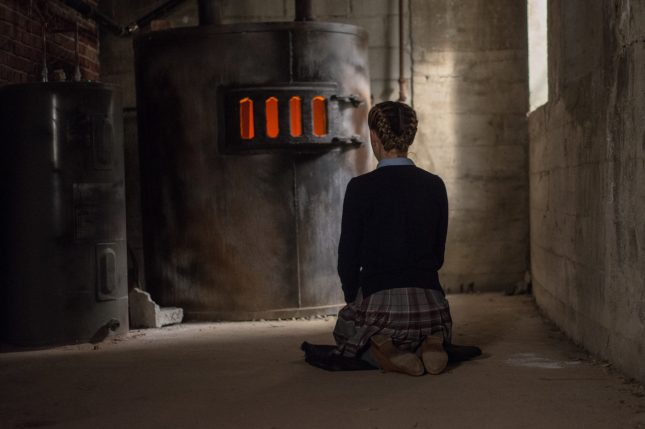
A weekend break is here for the students at Bramford Academy, a girls’ boarding in the Northeast. It’s a snow-covered February weekend, and Kat and Rose find themselves stranded with neither of their parents showing up to collect them. The headmaster leaves them under the watch of two sisters that look over the school, but for the most part, the girls are left to their own devices. Kat has been having strange dreams about her parents dying and is convinced that is why they haven’t shown up. Rose has bigger things on her mind, worried about a possible pregnancy from a local young man. All throughout the school, though, there is a strong presence evil. And who is the mysterious young woman Joan who is hitchhiking her way towards Bramford?

I was floored by how good The Blackcoat’s Daughter turned out to be. From the opening frames, there is a concerted effort to build a dark atmosphere, anticipating the coming horror. The director chooses to spend time developing the characters and not through heavy exposition. Perkins understands that often spouted film advice of “Show, don’t tell.” While some reviewers are expressing their dislike of the movie due to its slow burn nature, I see it as the same structuring that made The Witch so lucky. We learn who Kat is, not some facts about her life, but about the core of her character and her values through her actions and interactions with Rose.

The plot of The Blackcoat’s Daughter is not anything beyond a traditional horror film or short story, but it is the way that the aspects of production build that horror through lighting, cinematography, and music that draw you in despite knowing that this story is going to end up in some incredibly dark places. The music, in particular, composed by Osgood’s musician brother Elvis Perkins, is heavy with low strings and the faint pained echoes and chants of humor voices layered underneath the despair.

The acting is quite superb and is a style I personally see as a great litmus test for the quality of an artist’s talents. The performances demand a certain quiet and subtlety and Kiernan Shipka as Kat stands at the front of the cast with a performance that is powerful beyond her years. Having come of age on Mad Men, a show I often cite for cultivating a more controlled and nuanced style of acting, she has definitely learned a lot about what a powerful tool the face can be, with some expressions conveying tons of emotional weight. Lucy Boynton as Rose is tasked with a difficult role, carrying most of the film’s dialogue and could have easily come across as a cliched “cold ice queen/bitch”. Instead, she bring complexity to a character who is going through a difficult time, worried about the possibility of an unplanned pregnancy and what they would do to her life.

The film is not something that will appeal to all viewers and rewards one who chooses to be patient and thoughtful while meditating on images or sounds. When the nature of the horror is finally revealed in the last act of the film, it doesn’t flinch from showing realistic depictions of violence, in this instance with a kitchen knife. The final image of the film is haunting one, a figure in deep psychic pain and someone we are left asking so many questions. Parsing through the events of the picture and asking what was real, what certain gestures meant, and what happens next for this lone survivor of the events who appears to live in an unending nightmare.

Movie Review – At the Devil’s Door

At the Devil’s Door (2014, dir. Nicholas McCarthy)

SONY DSC

A teenage girl caught up in a new relationship plays a dark game where she barters away her soul. Decades later, Leigh, a real estate agent gets a new property with a dark history. At the same time, her angsty younger sister Vera is busy at work on her upcoming gallery show. Woven throughout these women’s lives is a demonic presence that seeks to use one of them to bring itself into the world through a vessel. Where this story ends up is surprising and how it gets there can be incredibly frustrating.

The work I saw from director Nicholas McCarthy was his 2011 short film The Pact and then his subsequent feature film adaptation of that short. I was very impressed with the surprising direction that movie took, the way it subverts audience expectations while telling a story from multiple perspectives. McCarthy’s most recent work was the Easter short in the Holidays anthology which was one of the more enjoyable pieces in that incredibly flawed collection.

At the Devil’s Door is an interesting concept that ultimately fails in its execution and commits the worst crime a horror film can: it’s so boring. Conceptually we have a very ambiguous demonic possession story that doesn’t hit all the familiar tropes. There were moments where I was genuinely hooked and the film did a great job reeling me in, only to plod on with dull and shallow characters for the next 20 minutes. The idea of a fragmented narrative could work in the film, but it’s handled in a confusion and ultimately distancing manner. We never get enough of a sense of who any of these characters are so it’s hard to care. I saw a comment that summed it up, this is a trilogy that has been compressed into one film. As a novel with the ability to get have an omniscient narrator the story would be something I’d eat up. It just fails as a film.

The positives are that McCarthy knows how to frame a shot. He loves to evoke and build atmosphere and the film is dripping with it. The atmosphere just doesn’t have a strong enough plot to take it anywhere. McCarthy has a love of suburban homes and lights them in ways that play up the creepiness of hallways and bedroom corners. The demon is very obscured and we get two glimpses of it throughout that are masterful. Once it is in the background, out of focus and the second is a quick glimpse as it hides in a cabinet. The design isn’t what you would expect.

At the Devil’s door biggest problem is that it doesn’t understand how to make a good ambiguous horror film. You need details in the world while the horror is kept ambiguous when you don’t have those world and character details the story never feels alive.

Movie Review – Ghostbusters (2016)

Ghostbusters (2016, dir. Paul Feig)

ghostbusters-2016-cast-proton-packs-images

Erin Gilbert is a physics professor on a tenure track a Columbia University but hits a road bump when her past as a paranormal investigator comes back into her life. She ends up working alongside her old partner, Abby, and a new one, Holtzmann, to investigate hauntings in New York City. They recruit Patty, a subway token operator with an encyclopedic knowledge of the city and Kevin, a ditzy secretary to take on an overflow of angry and vengeful spirits that seek to reclaim the land of the living.

Ghostbusters is arguably the most written about film of 2016, inspiring very polarized reactions online. It’s no surprise that the announcement of an all-female cast drew ire and admiration from the camps you would expect. In the lead up to its release, it was difficult to find any conversation that didn’t devolve into an online shouting match. I can’t say I was excited about the remake, but I hadn’t been a big Ghostbusters fan since I was a kid. They are enjoyable movies but nothing that hooked me and brought me back on a regular basis.

I’ve been a big fan of Paul Feig since his work on Freaks and Geeks. I was a senior in high school when that series came out, and it immediately caught my attention. I am a huge fan of Bridesmaids, one of the few films I’ve paid to see multiple times in the theater. It was one of those instances of an entirely perfect cast and well-written script. I enjoyed his follow up The Heat quite a bit but wasn’t too warm on his action-comedy Spy. Bridesmaids still stands as my favorite of his films and a hard movie to top.

If you look at the five highest grossing comedies of 2015, the list goes as follows: Minions, Pitch Perfect 2, Hotel Transylvania 2, The Spongebob Movie, and The Peanuts Movie. My tastes in comedy and the mainstream audience’s comedic preferences are not aligned in any manner. Just a matter of different taste, neither is better than the other. Major film studios are most interested in making broad, inoffensive comedies that they can sell to international audiences. Comedy is very hard to translate because so much of it is based on language play. To dodge that problem modern comedy has adopted even more of an emphasis on physical humor. Look at trailers for comedies; it’s a litany of people falling or getting hit in the head. This isn’t new; it’s just becoming more prevalent as studios look to broaden their revenue streams.

Ghostbusters, due to studio influence, rather than letting comedic minds work without hindrance, ends up being just another mediocre big budget comedy. It’s not an affrontery to humanity as the MRAs would have you believe, but it’s not a revolutionary beacon to womankind either. It’s a seed for a possible franchise as Sony seeks to recover from its failure to do so with Spider-Man. Set pieces are emphasized over interesting and potentially funny character interaction, and the finale is another cut and paste special effects deluge.

After watching the Richard Pryor and Gene Wilder films and reflecting on my love of improv comedy, I’ve come to realize that less is better when it comes to ad libs. You need a very talented comedian to pull off good improv. The success of films like Anchorman has convinced some studio execs that just letting the funny people riff results in comedy gold. It only works if the structure around them is strong enough. I don’t think Kate McKinnon is untalented, but she doesn’t appear to have the support of a strong script and editing, so her comedy feels very shallow and not as intelligent as I know she is. The direction she seems to be given is “make a silly face and contort your body.” I found Leslie Jones to be the funniest character in the film because she is more grounded and if she was improv-ing than she does it in a very nuanced way.

Ghostbusters was never a piece of cinematic art. It was a studio comedy that picked up traction over the years. The newest film isn’t a failure, but it’s just another middle of the road movie with a couple of light chuckles. What’s most annoying is the push to intentionally grow a franchise. Sony seems to believe that by plugging Paul Feig and his acting troupe into a film will result in The Funny. They fail to recognize that the reason why a movie like Bridesmaids was so funny in the first place was the freedoms the creative talent was given to structure a funny story and that is was something new and so the direction of the story was unexpected. Ghostbusters is a fine film for a rental and watch, kids would enjoy it, but it’s not very memorable.

Movie Review – Phantasm

Phantasm (1978, dir. Don Coscarelli)

phantasm-crop-1

Something is going on at the old cemetery in town, and young Mike is determined to find out exactly what. His brother Jody thinks Mike just imagines things as part of his grief over their parents’ death, but when Jody sees the evil firsthand. A tall menacing stranger stalks the grounds, sinister dwarves attack anyone seeking out the truth, and a chrome sphere makes quick work of trespassers. Phantasm paints a surreal, dreamlike tableau of horror that stands as a singular achievement in horror.

Watching Phantasm reminded me of my childhood, flipping through the channels on a chilly October Saturday afternoon. Certain images just feed the primal fears of a kid, and this film is chock full of them. When it comes to a logical story that makes sense, though, it falls apart. I was reminded of Beyond the Black Rainbow, a very stylish horror film from 2010. Director Yorgos Lanthimos spoke interviews about the working to infuse the film with an intense dream logic that focused more on playing with nightmarish imagery rather than a fully realized plot. Phantasm is one of the films Lanthimos will mention when he talks about those late night childhood experiences.

As a whole, Phantasm has a lot of flaws and doesn’t deliver on the promise of the horror it builds up. However, there are a nice handful of moments that show off some real cleverness and creativity. The chrome orbs are probably one of the most original concepts I’ve seen in a horror film. Their design and the utterly brutal way they dispatch unwanted visitors was genuinely shocking for me. The Tall Man as an antagonist is not like the slasher figure that was garnering so much popularity around the same time. When Mike discovers the gateway to the other world, we’re presented with a very striking and hellish image of another planet/dimension.

The acting is incredibly stiff, but I suppose some might chalk that up as part of the charm. I think there is a fascinating seed of an idea in the film, a real chance to tell a great horror story, but the execution just never pays off. The standout character, in my opinion, was Reggie, the shotgun wielding ice cream man, such a uniquely original character for this genre of film. He seems to have the most acting talent in the crew and every scene he is in ends up being very enjoyable.

I have plans to watch the second film in the series, but beyond that, I don’t have much interest. Despite its flaws, Phantasm is a genuinely original entry into the horror film genre. It doesn’t feel like anything that came before it, and there is nothing in horror today that seems quite so interesting to look at and as surprising in its ideas.

TV Review – The Exorcist: The First 3 Episodes

The Exorcist: The First 3 Episodes

(Airs Fridays at 9/8 Central on Fox)

the-exorcist-tv

Father Tomas, a young priest in Chicago, is approached by one of his parishioners about a problem in her home. Angela Rance is convinced there is a demonic presence in her home. She hears voices and things that shouldn’t move. Angela believes her eldest daughter, Kat, is the source of the presence and that it’s connected to the tragic death of a college classmate. Tomas begins receiving visions of another priest, Father Brennan, who fails to exorcise a demon inside a young boy and loses the child. These various figures converge in Chicago where a larger evil looms, bigger than just one young woman’s possession, that could have apocalyptic repercussions.

I didn’t watch the original 1973 film until I was a senior in college and found it to be an excellent example of the golden age of horror in that period. The way director Friedkin walked the line between the shock of horror and building atmosphere was perfect paced. What I loved most was the ambiguity of Regan MacNeil’s possession. There is never an explanation as to how this happened to her and that is a terrifying element.

The new series on Fox apparently takes place in the same universe as the original film. An incident in Georgetown in the 70s is mentioned by a priest when discussing possession. I love that they didn’t feel a need to ignore the original film. The series is a very different animal than the movies, though. There is a bigger emphasis on a larger conspiracy that permeates Chicago and seems connected to multiple possessions happening across the city. As a result, the series loses the intimacy of the 1973 film. Friedkin’s Exorcist was solely focused on a character exploration of Father Karras and the incident in the MacNeil household. If the television series had been on HBO or FX, I could see it having a quieter focus but because it’s on network television and up against increasing spectacle it has a more Lost-like sprawling narrative developing.

The largest problem with the series, and I suspect it’s due to network standards and practices, is that it is rarely actually scary. There are a handful of moments in the first three episodes that are creepy and only one I would say was genuinely scary. The interactions between the demonic presence and the priests is played a little more broader and as a result the demons don’t feel that intimidating. They talk too much and are too direct instead of toying with the humans who want to expunge them. Because of the mandated commercial breaks, the building of tension and suspense is constantly undercut. Good horror needs adequate breathing room to let itself take root and slowly grow. There’s a sense in each episode that suspense is focused in those acts from commercial break to commercial break, rather than an overarching tension to the story.

I’ll continue to stick with the series for this first season, but I sense it will become much less about the intimate horror of a family and the crisis of faith in a priest confronting that horror and more about the political machinations of the devil to bring about the apocalypse.

Movie Review – Tetsuo the Iron Man

Tetsuo the Iron Man (1989, dir. Shinya Tsukamoto)

tet1

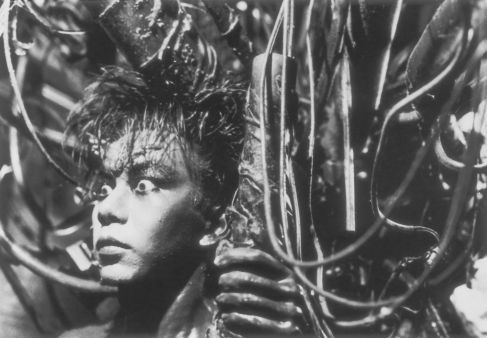
A mysterious man lives in a junkyard and fetishizes metal to the point that he cut open his body to insert iron rods and wires into it. He’s struck by a car and apparently killed. A salaryman (Japanese corporate drone) is haunted by strange techno-nightmares, even attacked in the subway by a woman transformed by a piece of metallic effluvia. Where this film goes and mood it evokes is truly unpredictable and very much of its time.

Tetsuo is a techno-horror film akin to David Lynch forming a death metal punk band. The energy in the picture is non-stop, grabs the viewer by the shoulders and violently tosses them around until they can’t take it anymore. In the 1980s, body horror was a growing sub-genre thanks to the likes of David Cronenberg and Clive Barker. The way a human body could betray its nature was of increasing interest as medical science evolved a breakneck pace, the AIDS epidemic slashed across humanity, and urban spaces became increasingly smother in pollution. Self-mutilation wasn’t a new concept and many cultures still practice scrying script into the skin or slicing off bits of their reproductive organs as a sacred ritual. The addition of technology into the mix is what took the exploration of these ideas in a new direction.

Tetsuo is a ghost story at its heart. One man wrongs another man, and the wronged man comes back to haunt him. Very simple, on the surface. A significant factor in what is happening in Tetsuo is the transformation of the Japanese culture at the time. Westernization was flooding Japanese culture, and traditional Japanese life was uprooted. Technology and industrialization were the greatest representation of that takeover and the unnamed man has become so absorbed in this new world of wires that he attempting to physically merge with it. The merger of the Fetishist and the Salaryman in the finale is sparked by their discovery of the New World, a possible future landscape where the planet is devoid of all natural life and now a techno-organic construct. The decision to close out the film with the words “Game Over” rather than “The End” is also a telling detail in reflection on the relationship that developed between Western culture and Japan through the medium of video games.

Tetsuo is a rough film to get through. It’s has zero interest in traditional narrative conceits and from the very opening it makes sure you know that. The film is almost virtually hyperlinked within itself as the narrative jumps around to fill in backstory, hint at the future, and provide the minimal information needed to understand it. The soundtrack is designed to shred your sense and it truly evokes the sense of being overtaken by some faceless industrial presence.