Wild Card Tuesdays – The Bad Lieutenant: Port of Call: New Orleans


The Bad Lieutenant: Port of Call: New Orleans (2009, dir. Werner Herzog)
Starring Nicolas Cage, Val Kilmer, Eva Mendes, Fairuza Balk, Xzibit, Jennifer Coolidge, Brad Dourif, Michael Shannon

At one point in this film, I swear Nicolas Cage was attempting to channel Tony Clifton, the obnoxious lounge singer persona adopted by Andy Kaufman on occasion. This unofficial sequel to the 1992 Bad Lieutenant film is such a bizarre piece of cinema that lives somewhere between classic film noir and surrealist Lynch land. And there really is no other actor who could bring the right level of insanity to this role other than Cage. Even when its impossible for the audience not to react with laughter, Cage is going to keep pushing the boundaries of what we will tolerate.

The film begins in the aftermath of Hurricane Katrina, Terence McDonagh and his partner, Stevie Pruit find a prisoner in the jail with water up to his neck. Instead of rushing to help they place bets on how long it will take the man to drown. Eventually, McDonagh decides to jump in and help, however the water is to shallow and he injures his back. McDonagh is a scumbag. He has the officer running the evidence room sneaking a cocktail of drugs out for him, he stalks college aged kids leaving nightclubs to confiscate their drugs, he has a prostitute girlfriend he seems in no rush to help get out of the business, and he’s just an all around asshole. A crime scene is discovered where an entire family has been killed execution style. McDonagh begins to uncover that the father was dealing drugs on another man’s territory and attempts to solve the case using methods that pretty much violate every law on the books.

Director Herzog employs some awfully strange choices in making this film. McDonagh’s drug use causes him to have hallucinations that the audience gets to see. During surveillance on a suspect’s house he swears there are two iguanas on the table while the other officers simply give each other confused looks. Later, after a mobster is killed Cage tells the killer to shoot again because “his soul is still dancing”, reflected by a break dancer spinning in the middle of the room. There are other pieces of scenery that keep that wacked out feeling continuing through the film. Actors like Brad Dourif, Michael Shannon, and Fairuza Balk add that twisted atmosphere to every scene they are in.

McDonagh is constantly on the go. There isn’t a single scene where we see him in his home, ready to fall asleep for the night. Instead he is always wheeling and dealing, playing one party against the other in incredibly flimsy ways that you know are going to catch up to him sooner or later. He owes thousands to bookie Dourif and tries dealing drugs out of the evidence room to pay it off, while trying to avoid the suspicion of his superiors. There really isn’t a film comparable to the insanity of this one and if you are a film lover like me, whom finds a sick enjoyment in Nicolas Cage’s frantic nature then  you desperately need to pick this up.

My 40 Favorite Film Moments – Part 1

This month I will be looking at my favorite moments in movies. These are not necessarily the best ever in films, but they are my personal favorites. In no particular order, here we go:

1) Let Me Out (Young Frankenstein, 1974, dir. Mel Brooks)

Gene Wilder is at his best when he goes from calm to frantic in a split second. His red-faced blue blanket tirade from The Producers is a gorgeous moment. This one however goes up there as one of my all time faves. Wilder as the nephew of Victor Frankenstein shines. In this scene we see him go from calm, to manic, to desperate, and finally to confident in his macabre heritage.

http://www.youtube.com/v/pu1DMSqTLyk&hl=en_US&fs=1&

2) Mike Yanagita (Fargo, 1996, dir. Joel and Ethan Coen)

Two actors here who deserve a lot more credit. Frances McDormand won the Oscar for her role of Marge Gunderson, but this scene also showcases the chops of Steve Park. Park is able to create a three dimensional character in a single scene of this film, its amazing what he does. Its hard not to imagine the life of Yanagita after watching this. A powerful example of what happens when good writing and acting are paired up.

http://www.youtube.com/v/r_Ge4F4E9JE&hl=en_US&fs=1&

3) Oh, Are They? (Rushmore, 1998, dir. Wes Anderson)

The film that really broke Anderson out and still one of his best. Max Fischer (Schwartzmann) turns a post opening night dinner into a farce when his love interest invites her male nurse friend along. Would be nice if Anderson tried to go back to his more comedic roots, not that his current work is bad.

http://www.youtube.com/v/VbqgSjik9NE&hl=en_US&fs=1&

4) Binary Sunset (Star Wars, 1977, dir. George Lucas)

It’s a short scene, but it says a lot. The dual suns reinforce the alien nature of this world, the lighting sets the perfect tone as Luke Skywalker stares out across the vast landscape of Tatooine, and the music gets across his desire to explore. Simple and perfect.

http://www.youtube.com/v/wEUGF3NGbPg&hl=en_US&fs=1&

5) Come Play With Us, Danny (The Shining, 1980, dir. Stanley Kubrick)

A perfect horror movie scene. The music and cinematography are in perfect unison and there isn’t much more to say other than, experience the scene yourself.

http://www.youtube.com/v/jFVyAjj3Bs0&hl=en_US&fs=1&

DocuMondays – We Live in Public


We Live in Public (2009, dir. Ondi Timoner)
Featuring Josh Harris

Josh Harris is much smarter than you. He is also likely more insane than you, as well. This documentary by director Ondi Timoner (also behind the great docu DiG! about the Brian Jonestown Massacre and The Dandy Warhols) follows a near prophetic vision of the internet and privacy that was unleashed from the mind of the aforementioned Josh Harris. The ideas he would present, for himself an experiment born out of curiosity, would shape the concepts of social networking and cultivation of user information as a commodity. The way Facebook works now is indebted to the research of Harris, a man who is unknown by the very executives whom run companies that wouldn’t exist without him.

In 1980, Josh Harris was a low level researcher in New York City. He attended a conference where the idea of computers being networked globally was being discussed and from this he began to think of how this could completely change the way people run their lives. He founded Jupiter, a company focused on surveying to gathering information on how people would use the internet. From there he developed the concept of public chat rooms which he sold to Compuserve. He was the first to think of making the internet a replacement for television and started Pseudo TV, back when streaming video was a blocky nightmare. Investors liked the idea but by 1999 Harris had become bored and was behaving in a more increasingly erratic manner. His next venture was a piece of performance art/social experiment where around a hundred people signed up to live in a subterranean village Harris built.

Before they could join though, they had to undergo extensive psychological testing, not to ensure their stability in the community but to help feed periodic interrogations that would be held during their stay. Everyone slept in Japanese style pods which had both a television and a closed circuit camera. Every channel was simply another pod. The bathrooms, showers, dining room, entertainment venues, simply everywhere was wired with cameras. The psychological effect it had was at first detachment by the citizens of the village and then a air of insanity took over. The experiment was busted on Jan. 1, 2000 after rumors spread that it was a Heaven’s Gate type cult. At this point, Josh and his girlfriend at the time set up cameras all throughout their loft and launched a 24 hour stream of every facet of their life online. This experiment culminated in Harris physically assault said girlfriend on camera when she refused to have sex with him.

From there he fell victim to the dot-com boom of the early 2000s, left New York City and ended up buying an apple farm. He tried to reinsert his “brand” into the current online climate but was met with executives of social networking sites who had no idea who he was. Harris is shown as being incredibly detached from others. His mother was on her deathbed and, instead of physically visiting, he recorded his message to her and mailed the tape, which arrived too late. His most formative experiences seem to have been bonding with virtual families via the television of the 1960s and 70s. Gilligan’s Island was a highly influential element in his life and he seems to transpose both the character of Mrs. Howell and his own mother onto a bizarre personality he would some times take on called Luvvey.

Harris ideas about people willingly giving over their information and their privacy has come true in the form of the 24 hour tweet culture we’re experiencing. He mentions that Warhol was right about the fifteen minutes of fame, however, he add people want that fifteen minutes every day. The documentary is an excellent examination of how we got to a moment where identity and privacy are typically forfeit when it comes to online culture. Through Harris’ insane experiments we can see that it is not so much about the technology as it is about a distance our culture has taken on in relation to each other, long before the internet.

Director in Focus: Brian De Palma – Casualties of War


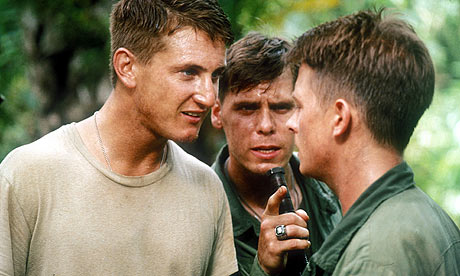
Casualties of War (1989)
Starring Michael J. Fox, Sean Penn, John C. Reilly, John Leguizamo, Don Harvey, Thuy Thu Le

Coppola made Apocalypse Now. Stone made Platoon. And De Palma made Casualties of War. At the end of the 1980s De Palma was secure in his place as a Hollywood film director. When he had been closing out the 1970s he was still immersed in Hitchcoclk style thrillers. A decade later he’s made a gangster epic (Scarface), a 1930s historical crime film (The Untouchables), and a Vietnam War flick. Despite the change in venue and content, there are the same cinematographic trademarks (deep focus and POV tracking shot). But how does this film shape up next to the other great Vietnam War flicks?

PFC Ericksson (Fox) is out on patrol with his unit when they are ambushed. He’s standing over a Viet Cong tunnel and falls half way in. As a Cong soldier inches closer, knife in teeth, Ericksson is saved in the nick of time by Meserve (Penn). Later, they both witness their commanding officer getting gunned down and Meserve takes over. He becomes obsessed with revenge and leads his group of five men to a village where they kidnap a  young girl with the intent to rape and savage her. Ericksson is frozen as he must decide whether to protect this innocent or honor the bonds of his military brotherhood.

Casualties is by no means a perfect film, but it is a surprisingly mature film for De Palma, where he seems to be balancing his camera flourishes with a thoughtful look at the nature of war. There are still some cringe inducing line deliveries and Penn’s Maserve is played a little too broad for my taste. I did like Meserve’s speech about hating the Army. Often in pop culture, the soldier who brutalizes for pleasure is made out to be a dedicated troop. It feels more realistic that such a sociopath would despise the lack of self-decision that comes with the military. Once Meserve is out of the eye of his superiors he adopts his own sense of law. Ericksson provides a balance as a soldier who appreciates the idea of duty and rank. When Ericksson goes to report what he has seen he goes through the proper channels of authority. Meserve tries to get revenge under the radar.

De Palma ends things in a way I didn’t expect. Moments before the credits rolled, I felt the film hinting at a possible dramatically violent finale, but then it ends in an ambiguous way. The message of the film is hammered way to bluntly, though. De Palma does an excellent job of telling this story in a clear, comprehensible way and he uses some interesting technical skills. At the end I felt a certain dissatisfaction with  product. It’s not as high an artistic achievement as Apocalypse Now and its doesn’t have the emotional weight of Platoon. It is a well made piece of cinema with some very enjoyable acting, but definitely doesn’t score as high as some of De Palma’s other films for me.

Next: The first big disaster, Bonfire of the Vanities.

Jolly Good Thursdays – Five Minutes of Heaven


Five Minutes of Heaven (2009, dir. Oliver Hirschbiegel)
Starring Liam Neeson, James Nesbitt

There is no collective event as traumatizing and as haunting in the United States as the conflict in Northern Island has affected those people. In 1975, Ireland was under siege by a civil war where neighbor killed neighbor. The IRA killed those who were Protestants and loyal to the British, while the Ulster Volunteer Force (UVF) would kill Catholics who were disloyal to the Empire. These murders were typically carried out by adolescent males, coerced into proving their loyality to their faction by terrorist cell leaders. In many ways, this is a parallel to the Islamic fundamentalist terrorism today; young men too dumb to know better end up dying or killing another. Over time, if they live, the glory fades and they are left with the emptiness of what they believed was a great act of glory.

Alistair Little was 16 when he killed James Griffin, 19. Alistair wanted to prove himself to Ulster and heard about a Protestant friend being hassled by Catholics. He and a group of boys steal a car, get ahold of a gun, and show up on James’ doorstep, shooting the young man dead. Witness to this crime is Joe Griffin, James’ 11 year old brother. Thirty years later, the BBC wants to put together a documentary that culminates in Alistair and Joe meeting. Alistair has served 12 years in prison for burglary and appears to have worked towards getting young men out of the situation he ended up in. Joe has agreed to meet but is both apprehensive and enraged at the prospect of finally confronting his brother’s killer. For the rest of his childhood, Joe was blamed for not doing something to save his brother by their mother, and now the grown man wants to unleash all of this pent up rage on Alistair.

Five Minutes plays out in a very unexpected way, primarily because it’s structured as a four-act play. Each act isn’t contained in a single set but is contained by a certain focus. The first act is the recreation of the murder in 1975, the second act is the build up to the documentary meeting between the two men, and so on. The acting weight is focused squarely on Neeson and Nesbitt and they are overqualified for the job. Nesbitt in particularly is able to see saw his character psychologically, increasing the intensity as the hour of he and Alistair’s meeting grows closer. A large piece of this are internal monologues, Joe simply looking in the mirror of his dressing room, pulling the knife he has brought to exact his revenge and mulling over if he should simply leave or go through with this.

Neeson is equally good but in a different direction. He plays Alistair with subtly, he’s a man who wants his victims to be able to confront him and knows they don’t care if he is sorry or not. As he tells one of the BBC crew, he wants them to step in and keep Joe from hurting himself. As we see later in the film, he is completely willing to let Joe unleash his anger on him. But he’s not just out to give victims their peace, Alistair also wants forgiveness. He’s closed himself up in an estate flat in Belfast, never married and has no children and spends his days either in non-violence support groups or stewing in his home. It is inevitable that these two men are going to meet, but the film lets us wondering under what circumstances will it be and under whose terms.

Newbie Wednesdays – Mystery Team


Mystery Team (2009, dir. Dan Eckman)
Starring Donald Glover, DC Pierson, Dominic Dierkes, Aubrey Plaza

I read through the Encyclopedia Brown books voraciously as a child. And out of the dozens published and the hundreds of mysteries contained in them, I think I only solved one without having to look at the answers in the back. The titular team of this newly released independent comedy were probably like me. They loved the possibility of solving the crime but when it came down to the actual investigation it was over their heads. Mystery Team is the first feature from YouTube comedy troupe Derrick Comedy. They were one of the first to upload videos to the now uber-popular website and because of their early adopter status they garnered an impressive fan based. So how does the transition from 5 minute web video to 90 minute feature film work out?

Once upon a time, Jason, Duncan, and Charlie were a beloved staple of their small town, solving harmless mysteries like “who ate the pie?” or “who stole Timmy’s lunch money?”. Now they are seniors in high school, on the precipice of adulthood, yet still behaving like scrappy tweens. They are suddenly hit with a case way out of their league when a young girl asks them to find out who killed her parents. Duncan, the brains of the outfit, immediately wants to turn this over to the police, but Jason, after becoming smitten with the girl’s older sister, demands that they take on the case. The result is a very high insanity journey into the suprisingly dark underbelly of their small town. It’s a mixture of grossout humor and eccentric characters, including a cameo by UCB alum Matt Walsh.

Donald Glover, who was a writer on 30 Rock before being cast in Community, has always been the standout in Derrick Comedy. He has an enthusiasm and charisma that make him incredibly likable. When I watch Glover acting I see the future of American comedy. He’s definitely a young actor with the potential to make it as big as someone like Eddie Murphy or Adam Sandler, with the hope that he remains true to his comedy roots rather then make a series of throwaway pictures (I’m looking at you Grown Ups). A recent Twitter trend popped up calling for Glover to be cast in the lead of the Spider-Man reboot. While I consider myself a traditionalist when it comes to the physical makeup of comic book characters on film, this is a casting move I am behind 100%. That’s how enjoyable it is to see Glover act, and he would make a hell of a Peter Parker.

The strength of the film is that it isn’t mean spirited towards its leading trio. It would be easy for a group of socially stunted teenagers to be cast in a mocking light, and while humor is found in their awkwardness, we’re meant to love them. And its impossible to resist liking these three guys, as they are living out the childhood fantasy of being a detective, finding clues, and being wrapped in a big mystery. The acting all around is spectacular. Bobby Moynihan, currently of SNL, appears as Jordy, a convenience store clerk who was an informant for the boys for years. Moynihan’s performance is phenomenal, getting across the pathetic nature of man who gave up on his dreams and is smothered by this small town, but playing it with over the top enthusiasm. It’s one of the best and most layered comedy performances I’ve seen in years. If you looking to see where film comedy is going in the next decade, this is it.

Wild Card Tuesdays – Someone’s Knocking at the Door


Someone’s Knocking at the Door (2009, dir. Chad Ferrin)
Starring Noah Segan, Ezra Buzzington, Andrea Rueda, Elina Madison

You should probably not watch this movie. By that, I don’t mean this is a bad film, but it is definitely not a movie for your casual filmgoer. This exists in a very specialized realm of film, grindhouse, but even still it doesn’t strictly adhere to the tenets of that genre and even openly plays with the conventions. This is not to say the film is some masterpiece. It’s very cheap and very gritty, and that’s what it has to be to do what its trying to do. If you decide to see this movie, and can track it down, you’re going to discover a very disturbing, very funny, and in the end oddly moving low budget horror flick.

The first scene of the film features a young man shooting up with some strange drug and then being raped to death by a demonic looking man. Flash to the young man’s friends, a group of med school students who react with coldness towards news of his death. The only one who seems to feel anything is Justin (Segan), the most drugged out of all of them who has a dream/hallucination where his dead friend appears in a morgue blaming him for his death. The kids are called into the police station for questioning where its revealed a few nights prior to the murder they had been poking around the basement of a records building on their campus. Justin discovered files on John and William Hopper, a husband and wife serial killing duo who would rape their victims to death. The two were on an experimental drug which Justin finds a vial of and shares with his pals. It appears that the drug has somehow broken down a barrier to Hell, and now the Hoppers have returned in demonic form to wreak havoc.

While the film follows many of the tropes of grindhouse, particularly  beginning with a big horrific scene, then slowing down until one more final climactic act of grotesque, it also throws some new ideas. There are a lot of jump cuts, particularly when focusing on Justin, which serve the purpose of showing how his drug addled brain is processing things. Sound is also used in an incredibly effective way, sound being an element that is normally overlooked. In certain scenes, instead of hearing the dialogue, we can see that the characters are talking but the soundtrack is overtaken by ambient static. There’s a reason in the plot for this, but just in terms of atmosphere it gives an otherwise mundane scene an air of creepy surreality.

There’s a lot of explotative sex, as you would expect in a grindhouse styled film, and this film definitely goes places with it you wouldn’t expect. If you thought A Nightmare on Elm Street or Halloween was a crudely disguised warning to adolescents to refrain from sex and drugs, this picture will blow those ideas out of the water. The two supernatural killers of the film possess…*ahem* macabre transformations of their genital regions that render them brutal and demonic. William Hopper in particular has a very unique method of killing his victims. I absolutely loved how evil the villains in this film were. I don’t believe a studio horror film would ever allow a director to go as far and as horrible as Ferrin takes the Hoppers. At the end though, the film has a strangely sad and poignant. Though once again, I warn you to not watch this film unless your brain is truly ready for the horror.

Shadows in the Cave Digest #05 – May 2010

Features
Asian Cinema Month
Eat Drink Man Woman – China
In the Mood For Love – Hong Kong
Thirst – South Korea
Yi Yi – China
Ponyo – Japan
Hard Boiled – Hong Kong
My Neighbor Totoro – Japan

Summer Blockbusters
1975-1985 – Sharks and Droids
1986-1995 – Dinosaurs and Robots
1996-2009 – Superheroes and Sequels

Director in Focus – Brian De Palma
Blow Out
Scarface
Body Double
The Untouchables


Hypothetical Film Festivals
Best Horror Remakes Evrrrrrrrrr!
Happy Birthday Ariana 2010!

Reviews
DocuMondays
Tales from the Script
The Weather Underground
Koko: A Talking Gorilla
LoudQUIETLoud

Newbie Wednesday
Harry Brown
Iron Man 2
Daybreakers

Jolly Good Thursdays
Nil By Mouth
Girly
I Capture the Castle

Next Month:
Hypothetical Film Festivals takes a vacation
My 40 Favorite Movie Scenes
Criterion Fridays

The Summer Blockbuster: 1996 – 2009

What marked the difference between the blockbusters of the 1970s and 1980s and the 1990s and 2000s were digital special effects. For the first two decades the focus was on practical special effects, as the B-rate science fiction films these blockbusters were inspired by used. When you saw a spaceship zipping through the sky there was a physical model of the ship built and there was usually a matte painting of some sort and through the use of green screen the two elements were combined. As unreal as the scene was all its elements were something tangible. The move to computer generated effects is marked as beginning with Terminator 2: Judgment Day. This began a regular tradition of James Cameron being on the cutting edge of film technology.

By 1996, CG effects were old hat. Films from that year included Independence Day and Twister, both of which are remembered more fondly for their special effects than their acting. Independence Day used practical effects for its alien villains and CG for its air battles, while Twister had real actors in real environments but completely CG twisters as well as a CG cow being carried away by it. On the other hand, 1996 saw the first Mission: Impossible film which primarily used practical effects for the majority of its story. These were followed by pictures like Men in Black and The Lost World, one of which began a franchise and the other which continued one. The trend in this period would be to establish franchises using original, and more commonly already established properties from comics and television. The mindset behind anchoring yourself to a franchise was safety. Trying a new formula out meant risk, and risk could mean financial failure. So studio followed the motto of “go with what you know”. This was seen in how franchises like Pirates of the Carribean, The Matrix, Spider-Man, Harry Potter, and Shrek have become perennial summer movies.

Before the end of the 1990s though, another director established himself as guaranteed box office during the summer: Michael Bay. His movie Armageddon followed many tried and true tropes. There were established actors, up and coming young talent, familiar character actors, a “rah rah” America plot, and lots of explosions. Bay’s name would become a common one on big summer movies, in particular the current Transformers franchise, which while commercially successful is reviewed dismally by critics. It doesn’t seems to phase Bay though, as he keeps churning at the same type of films and following his established formula to a tee. Another name to rise to prominence as a season favorite was Pixar. Pixar was a computer animation studio that, while part of the Disney family, retained much of its creative independence and is almost the anti-Michael Bay. Bay paints in broad strokes while Pixar is incredibly detail oriented, making sure to populate its worlds with minutiae and causes their films to truly breathe. It was Finding Nemo that put them on the summer blockbuster scene, and this was followed by The Incredibles, Cars, Wall-E, and Up. Up achieved a feat very few summer blockbusters can, it was nominated for Best Picture at the Oscars.

Hollywood’s obsession with clinging to the familiar hasn’t always given them typical movies and some times we see old favorites deliver something unexpected. Steven Spielberg played with the dinosaurs of Jurassic Park for awhile but switched gears to release Saving Private Ryan, an R-rated brutal portrayal of D-Day. The film works alongside Schindler’s List and the earlier Empire of the Sun as a sort of World War II trilogy. All three were quite unexpected from the man who created the blockbuster with Jaws. In the 2000s, Spielberg switched gears and aesthetics once again to tackle classic science fiction stories. He directed A.I., Minority Report, and War of the Worlds, all of which employed a harsh light and not quite as heartwarming look at life as his previous work. Spielberg was joined by Lucas who returned in 1999 to his Star Wars franchise with The Phantom Menace. Audiences were incredibly split on the film and its follow ups: Attack of the Clones and Revenge of the Sith. This time around the Star Wars universe felt very sterile and absent of the life it previously possessed. With the conclusion of this third trilogy, Lucas seems to have once again retreated to the world he was able to build for himself.

The end of 2000s closed out with very familiar faces on the screen. There was a reboot of the Star Trek franchise, a new Harry Potter, a new Transformers, a new Pixar film, and a second film based on the books of Dan Brown. Hollywood is firmly dug in to produce tried and true concepts, with the occasional allowance of a new idea. Just recently reboots of the Spider-Man and Planet of the Apes franchises have been announced and some of 2010s most anticipated summer films have been sequels to successful franchises and rebootings of old ones (A-Team, The Karate Kid).

The Summer Blockbuster: 1986 – 1995

Coming out of the mid-80s, if you had money invested in Steven Spielberg and George Lucas you were probably incredibly rich. They had success after success, not just in their own films, but in those of directors they were producing and supporting. However, there would be an odd dip that occurred in the remainder of the 1980s. A few film franchises would rise to prominence, Lucas’ stock would plummet, and Spielberg would attempt to try out some non-science fiction and fantasy films.

While science fiction flicks made big box office they also cost big budgets to make. It’s no surprise that many studio attempted to go with smaller budget films and these typically focused on “rah rah” crowd pleasers are mixtures of action and comedy. The Karate Kid franchise was one of those “rah rah” type films that aimed dead center at kids and young adolescents. You have a young man, bullied at school, who is taught how to fight by a wizened karate master. He’s able to overcome the bullies through beating them up. You also had the first three films of the Lethal Weapon series which raised Mel Gibson to prominence and managed to pull in big audiences on a fairly small budget, something studios always like to see. Along with Lethal Weapon, there was Beverly Hills Cop I and II, which vaulted the already popular Eddie Murphy into an even higher level of celebrity. Even today, if you notice every summer seems to have one Eddie Murphy film (this year’s is Shrek 4).

There was also use a big name actor to sell the film, rather than a premise. In 1986, Tony Scott’s Top Gun was released and took Tom Cruise, who had appeared in quite a few films before then, most notably Tony’s brother Ridley’s Legend, to stardom. Top Gun works as both a star making vehicle and a “rah rah” America movie. Tom Cruise’s Maverick leads his flight unit take on North Koreans flying a fictional style of fighter jet on par with the American F-14s. Despite the implausibility that North Korean would ever be able to compete with the US Airforce, the film was a huge hit and a high selling soundtrack. Tom Hanks was the other actor to make his way up to super stardom during the 1980s. Penny Marshall’s Big was his breakthrough, a simple story of a teenage boy who becomes an adult after making a wish. Budget-wise this was an incredibly cheap film to make. No real special effects and no actors who were huge names, at the time. What made the film such a great success was the honest charisma Hanks brings to all his roles. There are few actors that handle a film so naturally. Hanks would be attached to many more summer movies to come, most notably Sleepless in SeattleForrest Gump, and Apollo 13 and  both films that went against the Spielberg/Lucas formula for a blockbuster.

But you can always rely on certain films being a success based on the name attached to them in the director’s seat. James Cameron, unlike Spielberg, didn’t produce a prolific amount of work but it seemed that he didn’t need to to become notable. Cameron made non-summer movies The Terminator and Aliens which set him up for Terminator 2: Judgement Day. Character-driven films weren’t Cameron’s strong suit and he relied a lot on technology, particularly new types of computer generated effects not yet seen by the public. His T-1000, the liquid metal villain of T2 was a huge shift in special effects driven film making. However, his next film, True Lies would be a non-CG focused film with Arnold Schwarzenegger and Jamie Lee Curtis fighting Middle Eastern terrorists.

At the end of the day though, you could always rely on familiar names, be it director or franchise to fuel a successful movie. Spielberg put out the third Indiana Jones film at the end of the 1980s and established a new franchise with Jurassic Park. Jurassic was a type of film that really overtook pop culture in 1993 in a way it would be hard for a single film to do now. It was one of the last pre-internet media fueled movies and was in theaters from June of ’93 all the way to October of the same year. Disney also came to the forefront for the first time as a major summer draw. It seems like an obvious company to make summer blockbusters but they had never done so. They got their legs wet with The Little Mermaid and Beauty and the Beast, both Holiday season releases. Nothing compared to the success of The Lion King. It was a reworking of Hamlet, an odd piece of source material for a summer movie, but it worked. Audiences went again and again and since Disney has had a picture in the running every summer, though now its CG Pixar features.

Next: Batman, Spider-Man, and Star Wars