
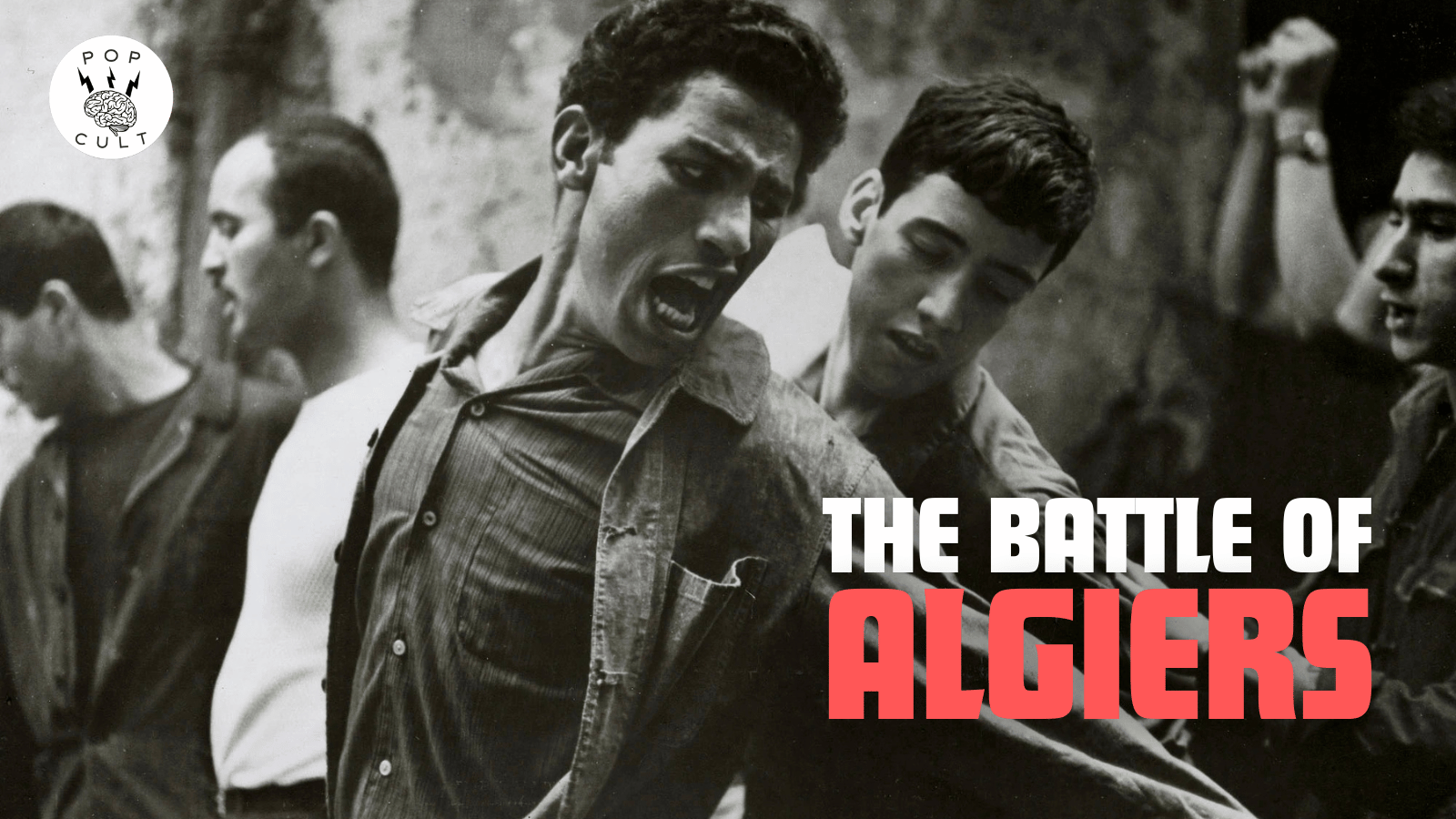
The Battle of Algiers (1966)
Written by Franco Solinas and Gillo Pontecorvo
Directed by Gillo Pontecorvo
From 1954 to 1962, the French government was at war with the Algerian people. Algeria had been a French colony since 1830 when King Charles X decided to take the land. They blamed pirates on the Barbary Coast and their ransoming of French captives. In reality, French sentiments towards their increasingly authoritarian king led Charles and his advisors to dream up a foreign conquest to calm the people. In the first thirty years of French occupation, it is estimated that up to one million Algerians were killed, nearly a ⅓ of the entire population.
The film opens in 1957, when an Algerian man has been tortured by the French military into giving up the location of Ali la Pointe, one of the revolution’s key figures. The film flashes back to 1954 and the beginnings of the uprising against the French. The conflict begins when Algerian locals come into conflict with the pieds-noir, or ethnic Europeans born in Algeria. This led to greater cohesion among the rebel groups that lived in the Casbah, which threatened French dominance. French Army paratroopers are sent in to quell the rebellion and do so using assassination and torture. As the French escalate, so do the Algerians until everything boils over and it becomes clear the colonizers are going to be made to leave.
Part of what makes The Battle of Algiers stand out is the choice of presentation. The Italian filmmakers chose to emulate the neo-realist cinema that had become popular in their home country. However, they also intentionally set about making the picture feel like a documentary or newsreel, allowing for an editorial distance from the subjects. Director Gillo Pontecorvo said he didn’t feel the film came down in support of one side or the other; he simply wanted to depict what happened in this conflict.
That might have been his intent, but fellow Italian Michelangelo Antonioni addresses this idea of neutrality with his film The Passenger. That sprung out of a conversation Antonioni had while shooting a TV documentary in China where one of his handlers pointed out that this Western fantasy of neutrality while depicting human life and conflict simply isn’t real. I think it would be nearly impossible to watch this film and not come down on the side of the Algerians. These people have had their homeland invaded and occupied for over a hundred years by a European power that does nothing but exploit them. It’s the story of apartheid we’ve seen play out in South Africa, Palestine, and so many other places. It’s a signature tactic of European colonialism.
Part of this film’s magic is how it serves as a blueprint for effectively pushing out an occupier. In the same way How to Blow Up a Pipeline provides a clear schematic for solidarity, and we see the same here. Refusing to extinguish the passion for liberation while maintaining a calm, tactical head is the key to defeating an occupier. Violence is going to be an essential element, but the typical Western reaction to the idea of violence from the oppressed is that it will somehow taint the revolution. These feelings never seem to extend themselves to conflicts in which white Europeans are the victors. That violence is always justified through propaganda. Western expansion in North America is a glorious, mythical crusade where the Natives were heathen hindrances to the proliferation of Christianity.
The filmmakers here are Marxists, and they approached the subject with trepidation. One of their great fears was to come in as European saviors telling the story of the Algerian people who couldn’t possibly be their own voices. They knew such an act would be antithetical to why they wanted to make the film in the first place. Finding a balance between the austere and the passionate was key, and through the faux documentary approach, it all came together. Almost every actor was a non-professional except for Jean Martin, who plays the dry French Colonel Mathieu, overseeing the paratroopers’ violence on the people.
Scoring the film is legend Ennio Morricone, a composer known for grand sweeping musical pieces. His work on Sergio Leone’s films is iconic. Yet Morricone wasn’t bombastic when it was unneeded. Instead, he chooses a sparse score, leaning more into percussion than orchestral structures. The film is structured as a series of episodes and events that happen to be caught by the camera. One particularly memorable moment sees a group of Algerian women venture into areas popular among the young French that lived there – a soda shop, a dance hall. They place time bombs under seats and tables. They calmly retreat back into the city, their bombs serving as a response to the French bombing of a residential building in the middle of the night. We are privy to each tense moment as these women know they might be caught and never survive.
The filmmakers were avid re-readers of Frantz Fanon’s The Wretched of the Earth, a book that does the best job I’ve seen at clearly outlining why colonialism is wrong and how violence will be necessary to liberate occupied people. Violence is how the occupier makes the occupied submit; it is a battle of wills where the invader purports to display they have no limit to the horror they will inflict. Thus, if people wish to be liberated, they have to do more than show they can endure such violence; they have to show an ability to strike at those things most important to their occupier. This is typically the idyll in which the occupier lives. If living on foreign soil is no longer something that can be considered “safe,” it is inevitable that the occupier will retreat. Make their campaign of horrors a dangerous waste of resources, and they will run away to lick their wounds.
The Algerian fight for freedom was the first domino in a series of reversals to European colonialism. Yet, as we can see in the work of Senegalese director Ousmane Sembene, removing the occupier doesn’t mean the threat is over. Sembene continually shows how financial entanglements can keep former colonies under the thumb of their oppressors. If your African nation has an economy dependent on the franc, then are you truly free of colonization, or is this just a new type of occupation?
The Battle of Algiers continually reminds the audience that liberation is not a single moment but an ongoing process and that people are not safe simply because a military force has retreated. The desire to be free must stay emblazoned within people. The film doesn’t end with the moment the French withdrew but a scene of mass defiance, where the people were so moved by the deaths of some of the revolution’s heroes that they had to stand against the French. Text on the screen tells us that Algeria would become independent years later. I think it is crucial that the movie ends here, refusing to show the moment the text speaks about.
Right now in the States, there’s a manhunt going on for a person who killed the UnitedHealthcare CEO. There’s talk among some of the more pearl-clutching Liberals about how disappointed they are over the ordinary person’s indifference or outright glee over this killing. What these Liberals refuse to recognize is Friedrich Engels’s concept of “social murder.” Premature deaths caused by the intentional deprivation of basic human needs perpetrated by private corporations and wealthy entities are perfectly acceptable in the West. A homeless person freezing to death on the streets of cities overflowing with wealth is never followed up by the arrests of land developers and slumlords who are responsible for homelessness. A person who is denied their claim for lifesaving treatments and subsequently dies will never see justice against the health insurance bureaucracy that killed them.
We are taught that the actions of the masked man who took out the CEO are morally repugnant and inexcusable. Yet, the actions of that same CEO to push policies that would lead to premature death are perfectly fine, and nothing can be done about them. More of us are colonized than we will admit. Our minds and worldviews are predicated on a hierarchical system where we are meant to accept powerlessness as the only truth. This is why so many can sit idly by as their labor fuels genocidal capitalist regimes around the globe. We have been conditioned to see this as humanity’s “natural” path. Until we can break free of these thoughts, we will be enslaved. We will help our captors in torturing the groups they tell us to. We will have hands drenched in blood. We cannot be surprised at the suffering we will inevitably experience when these colonial systems come crashing down around our heads.

 PopCult Reviews
One thought on “Movie Review – The Battle of Algiers”