
This special reward is available to Patreon patrons who pledge at the $10 or $20 monthly levels. Each month, those patrons will pick a film for me to review. If they choose, they also get to include some of their thoughts about the movie. This Pick comes from Matt Harris.
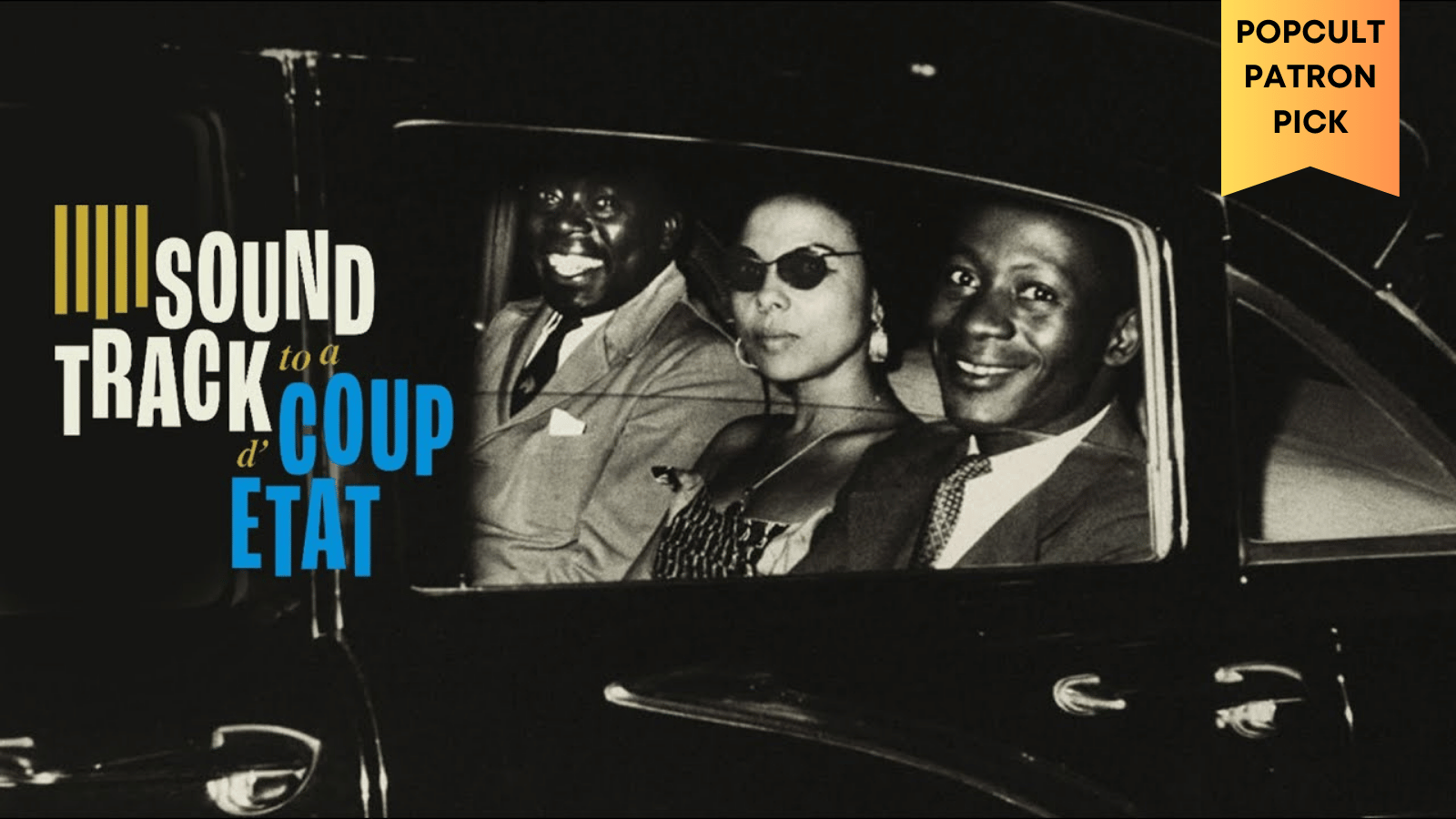
Soundtrack to a Coup D’état (2024)
Written and directed by John Grimonprez
Being a media-obsessed person for my whole life, I have come to a new understanding since my university days about the United States and the way it uses media as a weapon. Depending on how far along your understanding of the mass media’s purpose and how power becomes gained & is wielded, you might not see the reality just beneath the surface. As Michael Parenti said in his book Inventing Reality: The Politics of News Media, “Power is always more secure when cooptive, covert, and manipulative than when nakedly brutish. The support elicited through the control of minds is more durable than the support extracted at the point of a bayonet. The essentially undemocratic nature of the mainstream media, like the other business-dominated institutions of society, must be hidden behind a neutralistic, voluntaristic, pluralistic facade.”
This is why every movie theater I walk past here in the Netherlands is playing 95% American-made movies, infecting the rest of the planet with the U.S.’s twisted worldview. This is not new, and as Soundtrack to a Coup D’état shows us something that uses the victims of American brutality to further its goals.
The film begins with the conclusion of the events that will unfold. One morning in February 1961, a group of Black people crashed the UN Security Council to protest the assassination of Congolese President Patrice Lumumba. Among the protestors were Abbey Lincoln and Max Roach, musicians and activists. The film takes us back six months to USSR premier Nikita Khruschev’s visit to the UN as sixteen newly independent African nations were admitted to the body. This was the speech from which U.S. media boiled everything down to Krushchev slamming his shoe on the desk.
As is the standard in U.S. media, the context of this and the content of his speech were smeared into something unknowable to the masses. Khruschev spoke about the need to end colonialism and talked about the obscenity of what had been allowed on the floor of the UN. An undemocratic envoy, backed by the CIA, was allowed to be seated for Congo instead of their actual president’s people.
This came about when the Belgian government faced such backlash for its century-long occupation of Congo and had to withdraw. As with all colonizers, they would not really withdraw but simply use other tools to obscure their embedded institutions. Belgium did this by privatizing the nationally owned mining operation. In this way, they could say they were no longer manipulating circumstances in Congo while still having a privatized pipeline to keep flooding the nation with mercenaries.
The United States, under Eisenhower, became a willing ally because Congo has one of the world’s largest known reserves of uranium. The United States decided to go all in with amassing a nuclear arsenal following their use of two bombs on Japan that positioned them as the most psychotically dangerous nation on the planet. The U.S. State Department put together a new position of jazz ambassador and requested Louis Armstrong to take the position. He did and was sent to countries throughout Africa, with the U.S.’s intent being to soften the native people to further imperial interference. Using the cover of this tour, CIA agents would infiltrate African nations and foment dissent against governments that didn’t capitulate to the desires of America. It would get so bad that, at one point, Armstrong threatened to renounce his citizenship if he would be used in such a manner.
Using Black music to further U.S. white supremacist interests wasn’t new then and has become one of the favorite tools used by the empire. Look at the grotesquely jingoistic Super Bowl halftime show where Samuel Jackson was dressed up as Uncle Sam, and wealthy musicians were meant to serve as an example of achievement in the Black community. The American Empire needs to convince Black youth that their futures are best served by adherence to the system that enslaved their ancestors. They want to toss Black young people in the military grinder of imperial conquest; so far, they have been disturbingly successful.
The Church is no longer the potent tool it once was to cow Black populations as it has faded for almost every other demographic in recent years. Fame and mass media are the new religions of the 21st century. People like Jay-Z and Beyonce do not really care about the lives of the Black people who see no end in sight to their struggle. These celebrities are fully ensconced in capitalism. See Snoop Dogg performing for a Trump inaugural event. The U.S. has improved its vetting process so that nothing like Armstrong’s threat is likely to ever happen again.
The choices made by Grimonprez blend the artistry of the music and the urgency of a global foreign crime cartel that is still picking the bones of Africa to this day. This is not a linear telling, meaning it demands attention from its audience. That freeform spirit also indicates the jazz music at the piece’s heart. The documentary has some quite nauseating moments, such as when Grimonprez shows us a Tesla commercial and an Apple ad using famous jazz pieces. It does not escape us how Apple’s bottom line depends on the slave labor in mines to keep their batteries robust. The same for Tesla, but even worse in that Elon Musk’s grandparents (members of the Canadian Nazi Party circa WWII) moved to South Africa because they liked the apartheid.
Grimonprez’s core thesis is that the independence of former African colonies would never be a process where capitalists fairly released their chokeholds. Frantz Fanon said the same in his Wretched of the Earth, pointing out how economic interests always dig in their heels. Senegalese filmmaker Ousmane Sembene made a comedy on the matter, Mandabi, where a money order that arrives from a relative working in France causes no end of trouble for a community. This was not something African people were unaware of. They knew this breaking of colonialism would be brutal and organized collectively in response. The film spends considerable time with the words and images of Andree Blouin, Lumumba’s chief of protocol, who was an organizer of Congo’s women. Women are constantly emphasized as a key piece of the liberation movement, something often obscured by U.S. media.
Jazz music is used in every possible way – anthems of Black power and a means to mock the establishment. Since I first heard her, Nina Simone has stood out to me as one of the most potent Black voices in music. Here, we see how she was cruelly manipulated into performing for a CIA-backed group operating under the guise of sharing Black culture with Africa. This is why identity politics is not as cut & dry as so many conservatives and liberals would like us to believe. It is not above the empire to use the language of the oppressed to further their goals.
My only major critique of the film is that it needed to explain its figures better. I am a weirdo who spent hours reading about these people over the last two decades, so I knew who someone like Lumumba was before he appeared in the film. Having recently read anecdotes about a Politico writer not knowing about FDR and the New Deal or a New York Times reporter claiming they had never heard of Jim Crow and thought the person they were interviewing was “pushing an agenda,” we must assume rightly that our educational institutions are failing to actually build a baseline of historical knowledge. I don’t like the idea that we would have to rely on movies for that, but we must also understand the battle for the mind is being waged in mass media. It would be foolish not to engage on this battlefield in the most effective ways possible.

 PopCult Reviews
One thought on “Patron Pick – Soundtrack to a Coup D’état”