Mustang (2015, dir. Deniz Gamze Erguven)

mustang-2

While Mustang takes place in modern day Turkey it is a story that could happen at any time and almost any place. Five adolescent sisters suddenly have their lives changes when their guardians: their grandmother and uncle, decide they are becoming corrupted by secularism. They have everything that could provide them contact with the larger world taken away, from cell phones to laptops to clothes considered improper to makeup. They begin to seek out arranged marriages for the older girls and the imprisonment takes its toll on the girls.

Told from the perspective of the youngest, Lale, the film is made with a lot of confidence and skill. The camera is mostly handheld and conveys the youthful energy of its characters. Sunlight is also used quite effectively to act as a force that still connects the girls to the world. The subject matter could very easily lead to a bleak, hopeless film but director Erguven is able to sustain a sense of hope at the end of this nightmare. Each of the girls experiences the loss of their freedom in different and interesting ways.

When questioned on her wedding night on why she didn’t bleed after sex with her husband, the eldest sister finds it easier to just confess to having slept around with boys when no one listens to her explain she was a virgin. Another sister, seeing that an arranged marriage is inevitable, convinces her boyfriend to ask for her hand as a way to reclaim some of her freedom and choices. Choosing this story to be told through Lale’s eyes is perfect because it puts us at a disadvantage as it relates to the details. Like Lale, we have to try and figure out what is happening in the world as we go.

There have been some comparisons to the Sofia Coppola directed The Virgin Suicides, but beyond the very basics of the story, there is very little similarity. While The Virgin Suicides is told exclusively from the male perspective, Mustang a very intimate look at these young women’s lives. You gain a greater understanding of how each character is processing the experience rather than the broad strokes of Suicides.

The film must maintain a fine balance between the realism of its situation and refraining from despondency. There are moments in the latter half that are a shocking jolt in the midst of Lale’s dreams of escape. If there is a central message here it would be about the power of determination and will. Lale never resigns herself to the loss of her freedom. From the minute the girls are locked away, she is shaking the bars on windows, spying on locations of keys, and plotting an escape. The film has a quite a bit in common with films like The Shawshank Redemption and Escape from Alcatraz.

Filled with humor and joy, Mustang is a timeless story. It transcends any particular religious or geographic specifics and conveys an experience that is felt by women across the globe at varying levels of intensity. Societies seem to have a preoccupation with controlling the will of their female citizens, based on a fear of loss of control. Director Erguven states firmly that this type of energy is impossible to contain and through Lale she tells a story that gives hope to those who may feel like they have no more freedom.

Comic Book Review – The Ultimates: Omniversal Volume 1

The Ultimates: Omniversal Volume 1: Start With the Impossible
Writer: Al Ewing   |   Artist: Kenneth Rocafort
Purchase this book here

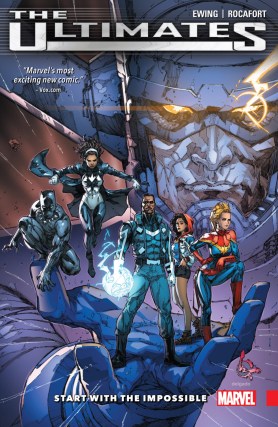
ulitmates vol1The Ultimates has been a superhero team name used in many different contexts in the last decade by Marvel Comics. The current incarnation is a drastic shift from the former. Led by Captain Marvel, the Ultimates is another one of those “pro-active” teams. It’s a concept that’s been done many times before and I’ve never felt it’s never been done too successfully. However, writer Ewing has figured out a format that allows everything to work. The team counts Blue Marvel, Spectrum, Ms. America, and Black Panther among its members and their focus right out of the gate is a huge one: complete the metamorphosis of Galactus that was hindered millennia ago.

Galactus is a carryover from the universe that existed pre-Big Bang. He was saved by his specialized spacecraft and became an omnipotent world devourer in the new reality. The problem was that various armadas from across the galaxy interrupted his gestation and that is why he now eats planets to survive. Blue Marvel has deduced that Galactus needs to be put back in his ship and the process will be completed. Every member contributes their skills to this might endeavor and it’s a very satisfying two-part story. The conclusion establishes a status quo for Galactus that me genuinely shocked and excited.

The remaining three issues in the collection focus on Blue Marvel’s quest to repair the damage done to the timestream in recent years. Between the original teenage X-Men running around in the present day, the timeline catching up with what used to be the “future”, and the reality rendering of the recent Secret Wars, the Marvel universe is operating on a razor’s edge. The team constructs a ship capable of traveling into the space beyond the universe where they plan to fix what’s wrong. What they find ties directly into Blue Marvel’s path and they get help due to some of their previous actions.

ultimates 02This was the first Marvel comic that felt like it was capturing some of the magic I used to love about DC. Having a team that tackles the cosmic and multiverse level problems is always so interesting to me. I also love when a writer takes well-worn concepts, like Galactus, and makes changes that will forever alter them and open up a whole new world of stories to tell. The sense of a growing universe is so much fun, better than comic books that feel stagnate or just kill characters off only to bring them back months later. Character growing and changing their mindset is much more interesting.

The stories here are definitely not new reader friendly. Even with an effort to fill in some backstory for Galactus or Blue Marvel, it’s still pretty essential to do some background reading if you want to fully understand who these characters are and what is happening. The final issue in the collection is particularly impossible to parse due to its focus on a character with a lot of complicated history in the Marvel Universe. So if you enjoy jumping in the deep end you’ll like this comic but if you prefer to have things explained detail you might look elsewhere.

If you read Jonathan Hickman’s work the last few years at Marvel (Secret Warriors, Fantastic Four, Avengers World, Secret Wars) then this takes the ball and keeps it rolling. Events happening in Civil War II were seeded right here. I will definitely be keeping the series on my reading list. It hits those high adventure, exploring the unknown notes that Fantastic Four provided in at its best, continuing an important tradition in the Marvel U.

Comic Book Review – Monstress Volume 1

Monstress Volume 1
Written by Marjorie Liu  |  Artist: Sana Takeda

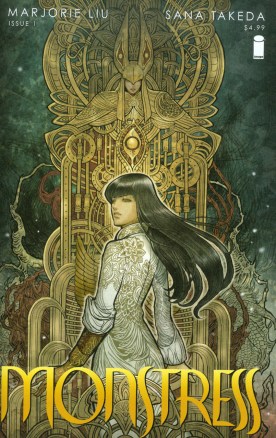
monstress 1At first glance, the protagonist on the cover of Monstress doesn’t look very monstrous at all. Maika is a beautiful young woman without horns or scales or anything denoting a monster nature. That’s sort of the point in this exploration of prejudice and feminism brought to us by writer Marjorie Liu and artist Sana Takeda. The beautiful art deco style cover is immediately given a counterpoint in the first full page panel: Maika naked, a chain collar around her neck, a riding crop under her chin, and the revelation that her right arm from the elbow down is missing. On her chest is a tattoo of a vertical eye. This rather ugly reveal presents what will be the theme of the series, a beautiful ornate baroque world that is hiding a society built on violence against the Other.

My initial reaction to Monstress was the same sort of disorientation I’ve felt watching most anime or reading manga. There is this push deep into the world where the reader is expected to catch themselves up as they go. Western media typically lays things out in a very deliberate fashion so it takes a little configuring of the brain to get involved. The world of Monstress is built on the divide between humans and the Arcanic. The Arcanic are a mixed race species between humans and a sort of interpretation of East Asian demons and animal spirits. Many Arcanic look perfectly human, they might be hiding a pair of wings or a foxtail, but if found out to not be fully human they lose all rights. Arcanic are part of a massive slave trade and some are even harvested for their essence called Illium.

Chief among the enemies of the Arcanic are The Cumea, a faction of female witches that are more like the Vatican than a coven. They have unlimited wealth and some even appear to be what I would consider Arcanic but avoid that label because they have power. An event occurred prior to the series, a great battle between the Arcanic and the Cumea that left some of these witches scarred by magic energies. They desperately want revenge for this transgression and it seems our hero, Maika is tied deeply to this past conflict.

There are very few male characters in the series and not a single one is in a position of power. All authority is held by women on both sides of the conflict. I particularly enjoyed how there is no sense of unity among the women of the two sides. They are truly human in that the concepts of tribalism and the Other are still going strong. How they choose to deal with problems comes from a different perspective but the hatred of the Cumea for the Arcanic is white hot and unflinching.

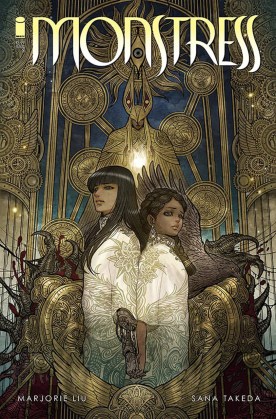
monstress 2The growth of Maika is the focus of the series. She starts single-minded and willing to let the innocent die if it means she gets closer to her goal of revenge. As she spends time with other characters she has a conflict with her inner nature and by the end of the first arc, she has learned the value of compromise. Her two companions, Kippa, an Arcanic with fox like attributes and Master Ren, a clever and witty cat, feel like paper thin characters. I was reminded of some forgotten animes that featured characters just for the cuteness appeal. There are hints at deeper levels and a rich history to the villains in The Cumea but it’s not explored very deeply in this first arc.

The pace of the series is very quick. We jump right into the story and hit major plot points every issue. There’s never a point where things feel dull or we lose momentum. You wouldn’t be blamed if you start to lose focus on what the larger conflicts are. The politics are so dense it can be overwhelming at points and it would have been nice to have the history of the world disseminated in a little more palatable manner. Each issue ends with mini “lectures” on some point of history in the world but I never found myself interested in reading these long passages of text when I was more interested in the core story.

Monstress is a very enjoyable first chapter in what looks to be a long sprawling saga. I think in hindsight, once the complete story is published, going back and reading these early issues will feel less challenging. The artwork alone is a great reason to pick up the book, it is so full of detail and movement. If you’re interested in jumping head deep into a complex and complicated new world give Monstress a chance.

TV Review – Orange is the New Black Season 4

Orange is the New Black: Season 4
Created by Jenji Kohan
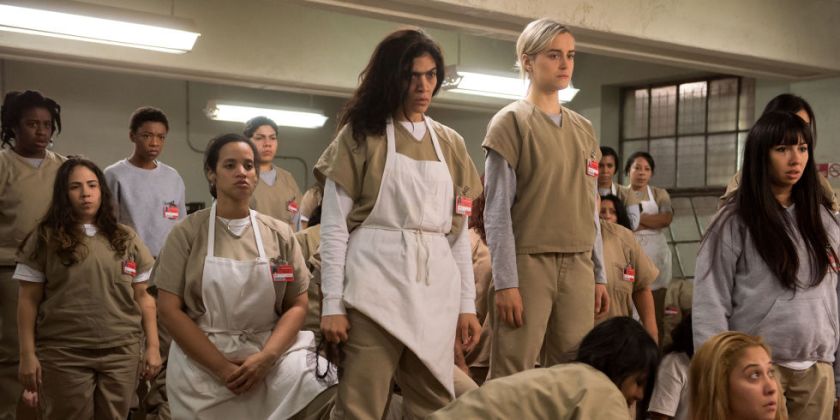
orange 01I have fully embraced the power of Netflix at this point. While I have not watched every original series they have released, I love the ones I have. When season one of Orange is the New Black came out I wasn’t very keyed up about it. The selling point at the time was “from the creator of Weeds” a series I didn’t find that interesting. I had watched the first two seasons of Weeds and it didn’t compel me to keep going. And I didn’t find Orange too intriguing in the first and second seasons mostly due to one character: Piper Chapman.

Piper Chapman. I get it. She’s meant to be an audience surrogate, the fish out of water through whom we will learn the ins and outs of Litchfield Prison. And this is no slight to actress Taylor Schilling, the character is grating. Even more grating than just Chapman is her relationship with Vause (Laura Prepon). I have never bought the thing these two have and the directions their plots have gone don’t help either. Is it bad that I have started the last two seasons hoping Chapman would get shivved at some point and then the series could just go on without her? She became more interesting separate from Vause and getting caught up in her panty-smuggling ring in Season 3. In Season 4 she continued to be interesting by having to deal with her inflated ego and the fallout of that attitude. But when the season concluded with she and Vause getting back together I had sigh annoyedly.

When Season 3 rolled around, something about the show just completely hooked me and reeled me in. I think the de-emphasis on Chapman’s character and the spreading out of storylines to the characters in the prison who are actually interesting. There’s no way I could say a single character stands out as my favorite because I am so happy when so many of them pop up on screen and we explore their lives. I love the friendships between characters: Taystee and Suzanne, Flaca and Ramos, Red and Nichols, Pennsatucky and Boo. In many ways, the reason I love Orange is because I love Lost. The moments when Lost really clicked for me was when it explored pairings of characters and how they played off each other and then, over time how those relationships evolved. Funny enough my least favorite character in Lost would probably be Jack for the same reasons I dislike Piper, main characters seem to start out as such bland ciphers.

Season 4 is probably my favorite run of Orange to date. I am excited to see where these characters go next and the season asked some very tough questions but didn’t feel the need to answer them. I love when a television show brings up complicated topics, creates difficult situations where there is no clear villain, and then lets the audience live in that space. Breaking Bad and Mad Men did this often and it is what made me love them, especially the latter. In real life there aren’t clear lines that define hero and villain, it’s more complicated. The conflict between Pennsatucky, Boo, and Donuts is a perfect example.

orange 02I genuinely believe that Donuts didn’t have bad intentions when he began his sexual encounters with Pennsatucky in Season 3, and I believe that at the start she was into him. But things became very complicated and messed up quickly. Donuts has a duty as a prison guard so their relationship should never have even gone to that place. In many ways, this relationship was offered as a counterpoint to Daya and Bennett, which I felt was a very dangerous portrayal. When one person has clear, direct authority over another there are clear lines that should not be crossed. So, on the one hand, I felt bad for Donuts, but I also totally sympathized with Boo’s stance on what had happened to her friend and knew she was right. It’s that sort of complicated writing that makes me love this show. It’s not going to answer the moral quandary, it’s going to pose the question.

Another thing Orange does so well is to rotate the spotlight on its cast, and it has an even larger and growing cast than Lost could have imagined. Season 4’s spotlight on Ruiz was very interesting and her evolution into a leader has me interested to see the fallout between her and Mendoza, the acting “mother” of the Latina group. The release of Diaz was one of those moments I hope we see more of in the next few seasons. A show set in a prison allows lots of flexibility from a casting perspective, prisoners can be released and new prisoners can be incarcerated. I do hope the show refrains from showing too much of life after prison on the outside. Keeping the focus on life on the inside is more important. Having moments where someone leaves and both the audience and characters know they will likely never see them again helps convey what these relationships are truly like. Prisoners bond with each other out of survival and need for companionship, but the system they are living in can pull these bonds apart at any moment.

I find Caputo is one of the most infuriatingly fascinating characters in the series. I can never exactly pin him down and that is what makes him so interesting. I believe he genuinely wants to do good, he has pure intentions, but he is so easily undone by crises. It reminds a lot of seeing upper-level leadership in teaching who deep down truly care about the students but get so tangled up in the absurdity of administrative policy and thinking they instead make destructive choices.

In that same vein is Healy, one of the most tragic figures in the series, and that is saying a lot. Here is another instance of Jenji Kohan and writing staff refusing to make someone an easy villain. Healy is both a victim of life and an abuser of his position of authority. He is what I wish Ben Linus had been able to be developed into on Lost. Someone who comes across as the obvious bad guy but as we peel back the layers becomes more and more broken and sad. Healy’s relationship with Lolly and it’s heartbreaking conclusion was one of those pinnacle moments in a season with so many great plots. My hope from a narrative and character point of view is that we just never see Healy again, maybe a short cameo in the final season by someone who gets released. The moment where he checks himself into the mental health facility is a perfect period on his story. He’s going to hopefully get the help he needs, but the audience, just like the inmates, will never know exactly where he vanished to.
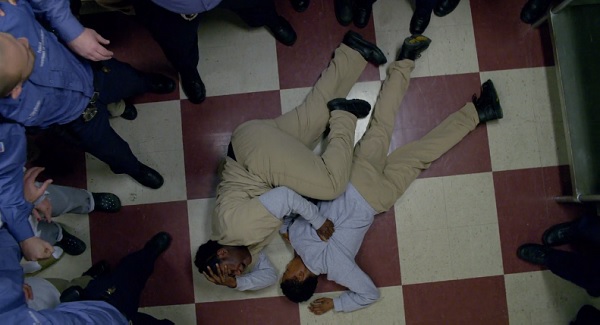
orange 03The moment everyone is going to remember of course will be the sudden death of Poussey. This was a very delicate moment and I think it was done in the right way. My only complaint was that a tragic ending for the character felt very telegraphed from about mid-season onwards. I suspected something would happen, I just didn’t know it would be so horrible. I’ve read a lot of criticism online about how the show dealt with Bayley, specifically that they made him too sympathetic. Much like I said earlier on how the show likes to raise difficult questions and present challenging situations, I believe that’s what this episode was about.

So often police brutality and murder is not the result of a malicious spirit but a frightened and improperly trained mindset. Bayley’s murder of Poussey was a result of leadership in the prison failing. Caputo kept leaving and not realizing things got worse when he did on top of Piscatella instituting a very cold, dispassionate policy of control in the prison. Add to that Suzanne’s trauma from being made to fight her ex by Humphreys and you had a confluence of people that could only end badly. If Bayley were a real person then I would expect he’d get charged with manslaughter, but he never wanted to kill Poussey. It’s a condemnation not of an individual but of corporations like MCC who cut corners on training and as a result, withdraw a sense of humanity from prisons. I think everyone’s grief and pain were touched on wonderfully and we saw the full spectrum of perspectives. What Bayley did was something we are all capable of, in a moment of extreme crisis if you can’t handle the pressure you can end up doing horrible things to another human being. You should be simultaneously held accountable to the full extent of the law but also shown compassion and love. Like a lot of the prisoners in Litchfield, Bayley had the worst day of his life and he’ll now pay for it. We could see that in the scene where he’s driven home by one of the army veteran guards and he looks genuinely broken when the man says he and Bayley are the same.

As a writer, it would have been extremely easy to make sadistic guard Humphreys the murderer. But that would not have had the emotional impact on the narrative that choosing Bayley did. Humphreys is easy to hate and he doesn’t challenge us. Including him as the focus of the final scene was a smart move. The dynamics in place bring up a lot of emotion. The audience truly hates Humphreys but does he deserve to die? Maybe you think he does. But Daya holding the gun not only gets her an extended sentence if she were to kill him she would also go to max and get life. She’ll never see her child on the outside if she does this. In the same way, Pennsatucky finds it in herself to forgive Donuts because *she* needs to do that, the audience has to find a way to let its hate go. Revenge killing a guard, even Humphreys, may satisfy a momentary emotional need for revenge but its long terms effects will be the destruction of Daya’s soul and her life. As in life, we don’t get to get back at those who have wronged us. Many times we don’t get proper justice is supposedly promised to us. What people have to do is find a way to forgive so that they can move on, so that they don’t have to live in that pain and hate for the rest of their lives.

I am very excited to see where Orange goes in its 5th season. I’d love for the opening to have let some time pass, to not show Daya or Humphreys right away. Slowly unfold those details, show the grieving process for Poussey continuing. Show Caputo facing the blame for what he is ultimately responsible for. Continue to tell these wonderful stories about these dynamic characters. And especially, I hope it continues to challenge the audience to think beyond black and white spectrums of morality, and be forced to face the fragile nuance of human existence.

The Purge: Anarchy (2014, dir. James DeMonaco)

the-purge-anarchy-default-1920

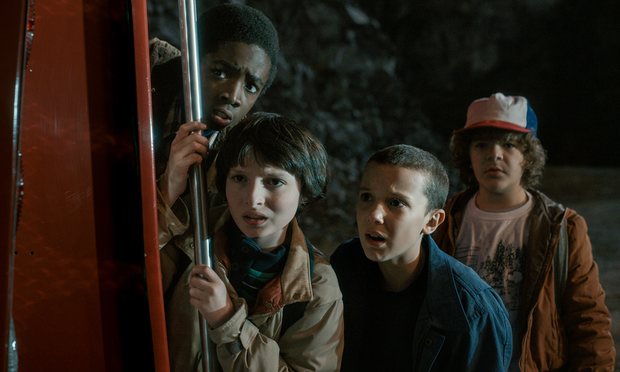
Whenever I’m playing through a video game and it suddenly forces me to engage in an escort mission, bringing a character I can’t control from point A to point B and keeping them alive, I will groan and slog my way through it. The Purge: Anarchy is a video game escort mission as a feature length film. I have not seen the first Purge film but was told it was unnecessary viewing and that this second film would fill me in. That was true, they deliver a lot of first act exposition to explain what is going on.

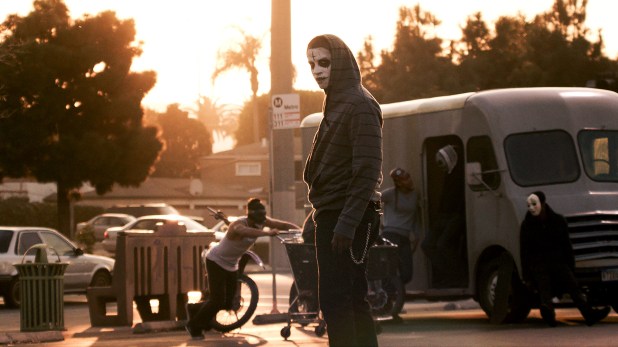
The film tells the story of the night of the sixth Purge. The Purge is an annual event instituted by an upstart extreme Libertarian political party as a way to help people release their rage. For twelve hours, all crimes are legal and the use of most weapons in committing these crimes is permitted. In Anarchy, we have an unnamed man (Frank Grillo) embarking on a mission of revenge. On his way, he makes the decision to help out a mother and her daughter and his Purge night takes an extreme divergence from his plans. A couple more characters join up with the group and they make their way across Los Angeles trying to survive the slaughter and mayhem around them.

It was probably not a good idea to make this my very next film after Green Room because the former definitely highlights the huge problems with the latter. Read my review of Green Room here. The Purge: Anarchy has five protagonists and none of them die until the last 15 minutes of the film and then it is only one. If the goal of the film is to make me feel that the event is the most dangerous and insane thing I could go through then it fails big time. Green Room kills off the most well prepared and confident character in a snap of your fingers. Here we have Frank Grillo essentially playing The Punisher and making it to the end and, spoiler, he’s the main protagonist of the third one currently in theaters. The film undercuts any sense of true fatality by keeping its main character alive the entire film.

Then we get to the metaphor of the film, and by god, it’s pretty hard to miss because they have shaped it in the form of a Mack truck. When I was in college, I stumbled across the film Mississippi Burning about the murder of three civil rights activists and directed by Alan Parker. I was astonished at how on the nose and disingenuous the message of the film felt. They kept beating you over the head with “Racism is bad”. Yes, I know that. But what interesting avenues in regards to racism do you plan to explore? Oh, none. Ok. Then why make this movie? But at least Parker’s film had a cogent message. I can’t tell you what Purge: Anarchy was attempting to say about anything. I suspect writer/director James DeMonaco is a little confused himself.

The first guess you might have is a message about Americans and their addiction to guns and the violence in our culture. Well, we have an allegedly anti-Purge group led by Carmelo (the always awesome Anthony K. Williams) telling us that the Purge concentrates its violence on the poor and minorities. Okay, a little on the nose, but let’s go with it. However, in the third act Carmelo and his group show up at a warehouse where One Percenters are hunting people down and state “It’s our time to Purge”. And the film portrays this as good and justified. I don’t think messages can get more mixed than that. They’re moments where we find young black men rounding up people from their own communities and selling them to the rich. We have two battling sisters who end up spilling blood over their shared love, one of the sister’s husbands. There’s a dude in an American flag baseball cap traveling around in a semi-truck with a personal army and mowing people down with a minigun. But the film never manages to compose a semi-cohesive point about any single thing it brings up. They’re bits of fictional media sprinkled throughout that build up the world but I never saw an underlying statement to any of it.

Even without a coherent thesis, the film could have done something stylistically interesting. The cinematography is sloppy and derivative. The pacing is dull and it becomes a movie where you are checking the time to see how much is left. If they had gone the route of Pulp Fiction-esque anthology that could have been interesting, playing with time and narrative order. They could have had the main character in one story as mere cameos in another. There were some points where we could have delved deeper into the racial impacts of the Purge but the film never has the guts to. I think having a late 40s white male director is going to keep the film from exploring those elements in any interesting way. I thought of a very different film, Lawrence Kasdan’s Grand Canyon (1990), that wanted to say something about race relations and came off as one the most insultingly dumb movies I’ve ever seen. This is sort of like Grand Canyon but with more guns, and even then I never felt the flinching and queasy sense of danger I got from Green Room.

The only moment in the film that got me truly interested were the final moments between Grillo and his target. There could have been some amazing themes explored there, some really complex and challenging performances. But then it just whimpers out and we cut away. The resolution is implied but I frankly would have rather seen a one room film set on the night of The Purge about Grillo and his target. Explore how people use the Purge to enact revenge and explore the psychological effects on those who do purge. The film just ends up being less than the sum of its parts. It didn’t make me interested in watching the newest film. Even looking at it as an ultra-violent escapist film you have to note it took the whole movie for even one of the five main characters to die! It just feels like a very surface level dip into sociology that other films have explored in more interesting ways.

Video Game Review – Asemblance

Asemblance
Developer/Publisher: Nilo Studios
Available on Steam and PS4

asemblance

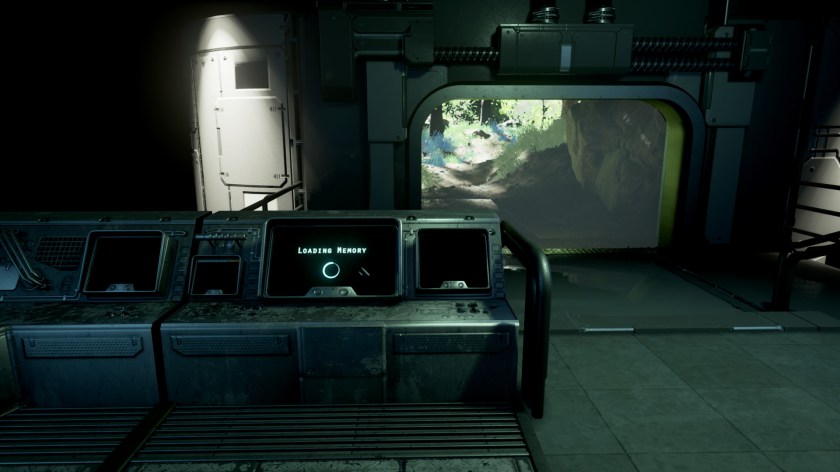
You’re immediately greeted by the sound of alarms and a computerized voice issuing warnings. As your vision goes from dark to blurry to focused you find yourself a dimly lit, cold metal chamber. A console sits in front of you, a room resembling Next Generation’s holodeck beyond that. This is the stage set for Asemblance, a game in the walking simulator genre that is heavily influenced by the mechanics and gameplay of P.T.

And like P.T., who you are is a big question. It would be easy to assume you’re the scientist who built all this equipment, the same scientist where the virtual memory simulations were harvested from. But the game is a mystery without clear answers. The first memory the computer allows you access to is a simple walk in the woods where you saw a butterfly. That butterfly serves as a motif through all the memories though it is not so easy to spot as in the first. The game is fairly small, only four memory files can be accessed in total. There are multiple endings though and each ending sheds light on different parts of the overall mystery.

During my own playthrough I found it became important to pay attention every single detail, no matter how significant. The contents of memos spread across office desks or placement and absence of framed photos were crucial in uncovering and progressing the story. The graphics are not spectacular. They are attempting to reproduce the near photo realism of P.T. but have some muddied textures and are rough around the edges. The biggest problem is the pacing of reveals. Early on you uncover one secret after the other and then suddenly there’s a wall. I spent an hour or so wandering back and forth between memories trying to figure out the next step. This is where those minor details play a crucial role.

The developer has said they see this as a potential anthology franchise, along the lines of the brilliant Black Mirror series. With some more polish I would be all in on something in that style. I’m personally a very big fan of the P.T. style of gameplay, particularly because I see good horror not as something where the protagonist can successfully fight back, but where exploration of the horror is encouraged and stepping into darkness is inevitable. Asemblance doesn’t break new ground but it provides a decent story and the promise of interesting things down the road.

Green Room (2016, dir. Jeremy Saulnier)

a24 visions

green room

There’s something dangerous about the woods. Yeah, the city is dangerous, but there’s something worse about the woods. You’re so far away from help. You’re isolated. The woods are cold and indifferent. So when the members of punk band The Ain’t Rights roll into the parking lot of neo-Nazi club plunked right down in the Oregonian forest there’s sinking feeling that hits your gut. I am ashamed to say I have not dedicated the time to watch Jeremy Saulnier’s previous picture Blue Ruin after hearing great things. Having seen Green Room, I must see this older film.

Green Room tells the story of a punk band that stumbles upon something they shouldn’t see in the back of a club. As mentioned before, neo-Nazis own the club and the band quickly become prisoners and involved in a brutal and violent standoff. Saying more would spoil the suspense of the film. The tension is built up beautifully through the moody ambient music of Brooke & Will Blair and the washed out cinematography of Sean Porter. Scenes are painted with pale green and blue ambiance and the tense drone that builds in the score. Right before all hell breaks lose all these elements come together and then explode into a nightmare.

The violence in Green Room reminded me a lot of Simon Rumley’s Red, White, & Blue. Harm to human beings is presented as realistically as possible, taking into account what actually happens to a body when hit with these sorts of traumas. There are many moments where you have to look away and the film doesn’t pull punches about who gets hurt and killed either. These are a group of young adults who aren’t trained to fight for their lives and they make the sorts of mistakes and show ineptitude with weapons that they truly would. I also loved the confidence of a couple characters going into extremely bad situations. That confidence is dealt with appropriately.

The acting is done very well with Patrick Stewart and the late Anton Yelchin heading up the cast. Stewart gives a great muted performance as the patriarch of this skinhead operation. He handles the band with just the right amount of calmness at the start, escalates as each side gets in their hits. Yelchin does a fine performance and is going for something very muted, unsure, and contemplative. You can’t watch his work now and not reflect on what we’ve lost. In the same way that seeing James Dean in Giant and East of Eden made me sad there weren’t films spanning decades featuring this actor, I feel the same way about Yelchin. I don’t believe we had truly seen his best work and films like Green Room show hints of that.

The supporting cast is excellent. Imogen Poots plays a local who ends up locked up with the band and brings a lot of physicality to the role that sold it. Her look and demeanor feel so real. The rest of the band does a great job, but it is the other neo-Nazis that are truly terrifying. Macon Blair plays Tad, the manager of the club and shows a lot of nuance. He’s not comfortable dealing with dead bodies and there’s a lot of unspoken and hinted at history that make him intriguing. Eric Edelstein plays an incredibly menacing skinhead that gets locked up in the room with the band. The stand out, though he is only on screen for a handful of minutes, would be Brent Werzner as Werm. He comes across a complete and total sociopath in his short screen time and is one of those people you pray to god you never meet in real life.

Green Room is a brutal story. But is is a very well told one. The narrative choices that are made help ratchet up the tension. Almost every moment of the film will leave you feeling the queasy, uneasiness, truly having no idea what horror is happening next. And this is definitely a horror film, not about the supernatural and not about a mindless slasher, but a horror story that preys on our fears of the big evil in the woods. This is what happens when you leave civilization and enter the realm of a vicious beast.

Book Review – While Black Stars Burn by Lucy A. Snyder

While the Black Stars Burn by Lucy A. Snyder
(Published by Raw Dog Screaming Press)

27181342._UY400_SS400_The collection begins with a story that only hints at the supernatural tales to come, keeping things fairly mundane. By the second piece, you are pulled into a beautifully created fantasy world. While the Black Stars Burn is a mix of Lovecraftian horror, fantasy, and science fiction and author Snyder handles each genre perfectly.
Personal highlights from the collection are:


“Spinwebs” – a story set in a medieval culture where humans and spider-like beings live in mutually beneficial relationship. The world of this story is very well developed in its few pages. You understand why the protagonist has such a love for her weaver and the way the world operates. The end of this story had me ready to read Chapter 2.

“The Strange Architecture of the Heart” – a science fiction story that hits the same buttons as “Spinwebs”. We learn all the details of the world that we need to know and it feels fleshed out. The piece is focused on a lonely housewife and her only friend, the family android. Dark and sadly tender. I wanted a second chapter on this one as well.

“Through Thy Bounty” – This might be my favorite story in the whole collection. A science fiction story set after a nightmarish alien species has conquered the Earth, we hear it from the point of view of a human enslaved to work as the alien’s cook. These creatures’ appetites are for the cook’s fellow humans so she was forced to butcher and prepare everything from infants to children to the elderly. I was genuinely surprised by the places the story goes and it has a very satisfying conclusion. Could imagine the movie version of this one.

“The Abomination of Fensmere” & “The Girl With the Star-Stained Soul” – This duo of stories is connected through a continuing plot. Penny is a teenage girl whose mother has just died in a car accident. A mysterious man appears on her doorstep and claims to be from the girl’s estranged aunt who wants her to live with the old woman. The girl ends up in a small town in the American South straight out of a Lovecraft story. There are familiar tropes but where the story goes is with these elements is very entertaining. The second part takes a very interesting divergence to a landscape most Lovecraft fans would know and provides some beautiful imagery.

While the Black Stars Burn is a collection well worth your time, I can’t say you will enjoy every single story, as with collections there is always one or two that just don’t click. The overwhelming majority of stories here are wonderful, though. Very confident prose with a strong sense of world building.

Games for Two – Dice Heist & Welcome to the Dungeon

Dice Heist

Designed by Trevor Benjamin, Brett J. Gilbert
Published by AEG

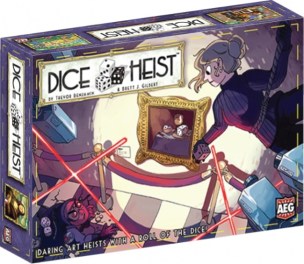
dice heistIn Dice Heist, each player is a master thief about to take on the four major art museums of the world: The Hermitage, The Met, The British Museum, and the Louvre. There are famous paintings, jewels, and artifacts to snatch up but you’ve got to be skilled and bring in sidekicks to help you out.
The four museums are each given a dice rating from easy (The Hermitage with 2 pips) to the hardest (The Louvre with 5 pips). Each player starts with one black die and each turn has the option to roll for a heist or recruit a sidekick (a white die). There is a limited pool of sidekicks and once you claim one it is yours for the rest of the game. Each turn, a player draws a card and places that item under the matching museum. If you roll on a museum and succeed then you get every single treasure that has accumulated there. When you roll your dice you look for at least one that beats the target value on the museum.

At the end of the game you add up the values of your total paintings, first place gets 8 points and the second gets 5. For each artifact you get 2 points and each set of gems scores in an ascending order (first red gem is 1 point, second red gem is 2 points, third red gem is 3 points, etc).

The game was very fast paced and there was some strategy in which museums you wanted to target based on their target value and what treasures they held at the moment. This was a game I think would benefit from a third player just to increase the tension. An okay game, very simple and easy to learn, very light on strategy.


Welcome to the Dungeon

Designed by Masato Uesugi and Paul Mafayon
Published by iello

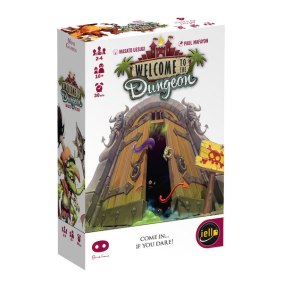
WelcomeDungeon_3DboxWelcome to the Dungeon is a game about a staple in tabletop gaming: heroes going into a dungeon and fighting monsters. The twist in this small card based game is that players all play the same hero. The first round of play is bidding which consists of pulling a monster card from the deck and either placing in the dungeon deck face down or keeping the card which allows you to take a piece of equipment from the hero. This mechanic does a couple things: the players are trying to make the dungeon as uninviting to the other players yet still beatable by themselves. There is the danger that you will think you are going to Pass and leave the dungeon in another’s lap only to have them drop out and leave you with a hellish dungeon.

Each successful run through the dungeon earns the player a Success card. The number of Success cards up for the getting varies depending on how many players you have. If you are killed in the dungeon you must flip an Aid card you individually have over to its red side. If you die again with this card on its red side you are out of the game entirely. To defeat the monsters you either expend a piece of relevant equipment (the Dragon Spear defeats the dragon for example) or be able to absorb the hit point damage based on the card value and your total armor added to your base HP.

While the game works with two players, the Bidding phase screamed out that it would work so much better with at least three. Bidding between two is a little lacking in the tension while adding a third would create some more variables. There are four different heroes to choose from at the start and we did only play once so with additional playthroughs some things might shine forward.

The BFG (2016, dir. Steven Spielberg)

bfg

On a dark night, at the witching hour, an orphan named Sophie glimpses a strange shadow on the streets, quickly realizing it’s a giant. She rushes to hide under the blankets of her bed, but a massive hand reaches in through the window and carries her off to Giant Country where her adventure begins. There she learns that her abductor is big friendly giant and that his kin are the ones she needs to watch out for.

I have been a lover of Roald Dahl since I was very little and had Charlie and the Chocolate Factory read to me chapter by chapter at night. From there I remember books like The Twits, Matilda, and of course The BFG. Of Dahl’s children’s books The BFG is one I don’t think about often. I remembered the illustrations by Quentin Blake with the giant’s comically oversized ears, but as for the story I didn’t remember much of it. Steven Spielberg is another figure I remember vividly from my childhood. I can’t say what the first Spielberg movie I saw was, I have memories of a some scenes from E.T. early on, but I would guess the first one I watched in its entirety was Raiders of the Lost Ark. Spielberg is known for the sentimentality he tries to weave into his work, which would seem to be in opposition to the sometimes caustic wit Dahl brings to his writing.

The acting in The BFG is pretty much perfect. Mark Rylance as the titular giant has captured every aspect of the character from his soft garbled understanding of language to his jumps from hunched shuffler around his cave to nimble leaper through the city streets. Ruby Barnhill as Sophie delivers a very confident performance, never coming across as an act-y kid, but feeling like an actual Dahl protagonist. The supporting cast doesn’t have much screen time, but they do their jobs adequately, the evil giants being the big standouts. The film lives or dies on the performances of Rylance and Barnhill and they are very strong.

The plot of The BFG is quite different than I think we’ve become accustomed to lately. This is an older style of Spielberg storytelling, where there is no epic battle between the forces of good and evil. The conflict is solved fairly quickly with a short exciting moment. The emphasis is on our two central characters and their relationship. An element of the Tim Burton directed Charlie and the Chocolate Factory that irked me was the addition of backstory to Wonka. It felt like the most unnecessary and pointless addition to a story that didn’t need it. In the same way we got the backstory of the Grinch or prequels attempt to fill in the gaps, these choices miss the point. We don’t need to know the origin of Santa Claus to love Santa. We don’t need to know how the Easter Bunny got his eggs to love Easter.

Dahl understood the details children are truly concerned about and he knew that they would accept larger than life characters without questions about where they came from. This is where the film shines because it flows like a Dahl narrative more than any other adaptation of his work I’ve seen. The plot is a lovely mess and not much really happens. But the time we spend with these two characters as they learn about each other is action enough. I loved how long some conversation scenes were, just these two bantering and hearing The BFG transformation of the English language.

I enjoy the latest superhero beat ‘em up very much. But it is very heartening to see a film like this still being made. It’s a picture about kindness and understanding. The BFG loves to help other but is very insecure about his speech and what other might do to him if they discover his existence. Problems are not solved through violence, but through peaceful means. Yes, the mean bad giants get what’s coming to them but it’s not being blown away and destroyed. Even they have a place in the world. And in this current climate, learning to understand that even your enemies deserve life and place in the world is a refreshing idea.