
Dice Heist
Designed by Trevor Benjamin, Brett J. Gilbert
Published by AEG
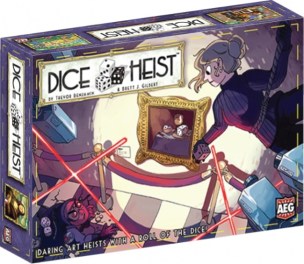 In Dice Heist, each player is a master thief about to take on the four major art museums of the world: The Hermitage, The Met, The British Museum, and the Louvre. There are famous paintings, jewels, and artifacts to snatch up but you’ve got to be skilled and bring in sidekicks to help you out.
The four museums are each given a dice rating from easy (The Hermitage with 2 pips) to the hardest (The Louvre with 5 pips). Each player starts with one black die and each turn has the option to roll for a heist or recruit a sidekick (a white die). There is a limited pool of sidekicks and once you claim one it is yours for the rest of the game. Each turn, a player draws a card and places that item under the matching museum. If you roll on a museum and succeed then you get every single treasure that has accumulated there. When you roll your dice you look for at least one that beats the target value on the museum.
At the end of the game you add up the values of your total paintings, first place gets 8 points and the second gets 5. For each artifact you get 2 points and each set of gems scores in an ascending order (first red gem is 1 point, second red gem is 2 points, third red gem is 3 points, etc).
The game was very fast paced and there was some strategy in which museums you wanted to target based on their target value and what treasures they held at the moment. This was a game I think would benefit from a third player just to increase the tension. An okay game, very simple and easy to learn, very light on strategy.
Welcome to the Dungeon
Designed by Masato Uesugi and Paul Mafayon
Published by iello
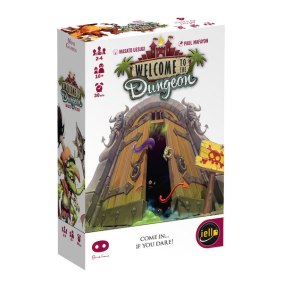 Welcome to the Dungeon is a game about a staple in tabletop gaming: heroes going into a dungeon and fighting monsters. The twist in this small card based game is that players all play the same hero. The first round of play is bidding which consists of pulling a monster card from the deck and either placing in the dungeon deck face down or keeping the card which allows you to take a piece of equipment from the hero. This mechanic does a couple things: the players are trying to make the dungeon as uninviting to the other players yet still beatable by themselves. There is the danger that you will think you are going to Pass and leave the dungeon in another’s lap only to have them drop out and leave you with a hellish dungeon.
Each successful run through the dungeon earns the player a Success card. The number of Success cards up for the getting varies depending on how many players you have. If you are killed in the dungeon you must flip an Aid card you individually have over to its red side. If you die again with this card on its red side you are out of the game entirely. To defeat the monsters you either expend a piece of relevant equipment (the Dragon Spear defeats the dragon for example) or be able to absorb the hit point damage based on the card value and your total armor added to your base HP.
While the game works with two players, the Bidding phase screamed out that it would work so much better with at least three. Bidding between two is a little lacking in the tension while adding a third would create some more variables. There are four different heroes to choose from at the start and we did only play once so with additional playthroughs some things might shine forward.





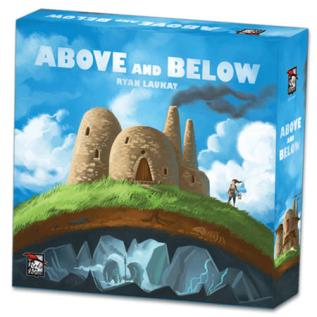 Above and Below is the story of rebuilding after disaster. Your village was destroyed by barbarians and you’ve moved your people to a new place to start a new life. However, you find beneath the ground is an intricate series of tunnels and the opportunity to discover great treasure. You’ll need to build new buildings, recruit new villagers, harvest resources, and explore the world below to win.
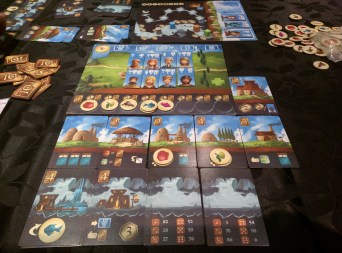 I was reminded a bit of IDW’s Machi Koro, a city building game, where certain cards are considered top shelf premium ones based on their cost and benefits. In Above and Below, there are six star buildings that provide multiple benefits if you can afford their large cost. There’s also four interchangeable star buildings that provide similar but less powerful benefits. Three pools replenish during your rounds of play: new villagers, regular buildings, and underground buildings. Each playthrough created vastly different villages for the both of us. Resources are harvested either from buildings or going into the caves. Once you have resources you can either stockpile them (which increases your income) or offer them up for sale to other players. At the end of the game you add up the resources you have stockpiled and multiply them by a point value based on where they were place on the stockpile track. So, selling resources can help the buyer increase that score while giving the seller a few quick gold pieces.
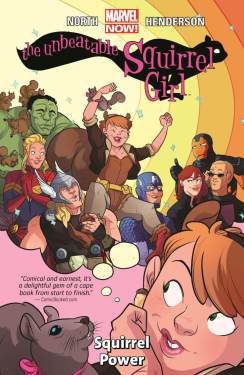 Without planning it, I decided to review the first volume of Squirrel Girl in the same week the internet is abuzz with Anna Kendrick pushing to play the character in a Marvel film. Kendrick has admitted she doesn’t know much about the character beyond that she is half-squirrel, so let me have the honor of helping to educate to Ms. Kendrick, and those of you in the audience who wish to read on further, about just who Squirrel Girl is.
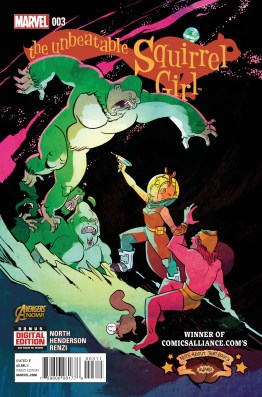 This is a very light-hearted view of the Marvel Universe and it is a pretty fun read. I would admit this is not my usual cup of tea when I read comics, but it wasn’t terrible. The jokes are very clever and I love the Deadpool villain cards that pop up every issue. While each issue is essentially a stand alone tale, there is a plot thread throughout of Galactus’ impending attack on Earth. The artwork is perfect this style of comic, very cartoony, conveys a sense of motion and kicks in when things get crazy. I saw a criticism online comparing this to Mike Allred’s X-Statix work as an insult. I think to have your art compared to Allred’s is a major compliment and Erica Henderson earns it.
 Two women marked by death attempting to understand the evil that lives in the shadows. This pretty much sums up the basic concept of Gail Simone’s first venture into Vertigo Comics territory. Chloe Pierce’s fiance killed himself and she miscarried their child. Now she wants to know what a Scientology-like cult run by Astrid Mueller. Astrid is a German woman who was brutally run down by a madman in a car when she was a child. After that experience she began to see what we might call “demons”. However, the series makes an effort to challenge our preconceptions about the nature of these monsters. In this first volume, we follow parallel stories of Astrid confronting a literal demon from her past while Chloe must decide if she trusts Astrid’s cult while attempting to figure out why her fiance killed himself.
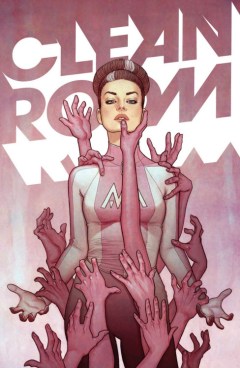 The artwork is very uneven. Artist, Jon Davis-Hunt draws an awesome demon, and brings a lot of interesting variety to their designs. Elements of insects and sea life are interwoven into his monster work and this adds to a sense of the larger than our perception Lovecraft style of horror. However, his normal humans often look like mannequins. His figures are very posed and there is a lack of sense of movement through the panels. It improves as the series goes on, but still retains a stiffness. His linework is very smooth and detailed though.


