Across the Pond: Misfits

In across the pond I look at television from the U.K. that stands out as amazing programming.


Misfits Series 1 (6 episodes)

One American television series that completely disappointed me was Heroes. The first season was a slow burn, but once it got where it was going it was incredibly good. After its first season though it started a downward spiral that ended with NBC put a bullet in its head halfway through the fourth season. The idea of a television series that works with the superhero concept is one I can get behind completely. When this BBC drama came around I heard about it, but didn’t really rush to watch it. Recently though, I sat down and tore through the six episodes in two days and it has jumped to being one of my favorite shows. It’s a bit teen drama (and British teen dramas are infinitely more racey than American ones) and a bit super hero series. The mix is a wonderful series that can be deathly serious and absolutely hilarious.

Five juvenile delinquents gather at a community center to perform their court-required service hours. While cleaning up trash along the Thames, they see a strange storm quickly gather over the city and begin to rain down massive chunks of ice. A bolt of energy strikes and moments later they appear to be fine. However, they have each gained a special ability they is tied to an aspect of their personality. Kelly, a chav girl from the estates, can read people’s minds (she’s concerned about what people say about her). Simon, a introverted and awkward boy, turns invisible as long as no one is looking at him. Curtis, a former high school track star caught with cocaine, can send his consciousness back in time. Alisha, a coquettish minx, drives any man who touches her bare skin into becoming compelled to have sex with her. And poor Nathan, the mouth of the group appears to have no powers.

These kids wouldn’t ever hang out with each other so the conceit of the community service hours is a perfect way to have a makeshift team. They even have uniforms, bright orange jumpsuits, which they change into when they meet up. Villains come in the form of other Londoners affected by the mysterious storm. Their first enemy is their probation officer, who is transformed into a Hulk-like agent of rage. From there they run into a man who believes he is a dog during a full moon, a girl who cause others’ hair to fall out, and a former nymphet turned svengali of purity. The show definitely mixes humor in, and is able to joke about what is going while still keeping a sense of urgency. The highlight of the season by far was the episode spotlighting Curtis, the time traveler. He is able to go back to the night the police caught him with drugs and tries to change things. Of course he is forced to deal with the large reaching ramifications of his trip back and is forced to make subsequent trips. The way backstory about all the characters is relayed in this episode is amazing, and puts a lot of the time travel storytelling in Heroes to shame.

My favorite character of them all is Nathan, the seemingly powerless member of the bunch. Every episode he attempts to manifest a different power but ultimately fails. There’s even clues early on as to what it will be and its not till the final episode of the season that we discover what that is. Also, in that final episode, Nathan delivers what is possibly one of the funniest rallying speeches I’ve ever heard. In his effort to convince his friends to shake off the mind controlling influences they are under, he champions teenage irresponsibility, claiming that they’re supposed to be getting drunk and shagging all the time. He plans to do so throughout his twenties, and possibly his early thirties. Its a interesting mix of that aforementioned urgency and comedy. If you have the chance, and this sounds even the smallest bit interesting to you, seek it out. It’s one of the most enjoyable comedy-dramas I’ve seen on television in a long time. Series two is scheduled for the end of 2010, with a Christmas special to precede it.

Tube Review: Mad Men and True Blood


Mad Men – S04E01 – “Public Relations”

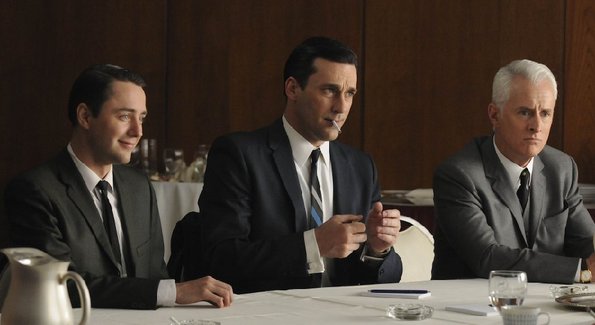
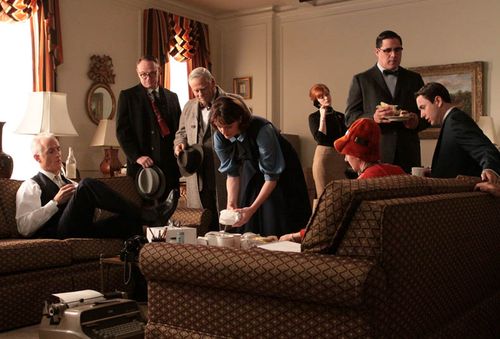
Mad Men is back and in a big way. It’s been almost a year since Sterling Cooper Draper Pryce was started thanks to Don’s midnight revolt against the British conglomerate. Since the, the agency has gotten some buzz around its challenging ad campaigns and relocated to offices in the Time-Life Building. Joan Holloway is not the queen bee, with her own office from which she runs the machine. Harry Crane is now a seasoned salesman to television companies, just returning from a trip to L.A. around Thanksgiving. Pete Campbell seems to have discarded his conniving ways and treats Don and his coworkers with respect. Peggy is one of the most drastic changes, appearing to be Head of Creative, with at least one male employee under her whom she makes no bones about showing she is in charge of.

Don is giving an interview to Ad Age magazine in the opening in which he is asked “Who is Don Draper?”, a question that works as the theme of the entire series. Don’s reply is defensive and awkward, and after the article comes out the picture of the agency’s figurehead causes them to lose the Jai Alai account, leaving Phillip Morris as 71% of their accounts. As Don deals with his partners irritation over this he is also handling the rather bitter aftermath of his divorce with Betty. Betty and the kids are still living in the old house, now with her new husband Henry. Don’s lawyer advises him to pressure Betty to finally find a new place and he does at the end of the episode. It’s pretty apparent Betty wants her “pound of flesh” for putting up with Don’s philandering and concealment of his true identity. She’s also the dominate one in her new marriage and is incredibly harsh on the now pre-teen Sally.

All in all, I felt things don’t bode well for Don Draper. There is a freshness and life in the new agency, but Don’s Manhattan apartment is a dark and cold den. He’s unable to bed what ever woman he wants anymore, and ends up calling over a prostitute who knows him well. In bed he shows an affinity for rough play, something we haven’t seen this full blown in the character before. In the end, his interview with a different reporter feels partially forced. Roger Sterling in particular really beat Don for fumbling the spot with Ad Age. We end with Don forcing a smile and telling a story that frames Sterling Cooper Draper Pryce as a rebellious company that is willing to let a client leave, rather than compromise their fresh and edgy ideas.


True Blood – S03E06 – “I Got A Right To Sing The Blues”

This season of True Blood has been the one that really clicked with me. I think its because a lot of what is happening is pay off from the set up of the previous two season, in particular the conflict between the vampire kingdoms of Louisiana and Mississippi. At the end of the last episode, Russell Edgington, the vampire of king of Mississippi, seemed delighted to discovery Sookie’s powers. This episode though, he doesn’t really know what she is or what they are, only that its a great source of power. Bill’s cover is finally blown and his creator, Marlena is tasked with draining his blood resulting in complete death. Eric, discovering that Russell was the man who killed his father centuries ago, is playing like he has complete allegiance to the man until he gets a chance to kill him. On the subplot side, Tara finds a way to escape Franklin and apparently bashes his brains out, Jessica feeds on a patron at Merlotte’s, Jason learns the girl who he was developing feelings for is engaged, and Sam learns his brother has been forced into using his shifting to participate in dogfights.

It can’t be said that there aren’t enough plot threads this season. I personally enjoy how packed every episode is, in comparison to last season which felt like it drug by painfully slowly. Now every episode seems to give a a lot of information and move along at a brisk pace. The cast has definitely grown and even characters that used to grate on me (I’m looking at you Tara) are actually enjoyable now. I am hoping that she didn’t kill Franklin though, as he has been the new addition to the series that I have enjoyed the most. His schizophrenic personality added some interesting dark humor to the show. I also have really liked the werewolves portrayal as trailer trash, juxtaposed against the vampires as Southern aristocracy.

The plots that aren’t keep me interested are Jason’s pursuit to become a cop and Sam’s trashy family. The Jason/Andy side plot has a lot of potential but it seems to be going aimless now and is simply filler. I hope that it gets tied into one of the larger main plots in a cleverly unexpected way. I’m think Lafayette’s local V dealing could lead he and Jason into an intersection. Sam’s family’s story seems like it could be wrapped up next week. He arrives at the dogfight ring and rescues his brother, telling his parents he never wants to seem them again. Unless there is a really interesting twist added to that story its going feel like they are stretching it out for as long as they can. Despite these weak spots, the season has been great fun so far. We just hit the halfway point and I am excited to see where the characters end up because it seems like a big shake up is about to happen in the vampire community.

Back Issue Bin: Alan Moore’s Swamp Thing


Swamp Thing #20-53, 60-61, 63-64
Written by Alan Moore
Art by Stephen Bissette and Rick Veitch

Before Watchmen, Alan Moore was simply known as the guy who saved Swamp Thing from cancellation. The series was born out one story in the horror anthology House of Secrets in the 1970s. The unnamed Swamp Monster proved so popular that creator Len Wein recast the story in the present day and gave the character an origin. He was Dr. Alec Holland, a scientists working in the bayous of Lousiana on a “bio-restorative” formula. Its end purpose would be to turn arid environments into lush forests. His lab is attacked and a fire is started, engulfing Holland. The poor man runs into the waters of the swamp where he dies from the burns, blood loss, and trauma. However, he was coated with the formula during the attack and his essences mixes with the swamps. He is reborn as a plant humanoid, with the memories of Alec Holland. All in all, it wasn’t too spectacular of a series and sales reflected it. That is until the British comics writer Alan Moore said he would taking over writing the series. He was given a handful of issues to turn sales around and that’s just what he did.

Moore’s first issue (Saga of Swamp Thing #21) is very reader inaccesible, but he had tie up the plot point left by the previous writer and he did so fairly well in one issue, ending with the death of the main character. Odd way to start a run on a series. The next issue is where he really kicks into gear. In this single issue, Moore completely resets the status quo of the series, with Swamp Thing learning he isn’t Alec Holland, but merely a mass of vegetation given sentience by the dying Holland’s consciousness and the formula. Now that Swamp Thing realizes he isn’t human, his behavior becomes increasingly alien. The series itself switches from a standard superhero comic into some mish mash of that and a horror series. Artist Steve Bissette is incredibly effective with his macabre, otherworldly illustrations. The enemies the creature fights from this point are not one who can be defeated through brute force alone, and stories take on a very philosophical bent.

One of the standout issues deals with Swamp Thing’s long running relationship with Abby Cable. Even upon discovering he is not the man she thought he was, Abby refuses to abandon him, seeing goodness in the human nature of his soul. They have sex which is one of the strangest love scenes I guarantee you have ever seen. It involves Swamp Thing growing strange fruit on himself, and Abby eating some. The fruit secretes hallucinogens and cause Abby’s consciousness to leave her body temporarily and merge with the plant life. Its a very clear example of how Moore writes comics in a more intelligent and mature way than most writers. He acknowledges the superhero tropes but he also doesn’t feel constrained by them. On the other hand, he doesn’t see spandex outfits and extraordinary powers as “cheesy” or “lame”. He is a great appreciator of the depth and breadth of comic books.

While Saga of Swamp Thing was on the verge of cancellation around issue 30, it went on to run until issue 171, a feat that would have been impossible without Alan Moore’s writing. Moore didn’t change or reinvent comics, he simply wrote them better than they had ever been written before. All the melodrama and soap opera are there, they’re just done in a skilled and crafty way. I particularly remember the inclusion of Golden Age villain Solomon Grundy (familiar if you grew up watching Super Friends). Despite being created forty years apart, Swamp Thing and Grundy had suspiciously similar origins. Moore, being a comic book fan, knew this and made it part of the story. It is such a smart little note of continuity for him to have picked up on and its something that continues to resonate with the Grundy character today. If you are looking for an amazingly literary comic you’ll find no better than Moore’s work on this series.

Tube Time: Mad Men Primer

It’s the eve of the Mad Men Season 4 premiere and fans of the show are definitely curious to find out what has happened to Don Draper and crew since last we saw them. If you’ve never seen the show (and are one of those people who starts watching a few season in, shame on you!) or are fan and just want to geek out with me, here’s a concise guide to everything you need to know about Mad Men.

Don Draper (Jon Hamm) – Don is the core character of the series. A charismatic, suave, yet incredibly cold figure. Draper is a mystery to his co-workers and even his family. He’s a man without friends, he makes acquaintances. His place of business in season one is Sterling-Cooper, a successful advertising agency in the heart of Manhattan. It’s here that Draper is the creative director, wrangling a group of frat boys into producing print ad campaigns for clients like Phillip-Morris, Kodak, and Goodyear, among others. At home, Draper does the minimal duties of a husband and doesn’t seem to have any sort of connection with his children. He often sneaks away to visit which ever mistress he has at the time, women who all seem to be the kind of female he prevents his wife from becoming. In season one, we learn that Draper’s real name is Dick Whitman, and that he served along the real Don Draper in the Korean War. Draper is killed as a result of Whitman’s error, and seeing a chance to shake off the life he hated, Draper takes the dead man’s dog tags. In season two, Draper goes to California for a business trip and ends up MIA, lost in a malaise of empty sex and booze with a young girl and her bohemian family, eventually reconciling with the real Draper’s widow. Season three was a major turning point, with all of his secrets coming out and his wife beginning an affair with another man as a result. By the end of that most recent season, Draper is on his way to a divorce and has broken off from Sterling Cooper to form a new upstart agency.

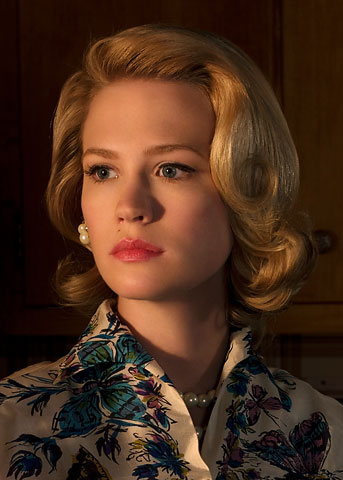
Betty Draper (January Jones) – Don’s wife, Betty, is an incredibly polarizing figure. You either love her, hate her, or see saw violently back and forth between the two. Betty was born into a fairly well to do family in Philadelphia. She ended up working as a model in Italy as a teen which is where she met Don. They moved to Long Island, had two kids and Betty did what every wife was expected to do at the time; be a stay at home mom. Shortly before the start of Season One, Betty’s mother dies and, much to her chagrin, her father begins dating another woman. Betty also seems to have a real issue with the mundanity of suburban life, and convinces to Don to let her see a psychiatrist. She is unaware that Don makes calls in the evenings after every one of her sessions, where the psych reads off his notes from the session. She is also unaware, but suspicious of, the philandering her husband is up to. In season two, Betty begins to transform, becoming fully aware that Don has slept with at least on other woman. They end up growing distant, until Betty’s father suffers a stroke. They both travel to Pennsylvania to see him and his growing senility frightens Betty. At the end of the second season, Betty learns she is pregnant and has sex with a stranger in the backroom of a bar. In the third season, the marriage is strained even further starting with Betty meeting Henry Francis, an advisor to Governor Rockefeller. She gives birth and also has to deal with her father coming to live with them. The family’s housekeeper ends up saddled with the responsibilities as Betty seems to reject all of it. She and Henry meet in secret, and she breaks into Don’s locked desk where she learns about his life as Dick Whitman. Using fraud as grounds, she files for divorce, and season three ends up with Betty on her way to marry Henry.

Peggy Olsen (Elizabeth Moss) – The opening of season one was Peggy’s first day in the typing pool of Sterling Cooper. She ends up as Don Draper’s secretary and she seems to be the first woman he doesn’t want to bed, not out of a lack of attraction, but from an unspoken respect they have between each other. Peggy grew up Brooklyn, raised in a strict Catholic family. She visits her mother frequently, but is straying away from the traditional upbringing. In her first year at Sterling Cooper, Betty ends up sleeping with sleazy accounts man Pete Campbell, is impregnated by him, and secretly gives the child up for adoption. We learn in season two, that Don was the only person at work she let know about this, and much like his own secrets, he guards it with the utmost privacy. Betty also gets promoted to writing copy after giving some surprising feedback during a focus testing of lipstick. In season two, Peggy continues her move towards independence when she begins spending time with a her mother’s parish priest. The priest urges Peggy to go to confession to relieve any guilts she might have but Peggy realizes she doesn’t need him to do that. In confrontation with Pete, Peggy reveals the existence of her child, something that hits him hard as his newlywed wife Trudy has just learned she is infertile. In season three, Peggy leaves Brooklyn for an apartment in Manhattan and realizes her ideas in Don’s daily meetings are being ignored by the boys’ club. She takes a certain satisfaction when one idea for Pepsi’s new diet soda, which she felt was dumb, gets shot down during the presentation. Peggy also begins an affair with a much older former employee of Sterling Cooper and she is brought in Don’s new ad agency when he leaves the company.

Sterling Cooper Draper Pryce – This is the new agency founded by Don and company. In season two Sterling Cooper is taken over by a British corporation, and over the course of season three the employees find themselves increasingly on the chopping block. As a final revolt, Don organizes a raid of the office accounts films in the middle of the night and steals away some of the top money making contracts. He also brings some of his fellow employees he respects the most. These include: Roger Sterling and Bert Cooper (his former bosses, now partners), Lane Pryce (a British executive who is tired of being a whipping boy), Peggy Olsen, Harry Crane (Sterling Cooper’s former television creative director), Pete Campbell (often a nemesis for Don), and Joan Holloway (the head secretary and the one who made the machine run at Sterling Cooper). Together they appear to be set up to unleash new dynamic advertising campaigns and provide a great antagonist for their former company.

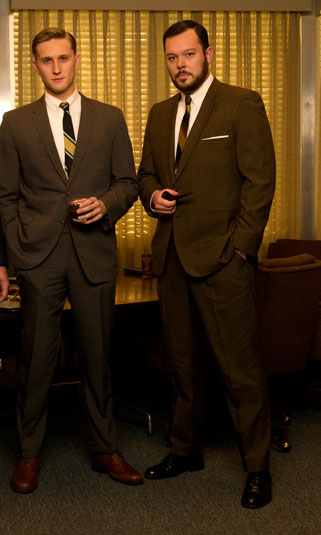
The Boys at Sterling Cooper – Left behind are two figures: Ken Cosgrove and Paul Kinsey. Cosgrove started out as a dopey accounts man who would forever frustrate Kinsey. Kinsey was an aspiring writer, inspired by the Beats, who grew irate when Cosgrove got a story printed in The Atlantic Monthly. What made it even worse was that the story was good. In season three, Cosgrove began to shine was promoted to Senior Vice President of Accounts, over Pete Campbell who became another enemy of Cosgrove’s. When Draper’s revolt took place, they grabbed Campbell over Cosgrove. Paul Kinsey worked closely with Peggy, writing copy in season three. He ends up despising her, but the two get wasted together during a late night session. It’s still remains to be seen how Kinsey will react when he learns he was left behind.

So get yourselves ready as we find out what they’ve all been up since last season. As per usual a few months to a year will have passed, so I think that puts us at the start of 1965. Tune in tomorrow night, AMC at 10/9c.

Mature Reading: Fables


Fables #1-96
Written by Bill Willingham
Art by Mark Buckingham, Lan Medina, Steve Leialoha, and Craig Hamilton

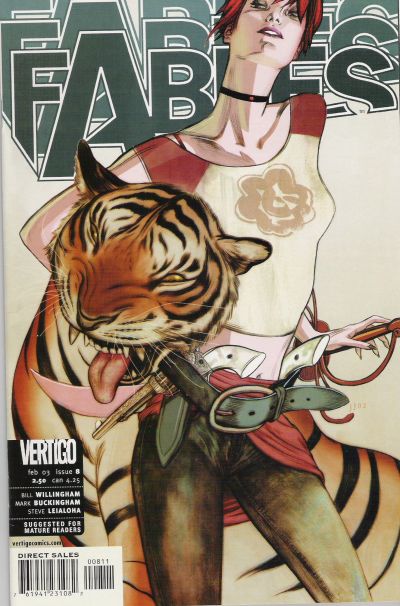
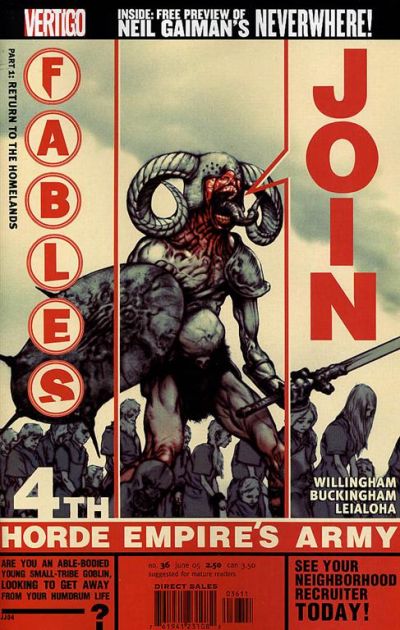
Once upon a time, there was a land where all the fairy tales you grew up reading were real. All your favorite characters lived side by side and everything was happy. That is until The Adversary appeared, a shadowy figure who gathered the aberrant armies of these realms and effectively took over. Those storybook characters afraid of what he would do now that he was in power migrated to the world of the Mundies, or our world. On a couple blocks in New York City, cloaked with expert magicks, is Fabletown, the home of the exiles. Here they plot a way to take back their homeland while dealing with discovery at the hands of the Mundies and their own evil fable brethren. This is the setting that kicks off Bill Willingham’s magnum opus (still being published today).

While the series is an ensemble piece, the main characters would be Snow White and Bigby Wolf (Big Bad Wolf). Snow is Deputy Mayor of Fabletown, the mayor is Old King Cole. Snow is in charge of settling disputes between the Fables and dealing with security issues in the neighborhood. The first arc of the series finds Snow believing her sister, Rose Red to have been murdered. She enlists the help of Bigby Wolf, who has taken a human form and is the acting sheriff of Fabletown. They go after suspects Jack Horner (Jack of Jack and the Beanstalk, Jack Frost, Jack Be Nimble) and the murderous Bluebeard. Its revealed in the end that Rose Red has been faking the whole thing, which drives a wedge between she and Snow.

Also amongst the cast are Boy Blue; Snow’s personal assistant, Flycatcher; the janitor in the mayor’s office and the former Frog Prince, Pinocchio; permanently stuck as a little boy due to the Blue Fairy’s spell, and Cinderella; a shoe store owner by day and super spy by night. Snow will come into conflict with her, and many of the other fable princesses’ ex-husband Prince Charming. In upstate New York, there is a farm dedicated to the talking animal fables, the ones who couldn’t blend in in the city. The Farm is the site of an animal revolution in the second arc, with Goldilocks leading them in revolt against Snow and her forces.

The first 75 issues of the series are focused around telling the story of how the Fables came to be in the Mundie world and how they fight to return to the homeland. Willingham showcases a deep breadth of knowledge by incorporating fairy tale characters who are probably unfamiliar to most but are actually found in old folktales and amongst the Brothers Grimm collections. I’ve always enjoyed the darker aspects of all those stories and characters, and that’s what we definitely get in this series. Fables has proven so popular its garnered an ongoing spin-off (Jack of Fables) and two mini-series (Cinderella, The Literals). The Jack of Fables series further expanded the Fables universe by bringing in characters like Humpty Dumpty, The Oz and Wonderland characters, as well as introducing a family of beings who can rewrite history. There’s even the Genres, the embodiment of genres of writing. If you are looking for a clever, funny, and many times exciting series written for mature audiences, I think Fables will definitely satisfy you.

Comics 101: Robin I/Nightwing/Batman II

This is the Robin you know if you came of age in the 1960s, watching the Batman television series. He’s Dick Grayson, one third of The Flying Graysons, part of Haley’s Circus. The circus came to Gotham City, where gangster Tony Zucco pressured the ringmaster to hand over protection money. The ringmaster refused and during that night’s performance the trapeze was cut, causing Dick’s parents to fall to their deaths. Bruce Wayne is in the audience that night, and sees himself in the emotionally scarred boy. Over the next few weeks, Dick is adopted by Bruce Wayne and comes to live in Wayne Manor. Dick goes exploring the mansion one day, and discovers the Batcave. Bruce reveals his double life and tells Dick that, if he wishes to use his anger about his parents’ deaths for good, he will train him. Fashioning a costume based on his family’s circus outfits, Dick becomes Robin, a beacon of light to counterpoint the darkness of Batman. A superhero good cop/bad cop sort of.

After a couple years working exclusively with Batman in Gotham, Dick ended up fighting a villain with other teenaged sidekicks. The result of this meeting was the formation of the Teen Titans, a sort of junior Justice League. Dick began devoting more and more time to the Titans while also attending college outside of Gotham. He frequently returned to help Batman on various cases and team-up with love interest Batgirl. Things change when, during a battle with The Joker, Dick is shot and rushed to the E.R. Once out of critical condition, Batman tells him he can’t put his adopted son in danger anymore. Dick is furious and parts ways with Batman on bad terms. He devotes himself fully to running the Teen Titans and the team receives some new members around this time, in particular Starfire, an alien princess whom Dick develops a relationship with. He eventually takes a leave of absence from the crime fighting game, discarding the Robin identity and looking to discover himself.

Dick spends some time in Metropolis with his other childhood mentor, Superman. Superman tells him the story of an ancient Kryptonian cast out of his family and wanted to help the helpless. He adopted a masked identity called Nightwing. Dick is inspired by this story and returns to his friends in the Teen Titans. He finds his teammates have been captured by their enemy Deathstroke the Terminator, and Dick dons the Nightwing costume for the first time. Dick eventually meets his replacement, Jason Todd the second Robin. He is angry at Batman for picking a new Robin and, when Jason is murdered by The Joker, unloads on Batman claiming he is responsible for the boy’s death. Dick and Starfire’s relationship becomes very serious, they get engaged and are on the eve of their wedding when the demon Trigon attacks and ruins the occasion. Doubts about their feelings for each other arise, and Starfire leaves the Earth. Around this time, Batman has his back broken by the juiced up Bane and is replaced by the anti-hero Azreal. Dick and Azreal clash, and after the latter drops the Batman identity, Dick takes it up for a short while as Batman heals.

Free of the Teen Titans and his Gotham City ties, Dick moves to Bludhaven, a neighboring city to Gotham with an even worse crime rate. Dick works as a bartender and eventually a police officer in Bludhaven, while battling the local kingpin Blockbuster. He’s eventually reunited with his now grown adult Teen Titans teammates who form simply The Titans. Barbara Gordon, formerly Batgirl, also comes back into Dick’s life and their romance is rekindled. At one point, when the Justice League are lost in ancient Atlantis, Dick takes the reigns of leadership for the team in the present. This leads into his leadership role of The Outsiders, a team originally organized by Batman. Alongside former Titan teammate Arsenal, Dick becomes more and more like Batman, keeping an emotional distance between he and his teammates. Dick’s ongoing battle with Blockbuster comes to end when he lets vigilante Tarantula shoot the villain. During this time, the death of Donna Troy (formerly Wonder Girl) has shaken Dick up and he is making very poor judgment calls.

This chapter in Dick’s life comes to a close during a major global crisis. The Secret Society of Super-Villains drops the living chemical bomb Chemo on Bludhaven, effectively destroying the city and killing its entire population. Dick front and center when the villainous Alexander Luthor and Superboy-Prime (twisted alternate reality versions of their namesakes) seek to destroy and recreate the multiverse. In the wake of this battle, Dick travels the globe with Batman and then current Robin, Tim Drake, as they bond as father and sons. Once back in the States, Dick remains with the Outsiders for a short time, then devotes himself fully to the Titans. Everything changes with the death of Batman. Dick returns to Gotham and takes up his adoptive father’s mantle, taking his “brother” Damien Wayne under his wing as the new Robin. Now, Dick Grayson honors the name of his fallen father, defending Gotham City from evil as the all-new Batman!

Comics 101: The Mighty Thor

The story of Thor really begins in Norse mythology. Thor was the son of Odin, king of the Norse gods. He wielded a powerful hammer named Mjolnir and was married to his fellow goddess, Sif. His greatest adversary was his half-brother Loki, the trickster god. Thor had grown too proud in the eye of Odin, and his father decided to banish Thor to Midgard aka Earth so he could learn what it was like to be mortal. Thor’s soul was placed in the body of crippled med student Donald Blake, and all his memories of godhood were taken. And for a few years, Thor lay dormant inside of Blake, until Blake takes a vacation to Norway and witnesses a fleet of aliens landing nearby. Blake scrambles into a nearby cave where he discovers a plain wooden cane. When he accidentally strikes the cane against a rock it transforms into Mjolnir and turns Blake into Thor.

Donald Blake defeats the alien invaders as Thor, and returns to the States to run his medical practice with help from nurse and love interest Jane Foster. Loki, Thor’s ancient nemesis, learns that his brother has returned and begins to dispatch mystical villains to challenge him. Among these were The Absorbing Man (whatever material he touches he becomes), The Wrecker (a construction worker turned behemoth), and The Destroyer (a mindless suit of armor powered by infinite cosmic elements). It was Loki who was responsible for driving the Hulk mad and bringing together Thor, Iron Man, Giant-Man, and The Wasp to stop him. This group would serve as the foundation of The Avengers. Odin decides he wants Thor back amongst the pantheon and orders him to return to Asgard, home of the Norse Gods. Thor refuses which infuriates Odin and drives a wedge between the two. Thor would also occasionally team with his father’s favorite son, Balder to battle enemies like Surtur the fire demon. Thor also has allies in the Warriors Three (Volstagg, Fandral, and Hogun), a trio of great adventurers with very differing personalities.

A turning point came for Thor when Nick Fury, the director of SHIELD, had the god investigate a mysterious spacecraft. The ship is the home to the Korbinites, an equine like race of people who are on the verge of extinction. The defender of the Korbinites is a man named Beta Ray Bill, who battles Thor, proving himself quite powerful. Thor loses the grip of Mjolnir and reverts to Donald Blake again. Bill manages to life the hammer, a feat only accomplished by those of great power and becomes an alien variant of Thor. Thor and Bill become allies and battle together against Surtur and his army of demons who storm Asgard. Odin is killed in battle and Thor remains in Asgard to take his father’s throne. During this period, the magical forces of Norse mythology began leaking into Earth. Bill and Thor would do battle constantly to keep them back. Thor would eventually learn Odin was being held captive by the Egyptian gods and do battle with them, rescuing his father. Thor learns Loki behind this trickery and kills him, so Heimdall, the ruler of Asgard at the time banishes Thor to earth again.

This time Thor is bound to the body of Eric Masterson, a construction worker in New York City. This would not last very long, but Masterson would keep some of the god’s power to become Thunderstrike. Thor would next bond himself to Jake Olsen, an EMT, and would find himself running into his old love interest Jane Foster again. Odin would die for good this time in battle with Surtur again, and Thor would take the throne. Only this time, he grew mad with power and began to impose the gods’ will on Earth. Thor would marry his long time enemy, The Enchantress, and she would bear him a child named Magni. Eventually, Thor realized he had been driven mad and attempted to use his power to reverse time. By changing the timeline he brought Loki back from the dead who amassed an army of giants wielding hammers made from the same mystic Uru metal that Mjolnir had been forged from. In the final battle called Ragnarok in Norse mythology, Loki and Thor did battle, ending with the complete destruction of Asgard and the gods.

It appeared Thor was gone and years passed. Then Mjolnir fell from the sky, creating a massive crater in Oklahoma. Many try to lift it but fail, until a stranger to the small town arrives. This is Donald Blake, long separated from him alternate persona. He wields the hammer and with its power seeks out the mortals in whom his brothers and sisters’ souls have gone to. Asgard is rebuilt on Earth, as a floating city in the Oklahoma wilderness. Loki also returned, this time in a female form, and became part of the Cabal, a shadowy collective of villains seeking to fool humanity into turning their backs on the heroes. Loki convinced his allies to go to war with Asgard, believing with Thor taken down she could become the ruler of the gods. In the last minutes of the Siege of Asgard, Loki realized what she had done and tried to stop her allies, only to be killed. Thor realizes he is not the one to lead his people, giving that title to Balder, and joining up with a newly formed version of the Avengers.

Comics I’m Getting This Week


BOOM! Studios
Darkwing Duck #2 (of 4)
Muppet Snow White #3

DC Comics
Batman Beyond #2 (of 6)
Batman: Streets of Gotham #14
Brightest Day #6
DC Universe Legacies #3 (of 10)
Justice Society of America #41
Legion of Super-Heroes #3
Power Girl #14
The Spirit #4
Supergirl #54
Superman/Batman #74
Time Masters: Vanishing Point #1 (of 6)
Zatanna #3

IDW
G.I. Joe Cobra II #6

Image
Invincible #74
Shadowhawk #3
The Walking Dead #75

Marvel
Age of Heroes #3 (of 4)
Amazing Spider-Man #638
Amazing Spider-Man Presents: American Son #3 (of 4)
Atlas #3
Avengers #3
Dark Wolverine #88
Deadpool #25
Heroic Age: Prince of Power #3 (of 4)
Lady Deadpool #1
Marvel Zombies 5 #5 (of 5)
Marvelman Classic Primer #1 (One-Shot)
The Marvelous Land of Oz #8 (of 8)
New Avengers #2
New Mutants #15
Thunderbolts #146
Web of Spider-Man #10
X-Factor #207
X-Men: Phoenix Force Handbook

Vertigo
Air #23

Wildstorm
Welcome To Tranquility: One Foot in the Grave #1 (of 6)

Event Fatigue: Second Coming


Second Coming
Written by Zeb Wells, Mike Carey, Craig Kyle, Chris Yost, Matt Fraction
Art by Ibriam Roberson, Esad Ribic, Greg Land, Terry Dodson

If you are wanting to jump into some of the most dense, hard to navigate continuity in comics today then look no further than Marvel’s X-Men titles (New Mutants, Uncanny X-Men, X-Men Legacy, X-Force, X-Factor). The X-Men characters have always seem to occupied their own little corner of the Marvel Universe, only occasionally linking up with characters like the Avengers and Spider-Man. So, when an event goes down amongst the mutant community its always very self-contained but rarely simple. The most recent event, Second Coming was all about the rebirth of the mutant race. Five years ago, Magneto’s daughter, Scarlet Witch used her reality bending powers to erase the majority of mutant powers from the face of the earth, leaving only 200 mutants left. Over the next few years, some of these mutants died and the creeping fear that their species would be wiped spread over the community. That is until one new mutant was born.

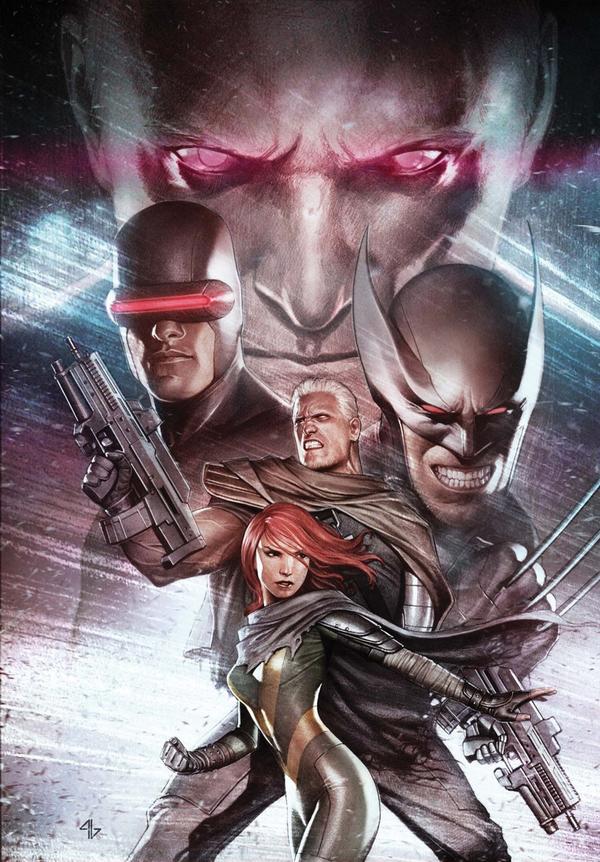
The X-Men rushed to Alaska, where the new mutant registered on their computers. Other competing groups of mutants, and anti-mutant hate groups were their competition. In the end they learned the mutant was an infant whose powers manifested at birth, defying all the medical knowledge that had gathered about mutant genes. Present day was deemed too dangerous for the baby girl, named Hope, so Cable, Cyclops’ warrior son from the future, took the baby with him on a roulette journey through time, staying one step ahead of their enemies. Once Hope was fifteen, she decided that she wanted to return to her time period to rejoin her people and learn what it was to be a mutant. Her arrival alerted Bastion, another time traveler and cyborg who was programmed specifically to wipe the mutant race from the Earth.

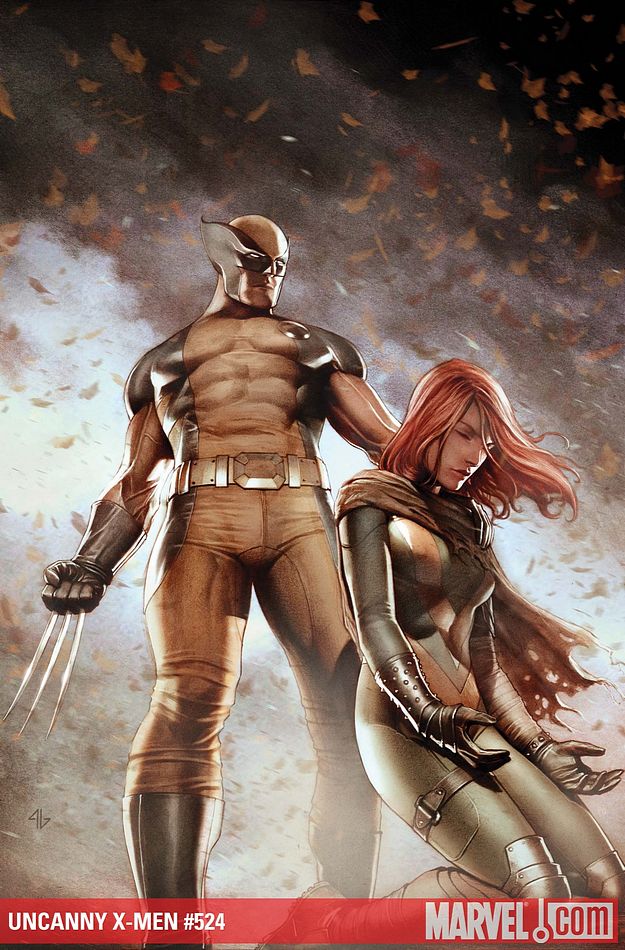
Since Cable had left, Cyclops had established a haven for mutant on the island Utopia, off the coast of San Francisco. Here they fended off attacks from forces that wished them dead, and Cyclops formed X-Force, a black ops team led by Wolverine that drew first blood on their enemies. This would be seen as a complete 180 from the dream Professor Xavier hoped for, so Cyclops kept it secret from the majority of mutants, even his long time lover Emma Frost. When Cable and Hope dropped on the East Coast, expecting the X-Men to still be there X-Force was dispatched, along with staples Storm, Colossus, and Nightcrawler. A battle on the freeway ended with Nightcrawler being killed and Cyclops’ bloody secret being revealed. Storm was disgusted, and Beast could no longer consider Cyclops a friend or ally. Hope and Cable eventually got to Utopia, where Bastion erected an impenetrable globe around the island and San Francisco. Portals opened inside, releasing Sentinels, mutant-killing robots on the population.

X-Force went on one final mission to the future, where these Sentinels were being dispatched and destroyed the Mastermold which made them. In the present, Hope unlocked her power and completely disintegrated Bastion and his forces. Cable, who went with X-Force, realizes that they are unable to return to the present unless he allows a technovirus that has plagued him his entire life to be unleashed. By allowing his body to become non-organic he hold the portal open and X-Force jumps through. Once on the other side Cable’s body crumbles and Hope is left to mourn the death of her adoptive father. A bonfire memorial is held that night on Utopia to the mutants that fell, and it is here Emma Frost witnesses the source of Hope’s power: The Phoenix Force. Suddenly around the globe hundreds of mutant genes are activated in humans and the mutant race is saved. Emma realizes in this moment that Hope is the reincarnation of Jean Grey, Cyclops’ late wife and that its only a matter of time until Emma loses him to her.

This series would be near impossible for someone without a dense familiarity to enjoy. I’ve read over four hundred issues of Uncanny X-Men in my life and it was still tricky for me to follow. It’s also built on seeds planted by Brian Michael Bendis five years ago in The House of M event, wherein Scarlet Witch erases a ton of mutants. It would also be a tricky event to follow if you hadn’t read the most recent two year long Cable ongoing series which followed the development of Hope. AND if you hadn’t read a few arcs of the recent two year X-Force ongoing you’d not understand why everyone freaks out when they find out what Wolverine has been up to with Cyclops. In many ways, this is the definition of a completely new reader inaccessible story. I think there’s definitely a place for rewarding loyal readers by pulling in a dump truck load of plot points, but the X-Men rarely open their doors for new readers to easily jump on. The next event has already started, the SAME WEEK Second Coming ended! While the latest event, Fall of the Mutants, is a little more accessible, it still makes me wonder what happens when the current fans die. They aren’t doing a good job of nurturing new fans.

Wild Card Tuesdays – The Dinner Game


The Dinner Game (1998, dir. Francis Veber)

You’ve no doubt seen the trailer or commercials for the upcoming Paul Rudd/Steve Carrell film Dinner for Schmucks. This is its source material, a very small and wry French comedy that, unlike the American version never makes it to the titular dinner. Instead, we get a very clever farce from the same director that brought us La Cage Aux Follies and many other French comedies brutally remade by American studios. I’m beginning to think studios simply wait around for him to release a film so they can rush to produce a butchered remake. While not the kind of funny the American remake is shooting for, The Dinner Game will make you laugh through clever wordplay and increasingly convoluted misunderstandings

Pierre Brochant is excited about the weekly “idiots dinner” held by he and his businessmen friends. He comes upon Francois Pignon, Finance Ministry employee (think IRS agent) whose obsession is building landmarks out of matchsticks. Brochant sees this man as the perfect idiot to bring along with him. However, his wife has left him and he has injured his back on the golf course on the same day he is to take Pignon to the dinner. The squat little man arrives, thinking Brochant is offering him a book deal about his matchstick constructions. Over the course of the evening, Pignon helps Brochant makes fake phone calls to track down his wife, mistakes the wife for the mistress, and brings on of his auditing buddies over to help out, unwittingly revealing some shocking infidelities. The film appears to be heading down a maudlin path when it returns to its comedic elements in a very clever way.

Pignon is a very endearing character. He has had his wife leave him and wants to legitimately help Brochant, but he possess a short term memory and care barely retain the simple plans they hatch when calling people they believe Brochant’s wife is with. Jacques Villeret plays the role of Pignon and manages to keep him from becoming a dolt. He’s a clever, sensitive, eager to help simpleton and the audience sighs with relief when we realize he won’t be subjected to the cruel evening Brochant has planned. From what I have seen of Schmucks, I get the feeling Carrell is playing a much broader, less sympathetic version of this character and that’s a shame.

The Dinner Game plays like stage play. It’s one set with characters coming in and out, a perfect comedy of errors. Schmucks looks like it is uninterested in the simplicity of the original and is opting for complex set pieces involving outsiders that we don’t sympathize with but mock. The overly sentimental finale that the original avoids feels all but inevitable for the American remake. The irony here is that The Dinner Game emotionally earns that ending if it wants, while I suspect Schmucks will be so mean spirited that when it comes to that “our hero learns a lesson” moment it will come off as ludicrous.