Wild Card Tuesdays – Right At Your Door


Right At Your Door (2005, dir. Chris Gorak)
Starring Mary McKormack, Rory Cochrane

The concept of Right At Your Door has the makings of an amazing movie. The story is relegated to single home with a small number of cast (2 lead, 2 supporting) and brings up topics and themes very relevant to modern America. With all of these elements present, you would expect the film to be good. Sadly, it never really becomes about anything. It touches on a lot of ideas briefly, then abandons them, then collapses as film that never really goes anywhere. Its definitely working hard to be important but the substance isn’t there. It’s truly disappointing though, because it could have been one of the best films about post-9/11 America.

It’s a normal weekday morning in Los Angeles, Brad makes sure Lexi wakes up on time so she can head downtown for work. A few hours after she leaves, news reports come on talking about a series of coordinated explosions that have gone off in the most densely crammed traffic areas of the city. Authorities believe these were dirty bombs and that people need to stay in their homes, sealing their doors and windows off. Brad tries to head down but police have things blocked, so he gives up and waits in his home, terrified that Lexi is dead. However, Lexi turns up at the house, after Brad has sealed it off and now the heavy weight of confronting mortality is before them.

I see this as an awesome stage play. Two actors on stage, divided by a prop door. Very minimalist and very open to exploring lots of ideas about relationships, love, death, and the effects of terrorism and fear on contemporary America. Instead, the film has a great set up, I was completely onboard and ready to take this journey. And when Lexi first shows up after the explosion things are interesting, Brad is very torn. However, the film becomes repetitive in a way that is a technique of stalling. The picture is an hour and a half long and the screenplay doesn’t seem to know how to stretch that one day out in an interesting way. So all sorts of ludicrous things are thrown in. A friend of the couple shows up, a neighborhood child is wandering the street, there’s gestapo like military wandering the city. But it never adds up to a point, never reaches the profound pinnacle that it feels like it should. Instead we get a third act twist that is technically plausible, feels forced as a way to end the film on  quasi interesting note.

Director in Focus: Brian De Palma – Femme Fatale

Femme Fatale (2002)
Starring Rebecca Romijn, Antonio Banderas, Peter Coyote, Eriq Ebouaney

De Palma came off of Snake Eyes and went in a total 180 to make Mission to Mars. I don’t think any one could have really predicted that film from him: A science fiction film set in the future involving a rescue mission to Mars with aliens and special effects and so on. It was definitely a risky move on his part, and ultimately it failed. There were moments that worked, in particular a planetfall sequence involving risky maneuvers using a deep knowledge of gravity and physics. It had a lot of tension in and drew me in, but overall the film was a mess. So for his second film of the 21st century, De Palma revisited some Hitchcock elements, but more he dipped fulling into the Noir genre, something he had skirted his entire career but never gone full bore into.

The film opens on a heist being taken by a trio of anonymous figures. The main element in the heist is a tall, attractive blonde posing as a photographer. She lures the arm candy of a director at a film premiere in Cannes to the bathroom, and the two women begin having a tryst. The photog undresses her from the flimsy gold and diamond encrusted chest ornament (its not really a shirt or bustier, its like gold snake that doesn’t cover all the bits and such). A second person takes the pieces of the ornament at it drops to the floor. Things go wrong and the photog double crosses the man running things and heads off with the diamonds. Through a case of mistaken identity she ends up in the place of a French woman whose husband and daughter have just been killed. Her life diverges onto a very strange path that culminates seven years later in a series of double crosses and cons.

This film is one where De Palma’s camerawork completely meshes with the plot. The opening heist sequence, taking place in a lavish theater in Cannes is so much fun. Its obvious that Mission: Impossible was the practice, and this heist is its culmination to perfection. Seeing all the devices and methods employed to get the ornament is lots of fun. Its also full of that nervous tension that makes those types of scenes enjoyable to watch. We root for the thieves and wriggling in our seats as security inches closer and the chance that every will fall apart goes higher. The entire sequence is near wordless and, like many of De Palma’s top film moments, could be presented as short film unto itself.

Rebecca Romijn is not a great actress, I know I shocked you with that statement. But, when you think about it, neither was Grace Kelly, but she made a hell of a Hitchcock female lead. Romijn does what she needs to do here, the classic film noir femme fatale is not really a three dimensional figure. And I have to say she fooled me during many of her double crossing, well both she and De Palma together fooled me. Like any great noir female she creates stories that make her sympathetic and earn the trust of those around her. She is duplicitous and evil, yet we root for her. Antonio Banderas’ tabloid photog on the other hand is not quite as charismatic or interesting, even though he makes for a more plausible protagonist.

The third act twist seemed a bit out of left field and reminded me of the much better Mulholland Drive (if we’re talking metaphysical identity mysteries, its is better). There are clues sprinkled in the first half of the film that hint at two interpretations of what happens in the rest of it. This could be a Dorothy Gale instance of imposing faces onto figures in one’s psyche or it could all be literal. De Palma never says for sure but he leaves the door open so that either makes sense within the universe of the film. There are set pieces galore here and a real admittance that this is not about substance, its about style. The fact that the director pulls this off in such a technically clever way makes it heaps more enjoyable than whatever a style focused director like Michael Bay offers up. The film was a colossal financial failure for De Palma, however, something he hasn’t recovered from in the eight years since.

Next Up: The Black Dahlia and De Palma bombs again

Hypothetical Film Festival – Unreliable Narrators

There’s a very interesting plot device called the Unreliable Narrator, wherein the point of view you are getting the story from comes from a person who is possibly skewing the facts in their favor, creating a story that is not quite true. Here’s some films that use that idea to great effect.


Rashomon (1950, dir. Akira Kurosawa)
Rashomon was the introduction of Kurosawa and post-war Japanese cinema to the world. The framing of the story was unlike anything that had really been seen in cinema, but had roots in older literature, particularly Shakespeare (whose works would be a major influence on Kurosawa throughout his career). A woodcutter and priest are seeking shelter in the husk of an old building while it storms outside. A passerby enters and they explain a strange murder of a samurai and the court case in which his wife, the bandit being accused, and the spirit of the samurai himself all testify. Through the three differing viewpoints we get three different pictures, with the added framing of these figures telling us the story. It’s a like a hedge maze of narrative.

Amadeus (1984, dir. Milos Forman)
The elderly composer Salieri tries to kill himself but is stopped. Later he is visited by a young priest and the old man tells the tale of his rivalry with Wolfgang Amadeus Mozart and how Salieri believes he killed the virtuoso. Salieri of course frames himself as pious and obedient, devoted to tradtion. Amadeus is seen a lewd and bawdy figure. Salieri sees his craft as a gift from God and cannot comprehend how someone as heathen and ribald as Amadeus was given a gift that far surpasses his own. The question we must ask is, how honest is this portrayal of the composer, and is this Salieri’s attempt to justify his hand in Amadeus’ death?


Memento (2001, dir. Christopher Nolan)
Both the film that introduced us to director Nolan (The Prestige, The Dark Knight) and what presents probably the most unreliable of unreliable narrators. Leonard is a man without the ability to form new memories. This was the result of a break-in at his home years prior that also resulted in the death of his wife. Now Leonard is on a hunt for the man responsible. Because of his lack of new memory he has tattooed key facts about the assailant on his body. Beyond that, he carries a Polaroid camera where ever he goes, photographing acquaintances and scribbling notes about them on the pictures. But what does Leonard really know? As we experience time in the same way Leonard does, we will ask lots of questions and when the disturbing conclusion comes about we will be left questioning Leonard himself.

Spider (2002, dir. David Cronenberg)
Dennis Cleg (Ralph Fiennes) has just been released from a mental asylum. The reason why he was there in the first place is not revealed at first, instead we follow him to the work home he has been assigned to in an attempt to transition back into society. He immediately draws the ire of the housekeeper and befriends housemate Terrence (John Neville). Mixed into his day to day life are nightmarish flashbacks to his childhood, focusing on his alcoholic father (Gabriel Byrne) and his beaten down mother (. The story of their tumultuous relationship is what forms Dennis and ultimately drives him to the asylum. The reason behind his nickname, Spider, is tied directly to this childhood incident. But then you must ask yourself, how reliable are the childhood flashbacks of a psychopath?


Bubba Ho-Tep (2002, dir. Don Coscarelli)
The film is told from the perspective of Elvis Presley (played brilliantly by Bruce Campbell), or it could be mechanic Sebastian Haff. Presley explains that he traded places with Haff in the 1970s to get away from the business, and for some reason the staff of his nursing home doesn’t believe him. Also living in this home is a black man who claims to be President Kennedy (Ossie Davis), explaining that he was dyed black and abandoned in the nursing home after the assassination attempt. Terrorizing the elderly at night in this home is an ancient Egyptian mummy who, for some reason, has taken on the garb of a cowboy. The two men, unable to get the staff on their side, take matters into their own hands and battle the mummy. But what if they are simply just two crazy people?

My 40 Favorite Film Moments – Part 4

16) Interrogation (The Dark Knight, 2008, dir. Christopher Nolan)

My favorite comic book based film, and an all around great movie. The screenplay is one of the tightest I’ve ever encountered and this is a great scene that really gets to the heart of the relationship between The Joker and Batman. The Joker is in love with Batman, not that he wants to have sex with him, but he is emotionally fulfilled by Batman’s existence. Without Batman, The Joker would have no one worthy of him to combat.

http://www.youtube.com/v/YPuToZT0vfY&hl=en_US&fs=1&

17) What’s In The Box (Se7en, 1995, dir. David Fincher)

This is one of those instances where every one is hitting their mark and it all comes together to make such a great film. I’m usually not a fan of Fincher, but the cinematography and editing here plus the actors all delivering make for one of the best climactic film scenes ever.

DocuMondays – Dogtown & The Z-Boys


Dogtown & The Z-Boys (2001, dir. Stacy Peralta)
Narrated by Sean Penn

As anyone who knows me well can tell you, I am by no means a sports enthusiast. However, even I know the names Stacy Peralta, Tony Alva, and Jay Adams. I can’t say I knew a lot about them before I watched this documentary, but I did know they were big names in the world of skateboarding. In the early 1990s, skate culture was a big deal. I was about 9 or 10 years old and in all of child-focused media you had skateboard bound characters; from Nintendo’s Skate or Die to the skateboard bound Michelangelo in TMNT. There was an entire aesthetic movement backing it as well: Chicano graffiti inspired neon clothing is what I remember most vividly. All of that started back in 1971 in South Venice Beach, California.

The story of the Zephyr Skate Team is the story of the class divide in America. The young men and women who skated on Zephyr were children of broken homes who lived in the “wrong side of the tracks” part of Venice Beach. The shoreline there was not one tourists ever visited and its most prominent landmark was the decrepit hulking skeleton of an abandoned theme park. The figures in the film began by surfing amongst the treacherous collapsing roller coasters and pier, and were forced to seek recreation elsewhere as the waves only came in at a very specific time of the day. As a lark they took up skateboarding, which had faded away as a fad in the mid-60s. The invention of polyurethane wheels, replacing the easily chipped and locking up clay ones, allowed the boards to grip the pavement and provide a smoother ride. Thus, many surfing techniques were brought in by the skaters. Basically, the modern skateboarding aesthetic is a direct result of the play these young people engaged in day after day.

The economic conditions of the key figures seemed to be one the largest driving forces. Many of the young men who skated on Zephyr came from homes where the fathers had left or, poor economic conditions resulted in, aggressive and abusive fathers. They found the Jeff Ho Surfboard Shop as a second home, where proprietors Jeff Ho, Skip Engblom, and Craig Stecyk encouraged the skaters to develop their own individual styles of the riding the boards. South Venice was a community envious of the North Venice mansions, and as fate would have it, a heavy drought struck California during the early 1970s. This left a lot of dried out pools and some of the more inventive skaters began to see the similarities between the flourishes and curves of the cement pools and the waves they were used to riding. And so, vertical skateboarding was born, skaters attempting to leave but one wheel touching the very rim of the bowl they rode in.

Much like a VH1 Behind the Music episode, we’re given a traditional Rise and Fall story, but what makes it so remarkable is that the key players were all teenagers for both the Rise and Fall portions. Stacy Peralta came out as the most successful, going on to champion and mentor skaters like Tony Hawk. Tony Alva struck out as a very successful entrepreneur, becoming the first skater to break away from the companies and start his own. The saddest of the lot was Jay Adams, whom all the interviewees agree could have been the best in history, but he got caught up in a drug lifestyle that included crystal meth that sent him to some rather difficult places. The film does an excellent job of structuring its narrative, and does everything I want from a good documentary: It causes me to have interest in a subject I have thought little about, tells me an interesting story about very human people, and leaves me wanting to know more.

The Summer Blockbuster: 1996 – 2009

What marked the difference between the blockbusters of the 1970s and 1980s and the 1990s and 2000s were digital special effects. For the first two decades the focus was on practical special effects, as the B-rate science fiction films these blockbusters were inspired by used. When you saw a spaceship zipping through the sky there was a physical model of the ship built and there was usually a matte painting of some sort and through the use of green screen the two elements were combined. As unreal as the scene was all its elements were something tangible. The move to computer generated effects is marked as beginning with Terminator 2: Judgment Day. This began a regular tradition of James Cameron being on the cutting edge of film technology.

By 1996, CG effects were old hat. Films from that year included Independence Day and Twister, both of which are remembered more fondly for their special effects than their acting. Independence Day used practical effects for its alien villains and CG for its air battles, while Twister had real actors in real environments but completely CG twisters as well as a CG cow being carried away by it. On the other hand, 1996 saw the first Mission: Impossible film which primarily used practical effects for the majority of its story. These were followed by pictures like Men in Black and The Lost World, one of which began a franchise and the other which continued one. The trend in this period would be to establish franchises using original, and more commonly already established properties from comics and television. The mindset behind anchoring yourself to a franchise was safety. Trying a new formula out meant risk, and risk could mean financial failure. So studio followed the motto of “go with what you know”. This was seen in how franchises like Pirates of the Carribean, The Matrix, Spider-Man, Harry Potter, and Shrek have become perennial summer movies.

Before the end of the 1990s though, another director established himself as guaranteed box office during the summer: Michael Bay. His movie Armageddon followed many tried and true tropes. There were established actors, up and coming young talent, familiar character actors, a “rah rah” America plot, and lots of explosions. Bay’s name would become a common one on big summer movies, in particular the current Transformers franchise, which while commercially successful is reviewed dismally by critics. It doesn’t seems to phase Bay though, as he keeps churning at the same type of films and following his established formula to a tee. Another name to rise to prominence as a season favorite was Pixar. Pixar was a computer animation studio that, while part of the Disney family, retained much of its creative independence and is almost the anti-Michael Bay. Bay paints in broad strokes while Pixar is incredibly detail oriented, making sure to populate its worlds with minutiae and causes their films to truly breathe. It was Finding Nemo that put them on the summer blockbuster scene, and this was followed by The Incredibles, Cars, Wall-E, and Up. Up achieved a feat very few summer blockbusters can, it was nominated for Best Picture at the Oscars.

Hollywood’s obsession with clinging to the familiar hasn’t always given them typical movies and some times we see old favorites deliver something unexpected. Steven Spielberg played with the dinosaurs of Jurassic Park for awhile but switched gears to release Saving Private Ryan, an R-rated brutal portrayal of D-Day. The film works alongside Schindler’s List and the earlier Empire of the Sun as a sort of World War II trilogy. All three were quite unexpected from the man who created the blockbuster with Jaws. In the 2000s, Spielberg switched gears and aesthetics once again to tackle classic science fiction stories. He directed A.I., Minority Report, and War of the Worlds, all of which employed a harsh light and not quite as heartwarming look at life as his previous work. Spielberg was joined by Lucas who returned in 1999 to his Star Wars franchise with The Phantom Menace. Audiences were incredibly split on the film and its follow ups: Attack of the Clones and Revenge of the Sith. This time around the Star Wars universe felt very sterile and absent of the life it previously possessed. With the conclusion of this third trilogy, Lucas seems to have once again retreated to the world he was able to build for himself.

The end of 2000s closed out with very familiar faces on the screen. There was a reboot of the Star Trek franchise, a new Harry Potter, a new Transformers, a new Pixar film, and a second film based on the books of Dan Brown. Hollywood is firmly dug in to produce tried and true concepts, with the occasional allowance of a new idea. Just recently reboots of the Spider-Man and Planet of the Apes franchises have been announced and some of 2010s most anticipated summer films have been sequels to successful franchises and rebootings of old ones (A-Team, The Karate Kid).

Jolly Good Thursdays – I Capture the Castle


I Capture the Castle (2003, dir. Tim Fywell)
Starring Romola Garai, Rose Byrne, Henry Thomas, Marc Blucas, Bill Nighy

This is not the sort of story you would expect from Dodie Smith, the same author behind 101 Dalmatians. Instead of a tale aimed towards the younger set, this is a coming of age story set in the mid-1930s. Themes of wealth and love and how the two are intertwined make up the spine of the picture and, what might have been a trite film, is aided by great performances to become something quite a bit better than that. The picture manages to be both an escapist romance and a grounding story of how much love can hurt.

The film opens with the Mortmains’ arrival at an old castle where their author patriarch has relocated them. The events are narrated by middle child Cassandra (Garai), who is overshadowed by their father’s second wife Topaz and Cassandra’s older sister, Rose (Byrne). The castle, which was a magical place when they first came to live there, has become a dank and moldy tomb for the family. Things begin to change when the owners of the castle, American brothers Simon and Neil Cotton arrive to decide what they are going to do with the estate. Rose sees this as her opportunity to marry into money and tries to woo Simon, the elder brother. However, Cassandra is also smitten with Simon and Neil has feelings for Rose.

The Mortmain family is incredibly eccentric and director Fywell is tasked with finding humor in their quirks as well as showing they have consequences. This is particularly highlighted through Mr. Mortmain, a successful author when his family was young, but who has failed to be able to write anything of value since. At first his hang ups and odd behavior come across light, but as the film progresses we see the detrimental effect that have on his entire family. Cassandra is also forced to face the fact that her father’s mental state may be beyond help. That’s quite a heavy weight for our plucky 16 year old protagonist to handle. In a similar fashion, Rose’s vapidity and desperation to find a man are played for laughs at the start, but when she enters into a relationship with a man she doesn’t actually love we can see how a harmless quirk becomes destructive to many people.

The film is not a major cinematic achievement by any means, but it is a very solid and well paced story about eccentric people having to deal with how their behavior effects others. The story is a very mature one, that lets the characters lose themselves in the giddiness of a first love, but also grounds them by not having everything tied up in a neat package. There is hurt and not much closure for our protagonists. In many ways this is a more adult Nicolas Sparks tale, that refrains from maudlin sentiment and allows its characters to have real flaws.

DocuMondays – loudQUIETloud


loudQUIETloud (2006, dir. Steven Cantor, Matthew Galkin)
Featuring The Pixies (Charles Thompson, Kim Deal, David Lovering, Joey Santiago)

Kelly Deal, sister of Pixies’ bassist Kim Deal, sums up the nature of the band in very simple terms. She tells her sister, “You are four of the worst communicators I have ever seen!” And she is most definitely correct in this summation of the group. Throughout their 2004 Pixies Sell Out tour, the bandmates communicate with each other the barest minimum, retreating into their individual solo projects when not on stage in front of fans. What the documentary confirms is that there is no new Pixies material coming any time soon, and that the band simply got back together because, like most of us, they have bills to pay.

The Pixies were formed in the late 80s and fell apart in the early 90s, particularly from in-fighting between Charles Thompson and Kim Deal. As the film opens, Deal has recently come off a rehab stint for alcoholism and is accompanied by Kelly on the tour. They travel in a separate buses from the guys in the band because Kim must stay away from alcohol. Drummer David Lovering is also dealing with issues of substance abuse, though he hasn’t come to that realization. The rest of the band is visibly uncomfortable in his presence and eventually confront him about his constant cocktail of booze and Valium. The film is a meditation on what happens when a group of people who produce great art end up absolutely hating each other.

The most telling aspect of the picture is Kim Deal and her sister in this separate bus, following the guys. Even on the guys’ bus, Charles is caught up in negotiation a switch to a new recording label, Joey is working on the soundtrack for his documentary film, and David is unnatural chipper from the drugs in his system. These were the twentysomethings of the 1990s, now in their late thirties and completely self absorbed. Kim plucks away on demos for the new Breeders album, writing songs for it, never once thinking about new songs for the Pixies. At one point a reporter from Rolling Stone interviews Charles and asks about new material. Charles says he’s been keeping his solo demos around and letting the band hear them to hint about getting some new stuff together, but from seeing the rest of the film he seems disinterested, and often times annoyed to work with these people.

It’s interesting to see the enthusiasm of the high school and college aged fans who became aware of the Pixies years after the band fell apart. In their eyes the Pixies are a single unit and unreal. One girl brings a sign reading “Kim Deal is God”. She manages to slip Kim a copy of Brave New Girl, a novel whose protagonist is an obsessive fan of the Pixies. The camera is on Kim later in her bus as she thumbs through the book. Her reaction is one of distress, she quickly puts the book down and lights a cigarette. These people are simply that, people. Nothing more. They are in the middle of divorces, struggling with addictions, and trying to get by.

Asian Cinema Month – Yi Yi


Yi Yi (2000, dir. Edward Yang)
Starring Nien-Jen Wu, Elaine Jin, Issei Ogata, Kelly Lee, Jonathan Chang, Hsi-Sheng Chen

The one thing all families have in common is that they are complex beyond belief and filled with emotional nuance. This millennial picture focused around a typical middle class family in Taipei is able to explore the fragmented lives of the individuals without resorting to clichéd dysfunction. The drama is kept moderate yet the film is never too slow to disengage the audience. If you are of the mind to enjoy explosive Michael Bay-esque movies than this may not be the best bet for you at the moment. If instead you want to patiently follow the rise and fall of a quiet family then you are in for something very fascinating.

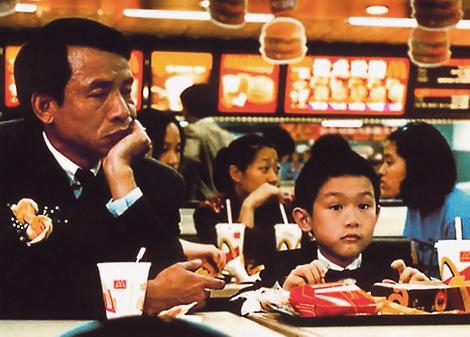
The film opens on the wedding of NJ’s brother-in-law. NJ is the patriarch of the central family in the film and he is a very patient and loving father. His son, Yang wants McDonald’s rather than the food being served at the reception and NJ submits to the child. On their way back to the party, NJ runs into his college sweetheart at the same hotel for a business meeting. Something appears to be rekindled between the two. NJ’s mother-in-law ends up in a coma shortly after the wedding and his wife becomes emotionally broken. The burden of tending the household falls on their teenage daughter, Ting. Ting has become friends with the new neighbor’s daughter and is caught in a high school love triangle with the girl’s boyfriend. Yang is constantly picked on by an older girl at his school and become very reclusive and obsessed with taking photos of mundane things.

The hits the three hour mark and is as epic as it is subtle and contemplative. There’s no sweeping score or dramatic crescendos. It’s simply life being played out and framed as if the mundane is just as epic as mythical heroes’ journies. The structure of the film is that of an entire human existence. We open on a wedding, end on a funeral, and in between there is love, heartbreak, tragedy, murder, people sharing good times over a warm meal, people feeling alienated, attempted suicide. But the picture never feels over the top or campy. The tone is kept tempered so this feels like dipping your hand in vat of pure distilled humanity.

I was made to think of Hollywood attempts at family dramas and how I can never fully engage with those characters because the script is forced to follow a 90 minute template. Yes, three hours is a long time for a film of this nature, but it is absolutely essential. And even three hours isn’t long enough to know these characters. No one is overly dramatic despite the situations they are put in. NJ is tempted with getting back together with his lost love and the outcome is left ambiguous. NJ does business with a Japanese video game developer during the film, Ota, who is one of the most intriguing characters in the film. He feels very real, a businessman who didn’t get to where he was because he was ruthless, but because he recognized the need of every person to be inspired by something.

This has to be one of the most positive, yet real films about people I have ever seen. It will leave you asking a lot of questions about our families, about the distance we have from them, and how large the scope of our lives truly is.

DocuMondays – The Weather Underground


The Weather Underground (2002, dir. Sam Green and Bill Siegel)

What is the line you would refuse to cross when it came to your beliefs about justice? Is it taking to the streets in protest? Is it standing up to the thug tactics of a corrupt cop? Is it killing in the name of your beliefs? No matter left or right on the political spectrum we can see multiple instances where once peaceful and calm movements were derailed by individuals desiring to commit acts of violence. There was Timothy McVeigh and the Oklahoma City bombing, The Unabomber, and various other extremists who either cling to an ideology or religion as their justification. This film is about one such group that used methods of terrorism against the US government in the late 1960s through the mid 1970s.

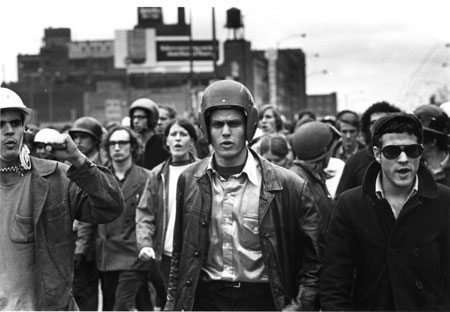
Through archival footage and interviews with the players in this story we are told of the rise and fall of a homegrown terrorist organization. It’s common knowledge that the 1960s were a period of cultural upheaval across the globe. In the United States, it was was student protests against the war in Vietnam that fueled the fire, and the government seemed bent on use brutal force to push them back. In 1969 the non-violent Students for a Democratic Society (SDS) held a convention in Chicago. The war in Vietnam was escalating and the current leadership of the SDS was trying to hold things together, while brasher elements in the group wanted to become violently pro-active. Out of this convention was born The Weathermen, a sub-group who clandestinely planned violent riots in the street and bombings of government buildings. At one point they were even hired to, and successfully did, break Timothy Leary out of a California prison. Their efforts had little effect on the government’s efforts in Vietnam, the ending of which was more influenced by the media’s release of graphic violence wrought on Vietnamese civilians. At the 1970s wound down, the members of the The Weathermen went into hiding, eventually turning themselves in at the onset of the 1980s.

The documentary was surprisingly balanced in how it presented this group. I personally would agree with many of the stances the Weathermen took on domestic and foreign policy up to the point where they brought violence into the mix. And while this is a left wing group, the mistakes made and regret felt year later transcend politics. At the time, this young men and women, including the much spoken about Bill Ayers, felt completely right and certain of their actions. One of the most fascinating interviews is with Brian Flanagan, a man who left the group shortly before Vietnam ended. He is able to sum up how things went from hopeful to cultish very quickly. He emphasizes that the leadership got so caught up in breaking the system completely, they failed to realize that lasting change comes in increments.

Mark Rudd, one of the leaders in the group, presents excerpts from his memoirs which detail a young man unsure of what he was getting into and heartbroken at the chaos he wrought, but not wavering in his political stance. I think this is a key point. While all the Weathermen regret the bombings and the riots, known as “The Days of Rage”, they have never stopped believing that many of the military conflicts the US has are not done with the best intentions. In our current political climate, we have a right wing movement with some members hinting at violence by brandishing weapons. The testimony of these men and women who have been there should be examined closely to understand the cost of violent actions and how they linger in the souls of those who commit them.