Shadows in the Cave Digest #01 – January 2010

I decided to end each month with a sort of “digest” or table of contents for the reviews and essays written over the previous weeks. Hope you like it and you find some things you might have missed the first time through.


Features
My Top 10 Favorite Films of 2009/The Long List
– Sundance Film Festival: The History, 2010 Line Up
– A Decade in Love With Movies: Part One, Part Two, Part Three
– The James Dean Trilogy: East of Eden, Rebel Without A Cause, Giant
– Director in Focus – John Sayles: Lone Star

Reviews
A Serious Man (Movie of the Month)
Up in the Air
Sherlock Holmes
The Road
Gommorah
The Lovely Bones
Youth in Revolt

Broken Embraces

Hypothetical Film Festivals

No Capes Film Festival
Deconstructing Darko

Next Month
– Spotlight on Robert Altman
– The Alien Quadrilogy: The Evolution of Ellen Ripley
– The Spider-Man Reboot

Sundance Film Festival – 2010 Highlights


Cyrus (dir. Duplass Brothers) – Indie film directors switch to more mainstream fare with John C. Reilly and Jonah Hill in a nice looking comedy-drama.

Buried (dir.Rodrigo Cortés) – Ryan Reynolds stars as a contractor in Iraq who wakes up buried in a wooden coffin with only a candle, knife, and cell phone. Very interesting circumstances could make for a real test of Reynolds’ talents.


Jack Goes Boating (dir. Philip Seymour Hoffman) – Hoffman’s directorial debut of a stage play he starred in. A romantic comedy set in NYC, starring Hoffman and Amy Smart.

The Killer Inside Me (dir. Michael Winterbottom) – Winterbottom is one of the most dynamic British directors working today and this film looks to be just as mind-blowing as previous work. Casey Affleck stars as a small town sheriff who is secretly a serial killer, finding it harder and harder to hide his crimes.

Holy Rollers (dir. Kevin Asch) -Jesse Eisenberg takes on his first purely dramatic starring role as a Hasidic Jew lured into the drug trafficking business.

High School (dir. John Stalberg) – In what is being billed as a stoner EPIC, the valedictorian of his high school realizes he has to get drug tested and this will reveal he’s a pothead. His plan to remedy this is to fix the drug tests of the entire graduating class to test positive for marijuana. Stars Adrien Brody as Psycho Ed, check out the pic above 😀

Hesher (dir. Spencer Susser) – Joseph Gordon Levitt plays the total opposite of his character in last year’s 500 Days of Summer. He’s a burnout, locked up in his trailer with nothing but hate for the world around him, and eventually becomes the mentor of a 13 year old boy. Natalie Portman co-stars.

Tucker & Dale vs. Evil (dir. Eli Craig) – I love the premise: Two rednecks, who are actually kind men, are believed to be psycho killers by a group of teenagers from the city who try to kill the pair. This could either be a big letdown or a genius film. Stars Alan Tudyk.

Film 2010 #18 – Broken Embraces


Broken Embraces (2009, dir. Pedro Almodovar)

Starring Penelope Cruz, Lluis Homar, Blanca Portillo, Jose Luis Gomez, Ruben Ochandiano, Tamar Novas
Director Pedro Almodovar has never disappointed me and continues that successful streak with his latest picture. There is something captivating about how he calmly lays out the strands of a plot. He does it so masterfully that before you know it, you’re completely absorbed in the story he is telling. With Broken Embraces, Almodovar weaves together his dramatic tones as seen in films like All About My Mother and Talk To Her with noir elements he began using in Bad Education. The result is a masterpiece.
The story begins with blind screenwriter Mateo Blanco, who signs his scripts under the pseudonym Harry Caine. His day to day affairs are looked over by his long time production assistant Judit Garcia and her son, Diego. Into their life comes Ray X, a mysterious director who appears to know something of Mateo’s past. Diego wants to know more and Mateo begins to tell the tale of he and an actress named Lena’s relationship.
Everything about the structure and pace of the film is spot on. Almodovar takes his time before getting to the core story, which is told mostly in an extended flashback, framed by the present day story. I’ve begun to look at the director’s films as having a lot of similarities with Shakespeare’s work from a structural standpoint. The plots are fairly straightforward with a cluster of key characters and flashbacks and framing devices are used frequently. I think by refraining from attempting to over complicate his scripts with too many characters or sub-plots and twists, Almodovar creates very classic films that are going to last for decades to come.

Film 2010 #17 – Legion


Legion (2010, dir. Scott Stewart)
Starring Paul Bettany, Dennis Quaid, Tyrese Gibson, Adrienne Palicki, Charles Dutton, Lucas Black

Interesting concepts, poor execution. Par for the course with a lot of sci-fi and fantasy on film these days, and Legion is no exception. The film has a few little twists but at the end of the day fails on pretty much all fronts.
Michael the Archangel (Bettany) learns of God’s plan to finally wipe out humanity and cannot go along with this plan. He rejects his angelic nature, falls to Earth, and gets a bunch of machine guns to fight with. Michael makes his way to a diner in the middle of New Mexico where a young woman lives who is pregnant with a child that is somehow the last hope for mankind, though what exactly this kid can do is never explained in the film. Michael even goes so far as to say if the child lives or dies it doesn’t matter near the end of the film. Okay…then why all the hubbub?
There is a lot in this film that is never explained and that is incredibly frustrating. In an arthouse film like Eternal Sunshine, the tone of the film never takes itself too seriously, hence we never wonder how the memory removal process works. In a film like Legion, which can’t laugh at itself once, the tone dictates that when action is taken there is a concise rhyme and reason. The biggest example is of how exactly does a machine gun hurt a being like an angel. Not a single effort to justify that one.
The biggest concept I like from the film was the idea of angelic possession. The movie is basically a zombie film with angel-possessed human hordes attacking the diner and trying to kill the pregnant woman. While the execution of the idea is downright yawn-inducing, the concept itself is incredibly originally. I’ve read a hell of a lot of comics and seen a lot of films but have never encountered the idea of angelic possession. Pretty cool idea, would like to see it implemented in a different film.

Film 2010 #16 – Goodbye Solo


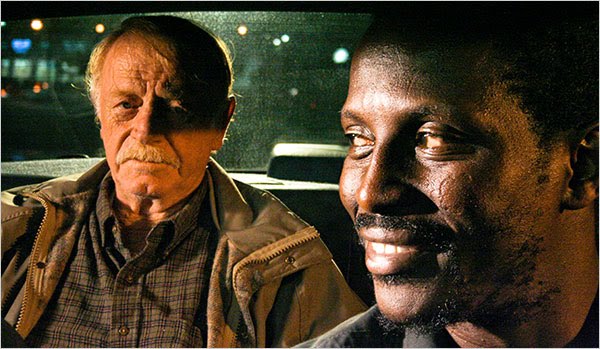
Goodbye Solo (2008, dir. Ramin Bahrani)

It begins in the middle of a conversation between two men, Solo and William. William wants a ride to national park in Eastern North Carolina two weeks from now and is offering Solo, the cab driver, a $200 down payment to ensure this. At first, Solo can’t quite understand why William wants a one way ride to the middle of nowhere, but soon he begins to figure out William’s motives and decides to do whatever he can to stop him.
I first became of aware of Ramin Bahrani with his 2007 film Chop Shop. Bahrani has found his niche in taking unfamiliar faces and non-actors and placing them in very human and very compelling stories. Goodbye Solo is no exception, and it owes the majority of its grounding in honest humanity to the acting of Souleymane Sy Savane who plays Solo. Solo is so incredibly genuine in his caring for William, that you cannot help but be pulled into this deceptively simple story.
Director Bahrani presents a very complex view of suicide in this film. We are never given explicit reasons as to why William wants to end his life, but there are hints dropped and Solo does some investigating of his own and learns some things about the elderly man’s past. The two characters are excellent foils for each other: both very connected to their role as fathers and both determined in their own ways. Solo is just as bullheaded as William, except Solo has the charisma and smile to get people on his side.
The film’s resolution will probably frustrate people more accustomed with mainstream cinema. There is a lot of ambiguity and Solo reveals the complexity he hides to most people. Bahrani is one of the most powerful new voices in American cinema. His landscape encompasses both the urban and rural masterfully and the faces in his films are a true representation of the diversity present in our nation. Bahrani also chooses to focus on the working class in all his films and really taps into the zeitgeist of daily life and the state of the economy today. His films are in no one overtly political and seem only to yearn to find commonalities between diverse groups in America today. Goodbye Solo is a film that, if you allow it, will stay with you for a long time to come.

Film 2010 #14 – The Book of Eli


The Book of Eli (2010, dir. The Hughes Brothers)
Starring Denzel Washington, Gary Oldman, Mila Kunis, Jennifer Beals, Malcolm McDowell

The post-apocalyptic world has been the setting for many films, the most obvious that comes to people’s minds would be the Mad Max trilogy. In the last few years we’ve seen I Am Legend, Terminator: Salvation, and The Road. So how does this latest entry into the sub-genre stack up? Not exactly a masterpiece, but not without its merits either.

The story follows the enegmatic Eli (Washington), a traveler across the devastated landscape who lives by a stoic system of conduct. He has the reflexes of superhero and a stony resolve. There isn’t much depth given to the character, and he is definitely in the category of Clint Eastwood’s The Man With No Name. We have no back story ever given for Eli and in fact it probably doesn’t matter too much anyway. There are some interesting twists that provide a different context for the film if you were to go back and rewatch it, however, the film never provides any real reason to want to.

The post-apocalyptic world the Hughes Brothers have designed feels incredibly bland. They add some new details: a world so sun bleached everyone must wear sunglasses when going outside. But other than a few details here and there, there is nothing that sets this world apart from richer futurist visions. The one thing that elevates the picture is the acting, particularly of Washington and Oldman. These two actors are much better than the material they are working with and its only due to their acting prowess that they make it enjoyable.

In the end, its a case of great concepts but poor delivery, very much like last year’s Pandorum. The film feels way too rushed (it’s about an hour and half), and the action doesn’t really kick in until an hour in. This imbalance of the plot can definitely be felt and ends up showcasing some of the sloppiness in the screenplay. It’s a film with a look once its on DVD or you come across it on HBO, but definitely not one to rush out to the theaters and see.

Film 2010 #12 – My Winnipeg


My Winnipeg (2007, dir. Guy Maddin)

If you aren’t familiar with Guy Maddin’s style of film making, then viewing one of his pictures can be a very jolting experience. Narrative is secondary to a more stream of consciousness style of storytelling. I’ve been very familiar with Maddin’s work, starting with Twilight of the Ice Nymphs, and this oddity of cinema lead me to watch Tales of the Gimli Hospital, Careful, Dracula: Pages from a Virgin’s Diary, and The Saddest Music in the World.

Maddin has an affinity for German expressionist and Soviet propaganda films from the early days of cinema. As a result, he typically makes black and white pictures that utilize the actual technology of the time period he attempts to recreate. In My Winnipeg, Maddin uses rear-projection and obvious sound stages to create a film that will be unlike anything you see in the theaters. The premise is that Maddin is attempting to psychologically break free from his frigid hometown of Winnipeg, Manitoba. The best way he decides upon doing this is to recreate moments from his childhood, focused around his cold and controlling mother.

Interwoven with these recreations are bizarre, Winnipeg legends. Maddin tells us about the First Nation (would be Native Americans for us) belief that beneath the forks of the rivers that converge in Winnipeg, are a second “forks beneath the forks” that are mystical in nature. This image of a parallel existing underneath what can be seen is crucial to understand what Maddin is doing in this film. All of his anecdotes about Winnipeg involve the idea of a darker side of things, and the world of myth and fable.

Many of Maddin’s claims about Winnipeg are suspect (10 times the number of sleepwalkers than any other city, a city hall built as part of an occult Mason rite) but they act as conduits into the subconscious and representations of the unseen nature of things. The fact that this entire film is a one long poem taking place in the mind of Maddin plays into the examination of a seedy underbelly to things. The film is also able to evoke strong emotion, particularly when Maddin laments the destruction of the city’s professional hockey stadium, a temple to him as he grew up.

What started as a commission by the city of Winnipeg to make a documentary of their city, evolved into an amazing exploration into one man’s psyche. Maddin is a director more interested in making what he likes to see and, if an audience happens to enjoy it, that is simply an added bonus. What Maddin creates as an end result is very similar to the film art created by David Lynch. This is not cohesive story with beginning/middle/end, but is an expression of the artist’s mood.

Film 2010 #11 – Gomorrah


Gomorrah (2008, dir. Mateo Garrone)

In Southern Italy there is a disease that infects the lives of many people living below the poverty line. This disease is a crime cartel known as the Camorra. The mafiosa organization has interwoven itself into the workings of both black market operations and legitimate enterprise, including investing in the construction of the rebuilding at Ground Zero in NYC. Such a concept seems too large to be real, but as director Garrone chronicles in this film, it is all too true.

Gomorrah, based on the nonfiction book by Roberto Saviano, takes an interesting direction in telling this story. The film is divided up into five separate plot strands that occasionally interweave, but more than not remain as their own isolated story. If the plots were to connect, it would cause the film to feel insular rather than expansive, which is the feeling Garrone wants to evoke. The Hollywood version of this film would seek to be sleek, refined, and would desperate to constantly try and engage the audience. Gomorrah, plays out slowly and at a pace that could be infuriating to some viewers. It is a slice of life film, showing how mundane and common these acts of violence and crime are in the lives of the people in these regions of Italy.

The main characters are Don Ciro; a man charged with distributing cash to the families of imprisoned members of the family, Toto; a 13 year old boy who seeks to join the family to gain prominence in his slum community, Roberto; a recent university graduate working with a mob boss to illegally dump toxic waste, Pasquale; a tailor who is struggling to make the order demands of the mob and moonlighting as a sewing instructor for a Chinese-Italian sweatshop, and finally Marco and Ciro; two young men who are caught up in the fantasy of being in the mob and are unaware of the real dangers of pissing off the wrong people.

Instead of focusing the top tier of the mafia and glamorizing it, the film seeks to explore the lives of the people at the bottom rung of the ladder. The lives displayed are gritty and bleak and there doesn’t seem to be much chance of rising out of the mire. The mob has so taken over every aspect of life that they have replaced the government, and in the case of Tito, his biological family. There is much this picture has in common with Fernando Meirelles’ City of God, just even less stylistic. In fact, I believe Garrone is trying to create a film without embellishment so that the every day nature of crime is the main focus. I highly recommend this as counterprogramming to the mainstream films that stylistically glorify the criminal lifestyle

Film 2010 #9 – Cold Souls


Cold Souls (2009, dir. Sophie Barthes)
Starring Paul Giamatti, Emily Watson, Dian Korzun, David Strathrain

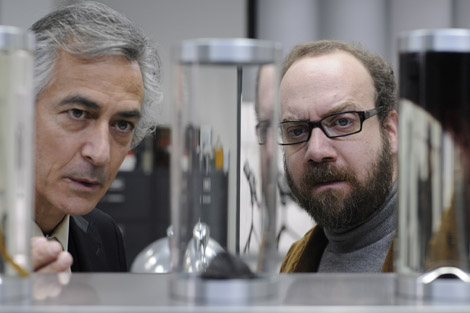
The premise is an intriguing one: Paul Giamatti playing an actor named Paul Giamatti, is having trouble tackling his role in an upcoming production of Uncle Vanya. His agent informs him of a new soul extraction service and hints that this might help him overcome his difficulties. Giamatti hems and haws over it and finally agrees and finds he’s lost his ability to act completely. Sounds like it could be good, right? Sadly, the film fails to explore its concepts fully and provides a picture that is moderately engaging.

Giamatti’s story is paralleled by that of Nina, a Russian woman who traffics souls back and forth to be used on the black market. Because the only safe way to transport a soul is to have a person carry it inside them. A side effect is that fragments of carried souls accumulate in a person and they begin to lose touch with the world. This story takes up more of the narrative and is eventually tied into Giamatti’s plot strand. It feels that the cleverness and originality of the plot concepts it lost on director Barthes.

The film owes a lot to the work of Charlie Kaufman, most notably Being John Malkovich and Eternal Sunshine of the Spotless Mind. Unlike those movies, there is an undeveloped nature to this script. The Giamatti angle doesn’t feel fully explored the true plot is Nina’s. In addition, Barthes creates a much darker landscape than Kaufman has ever attempted. His world’s lean more to the fanciful, while Cold Souls has merely dipped its toes. There seems to be a lot of influence from Russian literature and absurd and satiric theater, specifically that of Eugeneg Ionesco. There is not much humor in this picture, and for myself that is where I felt myself distancing from it.

I truly wanted to love this movie after seeing the trailer and seeing the interesting angle Giamatti was going to take. However, I finished it with a sense of dissatisfaction, wishing I could have seen the movie I had prepared myself for in my head. I wouldn’t encourage someone to not see this film, because there are some wonderful concepts and ideas, I just wouldn’t be able to recommend it enthusiastically.

Film 2010 #8 – The Lovely Bones

The Lovely Bones (2009, dir. Peter Jackson)
Starring Saorise Ronan, Mark Wahlberg, Rachel Weisz, Stanley Tucci, Susan Sarandon

Before he was known as the director who brought The Lord of the Rings to the big screen, Peter Jackson was a small budget New Zealand filmmaker. Among his work was the wacked out zombie flick Dead Alive, the Muppet show on crack Meet the Feebles, and the amazing Heavenly Creatures. And it is Heavenly Creatures, that seems to bear the strongest kinship to Jackson’s latest film. Both films focus on female protagonists and involve their subconscious being brought to the surface in surreal landscapes. However, where The Lovely Bones is an improvement in technical achievement, it lacks the narrative strength of Heavenly Creatures.

Based on the 2003 novel by Alice Sebold, The Lovely Bones is a first person narrative where the newly deceased Susie Salmon chronicles her afterlife and her family’s reactions to her death. Susie is unable to be at rest in the afterlife, due to her murderer still wandering free. She begins to influence the actions of her family and direct them towards the murderer’s house so that the case can be solved and she can move on. This is juxtaposed to her living out fantasies in a strange surreal afterlife landscape.

This film felt as much like fantasy as the Lord of the Rings trilogy. While there are no orcs or wizards, characters are so unrealistic they might as well be wielding magic wands and riding dragons. Susie is so perfect in her actions and attitudes that I could not connect or empathize with her at all. Susie’s biggest rebellion as a teenager comes in being embarrassed about her new knit cap. Everything Susie does is framed by the film in a sort of gauzy light. In contrast, Mr. Harvey, her murderer is filmed in an equally absurd but menacing way. He constant sweatiness and heavy breathing is over-emphasized, and Jackson employs low camera angles to create a sense of looming danger.

This over simplification causes the film to come across as shallow as a silent film. I half expected, Mr. Harvey to start twirling his mustache and tie Susie to a railroad track. I assume the audience is meant to be wowed by the CG effects employed in the afterlife sequences, but because of the initial depthless nature of the characters it was simply some pretty pictures. At the end, the characters are so poorly developed it doesn’t seem possible to have the strong emotional response I’m sure Jackson and co-scripter Fran Walsh intended. It seems that since, and in despite of the success of, the Lord of the Rings series, Jackson has been returning a diminishing product (see King Kong as well). One hopes that he can make his next project a bit more meaningful and more character-driven.