Charlie Chaplin Month – Limelight


Limelight (1952)
Starring Charlie Chaplin, Claire Bloom, Nigel Bruce, Buster Keaton, Norman Lloyd, Sydney Earle Chaplin

During Chaplin’s trip to Europe to promote this film, he had his re-entry to the Unites States revoked (he always legally remained a British citizen). It was the height of Red Panic at the time in the US and Chaplin had never been shy about voicing his personal opinions on the treatment of the working class. Chaplin’s long standing tensions with J. Edgar Hoover led to his re-entry papers being revoked and he decided to set up his home in Switzerland. This would be where he would live for the rest of his days and this film (while not his last) would stand as his symbolic goodbye to cinema.

It’s 1914,  and Calvero (Chaplin) is a former performer on the East End stages. He now comes home drunk out of his mind in the middle of the day, slowly weathering away in his flat. One afternoon he returns and finds his downstairs neighbor, Teri (Bloom) unconscious holding a bottle of pills and letting gas from her stove fill her apartment. He saves her life and afterwards learns she became suicidal when her dreams of performing ballet were slowly crushed. Calvero nurses her back to health as she suffers from psychosomatic paralysis. Eventually, she regains her confidence and becomes the prima ballerina of a great company. Teri meets and falls in love with composer Neville (played by Chaplin’s own son, Sydney Earle). She goes onto secure a part for Calvero in the show as a clown and he eventually gets his own showcase which is to be his final, great performance.

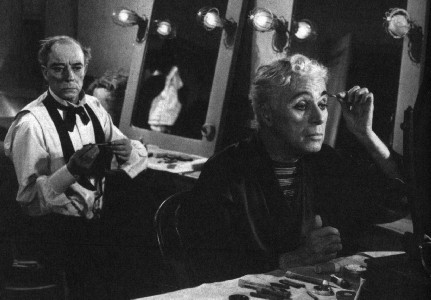
1914 is an incredibly significant year in the life of Chaplin. It was in that year he made a small appearance in the Keystone short Kid Auto Races at Venice. The character he played was called The Little Tramp. The birth of one of the most iconic film characters means the death of the stage variety that brought Chaplin up. As Calvero he recognizes both the twilight of his own career and how his rise to fame was responsible for the end of many East End performers’ careers. It’s made even more significant that Buster Keaton plays Calvero’s old partner who joins him in the final stage performance. Here we have the two men who birthed cinematic comedy taking one last bow in an era that no longer had room for their style.

Despite the symbolic significance of much of the film it is still a very self-indulgent picture. Chaplin made his film’s independently meaning he got to make final cut. Limelight clocks in at 2 hours, 11 minutes and it is a real stretch. Much like The Great Dictator, another over 2 hour picture, the middle sections sag painfully. The bits Chaplin performs are never all that funny either. The two man piece he does with Keaton at the end of the film is pretty decent but never lives up to his old films.

Newbie Wednesday – The Imaginarium of Doctor Parnassus


The Imaginarium of Doctor Parnassus (2009, dir. Terry Gilliam)
Starring Christopher Plummer, Heath Ledger, Lily Cole, Andrew Garfield, Verne Troyer, Tom Waits, Johnny Depp, Jude Law, Colin Farrell, Peter Stormare

After filming the first half of this picture, director Gilliam learned the tragic news that Heath Ledger had died due to an accidental drug overdose. Gilliam is no stranger to films having to overcome obstacles before their release. His 1985 picture Brazil was the victim of an unexcited studio and Gilliam had to break the law to get his version of the picture shown. His attempt to make a film version of Don Quixote at the beginning of the century was ultimately scrapped when financial and natural conditions fought against him. With Imaginarium Gilliam found a way that the film could continue without Ledger’s presence and it hinges on the movie’s core theme: Imagination.

The movie opens in modern day London and follows a old time traveling show made up of the ancient sage Doctor Parnassus, his daughter; Valentina, his right hand man; Percy, and the boy in love with Valentina; Anton. Their show is no longer captivating to contemporary audience and during the opening performance a drunk man stumble through a mirror on stage that places him inside his own imagination. Parnassus has been in a centuries old struggle with Mr. Nick, the Devil who is in a competition to see who can collect the most souls before Valentina’s 16th birthday. If Nick wins he takes Valentina from Parnassus. Into this scenario comes an amnesiac man found hanging underneath a bridge. The man slowly but surely takes over creative control of the show explaining he has Parnassus best interests in mind. As the date moves closer to the bet’s end more of this stranger’s secrets are revealed.

The film is better than much of Gilliam’s more recent films and I credit that to his choice of working with co-writer Charles McKeown. McKeown previously worked on the scripts for Brazil and The Adventures of Baron Munchausen which are two of Gilliam’s strongest pictures. The story here can be a bit straining on the brain but its able to keep up with Gilliam’s visuals the whole way through. I also like the use of CG effects here not in an attempt to replicate reality (see Avatar), but to make surreal landscapes feel tangible. In my opinion, that should be the purpose of using CG in films. While I didn’t care for the story of The Lovely Bones is also did an excellent job of created fully realized surreal worlds.

The subtext in the film seems to be Gilliam’s own examination of his profession. Parnassus starts out as a man sequestered in a Tibetan monastery where he and his disciples sit around telling the story of the universe. He makes a deal with the Devil and travels out to make his fortune with these stories, being told he will be immortal if he does. Valentina is a living breathing creation and the idea of turning her over to the Devil is what drives Parnassus to fight for independence. In his desperation he turns to a smooth talker who assures him he will be present the show in the way the doctor wants, but instead we see the integrity of Parnassus slipping away.

Like most of Gilliam’s work this will never appeal to a mainstream audience. He is very much an artist who makes the things that amuse him and its always coincidental if they appeal to anyone else. If you are open to a film that prefers to play rather than dictate and hit plot beats then I think you’ll enjoy this picture.

Wild Card Tuesday – A Nightmare on Elm Street (1984)


A Nightmare on Elm Street (1984, dir. Wes Craven)
Starring Heather Langenkamp, Robert Englund, Johnny Depp, Ronee Blakely

I remember the first time I ever heard about Freddy Krueger. I was 8 or 9 year old and sitting in my backyard in Smyrna where a neighbor kid was describing the R-rated horror films his parents had let him watch. Nothing stood out about Freddy that was too frightening to me, I do remember the description of the glove sounding creepy. Now it is twenty years later and I am finally seeing the film that was described to me all those years ago. So how does Wes Craven’s 1980s horror classic stack up?

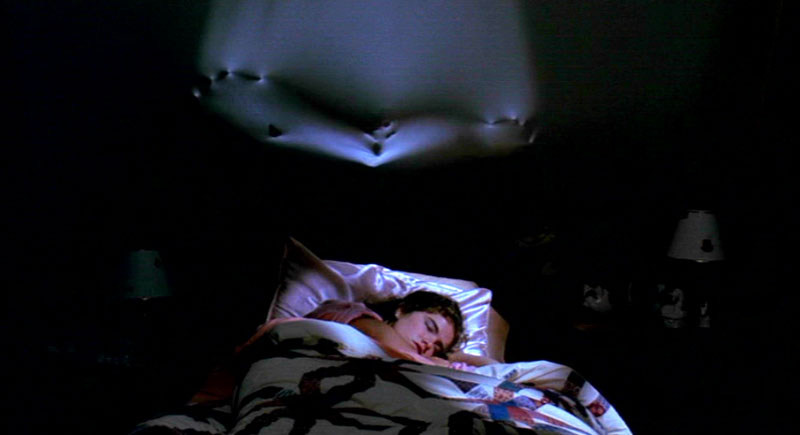
It takes barely any time for us to jump right into the thick of the plot. Nancy and her friends, Tina, Glen, and Rod are all suffering from nightmares about the same evil figure. He’s a man with a burnt face, in a fedora and striped sweater who wears a glove with blades on each finger. All four spend the night at Tina’s house and their slumber is interrupted by Tina’s brutal disemboweling by an invisible force. Tina’s thug boyfriend Rod is the only suspect and ends up in jail. But Nancy thinks otherwise and has her own face to face encounter with the man who calls himself Freddy. Nancy chooses to forgo sleep as she searches for answers about why this man has targeted her and her friends. But how long can she go without giving in to her exhaustion?

One of the things I noticed right away was how muted Freddy was. I was so used to the personality later films had developed of him as a wisecracking murderer that it was off putting to see him only have a few pieces of dialogue in the picture. Craven also chooses to keep Krueger’s face in the shadows most of the time and the make up effects are fairly simply, just a face damaged by fire and turned to scar tissue. I could also see the novelty of how Freddy kills. Figures like Jason and Michael Meyers are fairly one note. They stalk you and stab you. The added twist that you are in danger in your dreams does come across as a greater threat. There’s no authorities to go to that can save you in this instance.

Overall, the film doesn’t feel very frightening. I think having so many of its scenes used in specials detailing iconic horror and the Freddy Krueger character having been milked for all of its worth harms the ability of the film to still be affecting. I really liked Heather Langenkamp as Nancy, she felt like a real teenage girl who wasn’t a huge breasted pin up. The normality of Nancy definitely made her a much more sympathetic character than your typical horror scream queen. The acting was weak for the most part but the film is based on the premise that you will see gruesome kills, not great performances.

I was left with the desire to go back in time and see this film in the theater with an audience who was unaware of what they were getting. I have a feeling it would have been extremely fun. Now horror has become so clichéd and trite that its hard to have that jump in your seat experience anymore. Hoping the remake of Nightmare can find some way to reintroduce Freddy and give us surprises rather than a retread.

DocuMondays – Dirt! The Movie


Dirt! The Movie (2009, dir. Bill Benenson, Gene Rosow, Eleonore Dailly)
Narrated by Jamie Lee Curtis

There’s is something about the smell of healthy soil that is unlike anything else. My father got his degree in wildlife biology and worked for the Illinois Department of Agriculture for many years so soil and gardening and nature were a big part of my early years, whether I liked it or not. As I have gotten older I’ve become interested in nature from a global perspective, particularly the way our agriculture has slowly shifted into the hands of a few private corporate interests and away from typical citizen run farms. This documentary focuses on the impact of these practices on our soil and where this practices will inevitably leads us. It doesn’t sound all too excitement but the style of the film’s presentation keeps your attention.


The film begins with metaphor of soil as a living skin to the earth and goes on to talk about the amount of living microbes in a handful of soil. The film can come across fairly dry at the beginning and sags in moments that feel a little lesson oriented. It’s saving grace are the well educated group of interviewees who come from all over the world and present well thought out and reasoned ideas about how to create more sustainable systems. I particularly enjoyed Vandana Shiva and Gary Vaynerchuck.

Shiva is an Indian physicist whose focus has been on fighting against the corporatization of genetics and push towards stronger bioethics. Her experience growing up in India has helped her see the plight of farmers who are forced into working the land as dictated by corporate agricultural firms. The result is that many farmers end up in debt and kill themselves as the land dies around them. She also emphasizes that cultures where women are moving out of a subservient, second class role and into a more active role in their local agriculture are proving themselves to be incredibly sustainable and productive environments. Vaynerchuck, the host of a internet series about wine, is able to provide a poetic look at soil and its intricacies. He talks in length about going to vineyards where he tastes the grapes and the soil to get a better sense of the wine produced there. He has a lot of enthusiasm on the subject which helps pull the audience in.

Dirt! is by no means the greatest documentary made and it does definitely feel didactic in some sections. However, it is a topic that, if given a chance, will pull people in and teach them a lot about the complexity of their environment. I found the portion on mountain top blasting my mining companies to be particularly relevant to situations here in Tennessee. I think its our responsibility as socially conscious human beings to be informed about these topics and ideas.

Hypothetical Film Festival #12 – Working Class Heroes

Film has had a strong focus on the lives of the working class since the silent pictures and work of Charlie Chaplin. Through fictional stories and hard hitting documentaries cinema has taken a look at the struggles to feed, clothe, and house a family in America and while, the images are not always pretty or uplifting, they are always infused with truth.


The Grapes of Wrath (1940, dir. John Ford)
Starring Henry Fonda, John Carradine, Jane Darwell, Russell Simpson

Adapted from the incredibly popular John Steinbeck novel, John Ford was forced to take the film in a less bleak, but still as honest as he could it make it direction. Tom Joad (Fonda) has just been released from prison and returns to his family’s homestead in Oklahoma to find them victims of the Dust Bowl. The Joads pack up and head towards California where they believe their fortunes will change. Ford removed or was forced to remove Steinbeck’s more socialist themes which is a shame. The film still tries to look at the hardships of the the Okies and the utter lack of hope in their struggle to stay above drowning. John Carradine has always been my favorite as Jim Casy, the wandering preacher.


On the Waterfront (1954, dir. Elia Kazan)
Starring Marlon Brando, Eva Marie Saint, Karl Malden, Rod Steiger, Lee J. Cobb

“I coulda been a contender”, the oft repeated line came from this film by Hollywood legend Kazan. Terry Malloy (Brando) is a dock worker in Brooklyn whose boxing career ended when his brother, Charley (Steiger), a lawyer for the mob-controlled docks makes Terry take a dive in a fight. Now Terry is a broken man who hopes to find love with Edie (Saint), however Terry was part of an effort to kill her brother who was going to testify against the mob. It’s a tale grounded in tragedy from the start and the performance that really set Brando on fire. It should also be noted that Steiger is excellent in this picture as well and has always been a criminally underrated actor.


Salesman (1969, dir. Maysles Brothers)

Cinema vérité is a style of documentary filmmaking where the director simply lets the camera roll, they may interview the subject, but the majority of the work is just life unfolding as it happens. The Maysles employed this as they followed a group of Bible salesmen in the late 1960s. The film is chock full of amazing and real moments that if we experienced them in our own lives would be dismissed as mundane. However, captured in this frame they vibrate with life and insight. Paul Brennan, the middle aged Irish focus of the documentary, is a thousands times more interesting than most characters a screenwriter can churn out. We see him fighting to make his quotas, trying to sell an product that from our exterior view seems to be an extravagance.


Harlan County, USA (1976, dir. Barbara Kopple)

Another cinema vérité documentary, this one chronicles the battle between striking miners of the Duke Power Company and the brutal strikebreakers brought in to stop them. I was surprised with how riveted I was by this film. The anger on both sides is palpable through out the entire picture. The focus on the strikers side falls a lot on the miners wives, these are strong capable women whose upbringing in the harsh hills of Kentucky have shaped them into formidable fighters. Kopple catches some truly terrifying moments on film, including a nighttime drive-by shooting on the strikers. Though the film takes place in a small town in the hills, throughout we are given information about the work of the unions and how one of the strikers’ best hopes is found murdered with his family in their home.


Glengarry Glen Ross (1992, dir. David Mamet)
Starring Jack Lemmon, Al Pacino, Ed Harris, Kevin Spacey, Alec Baldwin, Alan Arkin, Jonathan Pryce

Mamet adapts and directs his own stage play about four real estate salesmen feeling the pressure of quotas and the demands of the management. Shelley Levene (Lemmon) is the focus as the oldest salesman and the one being looked at to get the axed if he can’t perform. Baldwin makes a one scene performance that has gone on to be one of his most defining roles. Leads to new properties have come in, leads that are guaranteed to sell, but before the salesmen are allowed access to them they must dump lower end properties. A couple salesmen take it upon themselves to steal the leads from the manager’s office and this where things begin to fall apart for them all.


Chop Shop (2007, dir. Ramin Bahrani)
Starring Alejandro Polanco, Isamar Gonzales

Set in Queens, New York, the film follows Alejandro (all actors play characters using their real first names), a twelve year old orphan who has set up in the Iron Triangle, a neighborhood full of auto body shops and scrap metal merchants. He spends his days scavenging and hording his money to support he and his older sister. The film is shot in a very loose documentary style with lots of improvisation on the part of its young actors. Because of this openness the picture comes across a feeling more like a slice of life documentary than a work of fiction. Alejandro goes through a complex and meaningful character arc that leaves him in a very different place from where he began and works to highlight the plight of the people who live in poverty their entire lives.

Director in Focus: Brian DePalma – Dressed to Kill


Dressed to Kill (1980)
Starring Angie Dickinson, Michael Caine, Nancy Allen, Dennis Franz, Keith Gordon

I have said it many times about de Palma already, but the man was obsessed with emulating Hitchcock. Here in his blatant nod to Psycho, we have a film that stays above water simply because of its stylistic flourishes. While much more entertaining and better at keeping my attention than Obsession, it lacks some of the depth of a picture like Sisters or Carrie. And there are moments that trend uncomfortably into homophobic territory as well as scenes that could be interpreted as heavily misogynistic. While I don’t think De Palma hates women (they feature heavily in all the features I’ve seen so far), I do think is highly attuned to the traditional portrayal of women in cinema as constant victims.

The film opens with a heavily “porn-y” shower scene featuring Angie Dickinson as Kate Miller. The heavily erotic scene ends up being a dream sequence and we learn Kate is a housewife who frequents the office of Dr. Robert Elliott (Caine), a psychiatrist attempting to help her through her psycho-sexual hang ups. After a visit which ends in Kate attempting to seduce Elliott, she travels to a local museum where she and a stranger flirt and end up in bed together. It’s at his point a catalytic murder occurs that brings a high priced call girl (Allen) and Kate’s son (Gordon) into the film. At the same time, Elliott is receiving threatening phone calls from a transsexual patient who is threatening to murder. All of these elements intertwine into a very over the top psycho thriller.

While there is a lot lacking in the structure of the film’s story, it can never be said that De Palma is incapable of filming a tightly crafted scene. The pursuit and withdraw flirtation scene in the art museum is a perfect example of how the director can create a scene without a single line of dialogue that tells the a complete story. The scene continues into a discovery Kate makes that sends her running from her lover’s apartment and once again contains zero dialogue. The movie is filmed through a sensual haze and has some moments that stand out from others, such a scene late in the film that takes place in a mental asylum. The lighting is a schizophrenic blue that seems to accentuate the twisted nature of what takes place there.

Yet, the film is more a style over substance endeavor. Nancy Allen lacks the skill to make her role sympathetic or interesting. Her line delivery can be truly excruciating at times. But she was sleeping with the director (they were married) at the time so how she got the role was by default. Michael Caine keeps things stoic and nonreactive throughout the film and because that is part of the character its hard to say if this was a poor performance or not. Angie Dickinson is definitely the standout in the picture, and her role consists of very little dialogue. She is a picture of class and is able to provide the perfect amount of information without speaking a word.

Dressed to Kill was certainly entertaining and is viewed best as a campy thriller in the vein of Hitchcock. It wouldn’t surprise me in the least if most people guess the film’s twist fairly early on. The story is fairly transparent and de Palma does cheat a little in an effort to cover it up.

Next up: Blow Out

Import Fridays – The Lives of Others


The Lives of Others (2006, dir. Florian Henckel von Donnersmarck)
Starring Ulrich Muhe, Sebastian Koch, Martina Gedeck, Ulrich Tukur, Thomas Thieme

What if we were able to see Big Brother not as a faceless entity, but as a series of human cogs that make up the machine? And, what if we could see each of those cogs, doing their duty in the name of the state, as an individual human being who possesses empathy and compassion. This is the scenario this Academy Award winning German seeks to explore the humanity of a “Statsi Man”, one of the grey men who did the dirty work of the German Democratic Republic so that the authorities could successfully arrest and detain suspected dissidents.

Wiesler (Muhe) is the best the GDR has to offer in terms of surveillance and interrogation. He’s a natural pick to monitor the playwright Dreyman and his live in girlfriend/actress Christa-Maria. Dreyman has been associating with a number of dissidents and secretly an East German official covets Christa-Maria and wants to ruin Dreyman. Wiesler’s crew wires Dreyman’s apartment and begins his ever constant vigil listening to the daily life of the couple. Slowly but surely Wiesler finds himself becoming captivated with Dreyman’s joy and sadness. The death of a close writer friend cause Dreyman to become inspired to write an expose on the GDR’s efforts to cover up suicide statistics and this puts him in a lot of danger. Wiesler is compromised and must make a choice between his duty to the state and his duty to his fellow man.

Wiesler is comparable to Gene Hackman’s portrayal of Harry Caul in the similar wiretapping film The Conversation. Both men are trapped in a world of paranoiac seclusion. The nature of their jobs planted seeds of mistrust and now they live lives of solitude, only feeling safe when they are alone, yet simultaneously feeling empty. Wiesler is glimpsed mostly sitting alone in the attic above Dreyman’s apartment with headphones on, transcribing what he hears through his typewriter. He finally breaks when Dreyman receives a phone call telling him his friend has killed himself. Dreyman grieves by playing a piece of music this friend gave him and its inter-cut with images of Wiesler weeping.

The film comes to a dark conclusion but emphasizes its hopeful message through its series of denouements. The film wants to remind us that even in the most oppressive of times and the most tightest chokeholds, that human compassion can never be predicted. No matter how loyal a person has become to an authoritarian body all it takes is a brief moment of human connection to forever change that instrument into a full human being.

Charlie Chaplin Month – The Great Dictator


The Great Dictator (1940)
Starring Charlie Chaplin, Paulette Goddard, Reginald Gardiner

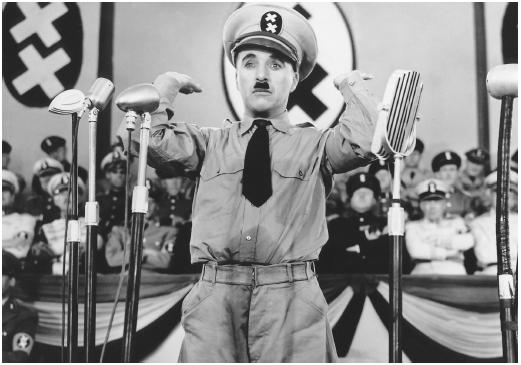
The comparison was all because of the toothbrush mustache. That little flourish is what linked Charlie Chaplin and Adolf Hitler at the time. Chaplin was disgusted by Hitler, and the way the American and British governments tried to keep him happy or ignore what he was doing at the time. It was also noted that Hitler was jealous of Chaplin’s popularity during a Berlin visit the actor made. To further rub it in, Chaplin wrote, directed and produced The Great Dictator, a send up of the Nazi actions in the build up to World War II.

The Little Tramp is now a Jew living in the fictional nation of Tomainia, fighting against the Americans in World War I. He’s clunked on the head and ends up in a military hospital unaware that on the outside dictator Adenoid Hynkel has come to power and is blaming the Jews of his nation for the post-War depression. The Tramp is eventually released from the hospital and is disheartend by the world he discovers on the outside. He eventually falls in love with fellow resident of the ghetto, Hannah and is spared execution by a Tomainian whose life he saved in the War. All along the way the film bounces back and forth with the Hitler parody of Hynkel, leading up to a Prince and the Pauper-esque role reversal.

This was probably the least funny of all Chaplin’s films I have seen, and most definitely the longest, hitting the two hour mark. I can see the challenge Chaplin would have making this picture, because he wants to make a comedy but he also wants to skewer Hitler and convey some sense of the pain being inflicted on the Jewish people. Later Chaplin admitted if he had known the extent of the treatment of the Jews and in particular the Holocaust he would have never made this film. Interestingly, the Jewish community was very welcoming to the film and its portrayal of their people despite Chaplin’s injection of comedy into the proceedings. The jokes in the film never create the sense of hilarity of early works because they typically involve the Little Tramp being brutalized by Tomainan storm troopers.

The film has a lot of heart and that hurts its comedy in comparison to the earlier films. The chief redeeming moment is one where Chaplin is playing the Tramp and completely drops the persona and it is Chaplin speaking. He conveys his concerns with the direction of humanity and reaffirms his belief that we are capable of so much more. While definitely harmful to the picture as a film, it is a very strong and well thought out political statement.

Newbie Wednesday – Kick Ass


Kick Ass (2010, dir. Matthew Vaughn)
Starring Aaron Johnson, Nicolas Cage, Chloe Moretz, Christopher Mintz-Plasse, Mark Strong

There’s a sort of geek wish deep down in those that read comics that somehow, someway they could don a cape and cowl and fight the criminal element of this world. The superhero idea goes all to the mythological heroes and into figures like King Arthur and Robin Hood to the Three Musketeers and the pulp mystery men and finally into comics. So our protagonist proposes a very legitimate question early on “How come no one has ever tried to be superhero?” It’s obvious that there are plenty of crazy people in this world and it comes as no surprise that there actually *are* people who have tried this. You can check them out at the World Superhero Registry. So how does the hero of our film try to tackle the nuances of masked crime fighting?

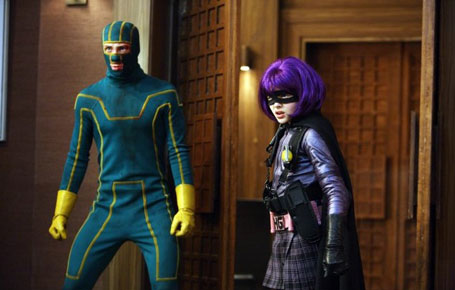
Dave is a high school student who is invisible to the opposite sex, but very visible to the bullies and street thugs of his city. After being robbed one to many times, Dave purchases a few essential components and becomes the mystery man known as “Kick Ass”. Kick Ass is immediately sent to the emergency room after his first battle and has steel rods and plates put in him that ironically grant him a certain level of invulnerability. And this is where the film completely goes off the tracks of its premise “What if superheroes were real?” and decides to be no more different than any other comic book flick. The duo of Big Daddy and Hit Girl are introduced, a father-daughter team of armed to the teeth avengers as well as The Red Mist, the son of a local mafia don who suckers his pop into stocking him up. The film goes through a lot of tonal changes and shifts, finally settling into a fairly predictable final battle sequence.

The movie is only shades different than Superhero Movie, a descendant of the Scary Movie parody genre. Whereas that film knew it was a comedy and behaved thusly, Kick Ass seems to want to be aloof and post-modernly ironic, yet still be a “bad ass” super hero movie. I’m not willing to go as far as Roger Ebert in his review, calling the film “morally reprehensible”. After watching the 2006 remake of Hills Have Eyes I think it could serve as a contender for that. I didn’t have a problem with the concept of this young girl, trained to be a super soldier by her father, slaughter masses of mob men on screen.

My problem with the film came from a couple elements that diverged from the comics which actually lent it real world credence. If you know me well, you know that I am not one of those comic book geeks who natters on about minutiae that differs slightly from the source material. I’m a geek who can be reasonable about conceits that have to be made in the process of adaptation. However, the first divergence from the original mini-series that irked me was when Dave reveals he is not truly gay to his love interest, she has mistaken him as such for the majority of the film. In the film, she is unnaturally forgiving and its implied the two have sex, after which they are a couple. In the comic book, she is pissed and eventually has her new boyfriend beat Dave up. That would be the actual real world way the story would play out. So while the film wants to be a wry commentary on the implausibility of superheroes in the real world, through this change it actually invalidated its premise to me.

The second divergence colors the audience’s entire perceptions of a character in a disturbing manner. In the film, Big Daddy was a police officer whose career was ruined by the mob, sending him to prison, while his wife went broke and died on the table giving birth to Hit Girl. Once out of prison, Big Daddy began training Hit Girl. In the comics, Big Daddy raised Hit Girl with this story. In reality, he was a no body, an accountant who had a mid-life crisis and kidnapped his daughter to create this more exciting existence. Once again, the film compromises its original intent for the sake of “superhero-ing” it up. I found the film to be enjoyable, but nothing I would watch again. Because it is too scared to make its characters truly real and give then the downbeat ending that naturally would happen it ultimately fails and ends up being yet another generic comic book movie.

Wild Card Tuesday – The Last Days of Disco


The Last Days of Disco (1998, dir. Whit Stillman)
Starring Chloe Sevigny, Kate Beckinsale, Robert Sean Leonard, Mackenzie Astin, Chris Eigeman, Tara Subkoff, Matt Keeslar, Jennifer Beals

If watching the burgeoning yuppies of early 1980s Manhattan sitting around vapidly waxing philosophic about the inanities of their lives doesn’t sound appealing to you then you may want to skip this film. Despite its title its not at all about disco really. Its about a generation of people who came of age in the 1970s and are focused on self-gratification and the hierarchies and status related to social life in New York. Another of way of looking at it, and how director Whit Stillman was thinking when he made the film, is that this is contemporary take on the comedy of manners genre.


The protagonists of the film are Alice (Sevigny), a recent college grad and an assistant publishing editor and Des (Eigeman), the employee of a disco club which bears a more than passing resemblance to Studio 54. Alice balances a tenuous friendship with snarky roommate Charlotte (Beckinsale) and ending up in awkward social situations with immature men. One of these men is a manic-depressive FBI agent (Keeslar) who becomes a part of a sting on Des’ nightclub which has been funneling cash to a Swiss bank account and failing to report millions the IRS. The characters meander through the film, talking in a completely artificial manner and nothing really seems to happen.

It’s apparent that Stillman’s work (Metropolitan, Barcelona) had a profound impact on the filmmaking of Wes Anderson and Noah Baumbach. Stillman’s characters aren’t so much people as they are roughly painted facsimiles of humans who carry on in conversations peppered with Tarantino-esque pop culture references. One character explains that the reason why so many of his own generation are environmentalists is because of the 1958 re-release of Bambi in theaters. Another conversation involves how Lady and the Tramp teaches women to pursue the bad boy and is at fault for a multitude of bad relationships in their generation.

The characters are dull as hell though. They barely even qualify as characters, as Stillman loves introducing a new and even quirkier one as the film progresses. Yet we get nothing past their surface eccentricities and Stillman struggles to manage any sense of a narrative. He tries to create a partial drama with the illegal business practices of the nightclub but even when the arrests go down all parties involved seem aloof and uninterested. The first hour of the film has potential but the second goes off the rails and becomes a chore to wade through. Much like the decade it highlights the start of, its incredibly shallow with nothing to really say.