Wyatt Butler sat hunched over in his desk chair, listening to his ex-wife Christine rightfully chide him for failing to pick up their son for Wyatt’s weekend. A case had fallen on the private investigator’s desk, a wealthy woman suspecting her husband of cheating, and she offered cash that Wyatt couldn’t pass up.
Northern Exposure Season Five (1993-94) Written by Diane Frolov, Andrew Schneider, Rogers Turrentine, Mitchell Burgess, Robin Green, Jeff Melvoin, Barbara Hall, David Chase, and Jed Seidel Directed by Daniel Attias, Michael Fresco, Jim Charleston, John David Coles, Nick Marck, Mark Horowitz, Michael Katleman, Michael Lange, Michael Vittes, Oz Scott, Bill D’Elia, Lorraine Senna, Tom Moore, and James Hayman
Joshua Brand and John Falsey, the co-creators and showrunners of Northern Exposure, were dealing with some stress by the end of season four. They had helped create shows like St. Elsewhere and I’ll Fly Away, but with this series, they finally found something they could cultivate and grow. The first problem came when writer Sandy Veith sued Universal, the production company behind NE, claiming they had stolen his idea and given him no credit or compensation. Universal may have cribbed some of Veith’s ideas and fed them to Brand & Falsey, who didn’t know where they had come from. Veith’s script was about an Italian-American doctor working in a small town in the U.S. South. Falsey was struggling with alcoholism and related sickness. He would be in that fight until his passing in 2019. It felt like it was time to leave. Who would they be replaced with? Cue David Chase.
Squadron Supreme (2021) Reprints Squadron Supreme #1-12 and Captain America #314 Written by Mark Gruenwald Art by Bob Hall, Paul Ryan, John Buscema, and Paul Neary
In 1969, writer Roy Thomas and artist Sal Buscema pitted the Avengers against the Squadron Sinister, a team of slightly familiar villains created by the bigger baddie Grandmaster. The creators intended it to be a DC Comics’s Justice League pastiche. The characters and their counterparts were as follows: Hyperion/Superman, Nighthawk/Batman, Doctor Spectrum/Green Lantern, and The Whizzer/The Flash. The idea would stick around and be reworked by Mark Gruenwald with a retconned explanation that these villains were based on the Squadron Supreme, the premier hero team of another Earth in Marvel’s Multiverse. Nighthawk would eventually cross over to the main Marvel Earth and join the Defenders for a short time. In 1985, Gruenwald took the idea further and devoted a year-long mini-series to this team. It’s a story noted as a possible inspiration for Mark Waid & Alex Ross’s Kingdom Come.
Oedipus Rex (1967) Written and directed by Pier Paolo Pasolini
Pasolini had a deep interest in the mythic. In his early films, the mythic could be found among the peasant class that lived on the outskirts of post-war Rome as it was rebuilt into a modernized city, complete with mass consumerism. Despite being a very modern type of person – queer, atheist, communist – Pasolini was constantly returning to the past, especially to myths & fables where symbolism provided a mystical explanation for how the world came to be what it is. After experimenting with it in a short film, this was the director’s first feature-length color movie. The result is a picture where Pasolini pushes his filmmaking to new heights but still stumbles along the way.
The Gospel According to St. Matthew (1964) Written and directed by Pier Paolo Pasolini
It may seem like an incredibly odd match. A queer, atheist, communist Italian man making a film about the life of Christ. Even more bizarre, it was In an effort to find relevance in the landscape of the post-war world, Pope John XXIII had asked for an audience with contemporary non-Catholic artists. Pasolini had been raised in the Church and accepted the invitation, knowing so much of his identity clashed with the institution. The meeting occurred in Assisi, and the subsequent traffic jam caused by the Pope’s presence in town left the filmmaker stuck in his hotel longer than he had expected. Pasolini claims he paged through a Bible in the hotel room, reading through each of the Gospels and settling on Matthew as the perfect one for the film he had in mind. His opinion was that the three other Gospels embellished or lacked a clear perspective on Christ; Matthew’s gospel was the most human.
Mamma Roma (1962) Written and directed by Pier Paolo Pasolini
Pasolini’s work stands out from his Italian peers of the era. He’s completely caught up in doing his own thing, making movies with a particular style nobody else brought to the table then. While his first few films, like this one and Accattone, are set contemporaneously, the filmmaker would quickly lose interest in that and dive deeper into the past through classic stories that shaped the world he was born into. Pasolini also held peasants in high regard, even though, as a gay man, he was often the subject of hate from them. That hate, of course, was stoked by the remnants of Italian fascism & generations of patriarchy that lie dormant until their more recent return to prominence (see Italy’s current fascist PM). Mamma Roma is a story of a peasant rising from her “lowly” beginnings to finally have a peaceful, more secure life, only to deal with challenge after challenge.
Well, that was a…week. One of our films purports to tell the story of a contemporary despot and the mid-century ghoul that helped to shape him. The second film is a French picture about a woman who takes a risk that could destroy her life.
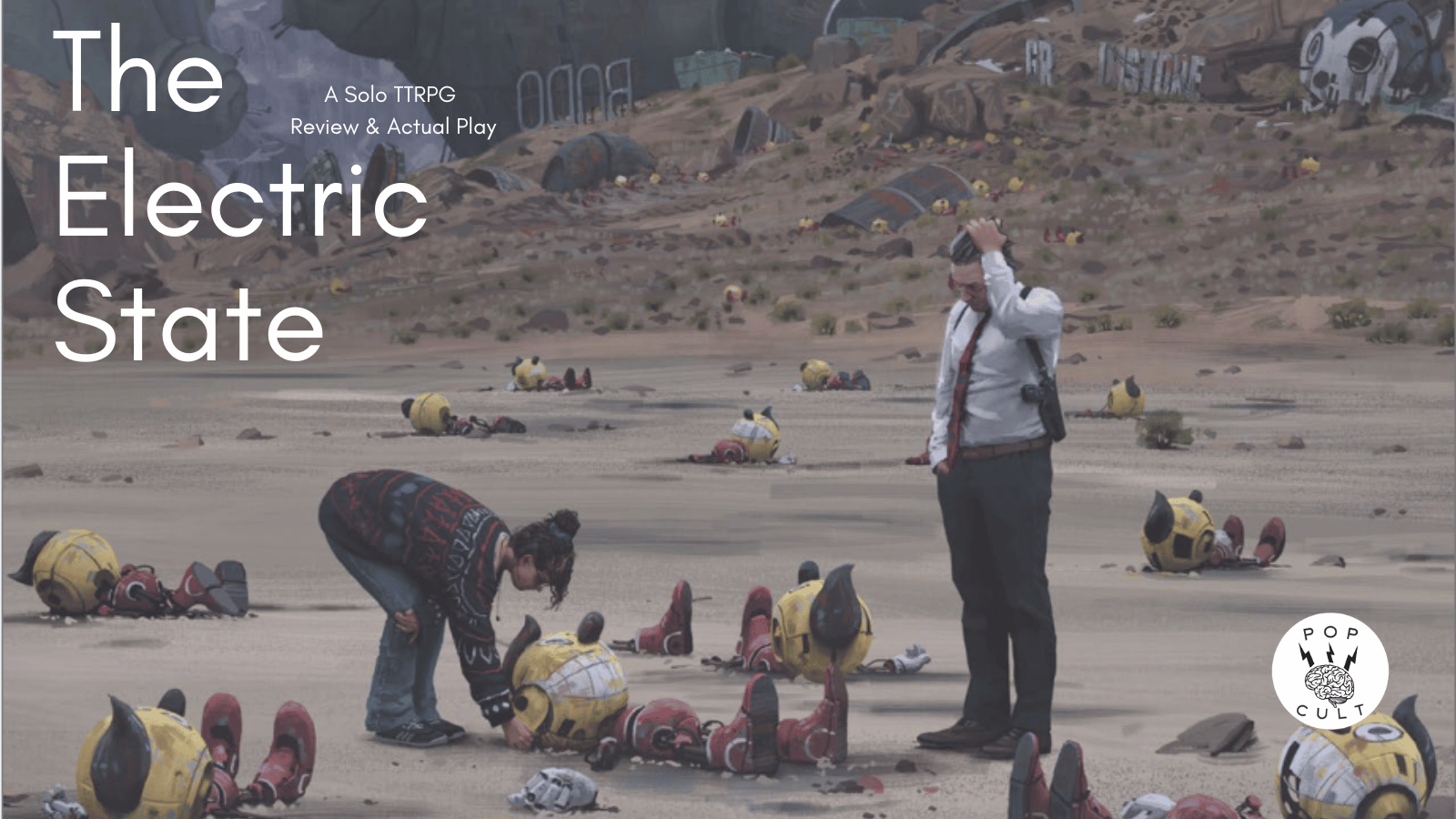
Solo play in The Electric State involves several playing card draws to generate details from tables. I won’t be recording every single card draw, focusing on those related to plots.
Wyatt Butler glanced out the driver’s side window to see the rusted smiling face of Victor Volt staring back at him in the early morning sunlight from across the desert brush. The Explorer quickly passed beyond the final resting spot of that long dead metal hulk and past a hand painted sign that read “California City. Pop: 220. Crystal nervously fidgeted with the zipper on her jacket. Wyatt asked if he should stop or keep driving straight through to make it to Bakersfield by midday. Crystal votes for “keep going”, so does Stella from the backseat. Wyatt glimpses the rearview mirror to see Taco, Crystal’s affectionate pitbull, laying across the seventeen year old’s lap as she thumbs through a tattered copy of Sassy she’s been carrying around since the detective met her.
Sideways: Steppin’ Out (2018) Reprints Sideways #1-6 Written by Dan DiDio and Justin Jordan Art by Kenneth Rocafort, Robert Gil, and Carmine di Giandomenico
Sideways: Rifts and Revelations (2019) Reprints Sideways #7-13, Annual #1 Written by Dan DiDio and Grant Morrison Art by Kenneth Rocafort, Max Raynor, Trevor Scott, Will Conrad, Cliff Richards, Shane Davis, Michelle Delecki, and Ibraim Roberson
Following the events of DC: Metal, a somewhat ludicrous storyline, DC Comics rolled out a line of comics that clearly attempted to create Marvel knock-offs. That’s nothing new. We’ll see later this month when I review Marvel’s Squadron Supreme that the Big Two have been doing this for decades, a playful series of non-copyright infringing homages that let writers make commentaries on the other company’s characters.