Set during the English Civil War, a deserter/alchemist joins up with a band of disparate soldiers to discover a treasure buried in a field. Psychedelic cosmic horror ensues.
Here Comes the Devil (2012, dir. Adrian Garcia Bogliano)
A couple loses their children in the hills, but they are returned safe and sound. But are these really their children. A violent, disturbing story of demonic possession and the lengths parents go to protect their children.
House of the Devil (2009, dir. Ti West)
A college student needing some extra cash takes up a job babysitting at a creepy old house in the woods. Filmed in a 1980s retro manner, Ti West manages to walk the line between respectful homage and originality.
Nightcrawler (2014, dir. 2014)
Less supernatural and more real life horror. Jake Gyllenhaal plays a hardworking man who finds his calling in is exploiting the tragedy of others for television ratings. A deeply disturbing character study.
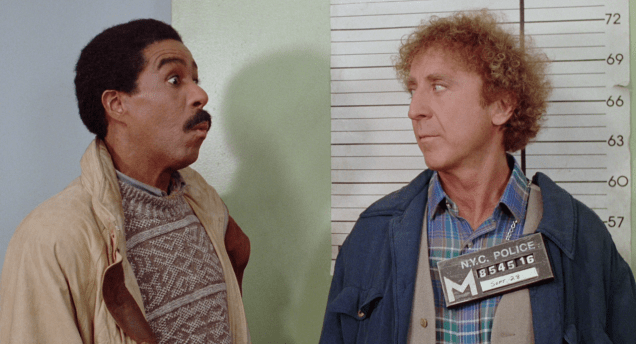
Eddie (Pryor) is a con-man that got caught and must fulfill 100 hours of community service per his probation. He ends up as the caretaker of George (Wilder), a recent mental hospital patient and reformed pathological liar. It doesn’t take too long in the outside world, and George is back to his old habits due to a case of mistaken identity. He’s thought to be Abe Fielding, the heir to a brewery empire and Eddie sees this as an opportunity to make some bank. A villain pops up in the form of Fielding’s business manager (Stephen Lang), but the twists and conceits used to get to the finale are incredibly convoluted and messy.
Another You was made in the period where Richard Pryor was succumbing to the effects of Multiple Sclerosis. He had announced his diagnosis four years earlier but it was this film that showed the public just how badly he was losing the battle. The film tries to work around it but it’s obvious when we see him being steadied by other actors in scenes and the way he tremors through the picture. Gene Wilder had done one film after See No Evil and prior to this one, Funny About Love, that was a box office failure. This would be the final film appearance of both actors. They would make the occasional television appearance and Wilder would star in his short-lived sitcom, but feature films would never be a medium they returned to.
It’s no wonder they gave up on movies after this. Another You is an unmitigated disaster. Peter Bogdanovich (The Last Picture Show, Paper Moon) had been hired to direct but quit after five weeks and Maurice Phillips was brought in as a replacement. Phillips and his editor showcase their complete ineptitude to construct a cohesive story. If reasonable minds had prevailed Pryor would have been left out of this because it becomes painful to watch him being forced through the picture despite his condition. It’s a nod to him that he just decides to say “fuck it” and do his own thing despite the movie happening around him. The picture is riddled with external car shots that have sloppy post-production ADR plastered over them expositing on plot points the director realized were unclear. The story is a complete mess that shifts its focus about three times and ends up in a confusing unfunny place, with relationship resolutions that are completely unearned by the script.
In the 1990s and early 2000s, Richard Pryor became the focus of a myriad of television documentaries about his stand-up career. His actual appearances were limited to a few and in 2005 he passed away due to complications from a heart attack. Gene Wilder tried his hand at television sitcoms in his own, Something Wilder; that was cancelled after a single season. He was seen in the television film version of Alice in Wonderland, playing the Mock Turtle. He subsequently starred in and wrote a duo of mystery films for A&E focused on a theater director turned investigator. In more recent memory, Wilder had a two-episode stint on Will and Grace as Will’s unbalanced boss. Wilder passed away in 2016 from complications of Alzheimer’s
The films of Pryor and Wilder never got better than Silver Streak. The key was that Silver Streak was a tightly scripted movie. Their subsequent films gave them lots of space to ad lib and mug, and that needed to be much rarer and tightly edited in post to be genuinely funny. For people around my age, I think we look back through the fog of nostalgia at these two men’s work together because with a crisper, more recent viewing of it I see there were a lot of problems. Somewhere, in some parallel reality, they were able to partner on Blazing Saddles, and movie houses are showing it on repeat for their Wilder retrospectives.
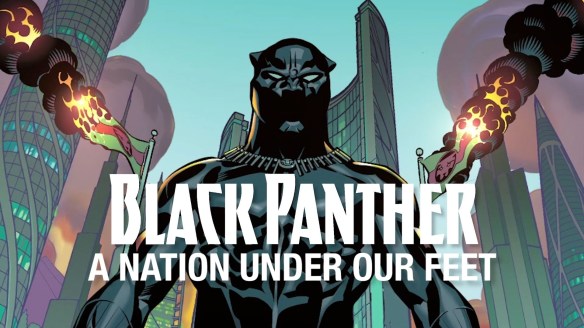
Black Panther: A Nation Under Our Feet Volume 1 By Ta-Nehisi Coates and Brian Stelfreeze You can purchase this book here!
The current ongoing run of Black Panther focuses on nation building both in the fiction and as metatextual-ly with the previous presentations of this hero and his homeland. Black Panther (real name T’Challa) is the ruler of Wakanda, an African nation with technology that puts it beyond futuristic. In the last few years, Wakanda has taken a major beating mainly from an attack by Namor and the Atlanteans. The attack led to Black Panther losing the throne to his sister and making his life a single-minded pursuit of revenge against Namor. He eventually got his revenge, stranding Namor on a parallel Earth but was then swept up as one of the survivors of the collapse of reality in Secret Wars. Present day, reality has been restored and so has Panther’s place on the throne. His sister is kept in a life-death stasis after an encounter with the mad Titan Thanos.
This first volume collects issues 1 through 4 of writer Coates’ run. There are two parallel storylines in the book and by the end of this first volume, they have not yet come together, though it’s apparent the story arc is leading up to that. First T’Challa is dealing with resuming the mantle of the king and its responsibilities. Various uprisings are occurring across his nation among the working class. The disputes are legitimate but get exacerbated by a mysterious woman with the ability to amplify anxieties and anger and create raging mobs. An even more enigmatic shaman accompanies the woman and his ties to people amongst the Wakandan elite eventually come to light.
The other storyline follows two of the Midnight Angels, the female personal bodyguards of Black Panther. Aneka, a trainer in the Angels, is charged with the murder of a tribal chieftain. She claims it was necessary because he was abusing and exploiting his tribe’s women, but Queen Ramonda, the mother to Black Panther refuses to hear it. Aneka’s lover and fellow Angel, Ayo pleads the case but is not listened to. The first issue ends with Ayo finding a way to break Aneka out of prison and two begin a cleansing of Wakanda from men who would mistreat women.
The story sets up a lot of interesting pieces, and I am interested in following the series to find out what happens when Panther and the Midnight Angels finally clash. There is not a complete story here, though. Due to delays, the series has been very inconsistent in its release. That’s not an uncommon problem when a previously non-comics author takes on a monthly assignment. Jodi Picoult had issues keeping her Wonder Woman run coming out on time and director Richard Donner had a horrifically late Action Comics run in the mid-2000s. I think the monthly schedule is difficult for creators who are used to longer stretches of time to complete work (movies, novels).
The art is by comics veteran Brian Stelfreeze who I remember vividly from his Batman work in the mid-1990s. He is splendid at playing with light and shadow. While his pencil and ink work is spectacular, you should google his paintings for some beautiful art that exists between photo-realism and comic book stylization.
It’s funny that the least interesting part of this comic is Black Panther. Instead the supporting characters that build out Wakanda are the ones I want to follow. Ironically enough, Marvel has announced Black Panther: World of Wakanda, a new series co-written between Coates and author Roxane Gay which will focus on telling the stories of these side players.
Our issue begins with Black Hoodie the Delinquent getting a hijacked text message from her former mentor, the imprisoned super genius Vincent Vincenzo. He baits her into visiting him at AEGIS Supermax where he’s locked up in a floating cell suspended in the middle of spherical chamber outfitted with lethal security measures. Through the intercom, he taunts Hoodie over the disappearance of the Elite and her team’s inability to find out what happened to them. Hoodie doesn’t go for it and tells him she’s leaving. Vincent replies that when she decides she needs his help just to let him know, he’s only choosing to stay in the cell for now.
Phoenix and The Sphinx (The Joined)
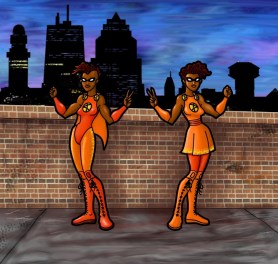
Lily and Rose aka Phoenix and The Sphinx (The Joined) are called in for a meeting with their school guidance counselor Mr. Dritz. Dritz is a retired superhero formerly known as The Phantom Spider and one of the few people who knows Lily and Rose’s secret identities. He tells the girls he saw their powers go on the fritz during the battle with Nuada and warns he’ll go to the authorities if they continue putting their lives in danger, even threatening to contact DCS.Lily and Rose falsely promise but decide to call his bluff in the end.
Magnificent Lad (The Legacy)
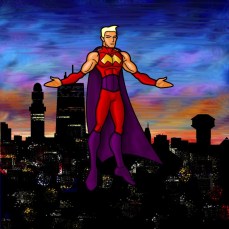
Magnificent Lad (The Legacy) is still hoping he can find his parents and gets news from Xion that he’s picked up a transmission that matches Gravinian energy signatures coming from an old warehouse in Damnation, the old town district. Symba, the Magnificent Family’s robot butler, tells Mag Lad he’s still very uncomfortable with the family’s former foe Xion being allowed access to the laboratory. Mag Lad says that Symba should just keep a close eye on the man.
Silver Arm (The Innocent)
Xion stops by the Mag Family’s Interstellar Menagerie, a portion of their island dedicated to housing near extinct animals from across the cosmos. Silver Arm has voluntarily allowed himself to be housed there after his absorbed Nuada’s silver arm. Xion taunts the young hero telling him he could use his power to cripple his enemies and is weak by choosing to be imprisoned. Silver Arm spits his taunts right back and refuses to give into the power lust.
Kid Atomic (The Protege)
Kid Atomic visits his mentor, Doc Atomic, still in a state of dementia and PTSD from whatever happened at the Eon Institute. Doc has cracked open the ink pens he asked the medi-drones to bring him and has scrawled black hearts across the walls of the recovery room. Kid inquires what this means, and Doc can only reply “The black heart beats within” and finally just chants “Eon” repeatedly. Kid hops in the Warthog and rockets to Magnificent Island. He and Mag Lad share their individual and immediate concerns and decide to split the team. Kid will take Silver Arm, Phoenix, and The Sphinx to Eon under the guise of allowing the scientists there to run tests on Silver Arm. Mag Lad and Black Hoodie will check out the strange warehouse in Damnation.
Director Marissa Wolfman
At the Eon Institute, the split team is met with a flustered and irritated Director Marissa Wolfman, the manager of the scientific research facility. She’s accompanied by armed security and eventually concedes to letting the young heroes in only if they remain monitored at all times. Dr. Conway Claremont runs a battery of tests on Silver Arm, but The Sphinx sees tests had been run previously on a sample of the metal composing the mystic arm and is took on demonic properties almost killing those present. She shouts out a warning just as thorny tendrils shoot off Silver Arm’s body and bore into the scanning equipment. Summoning a supreme level of will Silver Arm attempts to regain control of his powers and suddenly finds his consciousness floating in a black void.
Dr. Conway Claremont
A beacon of light floats towards him the void and feminine entity makes herself known. Silver feels a motherly love he had always wanted but never had as a foster kid and reaches out to her. She tells him she can soothe the pain of his arm if he accepts her. Silver hesitates but gives in and finds himself back in the laboratory with full and complete control of his now increased powers. Kid Atomic feigns the team departing now that the tests are over but instead hacks the security system and finds one curiously locked down sector. The half team fights past Eon guards and finally discovers a large testing facility containing a curious doorway connected to monitoring equipment. The Sphinx reaches out with her powers and sees the battle between the Elite and unseen, dark forces that occurred days ago. Strange cosmic interference shows her multiple realities where heroes are killed by chthonic forces emerging from the doorway or fighting them off and many other possible realities.
Kid Atomic remotely calls in the Warthog to blow a hole in the ceiling, but Phoenix detects another presence in the room. Shimmering into view is Mr. Drizt wearing his old Phantom Spider stealth belt. He tells the kids that they are going to the authorities to resolve the many crimes they committed breaking into this facility. Phoenix decides to solve things by overloading Drizt’s mind with images of his future and they leave him convulsing on the ground, regaining his senses after they have safely left.
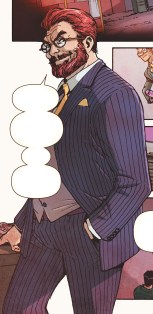
Director Marissa Wolfman watches on the security feed, looking incredibly annoyed and frustrated. Dr. Conway Claremont shows her that Kid Atomic had hacked the lab’s readouts on Silver Arm and that he had reversed the hack tunneling into Doc Atomic’s secret files. She relays this news to Institute’s mysterious and shadowy benefactor Mr. Truman.
Khinzir the Blood Pig
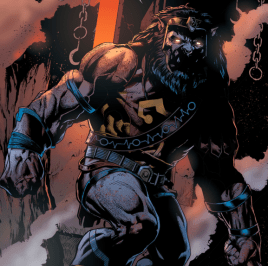
Across town, Mag Lad and Black Hoodie arrive at the warehouse and after Hoodies does some recon, they discover it’s housing an illegal metahuman pit fighting ring. Also, there’s some human trafficking going on as unwilling men and women are forced into the ring to fight the monstrous champion Khinzir, the Blood Pig. Mag Lad creates a distraction, busting in through the roof and drawing Khinzir’s rage while Hoodie sneaks into the management’s office to see where the Gravinian transmission is coming from.
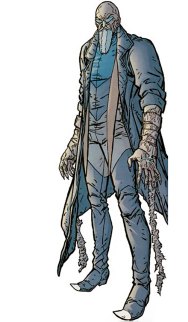
Black Hoodie discovers Prospero, a decrepit, rotting old man that seems to the brains behind this operation. He summons a pair of infernal stone creatures using a device on his arm, but Black Hoodie uses her psi powers, channeled through a baseball to make short work of them. Prospero attempts an escape but is foiled. Hoodie questions him about what he knows in regards to the Elite’s disappearance. Prospero reveals that they were “given as a blood sacrifice” to aid in the coming of the “dark gods.” He mentions “Golgotha and Gehenna” and that more will die to hearken their visitation.
Prospero, Acolyte of the Dark Gods
Mag Lad tricks Khinzir into letting down his guard, and the behemothic villain is tossed into deep space, belaying his threat for now. Mag Lad finds Hoodie and she shows him that Prospero was wearing a scrap of his father’s costume. Prospero will only say it was given to him as a boon from the dark gods. Hoodie attempts to burn the man alive in his business, but Mag Lad holds her back and turns the villain over to authorities. The Halcyon Police say Prospero was just a crazy old man, ranting on the street about some crazy religious nonsense, and that he’d dropped off their radar a few months ago.
The two half team reunite and head to Magnificent Island to debrief. When they arrive, however, they find Symba having gone mad and Xion lying bloodied and unconscious on the laboratory floor. To be continued…
See No Evil, Hear No Evil (1989, dir. Arthur Hiller)
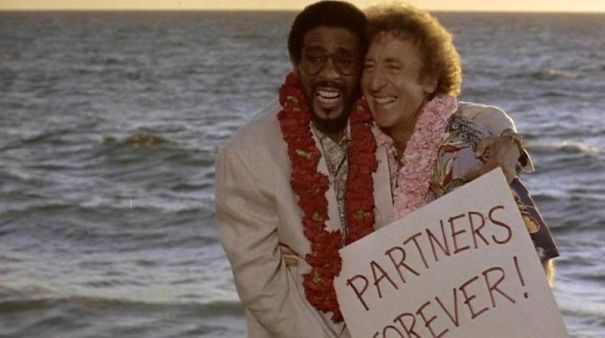
Wally Karew (Pryor) is a blind man who isn’t letting his condition slow him down, despite protests from his sister. He ends up getting a job working for newsstand owner Dave Lyons (Wilder), who happens to be deaf. The two become embroiled in a murder mystery. Karew’s bookie comes looking for money he’s owed but instead stashes a valuable coin in the newsstand when some, even more, unsavory types show up. Karew and Lyons get implicated in the murder, as ludicrous as that sounds and they have to bust out of jail and track down the real killers. Clearing their name involves posing as doctors at a hotel convention and enlisting Karew’s sister for help.
In both Stir Crazy and this film, there is a palpable desire to recreate the past success of Blazing Saddles and Silver Streak. In my Silver Streak review, I mentioned how Pryor was initially set to play the Cleavon Little role. I get the feeling the interaction between Gene Wilder and Cleavon Little looms over these films. Add to that the iconic moment in Silver Streak where Wilder is forced to “black up” to sneak past FBI agents and you can see the pressure these new movies had to create similar iconic comedic moments. That’s the problem with forcing those moments; it won’t ever happen. Comedy is a very organic thing and letting your actors “just ad lib” is rarely a smart move, even if they are as talented as Wilder and Pryor.
Instead, the comedy in this film awkwardly comes from the characters’ disabilities. Almost every joke is a slapstick play on blindness, deafness, or a combination of the two. There are some occasional amusing moments, but often it comes across as offensive and ableist. Isn’t it funny how the deaf guy misreads lips or isn’t it funny how the blind man gropes that lady? It doesn’t help that the main storyline, the valuable coin, is dumb and forgettable. It resolves in a very sloppy way that gives off the sense that the writers and director just threw up their hands and said: “Forget it!”.
A carryover from Silver Streak has been the idea that Wilder’s character must always have a love interest. Here there is an attempt to make it the female villain. It never goes anywhere which makes it better than the forced love interest in Stir Crazy. When I think back to the chemistry between Clayburgh and Wilder in Silver Streak, it feels real and natural. Much like the best moments between Wilder and Pryor, these romantic plots can’t get shoehorned in if there isn’t a reason for them and them chemistry isn’t there between the leads.
1989 was a critical moment in Wilder’s life. His wife of five years, Gilda Radner, died the year this film came out and it had a profound effect on his work. Previously, he had made three films with here that had not been well received by audiences or critics, so he was a rough place personally and professionally. Pryor had a mixed bag in the years since Stir Crazy. He’d co-starred in Superman III and had made the pictures Brewster’s Millions and Moving. He was enjoying a bit more commercial success than Wilder and was working to soften his edges. In 1980, the actor notoriously freebased cocaine which led to him dousing himself in rum and setting himself on fire. That violent incident would be a huge turning point in his personal life and lead to his eventually sobering up.
Wilder and Pryor would make one more film together, Another You, which we’ll look at next week.
Jessie (Elle Fanning) is a fresh-faced Midwesterner just off the bus in Los Angeles. She is making the rounds to become a fashion model and meets Ruby (Jena Malone) along the way. Ruby seems very struck with Jessie, who possesses an otherworldly beauty and brings her into the world of professional modeling. Jessie is also dealing with a potential new romance with an amateur photographer and the leering of a nightmarish hotel clerk.
The Neon Demon is a film about superficiality that thinks it has something profound to say about the nature of beauty but merely ends up being just as vapid as the target of its philosophizing. It is an exquisite film, no doubt, with some gorgeous and iconic cinematography done by Natasha Brier. Throughout the movie, there are great posed shots (a mountain lion snarling on a hotel bed, models bathed in blood-red neon lights, figures emerging or receding into the shadows). But it all adds up to nothing. There is an attempt to monologize some meaning into the story in the third act through an overwrought speech by Jessie, which comes across more as director Refn thinking he’s smart but is more embarrassingly sophomoric in his philosophy.
If you can separate the paper thin story from the film, then The Neon Demon is a very sumptuous visual feast. Refn doesn’t try to hide from his obvious influences; mainly the Dario Argento made Giallo films of the 1970s and early 1980s. The story’s framework is a nod to Suspiria, with a coven of witches and a naive ingenue unaware of the horrors that await her. Thematically, the movie touches on the same ideas as recent pictures like Black Swan, Starry Eyes, and Sleeping Beauty. However, those films explore the themes in much more interesting ways. Starry Eyes, in particular, seems like an apt comparison to The Neon Demon and while it’s visuals are not as stunning, it tells a much more meaningful story.
It’s hard to judge the acting of the cast because they either weren’t given much material to work with or were directing to be one dimensional and uninteresting. The few bright spots come in brief appearances by Christina Hendricks as a modeling agency rep and Keanu Reeves as the previously mentioned creep of a hotel clerk. It would have been nice to spend more time with those characters because they seemed to have deeper roots in this hellish version of Los Angeles and could have proven an intriguing counterpoint to Jessie’s blankness.
Refn has been a very polarizing director with his last film; Only God Forgives being very divisive among critics and fans. I’d argue that it is a better film than The Neon Demon simply because characters behave consistently, and they have a complete, coherent arc. Only God Forgives also has striking visuals and compelling Cliff Martinez score, just like The Neon Demon. The behavior of the characters in The Neon Demon is baffling because from scene to scene the actors seem to be told to play entirely different characters. As a tone piece the movie succeeds, but as a cohesive film with characters, plot, and themes it is as frivolous as cotton candy.
Stir Crazy is the second collaboration between Gene Wilder and Richard Pryor. This time, they are brought together by actor/director Sidney Poitier. The premise has the men as friends and roommates burnt out from life in New York City. They set out for the American Southwest where Wilder promises they will live a free and happy life. However, they end up framed for a bank robbery and receive a sentence of 125 years. Life is prison quickly drives them nutty, and they find a possible escape when it turns out that Wilder is a natural for the rodeo. The prison warden has a tournament coming up and plans to use Wilder to break his losing streak.
Since Silver Streak, life for Wilder and Pryor has been busy. Wilder has made The World’s Greatest Lover, inspired by a Fellini film, and The Frisco Kid, a Western that made Harrison Ford his co-star. Both films were considered significant failures at the box office. Pryor had two more successful comedy albums and starred in Car Wash, some forgettable comedies, and in Paul Schrader’s (Taxi Driver) drama Blue Collar. The comedian has also suffered a heart attack in 1977 but seemed just to double down on drug consumption which led to reportedly unprofessional behavior in being late the set of Stir Crazy. There was a lot of tension behind the scenes between Poitier and Pryor, and it can be felt a bit on the screen.
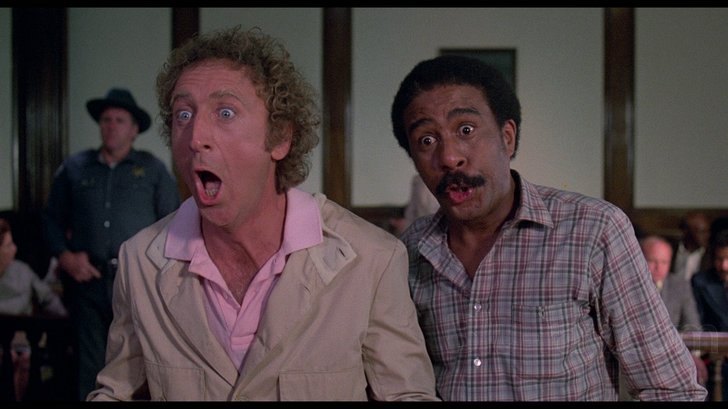
Stir Crazy is a pretty major disaster of a film. Silver Streak was a very tightly written and plotted, while Stir Crazy plays it way too loose and gives its two leads way too many scenes to mug and improvise in. There are multiple instances where Wilder especially is encouraged to just riff, and they fall flat in a huge way. His character mainly feels all over the place, in some moments being a naive doof and in others a Bugs Bunny-esque trickster. It becomes impossible near the end to know when he is genuine and when he is messing with the prison staff. There are a couple of moments where the two pull off genuinely humorous reactions. The sentencing scene is the highlight of the film with the result feeling natural and playing to the actors’ strengths. The scene where the two men are thrown into the county jail after their arrest is also funny until Wilder begins ad libbing a kung fu bit that just doesn’t work.
The film suffers from a lot of tone and plot problems. The film switches plot tracks numerous times with many characters introduced and ending up completely unimportant to the movie. JoBeth Williams shows up halfway through the film as an intended love interest for Wilder’s characters but goes nowhere and somehow still ends up with Wilder despite the story never earning that. After reading about the tension between Poitier and Pryor, I suspect Wilder had more plot added to his character as both a way to pad for Pryor’s absence and as a way to get a dig in at the comedian.
With contemporary sensibilities, it’s very hard to watch the Rory character, a horrible gay stereotype that I hope we have moved past. Rory is immediately attracted and clings to Pryor’s character. Pryor’s disgust at the attentions of a gay man is played for laughs culminating in the man kissing Pryor in the final scene. The comedian let’s lose an exaggerated “Yuck” to make sure we, the audience know he doesn’t return the affection. It’s a very gross type of character to include and he ends up being completely one dimensional.
Stir Crazy was the third highest grossing film of 1980 yet still was nominated for a Razzie. It was the highest grossing film by an African American director until I believe, The Wayans Brothers’ Scary Movie (2000). It’s an incredibly diverse cast in a very sloppy film with some problematic elements. Poitier would go on to direct Hanky Panky (also with Wilder), Fast Forward, and Ghost Dad. We’d see Pryor and Wilder come together nine years later in See No Evil, Hear No Evil which we’ll talk about next week.
Tale of Tales is an adaptation of a few fairy tales collected by Italian folklorist Giambattista Basile in the 15th century. Basile’s work would later inspire the Brothers Grimm to publish their collections in the early 19th century. So in this film, there are stories very unfamiliar to American audiences and likely most moviegoers around the world. The stories are loosely interconnected the film cuts between them in simple acts, with all three coming together in the final scene.
The first tale concerns a queen (Salma Hayek) who desperately wants a child. Her husband, the king (John C. Reilly) follows the advice of a wise man and hunts down a sea monster so that the queen may eat its heart and bear a child. The king dies in the process, and the woman who prepares the heart for consumption becomes pregnant from its magic. The unexpected cross-pollination results in a pair of identical twins from two different mothers whose lives as adults become fatefully intertwined despite the queen’s protestations. The second tale tells about a lustful and hedonistic king (Vincent Cassel) who hears beautiful singing and tracks it down to a cottage in the village below his castle. He is unaware the voice belongs to an aged woman and enters into a dance of seduction with her. Magic becomes involved, and this story goes to some horrific places. The third and final story concerns a silly king (Toby Jones) who becomes enamored with raising a flea until it becomes the size of a large dog. His daughter is caught up in the romance of chivalrous stories and wants a husband. The king holds a contest, and she ends up with a less than desirable suitor.
The practical effects work in the film is stunning. The film is one of those where we see the craftsmanship of fields in film production that are a dying art. Very minimal computer-generated effects are used and instead we have magnificent puppetry and makeup work. The costume and set design is also at a remarkable level. The castles and buildings used in the film add the fairy tale nature of the whole piece. I was reminded by behind the scenes content I’ve read and seen in Fellini’s films and how he went out of his way to employ these craftsmen and women who grow smaller in number by the day. Garrone makes a major case for practical effect in film production.
There is little character development in each story, but that’s expected with the emphasis on creating a fairy tale tone and atmosphere. These are morality plays, so the characters are larger than life and representative of points of view rather than individuals. That said, I did find some character moments in the second tale, the story of the elderly woman, to be quite painful, especially its grotesque and heartbreaking conclusion. The one thematic thread tying all three stories together is that of “be careful what you wish for”. No handsome prince is coming to save the day and instead we have three prominent female figures struggling to deal with expectations placed on them and their personal desires.
Director Garrone has previously directed Gomorrah, a hyper-realist film that tells a slice of life, almost documentarian story, of the influence Italian organized crime, has on the life of the nation’s citizens. He brings that same non-judgemental eye to these fairy tales to create a type of film that is unique beyond the deluge of fairy tale revisionism that is quite popular these days.
For my first online Masks campaign, we have the following characters. To read more about the Masks game system check out my overview from Origins 2016. Illustrations of our campaign’s characters are done by John Alexander. Junior Elite logo by Mick Bradley:
Possessor of a silver arm that grants him mystic powers connected to Celtic mythology, Silver Arm was tossed forward from 1996 to present day where he finds his modern self to be a cynical, jaded jerk.
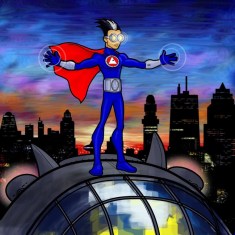
The orphaned son of a pair of super villains, adopted by Doctor Atomic and raised as his ward
Phoenix and The Sphinx the Joined (played by Misha B)
Twins, one of whom is a precog and one a postcog, more powerful when in each other’s presence.
The team has been named the Junior Elite by the press, due to two of their members’ associations with elder members of The League of Elite, Halcyon’s premiere superhero team. In our first session, we focused entirely on character building with lots of questions and note taking on my end.
The inciting incident for our campaign is the disappearance of almost all the League of Elite. The Junior Elite responds to an attack on the Eon Institute; a research laboratory focused on multiversal and temporal science. The attack is led by Professor Dark and his Children of the Night; a washed up 1990s goth styled villain. The Professor is wielding cosmic level weaponry that he couldn’t have made himself, and it takes the combined Junior Elite to stop him. Before the team can examine the weapons more carefully, Gen. Juliet Mayhem of AEGIS swoops in and absconds with the tech citing her organization’s ability to keep it locked up tight. The only member of the League of Elite that’s still around is Doc Atomic, and he seems to have been broken psychologically from whatever went down. The Junior Elite also met Dr. Conway Claremont, the lead researcher at the Eon Institute. Claremont explained that Professor Dark broke into the wing that housed viewing equipment for that the scientists had coined “The Dark Star Dimension” and that he believes this was all a diversion from something worse. The twins share a vision of a darkened void with a single molten planet floating in the darkness. From the darknesses rises a being composed of the world’s very essence. It reaches out to make contact with a small being consisting of pure light. The vision ends. The first mini session ended with an object hurtling from space and crashing into a farm on the outskirts of Halcyon. The farmer rushes out to investigate only to see a thorny silver arm reach up over the crater’s edge.
In our first full session, we kicked things off with Magnificent Lad at his family’s secret base on a jungle island off the coast of Halcyon. There his robot butler Symba is trying to get the young to sleep after 18 straight hours of searching the known universe for his parents’ using their alien equipment. The conversation is interrupted by Xion, a former friend turned enemy of the Magnificent family who has arrived on the island. Mag Lad and Xion clash, with Symba alerting the rest of the Junior Elite. The battle leaves the planet’s atmosphere and ends on the moon where Xion is able to explain that he has come to help Mag Lad find his parents. His reasoning is that with their disappearance it finally set in that their species was on the brink of extinction and he will help find them. The team can’t get a good read on Xion but he does seem genuine in his concerns. The former (?) villain sets up shop in the Magnificents’ lab explaining that Mag Lad’s father would likely construct a beacon wherever he might be and that Xion can build a receiver.
The team is pulled away quickly thereafter when massive destruction is reported in the district of Prosperity. Prosperity is a borough of the city that appeared from the 31st Century. However, none of the residents came with it so, while it was amazing and beyond anything Halcyon’s citizens were used to it quickly decayed because there was no one alive who knew how to maintain and repair the technology within it. Now Prosperity is a rundown area of squatters and homeless communities. The Junior Elite, airborne in Kid Atomic’s warthog helicopter, see a path of destruction coming from the farmlands into the city. On the ground is Nuada of the Silver Hand, the mythical Celtic hero who bears the same weapon as young Silver Arm. Silver Arm attempts to calm the time lost warrior but Mag Lad decides to get physical and wants to take Nuada down. The rest of team goes into rescue mode until Silver Arm miscalculates and causes a towering spire to collapse into the energy district, exploding a fusion reactor and taking power out across town. The Halcyon City Jail is hit, meaning Professor Dark has a chance to escape.
Black Hoodie, Phoenix, and Mag Lad head for the jail while Silver Arm, The Sphinx, and Kid Atomic hang back with Nuada. It becomes apparent that Nuada knows more than he originally let on. His silver arm separates itself from his body, revealed as a sentient demonic entity. The silver demon strikes at The Sphinx who loses control of her powers and begins opening rifts in space and time. We get quick glimpses of possible futures and alternate realities, including The Sphinx as a world-destroying cosmic force. Kid Atomic tries to fly the Warthog in to scoop her up but Nuada used his sword to blow out the engine. Across town, Phoenix senses Professor Dark is headed for Damnation, the old town district of Halcyon, but they head back to help her sister when she sense the twin’s pain.
Nuada is finally taken down when Silver Arm reaches out with his consciousness and absorbs the silver hand into his own arm, causing the liquid metal to grow from his arm and shoulder and down his torso and leg. Nuada shrivels into a husk and before he passes out utters, “Heaven has fallen.”
The final scene shows Professor Dark arriving at a strange pit fighting venue in Damnation. We briefly glimpse Apollonia, one of the supposedly missing League of Elite, fighting in the pits against other metahumans. There’s no time to figure out what’s going on there as Dark meets with a figure named Prospero who usher the villain into a backroom for a private conversation.
Growth in views from July to August was -65% (July: 716, August: 249)
Growth in visitors from July to August was -55% (July: 464, August: 207)
16% of views came from Google Plus
41% of views came from Google searches
6% of views from Facebook
Posts
The top five most visited articles for August were:
Comic Book Review – Omega Men by Tom King – 25 views**
The Childhood of a Leader (2016, dir. Brady Corbet) – 19 views
Games for Two – Lost in R’lyeh & Sushi Go – 15 views* Comic Book Review: The Vision Vol.1: A Little Worse Than Man – 15 views**
Great Books You Should Read #1 – 12 views
** denotes post was published in previous months, though the views came exclusively from August.
Analysis Due to a much-diminished posting schedule for August, I saw inevitable drops across the board. I posted less new content, so search engine hits became the core of my views for the month. As a result, my most viewed posts were more of my older content. It does appear that Tom King was increasing in interest, probably due to his current run on Batman and the release of a few trades at the end of July. Not on the top five for August, but prominent when I look at my statistics for the year is my Origins article on Bluebeard’s Bride. August marked the 100th view of that particular article since it went up in late June. To me, that is a sign of high interest in the unreleased roleplaying game.
Conclusion Posting will increase by a bit in September. One of my series for this month will be a Gene Wilder/Richard Pryor retrospective that I suspect will get decent views due to Wilder’s recent passing. I don’t expect to see numbers like June and July’s til next summer if I decide to post with that frequency. In October there will be an increased number of posts for Halloween, and I believe the numbers I generate that month will be more reflective of what will be the mean views.










 PopCult Reviews


