Movie Review – The Woman in Red

The Woman in Red (1984, dir. Gene Wilder)
woman-in-red

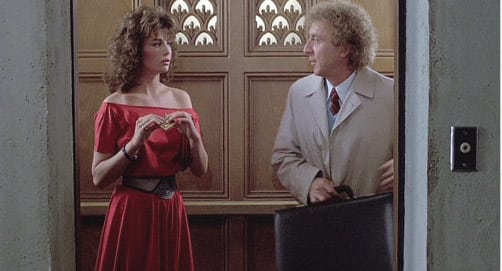
Teddy Pierce (Gene Wilder) begins the film standing on a ledge, just outside a window. Through voiceover, he takes us back to his fateful meeting with the Woman in Red (Kelly LeBrock) and how it led him to this place. He was a faithful husband and a doting father, comfortable in his job as an advertising executive. At first, Teddy’s gestures towards The Woman are scrambled around, and co-worker believes they are aimed at her (Gilda Radner). When the relationship finally does get off the ground, it becomes a series of lies and comically awkward scenarios where Teddy tries to dodge and mislead his wife (Judith Ivey).

One of the biggest wrinkles for me as I watched this film was the way Teddy’s infidelity was played for laughs. I can’t imagine this film being made today without some genuine pathos being written in for Teddy’s wife. There is a single moment in the third act that seems slapped in to handle any dislike the audience had for our protagonist, but it didn’t make me feel that he was justified in any way. I kept thinking about the culture Mad Men depicted and how this felt like the last vestiges of that, crumbling away in the early 1980s. Teddy has a cohort of buddies (Charles Grodin, Joseph Bologna, and Michael Huddleston) he pals around with and engages in raucous pranks on unsuspecting people. It appears that the intent was to make us think this was cute. Instead, it comes across as obnoxious and beneath characters that are supposed to be grown, professional men.

Despite the odd dismissiveness of the wife’s feelings, there are some moments of real consequence for side characters. Joseph Bologna’s character is notorious for his infidelities and early on in the film his wife leaves him. It feels like this will be handled seriously, as a counterpoint to what Teddy is contemplating. But then the film undercuts this plot halfway through, and it leaves Bologna’s character as having learned nothing from the ordeal. These are not “manly-men” per se though; they are a type of “fraternity of men” in their dynamic. So it shocked me that around the halfway mark it is very subtly and very honestly revealed that Charles Grodin’s character is gay. The words “gay” or “homosexual” are never spoken, the rest of the guys never rib him about it and the fact is just something they all knew and accepted. Grodin’s partner learns he’s been cheating on him and leaves their home. Grodin has a very real, emotional moment contemplating how his philandering has affected his life. For 1984, I was honestly shocked that a gay relationship was shown with such acceptance.

Wilder adapted the film from a French picture titled Pardon Man Affaire but infuses it with the Wilder tropes (red-faced hysterics, sad puppy-faced mugging, bawdy nebbish-ness). It just doesn’t work in the end. Reflecting on the films Wilder directed (Sherlock Holmes’ Smarter Brother, The World’s Greatest Lover, and this) it becomes a parade of diminishing returns. His work has moments of brilliance, but as a whole, they are muddled, confusing, and rarely funny. It’s clear to me Wilder has a very distinct point of view throughout his work, it is just messy and meandering. The one bright spot in The Woman in Red is Gilda Radner in a nearly wordless performance as a co-worker who mistakenly believes Teddy is after an affair with her. Where in Hanky Panky she is cast as “generic female supporting character” here she is allowed to flex her comedy and acting chops, proving what a great talent she was just with her face.

At this point in his career, Wilder has settled into the role of the WASP-y milquetoast, and it is clear that his greatest performances were behind him. He would direct one more film, though, Haunted Honeymoon, which is what I’ll be reviewing next time.
Movie Review – Hanky Panky

Hanky Panky (1982, dir. Sidney Poitier)

hanky_panky_1982_3h2016

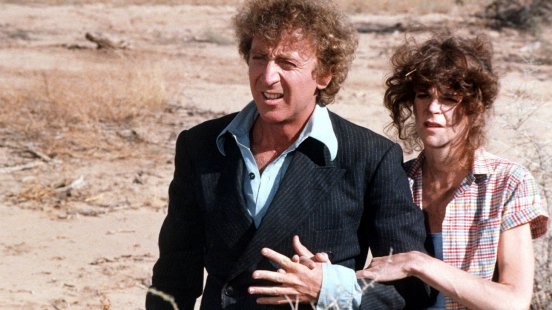
A Chicago architect named….(wait for it) Michael Jordan (Gene Wilder) is headed back to his hotel after brokering a deal in New York City when a woman on the run from a couple menacing fellows stumbles in. He quickly becomes involved in an international game of spies and espionage. He gets help from a reporter (Gilda Radner), and the two go on the run after Jordan is framed for murder.

Much like I felt about Poitier’s previous Gene Wilder venture, Stir Crazy, this movie is an utter failure as a comedy. And it’s not too great of an action/thriller film either. The MacGuffin that drives the whole plot is very confusing and unclear, and even at the end, I was still trying to figure out what the big deal was. Things start out interesting enough. A mysterious man wakes up, disoriented, sees a strange painting of a Southwestern landscape on his bedroom wall and proceeds to hang himself. It’s a pretty intense hook. Then we move to Kathleen Quinlan as the woman whose path crosses Jordan’s. She is playing it straight, which is perfect for an action comedy. The comedy comes from moments in the story but the story itself takes things seriously.

I kept thinking back to how good Silver Streak was, how it balanced genuine situational comedy with a legitimately exciting and interesting conspiracy story. Lots of things happen in Hanky Panky and the two leads go to lots of locations, but it never feels like it amounts to anything. It is a lot tighter in its structure then Stir Crazy but still misses the mark on the actual comedy. There’re some instances of Wilder’s trademark outbursts, but they hit too frequently and don’t feel appropriate for the scenes.

The strangest thing to me throughout the whole production was how underused Gilda Radner was. She was known for being a very high energy comedic talent, and she is a fine actor. They just never give her anything to play off of or do other than eventually become the damsel in distress. I got similar feelings from when I see Kristen Wiig in certain productions that seem to ignore her comedic talents.

As far as Wilder’s career, this was near the point where it was beginning to slow down regarding hits or highly memorable work. From interviews I’ve read, he seemed to be a particular actor, so I assume he was looking more at films that interested him rather than would do well. He also began his relationship with Gilda Radner at this point. We’ll see the pair again in his next film, The Woman in Red as well as Haunted Honeymoon. I’ll be posting about both of them very soon.

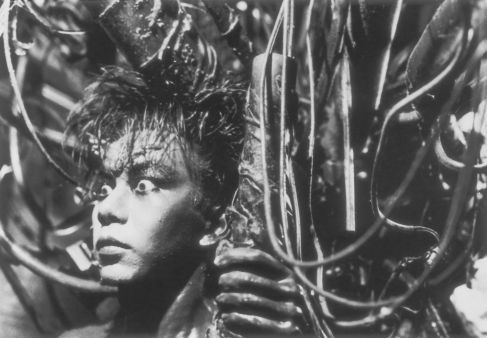
Movie Review – Tetsuo the Iron Man

Tetsuo the Iron Man (1989, dir. Shinya Tsukamoto)

tet1

A mysterious man lives in a junkyard and fetishizes metal to the point that he cut open his body to insert iron rods and wires into it. He’s struck by a car and apparently killed. A salaryman (Japanese corporate drone) is haunted by strange techno-nightmares, even attacked in the subway by a woman transformed by a piece of metallic effluvia. Where this film goes and mood it evokes is truly unpredictable and very much of its time.

Tetsuo is a techno-horror film akin to David Lynch forming a death metal punk band. The energy in the picture is non-stop, grabs the viewer by the shoulders and violently tosses them around until they can’t take it anymore. In the 1980s, body horror was a growing sub-genre thanks to the likes of David Cronenberg and Clive Barker. The way a human body could betray its nature was of increasing interest as medical science evolved a breakneck pace, the AIDS epidemic slashed across humanity, and urban spaces became increasingly smother in pollution. Self-mutilation wasn’t a new concept and many cultures still practice scrying script into the skin or slicing off bits of their reproductive organs as a sacred ritual. The addition of technology into the mix is what took the exploration of these ideas in a new direction.

Tetsuo is a ghost story at its heart. One man wrongs another man, and the wronged man comes back to haunt him. Very simple, on the surface. A significant factor in what is happening in Tetsuo is the transformation of the Japanese culture at the time. Westernization was flooding Japanese culture, and traditional Japanese life was uprooted. Technology and industrialization were the greatest representation of that takeover and the unnamed man has become so absorbed in this new world of wires that he attempting to physically merge with it. The merger of the Fetishist and the Salaryman in the finale is sparked by their discovery of the New World, a possible future landscape where the planet is devoid of all natural life and now a techno-organic construct. The decision to close out the film with the words “Game Over” rather than “The End” is also a telling detail in reflection on the relationship that developed between Western culture and Japan through the medium of video games.

Tetsuo is a rough film to get through. It’s has zero interest in traditional narrative conceits and from the very opening it makes sure you know that. The film is almost virtually hyperlinked within itself as the narrative jumps around to fill in backstory, hint at the future, and provide the minimal information needed to understand it. The soundtrack is designed to shred your sense and it truly evokes the sense of being overtaken by some faceless industrial presence.

TV Review – Stranger Things

Stranger Things (Netflix)
Created by Matt and Ross Duffer

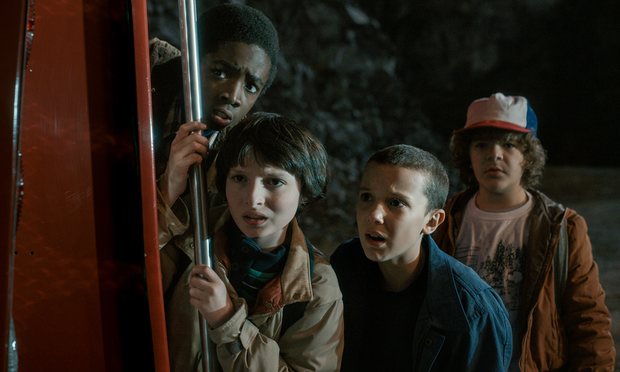
strangerStranger Things is an 8 episode series released by Netflix. It tells the story of the disappearance of Will Byers in the small town of Hawkins, Indiana and the bizarre phenomena that begins to occur around those affected. The series features an ensemble cast with David Harbour (The Newsroom) leading the cast as Sheriff Jim Hopper. Alongside Harbour are Winona Ryder as Joyce Byers, the mother of the missing boy, Finn Wolfhard as Mike Wheeler, Will’s best friend, and Millie Bobby Brown as a mysterious girl who know what happened to Will. The series is dripping in early 1980s nostalgia and plays out like a Stephen King novel or Spielberg film with a bit more darkness added.

The most noticeable aspect of the film is that it is firmly entrenched in creating an early 80s vibe. The title sequence’s music and visuals are tailored to mimic a dark synthy score of horror films and the font of a King novel cover. Because three of the series’ major characters are adolescent boys references to Star Wars and Dungeons & Dragons abound. There’s more tonal and thematic touches that bring E.T., Poltergeist, Alien, and other period films to mind. In fact, this probably the show’s highest selling point, the recreation of the feeling of the childhood of many of its viewers. As a child of the 80s, I definitely felt it, probably not as much as someone who was a peer to the featured children would. I am curious how millennials view the series due to not having the nostalgic buy in. It’s also impossible not to think of Super 8, a very similar homage to the sci-fi/fantasy films of the day. Super 8 is definitely enamored with the Spielberg vein exclusively, while Stranger Things is willing to go to darker places and play with Stephen King and David Cronenberg territory.

The plot is not necessarily revolutionary. Because the show is a nostalgia trip, it weaves together ideas from a number of sources. I was pleasantly entertained by the twists and turns, and there are some predictable moments that don’t detract from the pleasure of watching. The key piece of the story, what took Will and where he is, were the most original parts. Thankfully, there is never a large chunk of exposition to explain away what is happening and the series requires the viewer to piece together segments of plot over time to have a full understanding. I appreciate that the show respected my intelligence enough not to have the central human antagonist sit down and lay out the plot to another character.

The characters and acting were a slightly mixed bag. First off, Millie Bobby Brown is going to be a major actress in the future, and honestly, already is in my opinion. I always say the best way to tell how good an actor is would be to watch them in a scene without dialogue and see how well they convey emotion without being over the top. Ms. Brown knocks every scene out of the park. She tells a rich, nuanced story through her face and her eyes. I learned she was part of a BBC America series called Intruders where her character is possessed by an older evil man and cannot wait to dig in and see how amazing she plays that. David Harbour does a better than expected job as Hopper. So often the role of town sheriff in these sorts of stories comes across as a paint by the numbers character. Hopper’s story adds a tragedy that is never played up too huge and is only highlighted at just the right moments. The character’s descent into paranoia as he comes closer to the truth is very entertaining and if a second season comes, I am interested to see how his character develops. Winona Ryder did not feel natural in many of her scenes. She basically plays one note, hysterical grieving mother for the majority of the series. That is what her character is going through but it would have been interesting so see some more of her. She definitely knows her character’s motivation and it guides her acting in every scene. The trio of young boys are wonderful and they each have a specific dynamic in the group that doesn’t come off as a checklist.

Stranger Things is a very fun series. I’ve enjoyed most of the 1980s nostalgia media and particularly like when it is done with an attention to tone over nitpicky details. It felt like watching a very long film from my childhood and it kept me hooked the whole way through. The series ends with a number of hooks for the second series but I won’t be disappointed if we don’t get another. These eight episodes are a complete, satisfying story, very much in the vein British television where each series attempts to close off its plot. Stranger Things is a perfect recreation of 1980s summer cinema that you can get lost in.

Retro Review – Legend (1985, dir. Ridley Scott)

legend

I can remember being in my grandmother’s living room at her home in Clarksville, Tennessee. I was about seven or eight. My Uncle Thomas has control of the television and it was on the mysterious and forbidden HBO. The film playing captivated me with the dreamlike world being presented on screen and when the moment came that the towering demonic villain of the piece stepped on screen I was absolutely floored. Later, I would learn this was the film Legend.

Legend is about as classical of a fairy tale you could get. There’s a beautiful princess, Lily (Mia Sara) who plays in the forest with a child of nature named Jack (Tom Cruise). A foolish encounter with a pair of unicorns plunges the world into the beginnings of eternal shadow. It’s up to Jack and band of dwarves and fae to defeat the fiendish Darkness (Tim Curry) before evil overtakes the world for all time.

After watching The Force Awakens I realized more than anything that film is able to perfectly recreate how it *feels* to watch Star Wars for the first time when you were a kid. I don’t know how to explain it but it’s a very primal, emotional thing that Abrams is able to tap into. In Legend, Ridley Scott accomplishes the same sense of nostalgic wonder on the topic of reading a fairy tale. Every single archetype looks and plays so perfectly. Tom Cruise pulls of the generic hero who has received the Call. Mia Sara’s Lily is ethereal in her beauty but also brings a strength to her character not typically seen in fairy tales. It’s by no means a feminist portrayal, but her confrontational scenes with Darkness show she is a character able to overcome her initial fears. The supporting cast of goblins, dwarves, faeries, and demons are everything you remember from laying in bed and leafing through a hardback anthology of fairy tales.

Even now, some twenty-plus years later, the film still brings out that sense of slipping into a dream. This is accomplished thanks to two key crew members: Assheton Gordon, the production designer, and Rob Bottin, makeup designer. Gordon was a British film veteran having worked on some of the great British New Wave films of the 1960s (The Knack…and How to Get It, Wonderwall, The Magic Christian) and was part of the crew of Michelangelo Antonioni’s countercultural crime thriller Blow-Up. I don’t believe Gordon had done production design on a film of this scale before, but he produced a brilliant world. Filmed entirely on the famous 007 soundstage at Pinewood Studios, the entire enchanted forest and hellish citadel of Darkness were perfectly realized. It is obvious that our characters are moving through an artifice of nature, but I think that helps add to the dreamlike qualities of the picture. It reminded me of Canadian director Guy Maddin’s work which intentionally lets its audience in on the layered reality of watching a film. The plan had been to shoot on location and if that had gone through I think the story would have suffered.

Rob Bottin handled makeup design and the variety of magical beings, both angelic and sinister, look wonderful. The obvious crowning achievement of the film is Tim Curry as Darkness. This is the definitive Devil. Massive black horns, piercing cat’s eyes, brilliant white fangs in a malevolent grin, goats hooves that tower him above the rest of the cast. Just from an engineering point of view this is a massive task. Bottin made his way up on some classic 1970s cheesy films (King Kong, Rock and Roll High School), but really broke out through his work with John Carpenter (The Fog, The Thing) and particularly The Howling. The most important part about his transformative work with Darkness, and the testament to Tim Curry’s prowess as an actor, is that neither the makeup or the actor ever overwhelm each other. It’s such a perfect synthesis of both crafts.

Legend did not do well upon its release. The plot is paper thin and character development is almost nil. But I would argue neither was something the film set out to do. Legend is a film about dreaming and about imagination. I suspect it still works to lure in the attention of children even today, evoking in them those ancient curiosities that have kept fairy tales alive in our culture for centuries.

Film Review – Sherman’s March

Sherman’s March: A Meditation on the Possibility of Romantic Love In the South During an Era of Nuclear Weapons Proliferation (1986, dir. Ross McElwee)

When you think of Civil War documentaries none is more prominent than Ken Burns’ aptly titled The Civil War mega-series of the 1990s. It was an incredibly detailed and exhaustive look at an event that reshaped America and is still felt today. This is not that sort of documentary. Ross McElwee is a Southern filmmaker born into the war-haunted landscape of North Carolina. He begins the film with an honorable premise, attempting to travel the path of destruction Union General William Tecumseh Sherman left across the South. This quickly crumbles when McElwee’s girlfriend breaks up with him to go back to her ex. Suddenly, the tone of the film shifts into a bizarre examination of women in the South mixed with occasional delves into the original premise of the picture.

Continue reading “Film Review – Sherman’s March”

Kids in the Hall Season 1, Episodes 1 thru 6

I vividly remember the first time I became aware of the Kids in the Hall was through a blip in the 1992 Fall Preview issue of TV Guide. The minuscule paragraph mentioned their involvement with Lorne Michaels (whom I knew as the guy behind SNL) at the time. I never managed to stay up and watch their run on CBS, but about four years later as a college student I finally saw the series on Comedy Central. I was not disappointed. My first reaction was at how strange the cast was. I’m not sure if it was because of these five gentlemen’s roots as exotic Canadians or at how well they passed for women in many skits, but I was hooked. This is the first time (thank you Netflix) that I have sat down and begun to work my way through the five seasons of KITH from the beginning. Watching on Comedy Central I had no framework in my head of how the show developed.

Some background on the Kids: For those of you unfamiliar the five members of the comedy troupe are Dave Foley, Bruce McCulloch, Kevin McDonald, Mark McKinney, and Scott Thompson. The group formed in 1984, but like most comedy collectives, worked as duos or solo performers for many years before. There are also many behind the scenes players, particularly the infamous Paul Bellini who made a series of notable appearances in relation to a viewer contest the show held.

Though there are inevitable comparisons to Saturday Night Live, due the Lorne Michaels connection, the closest kin would be Monty Python. You have a fixed cast and skits that don’t rely on pop culture references for their humor. The laughs come from the absurdity of characters or situations. There is over the top violence and even skits that work to deconstruct comedy down to its raw nature. Because of the consistency in cast, you have a style of humor that is incredibly strong, the kind of thing that develops when people have  organic relationships and aren’t simply cast by a showrunner.

Continue reading “Kids in the Hall Season 1, Episodes 1 thru 6”

Director in Focus: John Cassavetes – Big Trouble


Big Trouble (1986)
Starring Alan Arkin, Peter Falk, Beverly D’Angelo, Robert Stack, Charles Durning

Big Trouble feels like a defeat. It’s the defeat of an extremely independent personality who made films that he wanted to make, not caring about building a large audience. With Big Trouble, Cassavetes gives in to the studios and it seems poetically appropriate that he died after making this film. The picture is an unofficial follow up to Arthur Hiller’s The In-Laws (1979), and Hiller was originally attached to direct until fights with the studio caused him to leave. Bring in Cassavetes (such a bizarre choice, but I suspect his friendship with Peter Falk played a part) and you have a film that is shredded so brutally in the editing bay by the studio that any humor that might have been gleaned from its piss poor script is lost.

Leonard Hoffman (Arkin) is an insurance salesman with triplets who have all been accepted to the music program at Yale. This has sent him into a breakdown as he tries to gather the funds to get his boys into school. Cue the sultry Blanche (D’Angelo), a woman looking to purchased an insurance policy for her ailing husband, Steve (Falk). She confides in Leonard that she and Steve plan to have him die at home via pills, the stage it to look like an accidentally death. They need Leonard’s help so that Blanche will be provided for in the wake of Steve’s demise. Leonard agrees, especially when he will receive a cut of the policy after it is paid out. However, once the scheme is hatched Leonard learns the truth about this deal and painfully unfunny hijinks ensue.

You can feel Cassavetes on set, tossing the script aside and encouraging Falk and Arkin to improve a lot of their scenes together, but it never works. Whether is was a lack of rehearsal before filming or studio suits of set hindering Cassavetes. It also reeks of multiple script re-writes with the film shifting tone and plot about three times along the way. Characters show up and vanish, and a terrorism subplot is thrown in at the end as a deus ex machina. The film is purportedly a farce, but seems to only be in the loosest sense. I get the feeling the people behind the film believed all you needed for a farce was an incoherent plot. The film chokes and sputters to its weak conclusion.

Looking back at the work of John Cassavetes, I can’t say he is a director whose work I consistently enjoy. I respect the hell out of his very personal and independent style of filmmaking, but honestly I am relieved to be done with his films. There were lots of strong highlights for me: Shadows, A Woman Under the Influence, Love Streams. However, to get into his movies you need an incredibly strong sense of patience, but for many of them you will be rewarded if you stick with the picture. I am also in awe of Gena Rowlands, who is now one of my favorite actresses. She was unafraid to look “un-ladylike” and uses her age as a plus. I can’t see a woman in her twenties or thirties delivering the level of performance that Rowlands brought.

Director in Focus: John Cassavetes – Love Streams


Love Streams (1984)
Starring John Cassavetes, Gena Rowlands, Seymour Cassel

As I’ve talked about before, Cassavetes focuses a lot on the psychological fragility of his characters. Often his main characters feel like Kerouac characters, they live life to self-destructive extremes, exploding like roman candles and inevitably fizzling when they can’t handle things. In Love Streams, he spends the first half of the film exploring two separate figures that fit this bill, then bringing them together for the last sad, heartbreaking hour. And, as with so many of his films, Gena Rowlands is the force of nature that powers things forward. Cassavetes also holds his own and looks much older than his appearance in 1977’s Opening Night. While I don’t know the details, it wouldn’t surprise me if this was when his health problems were starting.

Robert (Cassavetes) is an alcoholic writer who lives in a labrynthine mansion in the Hollywood Hills, populated with a parade of call girls. He finds women to obsess about, charms them, then reveals his true nature of drunken hopelessness and they leave. Sarah (Rowlands) is a women going through a divorce and trying to cling desperately to her teenage daughter, while her ex (Cassel) argues that Sarah’s history of mental illness makes her unfit to be the primary custody holder. These two figures come together and share an interesting connection that leads to a sad and rather bleak ending.

The film does wander as Cassavetes is wont to do, though it wanders into some interesting places. In particular is a segement of the film devoted to Robert’s meeting his son, now about 10 years old, and being pressured to take him for the weekend. Being the horrible figure that he is, he frightens the kid off with the bevy of women lounging around his house, chases the kid down and brings him back, then gets him drunk. Impulsively, Robert decides they are going to Vegas, where he drops the boy off to go carousing with women. When he shows up the next morning, the boy is weeping and saying he wants to go back to his mother, which pisses off the drunken Robert off and he berates the boy for not being a man. This is very interesting as we have seen what a grown up child Robert is for the majority of the film. Love Streams stands as one of the more captivating works by this director, with some strong artistic moments.

Next: we finish things up with the slapstick comedy Big Trouble (not the Tim Allen movie!)

Director in Focus: John Cassavetes – Gloria


Gloria (1980)
Starring Gena Rowlands, Buck Henry, Julie Carmen, John Adames

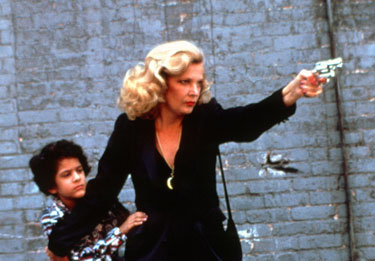
One of the few aspects of Cassavetes’ films that kept his work from falling into self-indulgent tripe was his muse and wife, Gena Rowlands. Rowlands regularly grounds the films she appears in with performances that challenge typical ideas about women. She’s just one of those actresses that its a joy to sit back and watch work. And here, in Gloria, she was given a larger commercial venue to display her skill. And it was thanks to Rowlands that Cassavetes directed this film in the first place. Cassavetes has originally just written the screenplay and sold it to Columbia Pictures, after which Rowlands was cast in the lead. She highly recommended her husband to direct his own script and he was hired.

The story follows the titular Gloria (Rowlands), a woman who grew up around mob types and has the hard exterior to match. She ends up in the custody of young boy (Adames) whose mob accountant father and family are murdered. Gloria uses her mob connections to try and negotiate she and the boy’s freedom from the endless pursuits. Along the way, Gloria clashes with her young charge, leaves him to fend for himself, but eventually chases back after him. Like the majority of Cassavetes’ movies, this is about a character, not necessarily the plot.

Unlike most of Cassavetes movies, this doesn’t have the ploddingly dull feel to it. The pace is very well done and some thing is always happening. Add to that Rowlands, who gives great performances every time and you have a film that actually had a bit of a commercial life. In fact, the premise of this film would be the basis for Luc Besson’s Leon about a decade later.What enjoyed most about this picture was, how the premise could easily have been maudlin crap, but Rowlands never lets her character fall for any “maternal instinct” nonsense. She has enjoyed a life unmarried without a children, and just because she is with this young boy she isn’t going to start treating him like her son. Even in the film’s conclusion we’re shown that she will not change who she is and is going to talk to this child like an adult.

Next up: Love Streams