The Childhood of a Leader (2016, dir. Brady Corbet)

priests-childhood-leader

By the final dizzying moments of The Childhood of a Leader, I was completely overwhelmed in a satisfying way. The film takes place in the temporary rural home of an American diplomat stationed in the French countryside at the close of World War I. His wife and child, Prescott, waste away the days with French lessons, performances at the local church, and malaise. Prescott has a series of tantrums with the film structuring this three fits as its chapters, with an epilogue that brings everything together decades later.

The film is the directorial debut of longtime child and indie actor, Brady Corbet. It is very apparent that Corbet’s work under directors like Michael Haneke and Olivier Assayas has been a masterclass in filmmaking. This is one of the strongest debut films I’ve ever seen. The cinematography is astounding, the performances are subtle but carry much weight, and every single aspect of the film is crafted with care. Add to this the nerve shattering score by veteran composer Scott Walker and you have a film that brings together a number of genres but defies to be defined by any of them. This is a horror film set in an alternate history of our world…or is it the mix of the real and the deluded visions of a troubled young boy?

It’s hard to pin down The Childhood of a Leader. The film keeps itself enigmatic to encourage the viewer to explore and think about what’s happening on screen. The two ways I saw to read the film during this viewing were as the literal story of a young boy at the center of world history who would rise to power one day. There’s also the idea that we’re dealing metaphor. The American Father, The French Mother, The English Reporter. All three seem oblivious to this ranting, tantrum-ing, seething child until it’s too late. With each tantrum, he increases his hostility and potential to do harm to those around him.

From the opening moments of the film to its conclusion, there is an unsettling tension building. Walker’s score for the film plays a major role in building that, but its juxtaposition to the dim visuals on screen following Prescott from behind as he runs through the woods, roams the empty halls of his house or wanders naked into the middle of his father’s meeting with important policy makers is what keeps the film at the edge. We never descend into complete horror until the final moments, but every second up to that point is fraught with terror. Highly recommended and with much potential to reveal more with subsequent viewings.

Colonia (2015, dir. Florian Gallenberger)

colonia-toronto-film-festival1

Colonia is a film about a fictional people living through a real historical nightmare. In 1973, General Augusto Pinochet led a military coup in Chile and began detaining, torturing, and worse to people who had been loyalists to the deposed President Salvador Allende. Lena (Emma Watson) is a German flight attendant who is in a relationship with photographer and Allende activist, Daniel (Daniel Bruhl). Both end up taken away by Pinochet’s men and imprisoned at Colonia Dignidad, a work camp and cult run by lay preacher Paul Schäfer (Michael Nyqvist). They endure psychological and physical torture as they struggle to find a way out of this living hell.

I am always eager to learn more history about regions of the world I’m foggy on. There’s just so much and our experience in the United States is very narrow. Paul Schäfer was a truly horrible human being who ran Colonia Dignidad for decades before Pinochet was toppled and he was finally brought to justice. It was discovered that Schäfer had been molesting young boys put into his care at the work camp, which the film hints at. The other members of the colony had their connections to the outside world removed and were even drugged to remove their sexual drives.

Colonia is a film about a fascinating topic. But it is an incredible failure in presenting a consistent tone and focus. The story begins as a period piece with a romance overlain. It’s a little cliche at moments and I didn’t feel a lot of chemistry between the two leads. Not sure if it was the actors or the director, but it never feels believable. Then reality sets in hard with Pinochet’s coup and the film starts to take on a more serious focus on the weight of the history happening around the characters. The film appears to be retaining that tone as Lena and Daniel end up at Colonia. However, when Lena has some real moments of peril we have convenient moments of plot occur to spare her the brutality. Almost every character around her is brutalized to a horrific degree, but through sheer luck, she escapes it. The tone undercuts the film again in the third act as the story devolves into a pretty simple race against time, thriller.

The film never felt like it handled its source material with the weight it deserved and came across more like a Lifetime Channel film than something of substance. The film wants to be a romance, it wants to be a documentation of a historical atrocity, and it wants to be a political thriller. It ends up being none of these things and feels embarrassing in many moments. Nyqvist is the highlight as Schäfer but still could have benefited from more development. Colonia does inspire me to want to find a documentary on this subject because I know there is so much more to this very important story.

Mustang (2015, dir. Deniz Gamze Erguven)

mustang-2

While Mustang takes place in modern day Turkey it is a story that could happen at any time and almost any place. Five adolescent sisters suddenly have their lives changes when their guardians: their grandmother and uncle, decide they are becoming corrupted by secularism. They have everything that could provide them contact with the larger world taken away, from cell phones to laptops to clothes considered improper to makeup. They begin to seek out arranged marriages for the older girls and the imprisonment takes its toll on the girls.

Told from the perspective of the youngest, Lale, the film is made with a lot of confidence and skill. The camera is mostly handheld and conveys the youthful energy of its characters. Sunlight is also used quite effectively to act as a force that still connects the girls to the world. The subject matter could very easily lead to a bleak, hopeless film but director Erguven is able to sustain a sense of hope at the end of this nightmare. Each of the girls experiences the loss of their freedom in different and interesting ways.

When questioned on her wedding night on why she didn’t bleed after sex with her husband, the eldest sister finds it easier to just confess to having slept around with boys when no one listens to her explain she was a virgin. Another sister, seeing that an arranged marriage is inevitable, convinces her boyfriend to ask for her hand as a way to reclaim some of her freedom and choices. Choosing this story to be told through Lale’s eyes is perfect because it puts us at a disadvantage as it relates to the details. Like Lale, we have to try and figure out what is happening in the world as we go.

There have been some comparisons to the Sofia Coppola directed The Virgin Suicides, but beyond the very basics of the story, there is very little similarity. While The Virgin Suicides is told exclusively from the male perspective, Mustang a very intimate look at these young women’s lives. You gain a greater understanding of how each character is processing the experience rather than the broad strokes of Suicides.

The film must maintain a fine balance between the realism of its situation and refraining from despondency. There are moments in the latter half that are a shocking jolt in the midst of Lale’s dreams of escape. If there is a central message here it would be about the power of determination and will. Lale never resigns herself to the loss of her freedom. From the minute the girls are locked away, she is shaking the bars on windows, spying on locations of keys, and plotting an escape. The film has a quite a bit in common with films like The Shawshank Redemption and Escape from Alcatraz.

Filled with humor and joy, Mustang is a timeless story. It transcends any particular religious or geographic specifics and conveys an experience that is felt by women across the globe at varying levels of intensity. Societies seem to have a preoccupation with controlling the will of their female citizens, based on a fear of loss of control. Director Erguven states firmly that this type of energy is impossible to contain and through Lale she tells a story that gives hope to those who may feel like they have no more freedom.

TV Review – Orange is the New Black Season 4

Orange is the New Black: Season 4
Created by Jenji Kohan
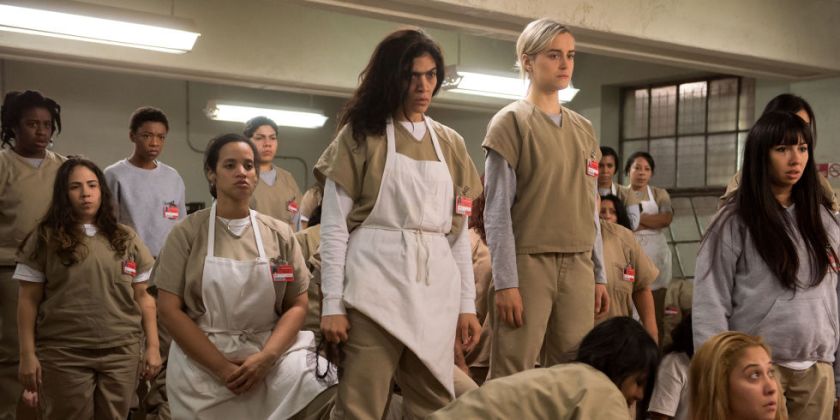
orange 01I have fully embraced the power of Netflix at this point. While I have not watched every original series they have released, I love the ones I have. When season one of Orange is the New Black came out I wasn’t very keyed up about it. The selling point at the time was “from the creator of Weeds” a series I didn’t find that interesting. I had watched the first two seasons of Weeds and it didn’t compel me to keep going. And I didn’t find Orange too intriguing in the first and second seasons mostly due to one character: Piper Chapman.

Piper Chapman. I get it. She’s meant to be an audience surrogate, the fish out of water through whom we will learn the ins and outs of Litchfield Prison. And this is no slight to actress Taylor Schilling, the character is grating. Even more grating than just Chapman is her relationship with Vause (Laura Prepon). I have never bought the thing these two have and the directions their plots have gone don’t help either. Is it bad that I have started the last two seasons hoping Chapman would get shivved at some point and then the series could just go on without her? She became more interesting separate from Vause and getting caught up in her panty-smuggling ring in Season 3. In Season 4 she continued to be interesting by having to deal with her inflated ego and the fallout of that attitude. But when the season concluded with she and Vause getting back together I had sigh annoyedly.

When Season 3 rolled around, something about the show just completely hooked me and reeled me in. I think the de-emphasis on Chapman’s character and the spreading out of storylines to the characters in the prison who are actually interesting. There’s no way I could say a single character stands out as my favorite because I am so happy when so many of them pop up on screen and we explore their lives. I love the friendships between characters: Taystee and Suzanne, Flaca and Ramos, Red and Nichols, Pennsatucky and Boo. In many ways, the reason I love Orange is because I love Lost. The moments when Lost really clicked for me was when it explored pairings of characters and how they played off each other and then, over time how those relationships evolved. Funny enough my least favorite character in Lost would probably be Jack for the same reasons I dislike Piper, main characters seem to start out as such bland ciphers.

Season 4 is probably my favorite run of Orange to date. I am excited to see where these characters go next and the season asked some very tough questions but didn’t feel the need to answer them. I love when a television show brings up complicated topics, creates difficult situations where there is no clear villain, and then lets the audience live in that space. Breaking Bad and Mad Men did this often and it is what made me love them, especially the latter. In real life there aren’t clear lines that define hero and villain, it’s more complicated. The conflict between Pennsatucky, Boo, and Donuts is a perfect example.

orange 02I genuinely believe that Donuts didn’t have bad intentions when he began his sexual encounters with Pennsatucky in Season 3, and I believe that at the start she was into him. But things became very complicated and messed up quickly. Donuts has a duty as a prison guard so their relationship should never have even gone to that place. In many ways, this relationship was offered as a counterpoint to Daya and Bennett, which I felt was a very dangerous portrayal. When one person has clear, direct authority over another there are clear lines that should not be crossed. So, on the one hand, I felt bad for Donuts, but I also totally sympathized with Boo’s stance on what had happened to her friend and knew she was right. It’s that sort of complicated writing that makes me love this show. It’s not going to answer the moral quandary, it’s going to pose the question.

Another thing Orange does so well is to rotate the spotlight on its cast, and it has an even larger and growing cast than Lost could have imagined. Season 4’s spotlight on Ruiz was very interesting and her evolution into a leader has me interested to see the fallout between her and Mendoza, the acting “mother” of the Latina group. The release of Diaz was one of those moments I hope we see more of in the next few seasons. A show set in a prison allows lots of flexibility from a casting perspective, prisoners can be released and new prisoners can be incarcerated. I do hope the show refrains from showing too much of life after prison on the outside. Keeping the focus on life on the inside is more important. Having moments where someone leaves and both the audience and characters know they will likely never see them again helps convey what these relationships are truly like. Prisoners bond with each other out of survival and need for companionship, but the system they are living in can pull these bonds apart at any moment.

I find Caputo is one of the most infuriatingly fascinating characters in the series. I can never exactly pin him down and that is what makes him so interesting. I believe he genuinely wants to do good, he has pure intentions, but he is so easily undone by crises. It reminds a lot of seeing upper-level leadership in teaching who deep down truly care about the students but get so tangled up in the absurdity of administrative policy and thinking they instead make destructive choices.

In that same vein is Healy, one of the most tragic figures in the series, and that is saying a lot. Here is another instance of Jenji Kohan and writing staff refusing to make someone an easy villain. Healy is both a victim of life and an abuser of his position of authority. He is what I wish Ben Linus had been able to be developed into on Lost. Someone who comes across as the obvious bad guy but as we peel back the layers becomes more and more broken and sad. Healy’s relationship with Lolly and it’s heartbreaking conclusion was one of those pinnacle moments in a season with so many great plots. My hope from a narrative and character point of view is that we just never see Healy again, maybe a short cameo in the final season by someone who gets released. The moment where he checks himself into the mental health facility is a perfect period on his story. He’s going to hopefully get the help he needs, but the audience, just like the inmates, will never know exactly where he vanished to.
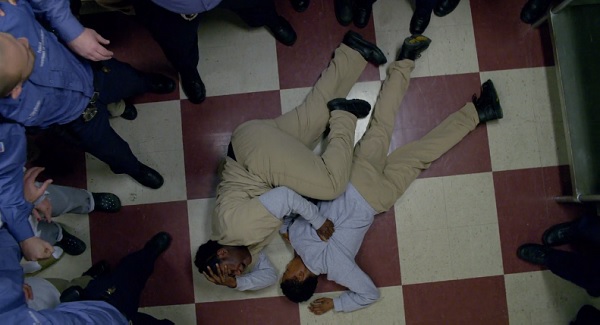
orange 03The moment everyone is going to remember of course will be the sudden death of Poussey. This was a very delicate moment and I think it was done in the right way. My only complaint was that a tragic ending for the character felt very telegraphed from about mid-season onwards. I suspected something would happen, I just didn’t know it would be so horrible. I’ve read a lot of criticism online about how the show dealt with Bayley, specifically that they made him too sympathetic. Much like I said earlier on how the show likes to raise difficult questions and present challenging situations, I believe that’s what this episode was about.

So often police brutality and murder is not the result of a malicious spirit but a frightened and improperly trained mindset. Bayley’s murder of Poussey was a result of leadership in the prison failing. Caputo kept leaving and not realizing things got worse when he did on top of Piscatella instituting a very cold, dispassionate policy of control in the prison. Add to that Suzanne’s trauma from being made to fight her ex by Humphreys and you had a confluence of people that could only end badly. If Bayley were a real person then I would expect he’d get charged with manslaughter, but he never wanted to kill Poussey. It’s a condemnation not of an individual but of corporations like MCC who cut corners on training and as a result, withdraw a sense of humanity from prisons. I think everyone’s grief and pain were touched on wonderfully and we saw the full spectrum of perspectives. What Bayley did was something we are all capable of, in a moment of extreme crisis if you can’t handle the pressure you can end up doing horrible things to another human being. You should be simultaneously held accountable to the full extent of the law but also shown compassion and love. Like a lot of the prisoners in Litchfield, Bayley had the worst day of his life and he’ll now pay for it. We could see that in the scene where he’s driven home by one of the army veteran guards and he looks genuinely broken when the man says he and Bayley are the same.

As a writer, it would have been extremely easy to make sadistic guard Humphreys the murderer. But that would not have had the emotional impact on the narrative that choosing Bayley did. Humphreys is easy to hate and he doesn’t challenge us. Including him as the focus of the final scene was a smart move. The dynamics in place bring up a lot of emotion. The audience truly hates Humphreys but does he deserve to die? Maybe you think he does. But Daya holding the gun not only gets her an extended sentence if she were to kill him she would also go to max and get life. She’ll never see her child on the outside if she does this. In the same way, Pennsatucky finds it in herself to forgive Donuts because *she* needs to do that, the audience has to find a way to let its hate go. Revenge killing a guard, even Humphreys, may satisfy a momentary emotional need for revenge but its long terms effects will be the destruction of Daya’s soul and her life. As in life, we don’t get to get back at those who have wronged us. Many times we don’t get proper justice is supposedly promised to us. What people have to do is find a way to forgive so that they can move on, so that they don’t have to live in that pain and hate for the rest of their lives.

I am very excited to see where Orange goes in its 5th season. I’d love for the opening to have let some time pass, to not show Daya or Humphreys right away. Slowly unfold those details, show the grieving process for Poussey continuing. Show Caputo facing the blame for what he is ultimately responsible for. Continue to tell these wonderful stories about these dynamic characters. And especially, I hope it continues to challenge the audience to think beyond black and white spectrums of morality, and be forced to face the fragile nuance of human existence.

Cinematic Immersion Tank #1: Martha Marcy May Marlene

Martha Marcy May Marlene (2011, dir. Sean Durkin)

Purchase Martha Marcy May Marlene on Blu-Ray
or Rent on Amazon Video

martha poster

This is my first stab at the Cinematic Immersion Tank, so I decided to go with doing a write up after each viewing. In future, I may do something more comprehensive, more of a critical analysis that isn’t as fragmented, but that would take a little more time. In the meantime, please watch Martha Marcy May Marlene *before* reading over this. I hope you find as much beauty and sadness as I did in this amazing film. My biggest take away from this film is the power of Elizabeth Olsen’s acting (she has some of the most powerful eyes) and the amazing supporting cast that surrounded her in this film. Every actor pulls so much depth out of their role.

Continue reading “Cinematic Immersion Tank #1: Martha Marcy May Marlene”

Anomalisa (2015, dir. Charlie Kaufman)

1401x788-068-ANOMALISA-008R

My first encounter with Charlie Kaufman, like most who know his work, came in the film Being John Malkovich. Kaufman wrote the screenplay and it was a truly off kilter, intriguing film. It seemed that more of his work came in quick succession via Human Nature, Adaptation, Confessions of a Dangerous Mind, and Eternal Sunshine of the Spotless Mind. After a brief lull he released his directorial debut: Synecdoche, New York. And now is his strangest visual work, Anomalisa.

Anomalisa is the story of Michael Stone (the voice of David Thewlis), the author of books on effective customer service. He’s come to Cincinnati, Ohio to promote his latest book at some sort of convention (the film keeps those details vague). Michael has a problem when it comes to other people, something I won’t spoil here, that causes him to never fully connect or interact in a meaningful way. He eventually meets Lisa (the voice of Jennifer Jason Leigh) and he begins to think things are turning around for him.

Like all of Kaufman’s work, this film has already burrowed itself into my mind and I know it will stay with me for a long time. His greatest talent is his ability to mine such unpleasant and neurotic landscape of our psyche in ways that make it difficult to look away. Synecdoche examined a man’s yearning to find a deeper connection with others, but Michael doesn’t seem to desire a means to overcome his personal issues. He wants the connection, he knows vaguely what is wrong with him, but he inevitably gives up. Everyone around Michael is very pleasant, even when they get angry they sound soothing. This lack of emotion seems drive Michael deeper into need to be separate, while frustratingly want to communicate. It is intentional that the only scenes in the film that don’t have an annoying level of background noise are when Michael escapes to his hotel room.

The choice to make Anomalisa a stop motion animated film might seem like a bit of visual vanity if you’ve just seen the trailers. The filmmakers strive for realism out of the characters, which they truly achieve. It is the context of Michael’s disorder when he views others that makes the animated elements essential. There is no way the film could have been done in live action and get across the alienation that the animation choices provide. A crucial scene between Michael and Lisa in the film’s third act is the ultimate realization of why stop motion was essential to the film.

This is not a “fun” movie to watch, much of Kaufman’s work is not. There was a backlash as the film made its way through the film festival circuit about the unsavory aspects of the Michael character and speculation as to what moral judgments Kaufman was attempting to convey. In my own viewing, I never felt that it was communicated to the audience that Michael was a positive character and I do not believe Kaufman was attempting to make him sympathetic. The director simply wanted to make him a “true” character. What Michael does is what hundreds if not thousands of despondent, aimless, middle aged men do every day. It doesn’t make them right, but the film is not intending to promote an idealized view of the world. At it’s core, this is anti-indie film. When you look at works that exemplify the “Manic Pixie Dream Girl” genre you find an absence of real emotion. Kaufman’s response in Anomalisa is to show the truth of those scenarios playing themselves out. Your life will not be saved through a fateful meeting with a spirited young woman who will awaken something in you. Young women are not thresholds through which middle aged men pass to rediscover themselves.

If you allow yourself to view Anomalisa on Kaufman’s terms you will end up with a film experience that will not leave you easily. If you are uncomfortable, then that is good because that was the intent of the film. Anomalisa is about the narcissistic malaise most privileged people find themselves in after achieving a certain level of success. It is about the struggle humanity continually has in forging real connections with others that don’t focus on what emotional energy you can take from them.

Tom at the Farm (2015, dir. Xavier Dolan)

xavier-dolan

Frenetic strings screaming. The sound of cornstalks furiously rustling. The blur of figure bursting through them. He enters a clearing in the field. We cut to a tight shot of his face. His bleach blond hair is a tangled mess. A thin line of blood travels from the corner of his lip diagonally down to his chin. He is suddenly thrown to the ground by a man exploding from the corn.

This sort of explosive moment is what Tom at the Farm is all about. It spend the majority of its run time letting tension crank up until the rope is tightly wound. When the tension is allowed to release we’re met with moments of raw brutality that are confusing and upsetting.

Brought to us by Quebecois director, Xavier Dolan, Tom at the Farm follows a young man (Dolan as the lead) as he journeys into the Canadian version of the Midwest. He’s headed there to attend the funeral of his boyfriend, Guillaume. Upon arrival, he quickly learns that Guillaume was keeping a lot of secrets from him and his own family. He meets Agathe, the matriarch, who was lied to about her youngest having a fiance and Francis, the psychotic older brother who believes he can beat Tom into submission about keeping these lies going.

The first time Francis assaults Tom it is shocking and unexpected. But as their aggressive relationship continues it begins to take on a twisted psychosexual tone. At moments, Tom seems to become submissive and seeks out this continued violent treatment from Francis. And even Francis seems to desire Tom despite his protestations. When Tom finally attempts to leave he finds his car dismantled in the barn, stranding him in this desolate farm country. However, he finds himself comforted by the pastoral lifestyle, helping the birth of a calf, and then finding a moment to break down with emotion of what he participated in. In the midst of this tense psychological battle, Tom and Francis end up in an embrace after the latter reveals he took ballroom dancing lessons for a long lost ex.

The tone of the film is balanced somewhere between a lesser Hitchcock picture and The Talented Mr. Ripley. As the film nears its conclusion we discover a secret about Francis that illuminates his virulent anger and rage over Guillaume’s sexuality. The final shot of the film lets up contemplate the consequences of a moment when that rage overflowed. We don’t know what Tom believes about this revelation but we know it will inevitably shake up his world. While as unreal and absurd as the choices are that Tom makes when we, the audience, are likely shouting at him to just leave, these quiet final moments bring the film back to some semblance of a grounded reality.

Movie Review: Drive

Drive (2011, dir. Nicholas Winding Refn)
Starring Ryan Gosling, Cary Mulligan, Albert Brooks, Ron Perlman, Bryan Cranston, Christina Hendricks

There is a sort of anti-hero, noted in films like Jean-Pierre Melville’s Le Samourai or Sergio Leone’s Once Upon a Time in the West, who is the epitome of the strong silent type. So too in Nicholas Winding Refn’s Drive, we have the hero who chooses to act, rather than speak. Its also a role that matches so perfectly with its star, Ryan Gosling, its hard to imagine anyone else playing the part (Hugh Jackman was attached for a time). Drive is a deceptive film in its public perception, having been marketed as a Fast & The Furious analogue, though it is anything but. Drive is a methodical, existential, and ultimately pop 80s movie.

Continue reading “Movie Review: Drive”

Film Review – Submarine

Submarine (2010, dir. Richard Ayoade)
Starring Craig Roberts, Yasmin Page, Noah Taylor, Sally Hawkins, Paddy Considine

The directorial debut of British comedic actor Richard Ayoade has drawn unfair criticism for “being too much like Rushmore or Amelie”. Its easy to see how you could mistake this film for something like that, but after viewing the film it becomes apparent Ayoade has made an homage to French New Wave cinema. Ayoade takes those hipster affectations he’d being excused of exploiting, and actually frames them in a poignant look at the hyper-urgency of the adolescent mind.

Continue reading “Film Review – Submarine”

Film Review – The Tree of Life

The Tree of Life (2011, dir. Terence Malick)
Starring Brad Pitt, Jessica Chastain, Hunter McCracken, Sean Penn

“A film is – or should be – more like music than like fiction. It should be a progression of moods and feelings. The theme, what’s behind the emotion, the meaning, all that comes later.” – Stanley Kubrick

In the first hour of Terence Malick’s The Tree of Life we see the Big Bang, the formation of galaxies, the violent volcanic upheavals of land masses on a young earth, and the evolution of animal life. This massively cosmic scope is sandwiched in the middle of an equally intimate examination of a young boy in smalltown Texas during the 1950s. Malick presents all of this in the form of a prayer, beginning with The Mother (Chastain), a red-haired aging woman who receives a letter that her son has died overseas in the Vietnam War. She must relay this news to The Father (Pitt) and the entire scene is done with as a little dialogue as possible. We also have the surviving eldest son, Jack (Penn), in present day still struggling with childhood anger towards his father and the loss of his brother. All of these plot pieces are purely interpretive though. What I stated in the most obvious, traditional narrative way of describing the film, but much more in happening underneath it all.

Continue reading “Film Review – The Tree of Life”