Director in Focus: John Sayles – Passion Fish


Passion Fish (1992, dir. John Sayles)
Starring Mary McDonnell, Alfre Woodard, David Strathairn, Vondie Curtis-Hall, Angela Bassett, Nora Dunn, Sheila Kelly

John Sayles makes films that are a bizarre phenomenon amidst Hollywood culture. His characters are all adults, usually in their late 30s, early 40s. They actually behave like adults. The conflict in these films is muted and commonly unresolved. It’s no wonder he is forced to make films independently. This particular film features the “umarketable” combo of two women in their late 30s and a conflict that is never truly resolved.

May-Alice (McDonnell) is a soap actress paralyzed from the waist down after a car accident. This is the last in a series of disappointments that sends the obstinate woman back to her family home on the Gulf in Louisiana. She goes through a series of in-home caregivers that are driven away by her temper, until she meets Chantelle (Woodard). The two women bond after Chantelle shows May-Alice she’s going to make her work to rehabilitate her body. Each woman learns about the other’s past and through these revelations they grow closer and learn to put down their aggressive facades.

This could have been a very overwrought melodrama, but Sayles is able to make very fleshed out, three dimensional characters. The friends and uncle of May-Alice who come to visit feel very unique in this world. The love interests of both characters feel very real as well, despite not having all that much screen time. Each of these characters feels like they could support a feature, or at least a short, of their own. And May-Alice plays a different role with each person, revealing that the only time she isn’t acting is when it is just she and Chantelle.

This is not a film for the CG driven and big explosion crowd. If you are looking for a thoughtful film about something, and a film that really highlights strong female acting, then I would definitely recommend you pick this up.

Some final thoughts about John Sayles: Sayles is most definitely an independent spirit. His films are not the kind Hollywood would ever think to make, and its a good thing he is there to make them. I can see how his style of muted filmmaking has influenced a lot of similar indie filmmakers today. He never felt a need to be too stylistic with his camera, preferring to make it clean and crisp, while focusing on fleshed out characters who are real people.

Films I watched by this director: Lone Star, Matewan, Men With Guns, Silver City, and Passion Fish

Maybe Sundays – Blind Date (2007)


Blind Date (2007, dir. Stanley Tucci)
Starring Stanley Tucci, Patricia Clarkson

Navigating the waters of a relationship, especially one that has gone on for decades is a dangerous and fragile thing. It is almost instinctual on many people’s part to use the vulnerabilities of their mates in verbal combat, attempting to make painful digs. External circumstances can also damage both parties in a way that makes their relationship irreparable. This very quiet, simple film examines those moments of conflict by combining emotional realism but aesthetic surreality.

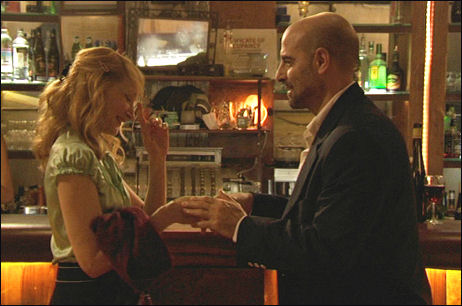
Don (Tucci) works in a bar/theater where he performs an intentionally bad magic act. He will regularly place and respond to singles ads in the newspaper, placed by he and his wife Janna (Clarkson) as part of a strange game they play. They always meet at the theater, where their ads have determined what roles they will play. In a few strange episodes, they play psychiatrist to each other. These meetings are revealed as ritual torture around the half way point when a tragedy is revealed as the reason why they do this back-and-forth routine. The rendezvous typically end in frustration on the part of Janna, unable to forget the pain that birthed this dance.

Despite the complex ideas and concept the film is very rough. The surreality of the setting the repetition, which on one hand is crucial to telling this story, feels tedious and the momentum of the film suffers. The acting is amazing, I wouldn’t expect less from these performers though. The film is part of a series which works to release English language remakes of Dutch filmmaker Theo van Gogh’s work. Van Gogh was murdered by an Islamic extremist in 2004 after releasing a film highly critical of the Islamic community’s treatment of women. Despite the flaws in this remake, it does have me interested in seeing the original and the rest of van Gogh’s work.

Jolly Good Thursdays – Son of Rambow


Son of Rambow (2007, dir.Garth Jennings)
Starring Bil Milner, Will Poulter, Jessica Hynes, Jules Sitruk

I can remember watching Ghostbusters (not the first time, probably the tenth) when I was seven, and afterwards taking an old backpack, a paper towel cardboard tube, and attaching the two with a long piece of a yarn. A shoebox with another piece of yarn attached served as my “ghost trap”. I was always doing these things as a kid. Not having the latest action figures of my favorite comic book or Saturday morning cartoon characters, I would draw and cut out figurines on paper to play with. My desire to tell stories was stronger than the limitations of economy. This is the same love of stories, and being forced to go low tech that informs Garth Jennings’ Son of Rambow.

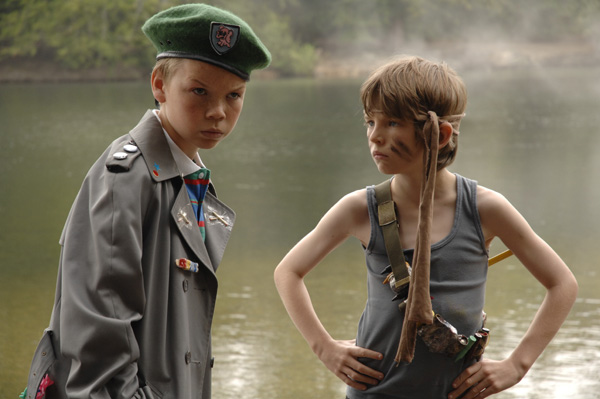
Living in the 1980s, young Wil Proudfoot is the son of a woman involved in a Mennonite-like religious sect. As a result, he is not allowed to view films or television, but has a strong sense of creativity, drawing intricate worlds on the pages of his Bible. Lee is the son of an absent mother, growing up in a nursing home owned by his step-dad, and has an older brother who forces Lee to bootleg movies for him to sell on the street. Lee and Wil meet each other during an incident at school and Wil follows Lee home and glimpses his first film ever: First Blood (the first Rambo film). Wil is smitten with the film and immediately sets about storyboarding his own sequel, Son of Rambow, which he and Lee decide to film together.

Jennings is a well known music video director (he’s worked with Blur and Radiohead) and is best known in film for his adaptation of The Hitchhiker’s Guide to the Galaxy. That less-than-stellar flick bears some similarities in its quality to Son of Rambow. Rambow starts out with a crackling sense of excitement and possibility. Wil’s fantasy sequence right after seeing the film is brilliance; done in line drawings on paper and with the slashing speed lines that accompanies such artwork. There’s some great meta-textual commentary on filmmaking as well. As more kids find out about the production, and particularity with the involvement of hip French exchange student, Lee’s vision as director is co-oped. A brilliant scene where Wil is admitted into the upper upperclassmen’s lounge, which parodies the sort of upscaled celeb parties one would encounter in Hollywood (Coke and pop rocks are used to substitute alcohol and cocaine).

The flick is definitely worth a view, but wans near the end as it tries to make a “lesson” of the story. I would have enjoyed the sense of playfulness at the beginning to continue throughout. It was also wonderful to see Jessica Hynes, best known for co-starring with Simon Pegg in Spaced. If you get the chance, and were a kid who loved to imagine, check this one out.

Newbie Wednesday – Brothers


Brothers (2009, dir. Jim Sheridan)
Starring Tobey Maguire, Natalie Portman, Jake Gyllenhaal, Sam Shepherd, Mare Winningham, Bailee Madison

“Support the troops”. Its a slogan we hear time and time again. Yet, no matter how many yellow ribbons we put up or bumper stickers we slap on our cars, there is a severe situation involving soldiers coming home with Post-Traumatic Stress Syndrome. While Brothers addresses this, it fails to create compelling characters and ultimately comes off as preachy, rather than significant.

Capt. Sam Cahill (Maguire) is preparing to ship off to Iraq, and the day before his little brother Tommy (Gyllenhaal) is being released from prison. Cahill leaves Grace (Portman), his wife and two daughters behind and ends up being declared KIA. While, Grace deals with the loss with the help of Tommy, Sam is actually alive and well, being held by Sunni extremists along with a private in his unit. Sam is put under severe torture and starvation and made to commit horrible acts. Tommy finds himself drawn closer to Grace but the two fight their urges to give in. Eventually, Sam is coming home and there will be a falling out.

The film is slow, but that is not a bad thing. The plot involving Sam is very interesting and were the moments of the film I paid attention to the most. The Grace/Tommy story is where the film drags. There is really no chemistry between the two so the hints that they might end up together feels incredibly forced. The relationship is so muted to the point of feeling like a way to kill time till Sam returns home. The most compelling interactions are between Tommy and his father (Sam Shepherd). It seems their father dealt with PTSD upon returning from Vietnam and drowned it alcohol, eventually taking it out on the kids. Tommy ends up being the black sheep of the family, and Sam enlists in the Marines because of his idolization of his father.

The picture ends on a very melodramatic note, though its last 20 minutes are its best. The top performance comes from 11 year old Bailee Madison, who plays Isabella, Sam and Grace’s daughter. She very natural and composed for her age, and is a key part of the conflict in the film. Overall, a decent picture but this director has made much much better films.

Director in Focus: John Sayles – Silver City


Silver City (2004, dir. John Sayles)
Starring Chris Cooper, Richard Dreyfus, Danny Huston, Mary Kay Place, Tim Roth, Thora Birch, Maria Bello, Miguel Ferrer, Billy Zane, Michael Murphy, Kris Kristofferson, Daryl Hannah

John Sayles is not shy about his politics, and this film is definitely the work of a bleeding heart liberal. I myself am a fellow bleeding heart so I sympathize with the sentiments of the picture. However, it is a piece of cinema made out of anger and frustration and, while those elements have helped make great art, they cause Silver City to feel overly bitter and despondent, and way too didactic.

The movie opens on the filming a campaign commercial for gubernatorial hopeful Dickie Pilager (Cooper), the dim-witted son of a former governor of Colorado now believing he can win the seat. Sound familiar? Cooper’s performance, obviously modeled on President George W. Bush was very well done and, as much as I like Josh Brolin, made me wish we could have seen Cooper in Oliver Stone’s W.  During the filming of this commercial, as Pilager casts a rod into the crystalline lake in the frame, he pulls up a hand belonging to a body left in the water. Immediately, Pilager’s campaign manager (Dreyfus) thinks someone is setting Pilager up and hires a detective agency to investigate. The investigator is Danny O’Brien (Huston), a former news reporter who is less than enthusiastic at first. As he journeys deeper he becomes obsessed with Pilager’s connection to a multi-corporate mogul Wes Benteen (Kristoffersen).

On paper, this sounds like a great concept. But it fails, and it fails badly. Huston is completely unnatural in the leading role, proving to me he needs to keep to the supporting ones. I can’t figure out if it was the dialogue or actor, but he comes incredibly stiff and forced in his performance. And with Danny O’Brien as the character we are following, it makes the film that much more painful to get through. Cooper and Dreyfus deliver great performances, but aren’t in enough of the movie to make it work. I would have preferred that it had focused on the Pilager character’s campaign more and been a satire of President Bush. Instead, we get a poorly made activist film where metaphors are incredibly shallow.

The film made me feel very conflicted, as every political note it touches I am right there in support of. But it proves that when views are expressed too overtly they bog a film down. The film takes it self too seriously for the majority of the time, and when it does attempt to go light, such as when Daryl Hannah’s tough hippie character is introduced, the humor feels hollow and tainted by Sayles bitterness. Not the best work of this director; he CAN make great films about his political views (Matewan for example).

Next up: Sunshine State and my final thoughts on John Sayles.

Cinematic Television – The Dramas

While I have not yet seen The Wire, I know that so many people view it as the epitome of great television drama. I plan on watching it one day, and I see it as one of those great works of literature that I want to find the perfect time for fully absorbing it. That said, these are some other great dramas on the tube right now.


Mad Men (2007 – present, created by Matthew Weiner)
Starring Jon Hamm, Elizabeth Mitchell, January Jones, John Slattery, Christina Hendricks, Vincent Kartheiser, Bryan Batt, Aaron Staton, Michael Gladis, Rich Sommer, Robert Morse, Kiernan Shipka

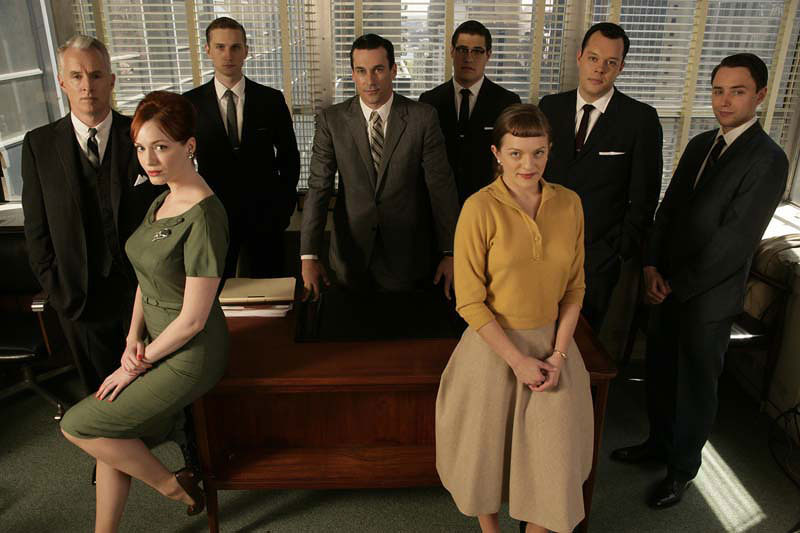
Mad Men is a series that hinges completely on a contemporary audiences knowledge of their society, so that they may contrast it with irony of early 1960s American culture. The focal point of the show is Madison Avenue ad exec Don Draper, played with calm and cool ease by Jon Hamm. Draper is man with a very distinct set of personal moral beliefs. Sleeping around on his wife isn’t a huge deal, and when she seeks psychiatric help, making regular calls to the shrink for a report on what his wife has said is never a violation of her privacy, its his right as a husband. The male-dominated culture around him doesn’t work to convince him otherwise though. But Draper is an imposter in this world, through out all of the three seasons which have aired he comes up against a fear of his past being exposed.

As foils to Don, we’re given three other characters: Peggy Olson, Betty Draper, and Pete Campbell. Each is in a place where they are unsure of their identity. Peggy is girl from Brooklyn who starts out as Don’s secretary, but finds herself moving up the ladder of power in the office incredibly quickly. Betty, Don’s wife, is not content at playing house after living as a model in Europe before she met Don. Her transformation over the three season has been the most dramatic and it is hard to predict where her character will go.

Pete is the most direct parallel to Don, a salesman at the Sterling/Cooper ad agency, he is from a family that expected more “respectable” work out of him and are completely opposed to supporting his life. Pete is newly married and seems at times disinterested in his bride, and other completely devoted to her. While Don seems representative of the Old Way, Pete is our manifestation of new ideas coming into society. Pete is confused when, after crunching the numbers and discovering the black community is buying a client’s brand of television more than the white, the client rejects his ideas to directly market to that minority. He sees it as both socially and economically ignorant.

The series is respectful of its adult audience. There’s little chance adolescents will enjoy the series, and the writers believe that the grown ups watching don’t need every emotion and thought telegraphed through blunt dialogue. There are long moments of silence in the series, where the only information we receive is through a simple look of Don’s, or the frustrated body language of Betty. This complete rejection of dumbed down television is an oasis in the desert. It makes each and every episode come across as highly cinematic and important.

Breaking Bad (2007 – present, created by Vince Gilligan)
Starring Bryan Cranston, Aaron Paul, Anna Gunn, Dean Norris, Betsy Brandt, RJ Mitte, Bob Odenkirk

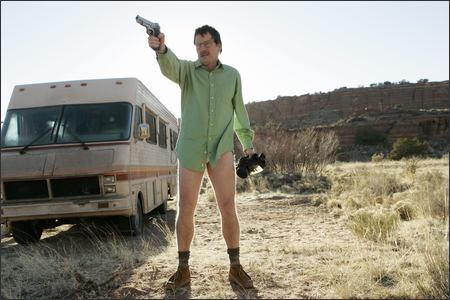
If you are only familiar with Bryan Cranston through his work as the befuddled father on Malcolm in the Middle you will be in for a shock. The same frenetic energy that informed Hal on the Fox sitcom, if filtered through a simmering boil in Breaking Bad. Cranston plays Walter White, a high school chemistry teacher who works part-time at a car wash to pay the bills. He has a teenaged son with cerebral palsy and a baby daughter on the way. One day, he collapses at work and learns he has terminal lung cancer. Walter keeps this a secret from his family and decides on a whim to join his DEA brother in law as a ride along on a meth lab raid. One of his students ends up being the meth cook who escapes from the raid and Walter tracks him down with a proposition: they work together to make and sell as much meth as possible. Walter reasons this will get him enough money for some experimental cancer treatment and, if he does die, provide his wife with a major financial cushion. Thus begins Walter White’s descent into Hell.

For the first half of the first season, Walter is unsure of himself. He is confident in the lab and he knows how to cook meth of a quality his partner, Jesse, and the DEA have never seen before. It’s not till the second half of the first season that Walter explodes. A mix of chemo therapy and the impending concept of his own death pounding in his skull forces the meek man to become a force of violence. This doesn’t come without a cost though, as strong as his newly found fury may be, he is also ignorant of the inner workings of the big money trade. Walter inevitably draws the attention of the wrong people and ends up in multiple circumstances where he is close to being murdered.

While Walter is descending, his young partner, Jesse is trying to emerge from the drug fueled mire he has sunken into. At one point, he tries to reconnect with his family, whom roundly reject him. Jesse has a brief foray into a rehabilitated life, but is pulled back down by Walter. A palpable sense of tragedy surrounds the young man and its becoming apparent the weight that won’t let him live his life is our protagonist. The place the second season ends leaves both characters in an unknown place. They are burdened by a massive loss of life that is the result of their actions; Walter has come out on top though, and Jesse, once again is left with the bloodied hands. Where these characters go to next is going to be a fascinating journey.
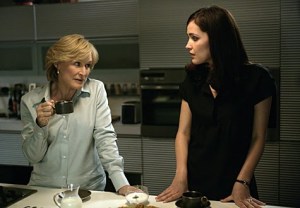


Damages (2007 – present, created by Daniel Zelman, Glenn Kessler, Todd A. Kessler)
Starring Rose Byrne, Glenn Close, Tate Donovan
Featuring Ted Danson, Zeljko Ivanek, William Hurt, Marcia Gay Harden, Timothy Olyphant, Campbell Scott, Martin Short, Lily Tomlin, Keith Carradine

Damages starts with the typical prime time drama setting, a law office. But that is where the similarities with your typical law drama end. Borrowing a device from Lost, flash-forwards, Damages allows us to glimpse pieces of the end of season while going back to the beginning and moving forward from there. The series follows law school graduate Ellen Parsons, who is hired at Hewes & Associates, to work underneath infamous lawyer Patty Hewes. Hewes’ focus is primarily in cases against large corporations, on the part of citizens harmed by them. While her goals are admirable, Patty has a “by any means necessary” approaching to getting her way. She lies, cheats, steals, and even hires people to kill those who are getting in her way.

Each season focuses on a single case, allowing it to be played out in great detail and devoting an equal amount of time to the defense. Much like Law & Order, the cases draw on real life events, but because they are for such larger stakes it only makes sense that it take 13 episodes for them to play out. Season One featured an Enron type case, wherein billionaire Arthur Frobisher convinced his employees to invest in company stock, only to defraud them and abscond with their life savings. Season Two is a more generic environmental case, where an energy company is knowingly withholding data that proves their practices have caused harm to the population. And in the current season, the series is tackling a Bernie Madoff parallel with an incredibly stellar guest cast. If you enjoy typical law dramas, but want something with more continuity and depth then definitely give Damages a shot.

Next: Science Fiction & Fantasy

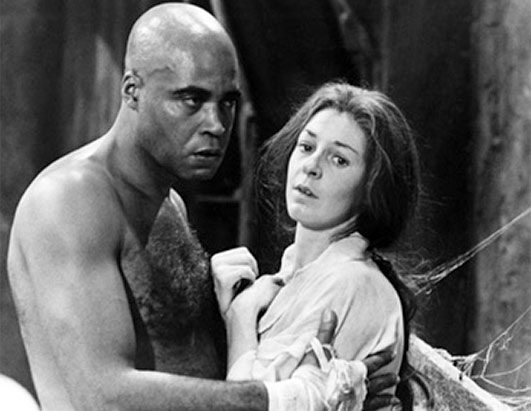
Seventies Saturdays – The Great White Hope

The Great White Hope (1970, dir. Martin Ritt)
Starring James Earl Jones, Jane Alexander, Lou Gilbert, Joey Fluellen

Based on the Pulitzer Prize winning play, The Great White Hope is a “names changed” version of the career of Jack Johnson, an African-American boxer during the early 20th century. Johnson was the first black heavyweight boxing champion and was known for patiently waiting for his opponent to slip up, then barraging him with a series of incapacitating blows. Johnson was a figure of great controversy, not just because he was a threat to the white male ego in the boxing ring, but because all of the women he became seriously involved with were white. Johnson showed little sense of humility about his dealings and was one of the first public figures to really use controversy as a way to promote his own celebrity.

In the film, Jack Jefferson (Jones) has just defeated the heavyweight champion and is celebrating this achievement with much bravado. The African-American community is divided about Jefferson though. While those around him immediately after the fight revel with him and dance in the streets, there are others who see Jefferson has creating negative image for their people because of his brazeness. Another group see Jefferson as being nothing but an “uncle tom” by consorting with white women and embracing what they see as a white way of life. Jefferson has an interesting take on all of this. In a scene early on, after he is weighed in before the big bout, an older black gentleman mentions that the young men will be inspired and “proud to be colored” when Jefferson wins. The boxer replies that they should already be proud and his winning or losing should have nothing to do with it. An interesting idea when thinking about the role of athletes as “role models” in contemporary society.

Jefferson and his fiancee, Eleanor’s relationship is played very well, but we don’t get enough background to understand how they came together. They are very much in love, but we’re never shown how, despite the social stigma of their relationship, they would defy it and stay together. The film also has some problems with how broadly a lot of characters are played. The white establishment villains literally “bwahahaha” at one point in the final scenes, and it would have been interesting to see them played with more internal conflict. Jane Alexander’s performance as Eleanor is also ruined by the pointless turn her character is forced to take, mainly to serve as momentum to move Jefferson forward to the finale. The one standout performance is James Earl Jones as Jefferson; he plays the character as incredibly multi-layered. Jefferson is charming and intelligent, but also selfish and arrogant. He loves Eleanor deeply but is resentful when he realizes she’ll never understand the limitations put on him.

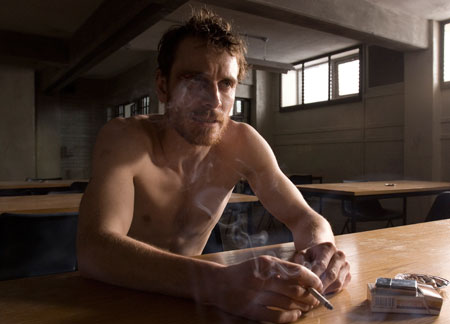
Wild Card Tuesday – Hunger


Hunger (2008, dir. Steve McQueen)

Starring Michael Fassbender, Liam Cunningham
The fight between Catholic and Protestant sides in Northern Ireland has devastated that country since the late 1960s. Each side has visited monolithic brutality on the other in of the greatest displays of community inflicting such cruelty on itself. But the cruelty that was the worst, was that of employees of the British empire on IRA members imprisoned in facilities across the country. Director Steve McQueen never give support for the terrorist actions of the IRA, but advocates that all prisoners, regardless of their crimes, deserve humane treatment.
The film’s focus is real life IRA soldier Bobby Sands (Fassbender). While the film doesn’t explicitly cover his activities with the IRA, he was no saint. He helped ferry weapons for the movement and was involved in the bombing of a furniture store in 1976. The film chooses to portray Sands as a figure unwilling to budge an inch for the brutal authority crashing down around his head. In this effort he has allowed himself to become dehumanized. Simply put, he has been caged and treated like an animal, so he will behave like one. Sands smears the walls of his cell with his own feces, allows the daily meals to rot and mold in a corner, and funnels his bed pan (synchronized with the other prisoners) out into the hallway. Is it vile? Yes. But there something innate within us that despise authority that wishes to break us, so it comes off as bizarrely admirable.
Bobby’s most memorable, and final, triumph came when he began a hunger strike in 1981 which took his life after several painful months of starvation. Michael Fassbender destroyed his body through malnutrition to take on the gaunt, sunken appearance of a Holocaust victim. He become the specter of death with additional help from an incredibly talented makeup department. His back is covered in open sores, he’s unable to urinate for the prison doctor’s physical, and he stains his sheets with black, acrid blood. The moments before Sands passes are truly powerful. The film moves into his consciousness as hallucinations of his younger self appear and his mind travels back to long distance race where he and both Prot and Catholic youths ran together, in fields of golden amber. Director McQueen doesn’t want you to take the IRA’s side, he wants you to realize how irrelevant any side is, and simply see a man dying.
The aesthetic choice made by McQueen are magnificent. For the first 30 minutes of the film there is little or no dialogue. Only 50 minutes in is there an actual conversation between two people for extended amount of time. Here Sands and a priest from his community debate the point of standing in defiance of authority. The priest tells Sands he must submit to the uniform being enforced on the prisoners and Sands simply won’t budge. Once again, neither side wins in the debate. They simply come to the conclusion that neither of them will change their ideas about it. Hunger is one of the best examples of director using the language of cinema to tell a visceral and moving story. There is no maudlin sentimentality, yet there is a deep emotional core. Not for those lacking a strong constitution, but one of the most amazing British films I’ve ever seen.

Seventies Saturdays – Johnny Got His Gun


Johnny Got His Gun (1971, dir. Dalton Trumbo)

Starring Timothy Bottoms, Jason Robards, Donald Sutherland
Here we have a film directed by the author of the novel on which is based. This author, Dalton Trumbo was investigated by the FBI as a result of the novel’s publication, and later blacklisted during the McCarthy Communist witch hunt. While blacklisted, he was given his widest recognition as the screenwriter of Stanley Kubrick’s Spartacus. And it was during the twilight of the Vietnam War he decided to adapt his controversial novel. While on the surface, the film is condemnation of war by how it treats the men on the frontlines, Trumbo is expanding his theme to comment on the fragility of life and man’s right to die with dignity.
Joe Bonham (Bottoms) is introduced as a body under a sheet. He’s not dead, but was shredded by shrapnel from a mortar shell fired on the last day of World War I. The doctors maintain an unrealistically upbeat outlook and have Joe put in a utility room so as not to upset the other wounded men. We learn who Joe is through the meanderings of his consciousness now in this eternally paralyzed state. The horror of Joe’s condition is unfolded to us gradually: first they take his arms, then his legs, ultimately he learns his face has been scooped out. All that exists is a screaming mind in a paralyzed frame.
As Joe tries to make sense of this in his mind, he returns to moments with his late father (Robards) and consults with a Jesus of his own invention (Sutherland). His memories begin as real events in his past and morph into surreal fantasies about his loss. One of the most touching moments of the film comes early on. On Joe’s last night before shipping out, he and his teenaged girlfriend decide to have sex for the first time. This scene is played with such beauty and tenderness. Every nervous movement is captured perfectly, and the scene aches with a bittersweet sense of how these characters are experiencing such great joy, a joy that inevitably will die.
The genius of the film is that it never takes political sides. In essence, it truly supports the troops, because it is all about them. Joe is a child who was sent off by old men who use their children to fight wars. He did his duty and suffered great wounds. And now, with no future besides being a lump of meat locked in a closet, he is denied a basic right to have his life ended. Joe eventually figures out a means of communicating with those around him, only to find his new voice stifled and the realization that the people around Joe, because of their own fears of death, want to simply forget that he ever existed.

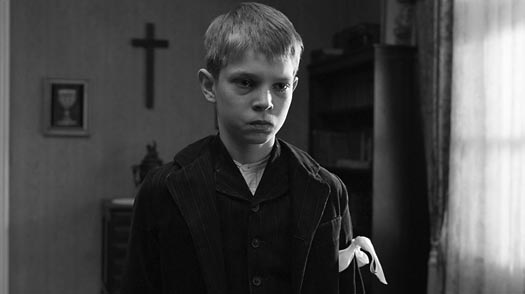
Import Fridays – The White Ribbon


The White Ribbon (2009, dir. Michael Haneke)

Cruel parents create cruel children. That is the moral of Austrian director Michael Haneke’s latest film, The White Ribbon. The object of the title is a device used as part of a technique implemented by the village minister to remind his children of purity. It’s no coincidence that children in a German village, whom will be adults when the rise of the Nazi party occurs, are shown wearing white armbands symbolizing purity. Haneke is not at work to simply tell the story of the psychological birth of the Nazi movement, rather he want to study and dissect what motivates terrorists and those who kill from a nationalist motivation.
In a small northern German village, about a year before World War I begins, a series of premeditated attacks occur. What sets things off is when the village doctor is thrown from his horse as the result of an near invisible wire strung across his property. Authorities find the wire vanishes over night and no one saw anybody tie it up there. The film is very fragmented and jumping from household to household, focusing on the interactions of parents and children. Like most Haneke films, he keeps things very ambiguous. He knows what to state outright and what to hint at.
Someone burns down a barn. A child is murdered. Another child is beaten severely and strung up in the town’s sawmill. I was reminded of Haneke’s 2005 picture, Cache, where the protagonist is presented with a mystery of someone filming the exterior of his flat for hours and hours, then mailing him the tape. Haneke cultivates mystery, presents us with plausible suspects, and then ends the film. A very similar technique is used here, so if you are someone who likes things wrapped neatly, this isn’t a film for you. However, if you enjoy philosophically contemplating the nature of evil and acts of tragedy visited on seemingly normal, undeserving people this is a fascinating picture.
German society at this time lives and dies on hierarchy and adherence to strict religious and moral tenets. In life you serve the land baron and thresh his fields, you go to church, and you never step out of place. So, for such chaotic acts to begin in the village is a cause for the erosion of propriety. As Haneke peers under the roofs of the villagers we quickly see no one submits to this system out of honest belief, they submit because they are beaten into it. What Haneke has done is make a film much less about the specifics of German society and about our own contemporary global culture of cruelty.