Movie Review – Quest for Fire

popcult_twinpeaksmonth

Quest for Fire (1981, dir. Jean-Jacques Annaud)

MSDQUFO EC007

Set approximately 80,000 years ago in the Paleolithic Era, Quest for Fire tells the story of the Ulam Tribe, early Homo Sapiens who struggle to master control of fire and improve their lives. Their camp is invaded by more primitive ape-like Wagabu and the Ulam’s flame is extinguished. Naoh (Everett McGill) is charged with finding fire somewhere in the world and bringing it back home. He’s accompanied by Amoukar (Ron Perlman wearing disturbingly little makeup to play primitive man) and Gaw (Nameer Al-Kadi). They cross treacherous mountains, confront ferocious saber-toothed tigers, combat the cannibalistic Kzamm tribe, and eventually encounter a group of humans who are progressing towards an advanced future.

Continue reading “Movie Review – Quest for Fire”

The Childhood of a Leader (2016, dir. Brady Corbet)

priests-childhood-leader

By the final dizzying moments of The Childhood of a Leader, I was completely overwhelmed in a satisfying way. The film takes place in the temporary rural home of an American diplomat stationed in the French countryside at the close of World War I. His wife and child, Prescott, waste away the days with French lessons, performances at the local church, and malaise. Prescott has a series of tantrums with the film structuring this three fits as its chapters, with an epilogue that brings everything together decades later.

The film is the directorial debut of longtime child and indie actor, Brady Corbet. It is very apparent that Corbet’s work under directors like Michael Haneke and Olivier Assayas has been a masterclass in filmmaking. This is one of the strongest debut films I’ve ever seen. The cinematography is astounding, the performances are subtle but carry much weight, and every single aspect of the film is crafted with care. Add to this the nerve shattering score by veteran composer Scott Walker and you have a film that brings together a number of genres but defies to be defined by any of them. This is a horror film set in an alternate history of our world…or is it the mix of the real and the deluded visions of a troubled young boy?

It’s hard to pin down The Childhood of a Leader. The film keeps itself enigmatic to encourage the viewer to explore and think about what’s happening on screen. The two ways I saw to read the film during this viewing were as the literal story of a young boy at the center of world history who would rise to power one day. There’s also the idea that we’re dealing metaphor. The American Father, The French Mother, The English Reporter. All three seem oblivious to this ranting, tantrum-ing, seething child until it’s too late. With each tantrum, he increases his hostility and potential to do harm to those around him.

From the opening moments of the film to its conclusion, there is an unsettling tension building. Walker’s score for the film plays a major role in building that, but its juxtaposition to the dim visuals on screen following Prescott from behind as he runs through the woods, roams the empty halls of his house or wanders naked into the middle of his father’s meeting with important policy makers is what keeps the film at the edge. We never descend into complete horror until the final moments, but every second up to that point is fraught with terror. Highly recommended and with much potential to reveal more with subsequent viewings.

https://www.youtube.com/watch?v=UnO78-d4Ybo

Colonia (2015, dir. Florian Gallenberger)

colonia-toronto-film-festival1

Colonia is a film about a fictional people living through a real historical nightmare. In 1973, General Augusto Pinochet led a military coup in Chile and began detaining, torturing, and worse to people who had been loyalists to the deposed President Salvador Allende. Lena (Emma Watson) is a German flight attendant who is in a relationship with photographer and Allende activist, Daniel (Daniel Bruhl). Both end up taken away by Pinochet’s men and imprisoned at Colonia Dignidad, a work camp and cult run by lay preacher Paul Schäfer (Michael Nyqvist). They endure psychological and physical torture as they struggle to find a way out of this living hell.

I am always eager to learn more history about regions of the world I’m foggy on. There’s just so much and our experience in the United States is very narrow. Paul Schäfer was a truly horrible human being who ran Colonia Dignidad for decades before Pinochet was toppled and he was finally brought to justice. It was discovered that Schäfer had been molesting young boys put into his care at the work camp, which the film hints at. The other members of the colony had their connections to the outside world removed and were even drugged to remove their sexual drives.

Colonia is a film about a fascinating topic. But it is an incredible failure in presenting a consistent tone and focus. The story begins as a period piece with a romance overlain. It’s a little cliche at moments and I didn’t feel a lot of chemistry between the two leads. Not sure if it was the actors or the director, but it never feels believable. Then reality sets in hard with Pinochet’s coup and the film starts to take on a more serious focus on the weight of the history happening around the characters. The film appears to be retaining that tone as Lena and Daniel end up at Colonia. However, when Lena has some real moments of peril we have convenient moments of plot occur to spare her the brutality. Almost every character around her is brutalized to a horrific degree, but through sheer luck, she escapes it. The tone undercuts the film again in the third act as the story devolves into a pretty simple race against time, thriller.

The film never felt like it handled its source material with the weight it deserved and came across more like a Lifetime Channel film than something of substance. The film wants to be a romance, it wants to be a documentation of a historical atrocity, and it wants to be a political thriller. It ends up being none of these things and feels embarrassing in many moments. Nyqvist is the highlight as Schäfer but still could have benefited from more development. Colonia does inspire me to want to find a documentary on this subject because I know there is so much more to this very important story.

Director in Focus: Brian De Palma – The Black Dahlia


The Black Dahlia (2006)
Starring Josh Harnett, Aaron Eckhart, Scarlett Johansson, Hilary Swank, Mia Kirshner, Mike Starr, Fiona Shaw, Rachel Miner

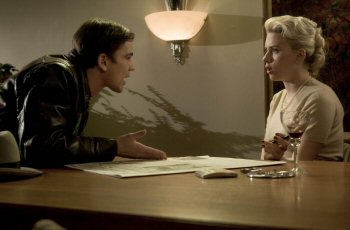
Coming off of the Euro Noir Femme Fatale, De Palma steps right into classic L.A. Noir, where the entire bleak genre really began. The film is based on the James Ellroy novel, which is in turn based on the real life murder of a young wanna be actress named Elizabeth Short, nicknamed “The Black Dahlia” by the newspapers. For the picture, we find De Palma restrained much more than in Femme Fatale. I didn’t notice too many visual flourishes, instead a lot of post-production gauziness added to the film in an attempt to make the film resemble its counterparts in the 1940s. He manages to directly reference old movies, a trademark of De Palma’s love of cinema. It’s a long picture, over two hours and there are many sub plots and third act twists. So how does it all come together?

Bleichert (Hartnett) and Blanchard (Eckhart) are L.A. beat cops who meet during the 1947 Zoot Suit Riots (sailors versus hep cats). The two men are promoted to being bond agents and fate finds them a block away from the discover of Elizabeth Short’s body. Blanchard becomes obsessed, while Bleichert becomes enamored with Blanchard’s girl (Johansson). Feeling the pressure to keep his partner from going over the edge due to the case, Bleichert does some footwork and meets a young woman, Madeline Linscott who traveled in the same lesbian circles as Short. Through a series of “what a coinky-dink” sub plots, all of these characters become entangled, ending just like all good noir should end, most every dies. The only part that really diverges is the very final scene which felt very tacked on by the studio in an attempt to not let the film end on a “sad” note. Pshaw.

This is a real mess of a film. If we were judging it on style and production design it gets an A+. That’s one thing you can never fault De Palma, the man knows how to make a film ooze style. The cinematography is pitch perfect, thinking in particular of a crane shot where as part of the background we witness the discovery of Short’s body by a mother out pushing her baby carriage. It’s done as this little thing in passing, that you could easily miss if you weren’t paying attention. That sort of clever detail is hard to not love. The entire set and costume design is solid, no one looks out of place. As always, there are some interesting set pieces that had to involve thousands of shots and takes. So from a technical stand point, its an excellent film.

Plot wise this film is trying to do way to much and tie to many things together that don’t make much sense. Characters who have no connection through the majority of the film are suddenly revealed through clunky exposition to have been sleeping with each other the entire time or connected to the murder of Short. By the time you get to the end its all so ludicrous and over the top it becomes absurd. While coincidence is a big part of noir, it at least as to make some sort of sense with the story told so far. I did however enjoy an incredibly macabre and creepy old Hollywood family that plays a crucial role in the film. While we only get a glimpse of their utter insanity, I found myself wanting to see more about them. There’s also some references to The Man Who Laughs, a Lon Chaney, Sr horror picture that served as the inspiration for The Joker. All in all, a rather middle of the road with too much plot to cram into two hours.

Next: we wrap things up with a shockingly different film, revisting Casualties of War territory, this time in Iraq, Redacted

Director in Focus: Brian De Palma – Casualties of War


Casualties of War (1989)
Starring Michael J. Fox, Sean Penn, John C. Reilly, John Leguizamo, Don Harvey, Thuy Thu Le

Coppola made Apocalypse Now. Stone made Platoon. And De Palma made Casualties of War. At the end of the 1980s De Palma was secure in his place as a Hollywood film director. When he had been closing out the 1970s he was still immersed in Hitchcoclk style thrillers. A decade later he’s made a gangster epic (Scarface), a 1930s historical crime film (The Untouchables), and a Vietnam War flick. Despite the change in venue and content, there are the same cinematographic trademarks (deep focus and POV tracking shot). But how does this film shape up next to the other great Vietnam War flicks?

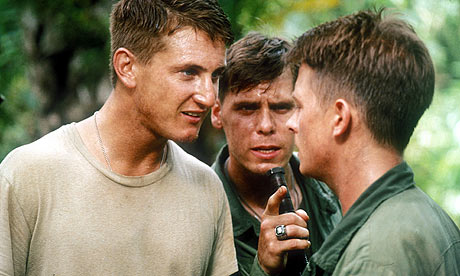
PFC Ericksson (Fox) is out on patrol with his unit when they are ambushed. He’s standing over a Viet Cong tunnel and falls half way in. As a Cong soldier inches closer, knife in teeth, Ericksson is saved in the nick of time by Meserve (Penn). Later, they both witness their commanding officer getting gunned down and Meserve takes over. He becomes obsessed with revenge and leads his group of five men to a village where they kidnap a  young girl with the intent to rape and savage her. Ericksson is frozen as he must decide whether to protect this innocent or honor the bonds of his military brotherhood.

Casualties is by no means a perfect film, but it is a surprisingly mature film for De Palma, where he seems to be balancing his camera flourishes with a thoughtful look at the nature of war. There are still some cringe inducing line deliveries and Penn’s Maserve is played a little too broad for my taste. I did like Meserve’s speech about hating the Army. Often in pop culture, the soldier who brutalizes for pleasure is made out to be a dedicated troop. It feels more realistic that such a sociopath would despise the lack of self-decision that comes with the military. Once Meserve is out of the eye of his superiors he adopts his own sense of law. Ericksson provides a balance as a soldier who appreciates the idea of duty and rank. When Ericksson goes to report what he has seen he goes through the proper channels of authority. Meserve tries to get revenge under the radar.

De Palma ends things in a way I didn’t expect. Moments before the credits rolled, I felt the film hinting at a possible dramatically violent finale, but then it ends in an ambiguous way. The message of the film is hammered way to bluntly, though. De Palma does an excellent job of telling this story in a clear, comprehensible way and he uses some interesting technical skills. At the end I felt a certain dissatisfaction with  product. It’s not as high an artistic achievement as Apocalypse Now and its doesn’t have the emotional weight of Platoon. It is a well made piece of cinema with some very enjoyable acting, but definitely doesn’t score as high as some of De Palma’s other films for me.

Next: The first big disaster, Bonfire of the Vanities.

Jolly Good Thursdays – Five Minutes of Heaven


Five Minutes of Heaven (2009, dir. Oliver Hirschbiegel)
Starring Liam Neeson, James Nesbitt

There is no collective event as traumatizing and as haunting in the United States as the conflict in Northern Island has affected those people. In 1975, Ireland was under siege by a civil war where neighbor killed neighbor. The IRA killed those who were Protestants and loyal to the British, while the Ulster Volunteer Force (UVF) would kill Catholics who were disloyal to the Empire. These murders were typically carried out by adolescent males, coerced into proving their loyality to their faction by terrorist cell leaders. In many ways, this is a parallel to the Islamic fundamentalist terrorism today; young men too dumb to know better end up dying or killing another. Over time, if they live, the glory fades and they are left with the emptiness of what they believed was a great act of glory.

Alistair Little was 16 when he killed James Griffin, 19. Alistair wanted to prove himself to Ulster and heard about a Protestant friend being hassled by Catholics. He and a group of boys steal a car, get ahold of a gun, and show up on James’ doorstep, shooting the young man dead. Witness to this crime is Joe Griffin, James’ 11 year old brother. Thirty years later, the BBC wants to put together a documentary that culminates in Alistair and Joe meeting. Alistair has served 12 years in prison for burglary and appears to have worked towards getting young men out of the situation he ended up in. Joe has agreed to meet but is both apprehensive and enraged at the prospect of finally confronting his brother’s killer. For the rest of his childhood, Joe was blamed for not doing something to save his brother by their mother, and now the grown man wants to unleash all of this pent up rage on Alistair.

Five Minutes plays out in a very unexpected way, primarily because it’s structured as a four-act play. Each act isn’t contained in a single set but is contained by a certain focus. The first act is the recreation of the murder in 1975, the second act is the build up to the documentary meeting between the two men, and so on. The acting weight is focused squarely on Neeson and Nesbitt and they are overqualified for the job. Nesbitt in particularly is able to see saw his character psychologically, increasing the intensity as the hour of he and Alistair’s meeting grows closer. A large piece of this are internal monologues, Joe simply looking in the mirror of his dressing room, pulling the knife he has brought to exact his revenge and mulling over if he should simply leave or go through with this.

Neeson is equally good but in a different direction. He plays Alistair with subtly, he’s a man who wants his victims to be able to confront him and knows they don’t care if he is sorry or not. As he tells one of the BBC crew, he wants them to step in and keep Joe from hurting himself. As we see later in the film, he is completely willing to let Joe unleash his anger on him. But he’s not just out to give victims their peace, Alistair also wants forgiveness. He’s closed himself up in an estate flat in Belfast, never married and has no children and spends his days either in non-violence support groups or stewing in his home. It is inevitable that these two men are going to meet, but the film lets us wondering under what circumstances will it be and under whose terms.

DocuMondays – The Weather Underground


The Weather Underground (2002, dir. Sam Green and Bill Siegel)

What is the line you would refuse to cross when it came to your beliefs about justice? Is it taking to the streets in protest? Is it standing up to the thug tactics of a corrupt cop? Is it killing in the name of your beliefs? No matter left or right on the political spectrum we can see multiple instances where once peaceful and calm movements were derailed by individuals desiring to commit acts of violence. There was Timothy McVeigh and the Oklahoma City bombing, The Unabomber, and various other extremists who either cling to an ideology or religion as their justification. This film is about one such group that used methods of terrorism against the US government in the late 1960s through the mid 1970s.

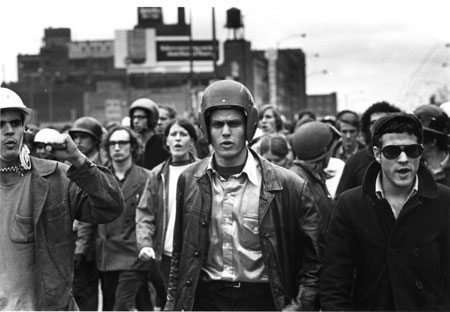
Through archival footage and interviews with the players in this story we are told of the rise and fall of a homegrown terrorist organization. It’s common knowledge that the 1960s were a period of cultural upheaval across the globe. In the United States, it was was student protests against the war in Vietnam that fueled the fire, and the government seemed bent on use brutal force to push them back. In 1969 the non-violent Students for a Democratic Society (SDS) held a convention in Chicago. The war in Vietnam was escalating and the current leadership of the SDS was trying to hold things together, while brasher elements in the group wanted to become violently pro-active. Out of this convention was born The Weathermen, a sub-group who clandestinely planned violent riots in the street and bombings of government buildings. At one point they were even hired to, and successfully did, break Timothy Leary out of a California prison. Their efforts had little effect on the government’s efforts in Vietnam, the ending of which was more influenced by the media’s release of graphic violence wrought on Vietnamese civilians. At the 1970s wound down, the members of the The Weathermen went into hiding, eventually turning themselves in at the onset of the 1980s.

The documentary was surprisingly balanced in how it presented this group. I personally would agree with many of the stances the Weathermen took on domestic and foreign policy up to the point where they brought violence into the mix. And while this is a left wing group, the mistakes made and regret felt year later transcend politics. At the time, this young men and women, including the much spoken about Bill Ayers, felt completely right and certain of their actions. One of the most fascinating interviews is with Brian Flanagan, a man who left the group shortly before Vietnam ended. He is able to sum up how things went from hopeful to cultish very quickly. He emphasizes that the leadership got so caught up in breaking the system completely, they failed to realize that lasting change comes in increments.

Mark Rudd, one of the leaders in the group, presents excerpts from his memoirs which detail a young man unsure of what he was getting into and heartbroken at the chaos he wrought, but not wavering in his political stance. I think this is a key point. While all the Weathermen regret the bombings and the riots, known as “The Days of Rage”, they have never stopped believing that many of the military conflicts the US has are not done with the best intentions. In our current political climate, we have a right wing movement with some members hinting at violence by brandishing weapons. The testimony of these men and women who have been there should be examined closely to understand the cost of violent actions and how they linger in the souls of those who commit them.

Asian Cinema Month – In the Mood For Love


In the Mood For Love (2000, dir. Wong Kar Wai)
Starring Maggie Cheung, Tony Leung

In writing poetry or prose you have a toolbox called language. This toolbox contains things like grammar, syntax, meter, rhyme, etc. Film has a toolbox as well, but is much much larger. And the idea of having more to work with sounds like it would be easier than writing, however more does not equal easier. In the film toolbox you have elements like sound and images. And subsets of sound would be dialogue, character’s accents, soundtrack, sound effects, sound mixing. Under images we find art direction, costume design, lighting, and the most vital of all cinematography. For even the most seasoned artist, misusing these tools is an easy thing to slip up and do. With this feature from director Wong Kar Wai every single tool is used perfectly and produces a flawless example of how rich style can blend with very clear, stated substance.

The film opens in Hong Kong in 1962. Chow (Leung) is renting a room in an apartment building on the same day as So (Cheung). They pass in the hall, barely acknowledging each other. Cut to a few days later and they happen to both be moving in on the same day. Chow’s wife is seen only from behind, her face intentionally not revealed. So’s husband travels abroad to Japan almost every other week and is glimpsed in a similar fashion. The months roll on and both Chow and So become convinced that their spouses have begun an affair. Not knowing how to deal with this they attempt to recreate the circumstances that led their spouses astray with themselves to understand what happened.

The plot is very loose and is carried mostly by the atmosphere created by Wong Kar Wai and his cinematographers, Christopher Doyle and Pin Bing Lee. You rarely see cinema filmed so beautifully and with such delicate craft. I found this to be the kind of film where I don’t remember scenes of dialogue or action, rather I remember images like paintings. Chow sits over his typewriter working on a story and the smoke from his cigarette billows up above his head. The rich detail of every gray tendril of smoke is captured on screen and I felt excitement at such a profoundly beautiful image. The film’s simple theme (a longing tune played on violin) is used repeatedly in scenes where Chow and So are navigating past each other, both physically and emotionally. The camera peeks around door frames, into crowded rooms of neighbors gathered to play cards. We see Chow and So separated by these people who are caught up in raucous laughing, and the tension bleeds off the screen.

The film is able to convey the conservative social pressures of the time. Chow and So meet in his bedroom, merely to share food and must be cautious of Chow’s landlord. They are unable to touch, made clear in a scene where So reaches for Chow’s hand after being caught up in a rare moment of happiness and then quickly withdraws. The film is greatly concerned with absence: the absence of the spouses, the absence of companionship or love, the absence of the spouse’s full identities. A title card that introduces the film reads “the past was something he could see but not touch”, a phrase that sums up what this lush film is all about.

Charlie Chaplin Month – Limelight


Limelight (1952)
Starring Charlie Chaplin, Claire Bloom, Nigel Bruce, Buster Keaton, Norman Lloyd, Sydney Earle Chaplin

During Chaplin’s trip to Europe to promote this film, he had his re-entry to the Unites States revoked (he always legally remained a British citizen). It was the height of Red Panic at the time in the US and Chaplin had never been shy about voicing his personal opinions on the treatment of the working class. Chaplin’s long standing tensions with J. Edgar Hoover led to his re-entry papers being revoked and he decided to set up his home in Switzerland. This would be where he would live for the rest of his days and this film (while not his last) would stand as his symbolic goodbye to cinema.

It’s 1914,  and Calvero (Chaplin) is a former performer on the East End stages. He now comes home drunk out of his mind in the middle of the day, slowly weathering away in his flat. One afternoon he returns and finds his downstairs neighbor, Teri (Bloom) unconscious holding a bottle of pills and letting gas from her stove fill her apartment. He saves her life and afterwards learns she became suicidal when her dreams of performing ballet were slowly crushed. Calvero nurses her back to health as she suffers from psychosomatic paralysis. Eventually, she regains her confidence and becomes the prima ballerina of a great company. Teri meets and falls in love with composer Neville (played by Chaplin’s own son, Sydney Earle). She goes onto secure a part for Calvero in the show as a clown and he eventually gets his own showcase which is to be his final, great performance.

1914 is an incredibly significant year in the life of Chaplin. It was in that year he made a small appearance in the Keystone short Kid Auto Races at Venice. The character he played was called The Little Tramp. The birth of one of the most iconic film characters means the death of the stage variety that brought Chaplin up. As Calvero he recognizes both the twilight of his own career and how his rise to fame was responsible for the end of many East End performers’ careers. It’s made even more significant that Buster Keaton plays Calvero’s old partner who joins him in the final stage performance. Here we have the two men who birthed cinematic comedy taking one last bow in an era that no longer had room for their style.

Despite the symbolic significance of much of the film it is still a very self-indulgent picture. Chaplin made his film’s independently meaning he got to make final cut. Limelight clocks in at 2 hours, 11 minutes and it is a real stretch. Much like The Great Dictator, another over 2 hour picture, the middle sections sag painfully. The bits Chaplin performs are never all that funny either. The two man piece he does with Keaton at the end of the film is pretty decent but never lives up to his old films.

Import Fridays – The Lives of Others


The Lives of Others (2006, dir. Florian Henckel von Donnersmarck)
Starring Ulrich Muhe, Sebastian Koch, Martina Gedeck, Ulrich Tukur, Thomas Thieme

What if we were able to see Big Brother not as a faceless entity, but as a series of human cogs that make up the machine? And, what if we could see each of those cogs, doing their duty in the name of the state, as an individual human being who possesses empathy and compassion. This is the scenario this Academy Award winning German seeks to explore the humanity of a “Statsi Man”, one of the grey men who did the dirty work of the German Democratic Republic so that the authorities could successfully arrest and detain suspected dissidents.

Wiesler (Muhe) is the best the GDR has to offer in terms of surveillance and interrogation. He’s a natural pick to monitor the playwright Dreyman and his live in girlfriend/actress Christa-Maria. Dreyman has been associating with a number of dissidents and secretly an East German official covets Christa-Maria and wants to ruin Dreyman. Wiesler’s crew wires Dreyman’s apartment and begins his ever constant vigil listening to the daily life of the couple. Slowly but surely Wiesler finds himself becoming captivated with Dreyman’s joy and sadness. The death of a close writer friend cause Dreyman to become inspired to write an expose on the GDR’s efforts to cover up suicide statistics and this puts him in a lot of danger. Wiesler is compromised and must make a choice between his duty to the state and his duty to his fellow man.

Wiesler is comparable to Gene Hackman’s portrayal of Harry Caul in the similar wiretapping film The Conversation. Both men are trapped in a world of paranoiac seclusion. The nature of their jobs planted seeds of mistrust and now they live lives of solitude, only feeling safe when they are alone, yet simultaneously feeling empty. Wiesler is glimpsed mostly sitting alone in the attic above Dreyman’s apartment with headphones on, transcribing what he hears through his typewriter. He finally breaks when Dreyman receives a phone call telling him his friend has killed himself. Dreyman grieves by playing a piece of music this friend gave him and its inter-cut with images of Wiesler weeping.

The film comes to a dark conclusion but emphasizes its hopeful message through its series of denouements. The film wants to remind us that even in the most oppressive of times and the most tightest chokeholds, that human compassion can never be predicted. No matter how loyal a person has become to an authoritarian body all it takes is a brief moment of human connection to forever change that instrument into a full human being.