Book Review – While Black Stars Burn by Lucy A. Snyder

While the Black Stars Burn by Lucy A. Snyder
(Published by Raw Dog Screaming Press)

27181342._UY400_SS400_The collection begins with a story that only hints at the supernatural tales to come, keeping things fairly mundane. By the second piece, you are pulled into a beautifully created fantasy world. While the Black Stars Burn is a mix of Lovecraftian horror, fantasy, and science fiction and author Snyder handles each genre perfectly.

Personal highlights from the collection are:


“Spinwebs” – a story set in a medieval culture where humans and spider-like beings live in mutually beneficial relationship. The world of this story is very well developed in its few pages. You understand why the protagonist has such a love for her weaver and the way the world operates. The end of this story had me ready to read Chapter 2.

“The Strange Architecture of the Heart” – a science fiction story that hits the same buttons as “Spinwebs”. We learn all the details of the world that we need to know and it feels fleshed out. The piece is focused on a lonely housewife and her only friend, the family android. Dark and sadly tender. I wanted a second chapter on this one as well.

“Through Thy Bounty” – This might be my favorite story in the whole collection. A science fiction story set after a nightmarish alien species has conquered the Earth, we hear it from the point of view of a human enslaved to work as the alien’s cook. These creatures’ appetites are for the cook’s fellow humans so she was forced to butcher and prepare everything from infants to children to the elderly. I was genuinely surprised by the places the story goes and it has a very satisfying conclusion. Could imagine the movie version of this one.

“The Abomination of Fensmere” & “The Girl With the Star-Stained Soul” – This duo of stories is connected through a continuing plot. Penny is a teenage girl whose mother has just died in a car accident. A mysterious man appears on her doorstep and claims to be from the girl’s estranged aunt who wants her to live with the old woman. The girl ends up in a small town in the American South straight out of a Lovecraft story. There are familiar tropes but where the story goes is with these elements is very entertaining. The second part takes a very interesting divergence to a landscape most Lovecraft fans would know and provides some beautiful imagery.

While the Black Stars Burn is a collection well worth your time, I can’t say you will enjoy every single story, as with collections there is always one or two that just don’t click. The overwhelming majority of stories here are wonderful, though. Very confident prose with a strong sense of world building.

My Favorite Disturbing YouTube Videos and Channels

Unedited Footage of a Bear
unedited bear
Adult Swim decided in 2013 to experiment with its deep late night programming. They took the banal infomercial that you come across if you’re up in the wee hours and turned it into some of the most powerfully transgressive film making out there. Most of you have probably seen their most famous output, Too Many Cooks, which, while funny, is nowhere near as powerful as this short film from director Alan Resnick. It starts out with what looks to be footage of people watching a grizzly bear, then becomes a commercial for allergy medicine, and then evolves into a nightmare. I’ve watched this around half a dozen times and there is a lot to take from it.


This House Has People In It

this house has people in it

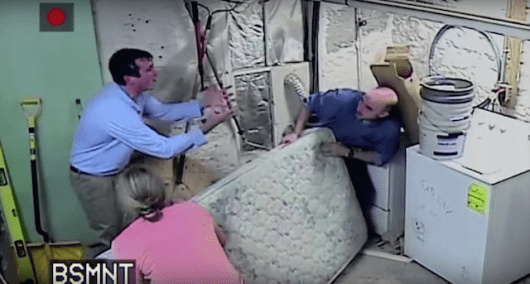
Another short from Alan Resnick. This one is harder to crack than “Bear”. It’s a series of CCTV feeds from a home security system. There is weird stuff right from the get go. A couple arguing, a teenage girl lying stiff as a board face down on the floor, grandma watching a bizarre pottery show, the baby wandering around. Things just get more odd and you will need to watch every window to catch what’s happening in the yard. It all culminates in creepy climax that leaves you with tons of questions. This one has a very extensive alternate reality game attached to it. See if you can discover the clues and get lost in this strange art piece.


Hey Kids

hey kidsGet your sport shoes ready! At first glance, the majority of the content on Hey Kids is just a series of repetitive and dumb finger family videos. However, you eventually come across the strange bald figure with over-sized eyes and mouth superimposed on its face. It speaks in a hard to pin down accent and talks in almost nonsensical sentences. The more recent videos on the channel seems to show an obsession with the Illuminati and creepypasta. Is there meaning behind this string of increasingly insane gibberish? What mind generates all of this demented content?

https://www.youtube.com/watch?v=JJfXFsuh-8c


Poppy

that poppyI always felt there was something off about Ariana Grande. I thought the apparent overnight flip from tween star to twerking Molly enthusiast by Miley Cyrus was bizarre. The entire assembly line of female pop in America is strange to me. Even stranger than American pop is the highly manufactured KPop and JPop scenes. This is where we come to That Poppy. She is influenced by the Asian pop scene and has a very polite demeanor in all her videos. Watch closely though, something is wrong with Poppy. All that Illuminati iconography in her video for “Lowlife. Such cryptic sentiments in her videos. Something is wonderfully wrong with Poppy…

Cinematic Immersion Tank #1: Martha Marcy May Marlene

Martha Marcy May Marlene (2011, dir. Sean Durkin)

Purchase Martha Marcy May Marlene on Blu-Ray
or Rent on Amazon Video

martha poster

This is my first stab at the Cinematic Immersion Tank, so I decided to go with doing a write up after each viewing. In future, I may do something more comprehensive, more of a critical analysis that isn’t as fragmented, but that would take a little more time. In the meantime, please watch Martha Marcy May Marlene *before* reading over this. I hope you find as much beauty and sadness as I did in this amazing film. My biggest take away from this film is the power of Elizabeth Olsen’s acting (she has some of the most powerful eyes) and the amazing supporting cast that surrounded her in this film. Every actor pulls so much depth out of their role.

Continue reading “Cinematic Immersion Tank #1: Martha Marcy May Marlene”

Podcasts You Should Be Listening To #1

I have been a huge fan of podcasts since I discovered them back in 2005. They are a great thing to have if you have a long commute and, if you are super lucky, you have job that let’s you put in earbuds and forget things around you. Here are some that I love to listen to.


Limetown (Two-Up Productions, Host: Annie Sage Whitehurst as Lia Haddock) http://www.limetownstories.com/

Limetown-logo-SQ-LargeIn the vein of Serial and The Black Tapes, comes this intriguing audio drama. Lia Haddock is an American Public Radio journalist who has a personal connection to an incident that occurred decades ago at neuroscience research facility in Tennessee. Three hundred people vanished without a trace and the government has worked to cover up the truth. As Lia digs deeper, she uncovers a vast horrific conspiracy. A beautiful artifact that immerses the listener in this dark parallel world. Only six episodes with a companion prequel novel in the works.


Spontaneanation  (Earwolf, Host: Paul F. Tompkins) http://www.earwolf.com/show/spontaneanation-with-paul-f-tompkins/

spontPaul F. Tompkins (Mr. Show, Best Week Ever) hosts this series that is half-interview show, half-improv show. Each episode begins with Tompkins interviewing a celebrity guest. In the second half, the guest offers up a location and Tompkins and his improvisers create a longform improv based on both the suggestion and tidbits from the guest’s interview. These are some amazing improvisers and they produce hilarious comedy.
 

Episode #3 (http://www.earwolf.com/episode/a-secret-society/) – Jason Ritter talks about his Nirvana obsession and insecurity with Choose Your Own Adventure Books

Episode #10 (http://www.earwolf.com/episode/the-student-lounge-at-a-performing-arts-high-school/) – Weeds’ Justin Kirk talks about acting school and the improvisers play out the cutthroat shenaningans behind the scenes of a student play.

Episode #52 (http://www.earwolf.com/episode/the-last-blockbuster-video-store/) – Ghostbusters screenwriter Katie Dippold talks about the reaction to the film’s trailer and we meet a sister-wife cult out to return tapes to the Last Blockbuster Video before their daddy-master gets upset.


Hollywood Handbook (Earwolf, Hosts: Hayes Davenport, Sean Clements) – http://www.earwolf.com/show/hollywood-handbook/

HollywoodHandbook_1600x1600_Cover1-300x300Hayes Davenport and Sean Clements aren’t industry douchebags, they just play them on a podcast. Each episode of Hollywood Handbook begins with the duo in media res humblebragging through a story that involves a mid-tier celebrity (think Elliot Gould or Anne Heche). What’s most cringey/captivating about Handbook is how real these characters feel. I’ve never worked in the entertainment industry, but even I can feel the genuine nature of the smarm coming off these characters. The target of their passive aggressive sneers is poor Engineer Cody. A classic duo of episodes are the dueling interviews with comedian Chris Gethard (whose podcast is featured below). Hayes, Sean, and a few friends also made an amazing appearance on Earwolf’s flagship Comedy Bang Bang podcast.

Episode #118 – Chris Gethard, Our Close Friend – http://www.earwolf.com/episode/chris-gethard-our-close-friend/

Episode #138 – Chris Gethard, Sean’s Close Friend – http://www.earwolf.com/episode/chris-gethard-seans-close-friend/

Comedy Bang Bang, Episode #351 (http://www.earwolf.com/episode/cbb-the-movie/) – The Hollywood Handbook crew does a readthrough of their Comedy Bang Bang movie script.


Beautiful Stories from Anonymous People (Earwolf, Host: Chris Gethard) http://www.earwolf.com/show/beautiful-anonymous/

Chris Gethard sits in a recording studio and receives an anonymous phone call. He cannotEAR_BeautifulAnonymous_Cover_1600x1600_Final-2-300x300 hang up, the caller can at any time. After one hour the call will automatically end. From this simple premise comes some of the most beautiful and funny human interactions you’ll be witness to. Callers often feel awkward at first, but there is inevitably some moment where they make a revelation about themselves. From there you can’t help but be pulled into the story.
 

Episode #10 (http://www.earwolf.com/episode/4-kids-0-sex/) – 4 Kids, 0 Sex – A male caller got married young and four kids later he and his wife are on the verge of a separation.

Episode #13 (http://www.earwolf.com/episode/married-to-a-monster/) – Married to a Monster –  A female caller talks about learning she was married to a child molester, now imprisoned, and how she deals with letting their son know what is happening.

Episode #15 (http://www.earwolf.com/episode/the-hardest-part-is-that-you-love-me/) – The Hardest Part is That You Love Me – a young woman in the midst of a quarter life crisis talks about her vagabond boyfriend and the tug and pull of being young and dumb with growing up and being responsible.

Book Review – Greener Pastures by Michael Wehunt

Greener Pastures by Michael Wehunt (Published by Shock Totem Publications, 2016)

greenerpastures_fullsm

Greener Pastures is the debut horror short story collection from author Michael Wehunt. This was my first encounter with Mr. Wehunt’s work but the latest in my over year long focus on horror short fiction. What I found was a very strong variety of stories that touch on various types of horror. Everything about this book feels nothing like a first timer, but someone who is very confident in their craft, of weaving themes into narrative and building characters who react in real, human ways to terrifying situations.

Highlights from the collection were:

“October Film Haunt: Under the House”, a found footage story. Ever since I read Mark Danielewski’s House of Leaves, I have been a sucker for representing visual media in text for horror. There’s something so effective about reading a transcript of found footage that is much more terrifying than seeing it. There is such distinct imagery in this piece, but the meaning is left ambiguous. I read this story a few days before the release of the Resident Evil VII demo that also features found footage in a haunted house, and this story is much scarier than the decent jump scares of the video game. The cover of the book features an image from this particular story, a dog emerging from the woods holding a wooden crown in its teeth. Something that bears such horrifying weight in the context of the story.

“Deducted From Your Share in Paradise” begins with a number of women falling from the sky and crashing into a dystopian trailer park. The narrator is on the outside of the core events but he sees enough to inform us about what is really going on here. This story felt very much like one of Terry Gilliam’s darker works. Not pure existential horror like some of the others, but a bit of fantasy mixed in with the uncertainty of these women’s purpose in our world. The climax is satisfying but like all good horror leaves lots of questions on the table.

The title story, “Greener Pastures” is all the things I love in a good Reddit NoSleep piece. It’s concise, it is able to build mood in a short amount of time, when the horror is revealed it cuts right to the core of the protagonist, and we end on an open note. The setting of a lonely truckstop diner in the middle of a pitch black night is just one of those perfect settings for a good horror tale.

The final story in the collection is “Bookends” which I wouldn’t even classify as a horror story. It’s a deeply gut wrenching character piece on a man who is left with a newborn when his wife of thirteen years dies. It’s a reflection on grief and how blinded we can become when we experience a love that potent. The places the story goes are very dark and should be careful before you delve in due to the emotional weight and very real events present.

The stories here are all signs of a talent that is ready to go. Everything is polished and tight. Not a single story feels like filler and they all have shared thematic threads, grief in particular. A collection worthy of your time that will provide a satisfying experience.

Origins 2016 – Bluebeard’s Bride

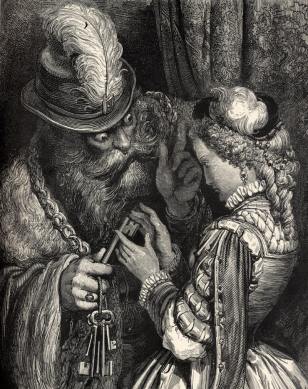
BarbebleueIf you know the overlooked fairy tale Bluebeard then you are good. If you don’t, let me summarize: A young maiden is convinced to marry a brutish, ugly aristocrat named Bluebeard. After their wedding, the maiden is left alone in Bluebeard’s home and told the place is her’s, except for one room that must remain closed at all times. As in all fairy tales, she succumbs to her temptation and discovers an abattoir of Bluebeard’s former wives. The husband returns and vows to kill her. Depending on the version, a family member arrives and saves the maiden.
Bluebeard’s Bride (designed by Whitney Beltran, Marissa Kelly, and Sarah Richardson, to be published by Magpie Games) takes this fairy tale and explores and turns the message of the original on its head. Intended to be a warning to young girls to obey their husbands, Bride is an exploration of the female experience through a lens of body horror. The game is yet another using the Powered by the Apocalypse engine, with some very interesting variations to the mechanics. The players are all a singular character, The Bride, but choose playbooks modeled after aspects of her mind: The Virgin, The Fatale, The Witch, The Animus, and The Mother. A physical “wedding” ring is used to represent which aspect is dominant at the moment and is passed voluntarily or when triggered by certain moves. This was our game for the Friday afternoon session of Games on Demand and we were lucky enough to have Sarah Richardson as our GM.

Game play consists of the controlling aspect describing a key on the key-ring left to her by Bluebeard, the GM referring to an oracle type sheet, and then describing the room. Once inside the room, the Bride may not leave until she declares a Truth about what is going on. The truth can either be one that strengthens her trust in her husband or grows the distance between them. While most PBtA games are open ended, Bluebeard’s Bride has two tracks that, once one is completed, bring about a series of endgame moves and decisions to be made.

It is difficult to talk about the game because in my personal experience it was a very visceral, emotional session. As my friend Mick said in a write up about the game: “[..] it felt like the kind of thing I’ve always been taught Eucharist is supposed to be like[..]”. It did feel a bit like moving through the stations of the cross or similar religious rite but much more interactive. Very quickly, based on the Moves and explanation from the GM, you realize that the typical response of fighting back is not an option. Instead you’re encouraged to explore and illuminate the purpose of each room or object. The Truth revealed before exiting takes your discovery and gives them context in the larger meaning of the Bride’s experience.

I don’t know if I could ever play Bluebeard’s Bride again. Not a slight to the game but a compliment to both the design of the piece and Sarah, our GM. I view the game in the same category as Requiem for a Dream or the films of Simon Rumley. They are perfectly made and one of their purposes is to interact with parts of your brain you aren’t used to experiencing in “entertainment”. Bluebeard’s Bride is one of those games that challenges the notion that all games should be “fun”, in the same way some films aren’t made to help you escape from reality but to examine it from new perspectives and with a creative twists.

The body horror of the game was not what affected me on such a deep level. The existential horror was what lingers with you in the wake of the session. I immediately thought about the works of some of my favorite horror author, Laird Barron foremost, who manage to find ways to disturb and shake me. For a piece of writing to wield that sort of power is admirable. Helplessness against a looming horror is profoundly more disturbing than any monster the mind can conjure up. In a climate where people are overfed stimulus through media it takes a deft and creative hand to fashion something that can shake a viewer/reader/player.

I would imagine Bluebeard’s Bride is a delicate game to run. You need the right GM and players with open minds who are ready to explore dark places. Like all games run at Games on Demand, the X Card is present for players who get uncomfortable if triggering subject matter is broached. A good GM would need to be agile in making sure the content strongly affects the players without venturing into territory that would bring up personal traumas. But I personally believe good horror can’t be too delicate. It loses its power when it is too restrained in the same way it loses power if it is allowed to go completely gonzo. The work exists as both a playable game and a poetic piece. I compare it to my purchase of Black Sun Death Crawl, something from a system I would never likely run, but a quality work of writing and craft

Bluebeard’s Bride has not yet been published, but a Kickstarter is coming. I would recommend backing it because you’re going to help get a game out there that deals with subject matter not often touched upon in tabletop gaming. For more on the game and the place to look out for the Kickstarter’s launch visit here – http://www.magpiegames.com/bluebeards-bride/

Origins 2016 – Monsterhearts

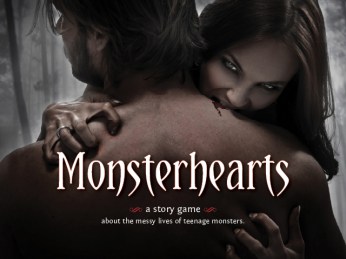
monsterheartsFriday morning rolled around and I knew exactly what table I would be at. We had the great honor of playing Monsterhearts with Joe Beason. Joe has been a Google Plus friend for awhile and I’d been very interested in his variation on Monsterhearts, Elderhearts which focuses on a retirement home rather than a high school. However, we were feeling the original that morning.
Monsterhearts (Designed by Avery Alder McDaldno, Published by Buried Without Ceremony) takes popular media like Buffy the Vampire Slayer, Twilight, Ginger Snaps and similar works and turns them into one of the most enjoyable systems I’ve ever run or played. Once again, this is a Powered by the Apocalypse game meaning it uses fictionally triggered Moves and two six sided die plus the relevant stat to determine the outcome of actions. The playbooks consist of what you would expect with some twists. There’s The Vamp, The Wolf, The Ghost alongside The Mortal, The Queen, The Ghoul and many more both official and fan made. In other PBtA games relationships between character are played as favors or debts, but in MH characters have Strings, representations of the emotional pull you have on others and they have on you. These are meant to be much more manipulative than debts or bonds and they help heighten that sense of adolescent emotional immaturity. Monsterhearts also heavily emphasizes the fluid nature of sexuality. Every character is expected to be able to be Turned On by any other character. The extent of how that arousal is acted on is determined in the fiction and how much detail the players want. Most games I play in typically fade to black or cut away before the descriptions get too gratuitous.

For Joe’s game we were students in a Florida high school that was in the path of Hurricane Danny, a brewing tropical storm. In our group we had The Ghost, The Chosen (a Buffy style hunter skin), The Witch, The Fae, and I played The Queen. Every experience I’ve had playing MH has been a lot of fun. Getting to indulge those over-dramatic hormone driven personalities of teenagers is a great time. I really hammed it up with The Queen, a stuck up rich girl whose twist involved her mind being taken over by a genetically engineered parasite her daddy’s medical research company brewed up. She was now the leader of a hive-mind (her clique) with a group text on her smartphone serving as the hub of communication. Lots of selfies were taken, many Snapchats were snapped.

Joe did a great job weaving a lot of elements through the fiction of the game based on the material we brought through our characters. The chief difference between traditional tabletop scenarios and PBtA is the planning. You can pick up Monsterhearts with no scenario in mind, sit down with friends, and simply listen and engage in conversation to build the world. Games like this will definitely stretch your mind and your creativity but you’ll up getting quicker on your feet as a result. Our high school Spring play had ground to halt with the death of the drama teacher. In his place an older, former teacher at the school was substituting, the same teacher responsible for our Ghost’s murder in the 1980s. My Queen was missing one of her clique, the girl was part of the trio of backup singers in the school’s production of Little Shop of Horrors. After a power outage, The Queen found her way to the auditorium and, along with the other player characters, got caught up in an occult ritual that was connected to the presence of the powerful storm outside.

This was one of those table at Games on Demand where everyone was firing on all cylinders and we were simpatico. The story flowed from player to player and GM. In those four hours we had a complete and satisfying narrative that left hints of other plots that could come from these characters had we been able to continue. That is also recurring note at almost every game I played: the players getting so deeply into the session they wished it was a regular weekly or monthly game so they could discover what happened next to these characters.

Avery McDaldno is currently looking at revising and releasing a second edition of the game. Since Monsterhearts’ publication in 2012, many more variations and hacks on PBtA have been released and the best iterations have brought new and intriguing mechanics to the community. As with Vincent Baker’s revision of the original Apocalypse World, I cannot wait to see what Avery adds and refines with Monsterhearts.

Even if you don’t care for the inspiration behind Monsterhearts, I’m confident you would love the game. The places the game explores aren’t represented in many other tabletop games and, with the right group of people who have buy in with the material, you’ll end up with some of the most satisfying sessions of gaming you’ve ever experienced.

You can purchase Monsterhearts here – http://www.drivethrurpg.com/product/100540/Monsterhearts

Later today: Bluebeard’s Bride and Dungeon World

Origins 2016 – Urban Shadows

urban shadows

Urban Shadows (Designed by Andrew Medeiros and Mark Diaz-Truman) is another game from Magpie Games and another variation on the Powered by the Apocalypse system. Are you noticing a trend with me? Urban Shadows was actually the first Magpie game I went all in for. I heard of some of their previous work but didn’t know these games were all from the same publisher. Urban Shadows is also a system I’ve run about 30 times in a series of small interconnected campaigns. I always love playing with a new GM though, because I learn techniques on how to run the game or discover subtleties about it that had completely gone over my head.

Urban Shadows takes many of the elements of World of Darkness with a focus on the faction politics. The four factions of the game are Mortality (Aware humans, monster hunters), Night (vampires, werewolves, ghosts), Power (Wizards, Oracles, Immortals) and Wild (Fae, Humans tainted by demons). Players have two sets of stats: one related to their individual abilities and the second for their knowledge and connection to each Faction. There are Basic Moves but also Faction Moves that require rolling with the relevant Faction stat. You accumulate Debts on other players and NPCs and can spend those debts for favors or greater influence in negotiations. You “level up” or advance by interacting with the four Factions. On top of all of this, there is a Corruption track that is advanced by certain choices in the Basic Moves and by a Corruption condition specific to each playbook. You can pick up new Corruption moves but in the fiction this moves you closer to your character becoming an NPC threat in a later game or campaign.

Thursday evening we sat down at the table with Derrick Kapchinksy, a member of Magpie. This was our first time with him running a game so I was very interested to see how things went. There was also a complete newbie to the PBtA style of game and appropriately Derrick spent time going over the basic mechanics and making sure he was comfortable with the game. After the game, my wife and I talked about how perfectly Derrick described how the system worked, talking about it in the context of a conversation with some mechanics that come to the surface only when needed. Our novice player definitely seemed to take to the game quickly. The urban environs of our game was Albuquerque, New Mexico, a city Derrick is very familiar with. As with all Urban Shadows games it’s fairly important that the GM have a good understanding of the city so they can weave real world elements with a fictional supernatural underbelly.

I played Raul, a Tainted Iraq War vet. He sold his soul in the midst of a firefight to an Ifrit. The result was that he was the sole survivor of his unit and returned to the state haunted by the fiery demon. Now the Ifrit had turned its attention to Raul’s nephew as a potential new host. Raul’s own rage built as the influence of the demon increased causing him to becoming brutally violent with bystanders, he particularly focused on the homeless population knowing they wouldn’t have many people looking out for them. In the opening hour of the game we established that vampires had been wiped out by a fellow player’s Veteran hunter. The Fae filled in that power vacuum but now the vampires were returning to the city.

I was particularly impressed with Derrick’s Redcap enforcers. They appeared as teenage Native American young men in backwards red baseball caps for the Albuquerque Cannons (now the Isotopes). I love that clever blending of traditional folkloric beings with touches of modern life. It helps to create the atmosphere of the supernatural embedded among us. The game consisted in the players getting their characters deeper and deeper into trouble between the Vampires and Fae, culminating in a showdown at a vampire nightclub.

Urban Shadows is one of the best adaptations of the PBtA system. It has a lot of moving parts and thus can be daunting the first time you look over a character sheet. With a little reading up and given some time the fluidity of these elements comes to the surface. As long as you run and play the game with an emphasis on the political you’ll have a great time. This does involve a shift in the traditional tabletop mindset where players receive plot from the GM. Here the GM looks to the players to communicate what things they are interested in doing and see happen. When everyone is on the same page the system sings. If this type of dark, political, supernatural style of storytelling appeals to you then I say you need to buy this game. I know for me it’s provided hours and hours of great gaming sessions.

Urban Shadows – http://www.drivethrurpg.com/product/153464/Urban-Shadows

You can also see Urban Shadows in play, run by the masterful Jay Brown here – https://www.youtube.com/watch?v=NZ5Vuy-KoEM

Tomorrow: Monsterhearts & Bluebeard’s Bride

Origins 2016 – Zombie World

zombie_horde_by_joakimolofsson-d5mudbk

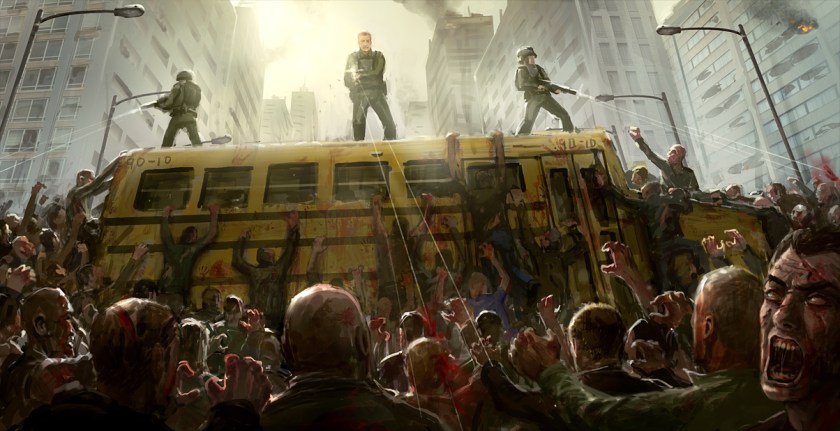
For the Thursday afternoon slot at Games on Demand, my wife and I went with Zombie World (designed and published by the team at Magpie Games). Our main reason was the game’s GM, Mark Truman-Diaz, co-founder of Magpie. Mark is both a stellar GM and an all around awesome human being so we knew we were in for a great experience. Two additional players joined our table and we were ready to begin.

Zombie World is another game that is Powered by the Apocalypse. Unlike with Masks, and most PBtA games, Zombie World uses playing cards instead of dice for resolution. Character creation involves drawing three cards and referencing an Oracle document for their meanings. The cards represent your character’s Past, Present, and Trauma. Each aspect provides specific moves or boons that only your character will have, as well as informing you on how to roleplay that character. Character creation in this style makes you think on your feet to connect what has the chance to be three very conflicting, yet compelling, aspects.

My character’s Past was Social Worker, Present was Scavenger, and Trauma was Imperious (I interjected myself into social conflicts, always wanting to solve problems). Holloway, was a social worker who still had a sense of concern for others, but this was balanced with his survival instincts. Getting involved in other’s arguments could shore up power and over time he could be seen as a de facto leader, or least open up avenues to get much needed resources if he was seen as a helper. He made a good Scavenger because his job required him to find resources for people in need and he also navigated the tougher parts of the city for many years.

Our particular game was set in an abandoned prison, which came with a playbook that we at the table collectively fleshed out. Cards were used to determine resources, threats, needs, etc. Once we had our characters and settings complete we began. Mark described a caravan of vehicles, some being manually pushed along a road outside of town. One of our hunters had spied the scene and said there was a chance a devastatingly large horde was following in the wake of these people. Two characters, our sharpshooter and a former cop, took the direct approach on the caravan while a third character, a guard who worked at the prison, led a group of Syrian refugees that had been living with us out into the woods to provide backup in case relations went south. Holloway, my social worker, didn’t volunteer to go, but snuck out of the prison to spy from a distance.

Things definitely fell apart and, while no one died, the characters suffered a number of serious setbacks, injuries, and were forced to make brutally hard choices. Conflict resolution was done by triggering one of the Basic Moves in the fiction of the game, then drawing a number of cards equal to the relevant stat. The highest card drawn would be used to determine how successful an action was. Jacks were complete successes, 8-10 was a success with a cost, and anything less than a 7 was a failure. Queens represented expendable resources and their effects and were removed from the deck after a use until they could be replenished or maintained in the fiction. For instance, our prison had a strong fence. Having a strong fence could have allowed you get very restful sleep because you didn’t need to be walking the perimeter all night. That rest could be what helped you stay alert in a firefight. But, if you don’t look for damage to the fence periodically or a massive horde crushes it to the ground then that Queen would not be reinserted into the deck again. Aces could be successes but required the player to take Stress if they wanted that boon.

I felt the character creation had light touches of Fiasco with the use of the Oracle. The drawing of cards created a sort of meta-tension. It worked even better because the higher your stat the more cards you had to draw. So being good at something actually meant the tension could be higher with each pull from the deck. From a fictional standpoint, the game completely got across the atmosphere of popular character focused zombie media (The Walking Dead). The zombies were there but not necessarily the greatest danger to our characters. As is typical with this sort of thing, it’s the other human beings you need to worry about. The game seems incredibly well suited for both one shots and small campaigns. It’s yet another Magpie production that has me excited as a hell to get my hands on it and run for friends. Zombie World does not yet have a release date, but Mark said it is pretty much at completion and will be released in the near future.

Later today: Urban Shadows.

Holidays (2016, dir. Various)

Holidays-Fathers-Day-Still-116-e1460641150837

Valentine’s Day (written & directed by Kevin Kölsch & Dennis Widmyer)

St. Patrick’s Day (written & directed by Gary Shore)

Easter (written & directed by Nicholas McCarthy)

Mother’s Day (written & directed by Sarah Adina Smith)

Father’s Day (written & directed by Anthony Scott Burns)

Halloween (written & directed by Kevin Smith)

Christmas (written & directed by Scott Stewart)

New Year’s Eve (written by Kevin Kölsch & Dennis Widmyer; directed by Adam Egypt Mortimer)

These days the horror anthology is quite popular. I’d say their revival started with 2007’s Trick R Treat, though in the low budget independent world they never went away. Some popular recent ones have been The ABCs of Horror 1 & 2, V/H/S 1, 2, & 3, A Christmas Horror Story, and Southbound. You know what they all had in common? They’re mostly awful. You get a good segment here or there, but it’s not a complete collection of great horror. I can see the appeal of this type of movie. In the YouTube age, short form entertainment is in high demand so many viewers probably sit down with the mindset of “If I don’t like this in fifteen minutes I’ll be seeing something else”.

Holidays is another horror anthology that suffers from this problem, and has some of the worst segments I’ve seen in a modern horror anthology. The bookending stories are terrible and in particular Kevin Smith’s contribution is pointless garbage, that he also manages to also shoehorn his untalented daughter into. The concept of Holidays is just that: Holidays. Each horror short is themed after a particular holiday. Lots of potential, eh? Of the eight short films included here there are only three good ones. Those three are really good though. Worth paying money to sit through the five other pieces of crap?….ehhhhh.

Let’s be positive though. We’ll talk about the good stuff.

Easter is from the writer-director of The Pact, a pretty decent horror film from a few years back. He knows how to pace things, he knows what ambiguity is. He takes horror seriously and doesn’t view it as gory comedy, like some others in this collection. Easter goes to some really weird places and it leaves us with lots of questions. On the surface we get a very silly monster, but the things he does and says overcome his silly nature and make him really creepy and unsettling. You’ll think about this one more than most of the others.

Mother’s Day is a little predictable. And it’s the second film in the anthology to deal with an evil pregnancy. St. Patrick’s Day also features an unwanted pregnancy but ends on such a stupid, ridiculous note you’ll want to get your tubes tied (snake with a pompadour, really movie?). Mother’s Day is about a woman who gets pregnant every time she has intercourse and has had two dozen abortions. Her doctor can’t figure out why she is so overly fertile so she sends the woman to an isolated commune for holistic healing. Like I said, the plot is pretty predictable but at least the acting and directing show some skill.

Father’s Day is the best film in the collection. Like seriously, turn off the movie after you watching this one. They get progressively worse. Father’s Day is about a young woman who receives an audio cassette recording from her deceased father. Turns out he didn’t die like mom told her. The recording leads her to the last place she saw him and she retraces his steps. This is actually a horror film. It has character development. It has a plot that we can’t predict and a resolution we don’t see coming. It doesn’t think horror stories are one big bloody joke. There’s no gore. It ends in a really really ambiguous way.

Horror anthologies have a shitty trend of thinking the only way you tell horror stories is to make them into jokes with gore. That’s not scary. Horror should be the opposite of comedy. Comedy is set up and then pay off. Horror should be 90% set up and then most of the time not even give pay off. That’s what makes it horror. You don’t get the clean resolution so it gets stuck in your brain and creeps you out every time you think of it. I recommend those three segments, so if you can somehow find them separately online or can get someone to pay for your rental of Holidays watch them. But skip every other segment in this collection.