Movie Review – At the Devil’s Door

At the Devil’s Door (2014, dir. Nicholas McCarthy)

SONY DSC

A teenage girl caught up in a new relationship plays a dark game where she barters away her soul. Decades later, Leigh, a real estate agent gets a new property with a dark history. At the same time, her angsty younger sister Vera is busy at work on her upcoming gallery show. Woven throughout these women’s lives is a demonic presence that seeks to use one of them to bring itself into the world through a vessel. Where this story ends up is surprising and how it gets there can be incredibly frustrating.

The work I saw from director Nicholas McCarthy was his 2011 short film The Pact and then his subsequent feature film adaptation of that short. I was very impressed with the surprising direction that movie took, the way it subverts audience expectations while telling a story from multiple perspectives. McCarthy’s most recent work was the Easter short in the Holidays anthology which was one of the more enjoyable pieces in that incredibly flawed collection.

At the Devil’s Door is an interesting concept that ultimately fails in its execution and commits the worst crime a horror film can: it’s so boring. Conceptually we have a very ambiguous demonic possession story that doesn’t hit all the familiar tropes. There were moments where I was genuinely hooked and the film did a great job reeling me in, only to plod on with dull and shallow characters for the next 20 minutes. The idea of a fragmented narrative could work in the film, but it’s handled in a confusion and ultimately distancing manner. We never get enough of a sense of who any of these characters are so it’s hard to care. I saw a comment that summed it up, this is a trilogy that has been compressed into one film. As a novel with the ability to get have an omniscient narrator the story would be something I’d eat up. It just fails as a film.

The positives are that McCarthy knows how to frame a shot. He loves to evoke and build atmosphere and the film is dripping with it. The atmosphere just doesn’t have a strong enough plot to take it anywhere. McCarthy has a love of suburban homes and lights them in ways that play up the creepiness of hallways and bedroom corners. The demon is very obscured and we get two glimpses of it throughout that are masterful. Once it is in the background, out of focus and the second is a quick glimpse as it hides in a cabinet. The design isn’t what you would expect.

At the Devil’s door biggest problem is that it doesn’t understand how to make a good ambiguous horror film. You need details in the world while the horror is kept ambiguous when you don’t have those world and character details the story never feels alive.

John Wick (2014, dir. Chad Stahelski, David Leitch)

john wick

I remember seeing the trailer for John Wick a couple years ago and thinking “You can’t be serious. Because they killed his dog?” Now that I’ve seen the film, I sit here thinking…well, I’m not sure. The film tells the story of retired assassin John Wick, played by Keanu Reeves. His wife died suddenly and not long after he receives a dog that was her last gift to him. The dog is brutally killed by Iosef Tarasov (Alfie Allen), the son of a Russian crime boss, and this pulls Wick back into the game he thought he had left behind. Throw in supporting roles from a bevy of character actors: Ian McShane, John Leguizamo, Willem Dafoe, Adrianne Palicki, Lance Reddick, and David Patrick Kelly (Warriors! Come out and play-ayyy!).

This film felt like a comic book. That is it felt like I picked up the collection of “John Wick Returns”, a mini-series wherein a popular crime comics character was brought back after an absence of a few years. The way we were introduced to the world and its inhabitants without tons of exposition to explain themselves, made me feel like this was a world I could go back and read about in other titles. Of all the places and characters the world was peppered with, I enjoyed the Continental, a hotel that caters exclusively to assassins and paid killers, the most. I also loved the sense of history John had with everyone. We have no idea what the details are to these connections, but it felt like there would be dozens of stories to tell. Marcus (Willem Dafoe), John’s mentor, held a lot history in his interactions with John and, like any good comic book universe, I am sure the equivalent of “John Wick Begins” detailing his training under Marcus would be amazing.

I would never say I was a huge action movie fan so I was not the target audience of this film. Not being an expert on the craft and technique behind movie fights, I thought everything felt realistic. Nothing John did was too incredibly unreal. If you’re used to more hyper-stylized fighting you might think this was a more toned down version, but it looks like the way someone like John Wick would really fight. It’s funny now that I think about it; the action which you would expect to be the exaggerated element is played fairly real while it’s the world building that goes over the top.

There’s definitely some nods to classic action directors: The shooting out of the glass walls made me think of John Woo. Wick is your archetypal silent, stoic killer along the lines of a lot of French noir crime films.The acting is fine. I didn’t see any performances that blew me away, everyone sort of knew who they were playing and did that. I always love seeing David Patrick Kelly in anything and I did really enjoy the mannerisms he brought to his “clean up crew” character.

There’s a sequel on the horizon and I’m interested to see what they do. This film really plays like “the final John Wick” story and the stakes used to pull him back into action are about as intense as they get. Something taking place before this would work but I would like to see this older, broken Wick continue however they decide it might work. This isn’t going to be one of my favorites of the year, but it is an enjoyable film that kept my attention the whole run time. If you enjoy films with sense of a deep, developed world then I definitely think John Wick will deliver.

Cinematic Immersion Tank #1: Martha Marcy May Marlene

Martha Marcy May Marlene (2011, dir. Sean Durkin)

Purchase Martha Marcy May Marlene on Blu-Ray
or Rent on Amazon Video

martha poster

This is my first stab at the Cinematic Immersion Tank, so I decided to go with doing a write up after each viewing. In future, I may do something more comprehensive, more of a critical analysis that isn’t as fragmented, but that would take a little more time. In the meantime, please watch Martha Marcy May Marlene *before* reading over this. I hope you find as much beauty and sadness as I did in this amazing film. My biggest take away from this film is the power of Elizabeth Olsen’s acting (she has some of the most powerful eyes) and the amazing supporting cast that surrounded her in this film. Every actor pulls so much depth out of their role.

Continue reading “Cinematic Immersion Tank #1: Martha Marcy May Marlene”

The Lobster (2016, dir. Yorgos Lanthimos)

a24 visions

lobster2-xlarge

I knew I had read literature that fell into the genre of magical realism, but it wasn’t until I read One Hundred Years of Solitude the summer of 2004 and followed that up with a ravenous consumption of Jorge Luis Borges’ short fiction that really came to understand, and in turn fall in love with, the genre. Magical realism is a style of storytelling that presents a normal world where there are extraordinary occurrences that the populace views as simply mundane. This is often used as an extended metaphor to be dissected and explored,usually a commentary on our own perspectives of the world. There are many everyday practices that to alien eyes would pop out as bizarre and unreal, but for us it’s simply life.

The Lobster falls strongly into the category of magic realism, without it become a “cute” gimmick. The film tells the story of David (Colin Ferrell), a divorced man who must stay in a hotel for singles for 45 days and find a partner. If he is unable to find a partner he’ll be transformed into the animal of his choice. In David’s case, he chooses a lobster (They stay fertile their entire lives). There is an eclectic cast of characters that we watch interact, with moments of brilliant dark comedy and painful heartrending tragedy. The film has a very defined split as David makes a drastic decision about his place in the Hotel as well as the society midway through.

This is the second film I’ve viewed from Yorgos Lanthimos, the Greek director. His breakout film, Dogtooth, explores the nature of family units focused on a couple who have kept their adult children locked up on the property for their entire lives. It balances the same comedic tones and horrific violence, but I think The Lobster elevates that to a masterful level. It also continues the director’s work examining the cultural norms of Western society, in this instance the concept of falling in love in the modern era.

Personality is absent from every character in the film. Conversations are monotonous and devoid of emotion. A character is violently punished for self-pleasure and his reaction is fairly muted for what happens. Characters fall in love and barely crack a smile. Characters die and are killed and everyone essentially walks away with a shrug. There’s no room for sentimentality in the world, dating, marriage, and having children are like business transactions. It is expected and frankly demanded of everyone in the world of the film. David is faced with a choice of severe sentimentality at the film’s conclusion and as I simmered on it afterwards it struck me that by not committing this act he would show the strongest sense of individualism in the entire film. So while, the culture around him is unsentimental he would possibly conform to it in the end.

What is most interesting are the “rebel” group in the woods, whose leader (Lea Seydoux) imposes a system of rules between the other loners, especially no physical or romantic contact. We see the bloody results of a simple kiss and worse is implied. While the Leader believes she is shirking the status quo of required relationships, she is actually creating a parallel system of dogmatic social norms that are punished with the most extreme methods. This leaves us to wonder if individualism is even a workable concept in this world.

The couples that do end up together are driven by the requirement of a match up of defining characteristics. David is nearsighted and seeks out a partner who shares that trait. Another character is saddled with a limp (the result of trying to find his mother who was turned into a wolf after a failed matchmaking attempt). Yet more characters present themselves this way: She has chronic nosebleeds, he has a pronounced lisp, she is emotionally distant, she loves butter cookies. Even in the film’s credits a multitude of characters are named by their defining trait. Almost the way, when filling out an online profile for a dating service, you would highlight aspects of yourself that you want to present, aspects that are intended to provide others with a definition of you.

Lanthimos is exploring the way people form romantic relationships in our current era. If you look at the business of matchmaking, whether it is OKCupid or speed dating or Match.com, people are boiled down to their essentials. Personality is near imperceptible and a person’s true nature is impossible to convey through these methods. But Lanthimos isn’t happy to simply comment on technology’s relationship to our relationships, he goes deeper, to the very core of why anyone ends up with anyone else. Characters lie about their defining trait in desperation to end up with someone else. The Hotel guests routinely arm themselves with tranquilizer guns and hunt the band of guerrilla Loners in the surrounding forest. And the Loners in turn sneer at those foolish guests who stupidly pursue companionship. All of these characters are deluded and define themselves based on cultural expectations, whether in conformity or opposition to. The Lobster ends on a suspended note, blatantly letting us stew on what happens next. Is their any way to succeed in this world, or is the best you can hope for to become a lobster?

The Boy (2015, dir. Craig Macneil)

Jared-Breeze-The-Boy-Movie-2015

As someone who works with children approximately the age of the title character, watching The Boy is a very interesting experience. It’s fairly well known that during the Victorian Period, the cultural perceptions of childhood changed. Prior, children were seen as small adults and their exposure to hardship and cruelties of life was seen as the norm. In the late 19th century, social justice groups began to criticize the harsh conditions that children were forced to endure and demanded better. Childhood was now seen as a precious, fragile time for these angelic beings to develop. Even Peter Pan was born out of this mode of thinking, along with a myriad of literature aimed at children that approached its material from a place of gentleness. Craig Macneil’s The Boy attempts a character study focused on questions surrounding what happens to a child who has to live through the aforementioned brutality.

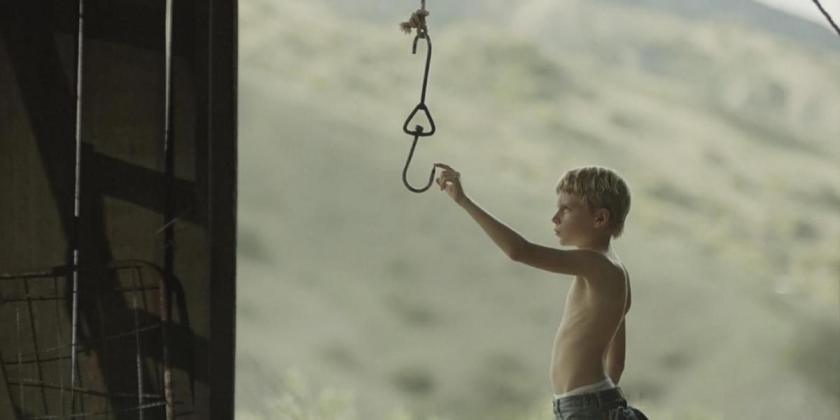
Set in 1989, The Boy points its watchful eye on Ted (played with remarkable coldness by Jared Breeze). Ted has grown up at the Mt. Vista Motel, located in some lonely corner of the American Southwest. Ted spends his days collecting roadkill for quarters and wandering the brush around the property. One rainy night, Ted causes a car crash that brings Colby (Rainn Wilson) to the motel for an indeterminate time. Colby is a mysterious figure who avoids the hospital and the local law and this intrigues Ted. At the same time, an anger is growing in Ted that troubles his father (David Morse) and is leading to a violent conclusion.

This is mostly definitely a character study and eschews any sort of heavy plotting towards that style of film making. The camera lingers on Ted and we intentionally view long moments of mundane wandering. As a result, the horror of the film is amplified by the slow burn. I would understand if a viewer became massively frustrated in the first half of the film because it does take its time putting all its pieces in place. Ted’s sociopathy is hinted at and I found myself questioning if there was anything wrong with him, if instead of being mentally ill he was simply a child who was working through feelings of confusion and alienation. The finale of the film removes any doubts yet still holds our lead character in a gray space where his actions could be viewed as justifiable revenge in the mind of an abused child.

The standout aspect of The Boy is the acting. When plot is secondary, a director must have a cast that can develop their characters in organic ways. Jared Breeze is so convincingly cold and distant as Ted, and brings out pathos and emotion only when absolutely necessary. It is incredibly unsettling how well this young actor brings out the complicated psyche of Ted. David Morse and Rainn Wilson, the actors who share the most screen time with Jared, both deliver subtle and powerful performances. Morse, a character actor whose face you know already, is pathetic and infuriating as Ted’s father. He lived the same life as Ted, raised by his father at the motel and admits he doesn’t want this life for his son, but an invisible guilt appears to shackle the patriarch to this place. Even more interesting is Rainn Wilson as the mysterious Colby. We never quite get the gritty details of Colby’s past but so much can be inferred by what we are told. He desperately doesn’t want the police to search his damaged car in the local junkyard and his kinship with Ted is left open for interpretation. Is he actually developing the fatherly relationship the boy doesn’t have with his actual dad? Or is Colby just using the boy to process his own guilt about his past crimes?

The Boy is an incredibly dry and slow film. Don’t expect a campy melodrama pastiche of Psycho despite the setting and themes. The film traffics in one of my favorite element of great art: ambiguity. Lots of questions are left on the table. We never really know “Why?”. And that is okay. So often that’s the question we’re left with in real life, in the wake of tragic violence committed by the grown men Ted might grow up to be. Here, we are allowed a microscope to examine the birth of such evil in detail. What we learn is that the origins of darkness in the soul are more complicated than we would like to think.

Film Review – Red, White, & Blue

Red, White, & Blue (2010, dir. Simon Rumley)
Starring Noah Taylor, Amanda Fuller, Mark Senter

British director Simon Rumley seems intent on shredding every last ounce of emotional energy I have. As you can read in my review of his 2006 film, The Living and The Dead, he is able to present a psychological horror film unlike any you will ever see. Here too, in Red, White, & Blue, Rumley takes the revenge/gore film made popular in 1970s and still alive and strong today, and goes down avenues no mainstream picture would ever think about. The result is another film that hammers itself into your mind and squeeze every ounce of composure from your soul. The last fifteen minutes left my heart pounding and my head feeling dizzy, shocked at the level of physical gore and psychological torment.

Continue reading “Film Review – Red, White, & Blue”

Film Review – Catfish


Catfish (2010, dir. Henry Joost, Ariel Schulman)

Its strangely appropriate that at the same The Social Network is playing in theaters, this documentary about what Facebook hath wrought is making the rounds as well. It can be looked at a sequel in some ways: The Social Network are the origins and this is the results of its existence. Since the film premiered at Sundance earlier this year it has garnered mixed reviews. Some critics have seen it as a perfect slice of life in a society where identity has become malleable, while others question the very reality of the documentary, charging it as a meta piece that forces the audience to question if they are being fooled. Catfish was preceded by a mountain of hype and I approached the film with a tempered mind, thinking I would encounter something not quite as good as the trailer claimed.

Nev Schulman is a professional photographer who struck up a relationship with a young girl in Michigan who saw his work in a newspaper and made an oil paint reproduction of it. Through Facebook they converse, he meets her mother, and eventually her 19 year old sister, Megan. Nev and Megan hit it off and find themselves chatting online or over the phone frequently. As time goes on, Nev and his friends, who are documenting the experience, begin to question why Nev has never been able to talk to Abby. This causes a domino effect of other lies being revealed, and leads to the group driving to Michigan to surprise the family and learn the truth.

Whether the film is real or not, it is still an intriguing examination into what the anonymity of the Internet allows. I think the filmmakers do a good job in not passing judgment on anyone who is lying in the film, because they understand that all of us have exaggerated an aspect of ourselves in those moments of conversation where we feel that we can get away with it. The deceit in the film is not one of spite or cruelty, rather its someone seeking to create an universe to escape into. Being an artist, particularly in the small town the family lives in has to be a difficult and alienating situation. So for one of them, populating a Facebook microcosm with characters of your own invention seems like a freeing opportunity.

Director in Focus: John Cassavetes – Big Trouble


Big Trouble (1986)
Starring Alan Arkin, Peter Falk, Beverly D’Angelo, Robert Stack, Charles Durning

Big Trouble feels like a defeat. It’s the defeat of an extremely independent personality who made films that he wanted to make, not caring about building a large audience. With Big Trouble, Cassavetes gives in to the studios and it seems poetically appropriate that he died after making this film. The picture is an unofficial follow up to Arthur Hiller’s The In-Laws (1979), and Hiller was originally attached to direct until fights with the studio caused him to leave. Bring in Cassavetes (such a bizarre choice, but I suspect his friendship with Peter Falk played a part) and you have a film that is shredded so brutally in the editing bay by the studio that any humor that might have been gleaned from its piss poor script is lost.

Leonard Hoffman (Arkin) is an insurance salesman with triplets who have all been accepted to the music program at Yale. This has sent him into a breakdown as he tries to gather the funds to get his boys into school. Cue the sultry Blanche (D’Angelo), a woman looking to purchased an insurance policy for her ailing husband, Steve (Falk). She confides in Leonard that she and Steve plan to have him die at home via pills, the stage it to look like an accidentally death. They need Leonard’s help so that Blanche will be provided for in the wake of Steve’s demise. Leonard agrees, especially when he will receive a cut of the policy after it is paid out. However, once the scheme is hatched Leonard learns the truth about this deal and painfully unfunny hijinks ensue.

You can feel Cassavetes on set, tossing the script aside and encouraging Falk and Arkin to improve a lot of their scenes together, but it never works. Whether is was a lack of rehearsal before filming or studio suits of set hindering Cassavetes. It also reeks of multiple script re-writes with the film shifting tone and plot about three times along the way. Characters show up and vanish, and a terrorism subplot is thrown in at the end as a deus ex machina. The film is purportedly a farce, but seems to only be in the loosest sense. I get the feeling the people behind the film believed all you needed for a farce was an incoherent plot. The film chokes and sputters to its weak conclusion.

Looking back at the work of John Cassavetes, I can’t say he is a director whose work I consistently enjoy. I respect the hell out of his very personal and independent style of filmmaking, but honestly I am relieved to be done with his films. There were lots of strong highlights for me: Shadows, A Woman Under the Influence, Love Streams. However, to get into his movies you need an incredibly strong sense of patience, but for many of them you will be rewarded if you stick with the picture. I am also in awe of Gena Rowlands, who is now one of my favorite actresses. She was unafraid to look “un-ladylike” and uses her age as a plus. I can’t see a woman in her twenties or thirties delivering the level of performance that Rowlands brought.

Director in Focus: John Cassavetes – Love Streams


Love Streams (1984)
Starring John Cassavetes, Gena Rowlands, Seymour Cassel

As I’ve talked about before, Cassavetes focuses a lot on the psychological fragility of his characters. Often his main characters feel like Kerouac characters, they live life to self-destructive extremes, exploding like roman candles and inevitably fizzling when they can’t handle things. In Love Streams, he spends the first half of the film exploring two separate figures that fit this bill, then bringing them together for the last sad, heartbreaking hour. And, as with so many of his films, Gena Rowlands is the force of nature that powers things forward. Cassavetes also holds his own and looks much older than his appearance in 1977’s Opening Night. While I don’t know the details, it wouldn’t surprise me if this was when his health problems were starting.

Robert (Cassavetes) is an alcoholic writer who lives in a labrynthine mansion in the Hollywood Hills, populated with a parade of call girls. He finds women to obsess about, charms them, then reveals his true nature of drunken hopelessness and they leave. Sarah (Rowlands) is a women going through a divorce and trying to cling desperately to her teenage daughter, while her ex (Cassel) argues that Sarah’s history of mental illness makes her unfit to be the primary custody holder. These two figures come together and share an interesting connection that leads to a sad and rather bleak ending.

The film does wander as Cassavetes is wont to do, though it wanders into some interesting places. In particular is a segement of the film devoted to Robert’s meeting his son, now about 10 years old, and being pressured to take him for the weekend. Being the horrible figure that he is, he frightens the kid off with the bevy of women lounging around his house, chases the kid down and brings him back, then gets him drunk. Impulsively, Robert decides they are going to Vegas, where he drops the boy off to go carousing with women. When he shows up the next morning, the boy is weeping and saying he wants to go back to his mother, which pisses off the drunken Robert off and he berates the boy for not being a man. This is very interesting as we have seen what a grown up child Robert is for the majority of the film. Love Streams stands as one of the more captivating works by this director, with some strong artistic moments.

Next: we finish things up with the slapstick comedy Big Trouble (not the Tim Allen movie!)

Director in Focus: John Cassavetes – Minnie and Moskowitz

Minnie and Moskowitz (1971)
Starring Seymour Cassel, Gena Rowlands, John Cassavetes, Timothy Carey, Val Avery

The first time I ever remember being aware of Seymour Cassel was in Wes Anderson’s Rushmore. When I look back, I realize it was one of those instances where an actor has an incredibly distinguished career in film, but, because its not mainstream cinema, you don’t discover them until they appear in a contemporary movie. In Anderson’s films Cassel is so muted, always a background player, with not much to do. In Cassavetes’ Faces, Cassel plays a young hipster, and this is that same character a few years down the road, a little older, but still full of energy and oddity. This is also the first (but definitely not last) film where we get to talk about Gena Rowlands, Cassavetes wive and figurehead of independent cinema in her own right. This is a film where we start to see the cinéma vérité elements pushed away for just a little bit more structure.

Seymour Moskowitz (Cassel) is a parking garage attendant in New York City who not only enjoys his job, he loves it. Moskotwitx happily jogs from one care to the next, bringing them to their owners. He visits his mother on ocassion and, as the film opens, borrows $400 to move to Los Angeles on a whim. In L.A. he meets museum curator Minnie Moore (Rowlands). Moore’s most recent relationship has been with a married man and her personal life is a shambles. Moskowitz is the last guy you would expect her to end up with, but through their bickering and frustration they see the better parts of each other and very strange romance takes root.

With Minnie and Moskowitz, Cassavetes took the bickering couple sub-genre made popular in the 30s and 40s and recast it with a 1970s filmed on the fly aesthetic. Moskowitz is his mother’s angel but lives as if he is a ramblin’ hippie. Minnie is a woman who has had nothing but problems with men, and when she meets Moskowitz its during a fight with her overly aggressive and manic date (Avery) in a restaurant parking lot. It’s Moskowitz who is the fickle one in the relationship, Minnie is typically exasperated by him. And then, through trial and error, after working through their problems everything clicks. Its a romantic comedy done in non-cliched manner, it ends on a happy note, but it also ends on an honest note.

Once again, Cassavetes is not a filmmaker who would ever appeal to a mass audience. But for people who feel that today’s romantic comedies are being spat out of a screenplay factory, his work can provide a fresh breath of air that keeps you surprised and presents characters who behave just irrationally as we all really do. There’s also great little side moments that have nothing to do with the overall narrative but still work. In particular, Moskowitz visits a diner at the beginning of the film and has a conversation with a vagrant (Carey). This scene alone could be cut out and framed as its own short film and the homeless man is a rich character unto himself that never gets fully explored.

Next up: A Woman Under the Influence