Director in Focus: John Sayles – Silver City


Silver City (2004, dir. John Sayles)
Starring Chris Cooper, Richard Dreyfus, Danny Huston, Mary Kay Place, Tim Roth, Thora Birch, Maria Bello, Miguel Ferrer, Billy Zane, Michael Murphy, Kris Kristofferson, Daryl Hannah

John Sayles is not shy about his politics, and this film is definitely the work of a bleeding heart liberal. I myself am a fellow bleeding heart so I sympathize with the sentiments of the picture. However, it is a piece of cinema made out of anger and frustration and, while those elements have helped make great art, they cause Silver City to feel overly bitter and despondent, and way too didactic.

The movie opens on the filming a campaign commercial for gubernatorial hopeful Dickie Pilager (Cooper), the dim-witted son of a former governor of Colorado now believing he can win the seat. Sound familiar? Cooper’s performance, obviously modeled on President George W. Bush was very well done and, as much as I like Josh Brolin, made me wish we could have seen Cooper in Oliver Stone’s W.  During the filming of this commercial, as Pilager casts a rod into the crystalline lake in the frame, he pulls up a hand belonging to a body left in the water. Immediately, Pilager’s campaign manager (Dreyfus) thinks someone is setting Pilager up and hires a detective agency to investigate. The investigator is Danny O’Brien (Huston), a former news reporter who is less than enthusiastic at first. As he journeys deeper he becomes obsessed with Pilager’s connection to a multi-corporate mogul Wes Benteen (Kristoffersen).

On paper, this sounds like a great concept. But it fails, and it fails badly. Huston is completely unnatural in the leading role, proving to me he needs to keep to the supporting ones. I can’t figure out if it was the dialogue or actor, but he comes incredibly stiff and forced in his performance. And with Danny O’Brien as the character we are following, it makes the film that much more painful to get through. Cooper and Dreyfus deliver great performances, but aren’t in enough of the movie to make it work. I would have preferred that it had focused on the Pilager character’s campaign more and been a satire of President Bush. Instead, we get a poorly made activist film where metaphors are incredibly shallow.

The film made me feel very conflicted, as every political note it touches I am right there in support of. But it proves that when views are expressed too overtly they bog a film down. The film takes it self too seriously for the majority of the time, and when it does attempt to go light, such as when Daryl Hannah’s tough hippie character is introduced, the humor feels hollow and tainted by Sayles bitterness. Not the best work of this director; he CAN make great films about his political views (Matewan for example).

Next up: Sunshine State and my final thoughts on John Sayles.

Wild Card Tuesday – Hunger


Hunger (2008, dir. Steve McQueen)

Starring Michael Fassbender, Liam Cunningham
The fight between Catholic and Protestant sides in Northern Ireland has devastated that country since the late 1960s. Each side has visited monolithic brutality on the other in of the greatest displays of community inflicting such cruelty on itself. But the cruelty that was the worst, was that of employees of the British empire on IRA members imprisoned in facilities across the country. Director Steve McQueen never give support for the terrorist actions of the IRA, but advocates that all prisoners, regardless of their crimes, deserve humane treatment.
The film’s focus is real life IRA soldier Bobby Sands (Fassbender). While the film doesn’t explicitly cover his activities with the IRA, he was no saint. He helped ferry weapons for the movement and was involved in the bombing of a furniture store in 1976. The film chooses to portray Sands as a figure unwilling to budge an inch for the brutal authority crashing down around his head. In this effort he has allowed himself to become dehumanized. Simply put, he has been caged and treated like an animal, so he will behave like one. Sands smears the walls of his cell with his own feces, allows the daily meals to rot and mold in a corner, and funnels his bed pan (synchronized with the other prisoners) out into the hallway. Is it vile? Yes. But there something innate within us that despise authority that wishes to break us, so it comes off as bizarrely admirable.
Bobby’s most memorable, and final, triumph came when he began a hunger strike in 1981 which took his life after several painful months of starvation. Michael Fassbender destroyed his body through malnutrition to take on the gaunt, sunken appearance of a Holocaust victim. He become the specter of death with additional help from an incredibly talented makeup department. His back is covered in open sores, he’s unable to urinate for the prison doctor’s physical, and he stains his sheets with black, acrid blood. The moments before Sands passes are truly powerful. The film moves into his consciousness as hallucinations of his younger self appear and his mind travels back to long distance race where he and both Prot and Catholic youths ran together, in fields of golden amber. Director McQueen doesn’t want you to take the IRA’s side, he wants you to realize how irrelevant any side is, and simply see a man dying.
The aesthetic choice made by McQueen are magnificent. For the first 30 minutes of the film there is little or no dialogue. Only 50 minutes in is there an actual conversation between two people for extended amount of time. Here Sands and a priest from his community debate the point of standing in defiance of authority. The priest tells Sands he must submit to the uniform being enforced on the prisoners and Sands simply won’t budge. Once again, neither side wins in the debate. They simply come to the conclusion that neither of them will change their ideas about it. Hunger is one of the best examples of director using the language of cinema to tell a visceral and moving story. There is no maudlin sentimentality, yet there is a deep emotional core. Not for those lacking a strong constitution, but one of the most amazing British films I’ve ever seen.

DocuMondays – What Would Jesus Buy?


What Would Jesus Buy? (2007, dir. Rob VanAlkemade)

Starring Reverend Billy and the Church of Stop Shopping Gospel Choir
There’s a huge problem going on in America and it is known as the Shopocalypse, can I get a Change-alujah?! This is the message being preached by faux-preacher/political theater activist Reverend Billy Talen. Now, with his Church of Stop Shopping, he is touring the country promoting the idea of thoughtful consumerism, wherein we make choices based on where products were made and their actual usefulness. During this outing, the group traveled from the East Coast to Disney Land over the Christmas Holiday spreading their message.
I loved much of the the concept of this documentary, however, it has a problem I find common in issue films of this nature. It presents the problem very well, and I am on board with that, but it never really offers a strong solution and seems to wander too much. The filmmaker seems unsatisfied with simply focusing on Reverend Billy or actually taking piece of his “sermons” and expanding on them Super Size Me Style. In that film, Morgan Spurlock would take an idea (children’s nutrition, usage of sugar) have his bit relating to it in his experiment and then expand upon it with interview of experts and people suffering from the after effects of a process food product. There are moments that come close to that here, but ultimately fall flat.
The film hits the targets you would expect it to: Wal-Mart, Disney, Starbucks. And the bizarre sermons are quite humorous. What the film needed was a strong grounding in anti-consumption message with statistics. It needed to hit three areas strongly: Pollution, Conditions in Third World Countries, and Long-Term Economic effects of spending. The director grazes these ideas so briefly that he shouldn’t have even bothered. It’s interesting how violent authorities become when Reverend Billy and his crew start talking about people ending their unchecked spending. Before anyone is aware of their message, most people seem confused and bit amused. Once the sermons about not giving into the Want impulses drilled into your brains, the security guards and police show up and become quite rough.
Because of the title, I think the film should have centered on rabid consumption juxtaposed against the teachings of Jesus. Once, he’s mentioned in a very interesting way by a question of when was the only time Jesus became violent. The answer being in the Temple when he saw the money changers and lenders. I found it interesting that I had never contemplated his one act of aggression coming towards others in relation to people seeking to profit off of others and using the religion to do so. What Would Jesus Buy? is an interesting film, but remains constantly on the surface and never tries to breakthrough.

Film 2010 #21 – A Face in the Crowd


A Face in the Crowd (1957, dir. Elia Kazan)

Starring Andy Griffith, Patricia Neal, Walter Matthau
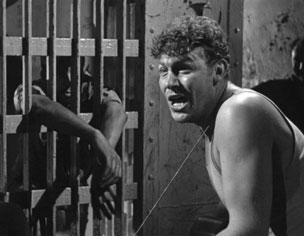
Sheriff Andy Taylor this ain’t. If you familiarity with the acting of Andy Griffith doesn’t expand much further than The Andy Griffith Show then prepare to be shocked by this picture. Released three years prior to the television series, the role Griffith plays is that of a scoundrel, liar, womanizer, emotionally abusive drunk. The character’s profession as a television personality delivering blues-based country music and humorous monologues about his upbringing in North Carolina is remarkably similar to how Griffith made his start in show business. However, the darker aspects of the character are believed to be inspired by television and radio personalities Arthur Godfrey (who fired an employee on air in 1953, revealing his controlling personality) and Uncle Don, a child TV personality who was caught calling his audience “little bastards” on air.
The story begins with Marcia Jeffries, the niece of a radio station owner in North Arkansas who hosts a series called “A Face in the Crowd”, whose focus is finding everyman figures with dynamic personalities. She comes across Larry Rhodes, a drifter picked up for public drunkenness. Larry is a very charismatic person who pulls people in and Marcia decided to make him a regular on the station, nicknaming him Lonesome Rhodes. Lonesome rises up through a local television station in Memphis and is eventually picked by a national network in New York City. All the while, he reveals his true nature to Marcia as someone not truly as “salt of the earth” as he claims.
The film feels prophetic, but when its based on personalities and hosts of the past it reveals how cyclical the fame and media machine truly is. It is inevitable that parallels would be drawn between this film and Bill O’Reilly, Rush Limbaugh, Glenn Beck, and countless other politically driven svegalis who emphasize their simple roots and connection to the common man. Lonesome Rhodes is a sympathetic character at points in the film, but never an admirable one. The theatrical audience could easily be pulled in by Lonesome’s grin and “fuck you” to the Man take on his earlier career.
The film is a pretty standard cautionary tale and director Kazan knows how to use his camera to accentuate the madness that begins to overtake Lonesome. I absolutely loved a montage that shows how Lonesome’s national television series becomes a hit. It was the perfect example of how to use montage in an effective way that isn’t simply cheating on the part of a screenwriter. I also loved a sequence near the end where Lonesome is taking an elevator down to the limo waiting for him. The camera cuts between the elevator buttons lighting as he descends and simultaneous descent of his approval in the eyes of the public and his sponsors. Brilliant, classic piece of cinema.

Film 2009 #109 – In The Loop

In The Loop (2009)
Directed by Armando Iannucci
Starring James Gandolfini, Chris Addison, Tom Hollander, Peter Capaldi

“War is unforeseeable.”

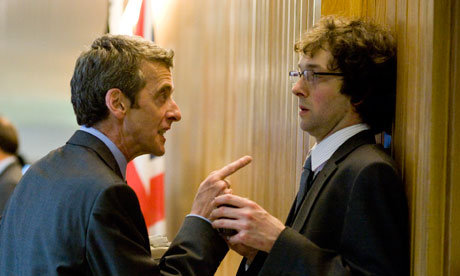
With this statement from an interview Simon Foster, the U.K.’s Secretary of State for International Development starts a hellstorm of media attention. He’s met with the ire of the Prime Minister enforcer, Malcolm Tucker and told he has to work damage control. Foster and his aide Toby journey to the United States and attempt to play the political game.

Armando Iannucci came to fame in the U.K. through his work writing and producing comedic series, in particular Knowing Me Knowing You and I’m Alan Partridge, both semi-improvised shows starring Steve Coogan. He was also the mind behind The Thick of It, a satirical look at the goings on in the Prime Minister’s office and what would become the foundation of In the Loop.

While American filmmakers feel a need to make their political films hard-hitting or iconic idolatry, Iannucci opts for the stance of pointing out the epic buffoonery that goes on behind the scenes of the most powerful in the world. The relationships in the film are all a series of adolescent one-upmanship. The methodology of going to war for many of the characters is simply to prove a rival wrong or usurp their position.

Iannucci and his actors are extremely comfortable with language and the dialogue is strengthened by that confidence. There are moments that feel like the dialogic equivalent of a blockbuster film’s shoot out and explosion sequences. This is also an incredibly subversive film that works to show incompetence at every level and a disconnect between those in power and the people at the bottom. One particular sequence involves Steve Coogan playing a character whose mother lives next door to a government building and is calling Simon Foster to complain that the wall between the properties is slowly crushing his mother’s greenhouse. Foster, at the U.N. and rushing to save face for a series of flubs constantly shrugs the man off.

If you are looking for some strong counter-programming to the thoughtless films of the summer, In the Loop provides an alternative that is equal parts entertaining and incredibly intelligent.