
Cosmos (2015, dir. Andrzej Zulawski)

cosmos-zulawski

This was probably one of the most French movies I’ve seen in a long time. The final film of Polish director Andrzej Zulawski, the film tells the story of Witold, a law school dropout obsessed with writing a garishly romantic novel. He and his friend Fuchs end up at a rural inn run by a family just as crazy as our protagonist. Mrs. Wojtys is prone to outbursts of screaming only to freeze in place for a few moments after. Her husband Leon is an insane retired banker who is constantly twisting around language. Her daughter, Lena, becomes the focus of Witold’s obsession and comes to despise her pretty boy architect husband. He also holds an obsession with the housemaid, Catherette, who suffers from a lip deformity as the result of a car accident. Throughout the story is the ongoing mystery surrounding a bird found hung by its neck in the garden behind the house. The film meanders through the inn and the group all end up at a seaside cottage for the finale, chasing each other through the woods with lanterns.

To say Cosmos caused major confusion as I watched it would be an understatement. There is very little plot to the film beyond what I described. The majority of the picture consists of Witold exploding in wildly emotional monologues either while typing out his novel or lamenting and pining over the unobtainable Lena. I personally love films that challenge narrative structure and experiment, but moments of Cosmos went so far over the top it lost me. Scenes play as vignettes that don’t really add up to a meaningful whole.

The acting was wonderful due in part to how free and insane the characters were meant to be. Sebastian Genet as Witold did an incredibly convincing job of portraying a comically angsty poet/philosopher. He even made the stranger moments captivating enough to keep me engaged. Early in the film, he has a moment where he faces the camera and repeats the phrase “The savage power of stupid thought” over and over in a Donald Duck voice, looking like he is both on the verge of tears and bursting out laughing. In many ways, that phrase serves as the thesis statement of the film.

The film was packed with references to authors and figures of note in the arts. This becomes part of the word play with Witold referring to Sartre’s Modern Times, only to have Fuchs mistake it for the Chaplin film of the same name and proceed to perform the waddle of Chaplin’s Little Tramp. The crazy old man Leon overhears a conversation about films and chimes in with “Spielbleurgh” (bleurgh being an expression of disappointment) which leads to a sort of pun competition between the man and Witold to plug bleurgh into a litany of other names (Bleurghman). I seem to recall another of Leon’s bizarre turns of phrase being “When an icicle mounts a bicycle it becomes a tricycle”. *Shrugs*

I was never bored by Cosmos but I was pretty strongly confounded for 90% of it. It is a movie that has a very strong forward momentum, that momentum is just leading you to nowhere, but that is on purpose. By injecting things like the hanging bird mystery into the film Zulawski almost seems to be daring you to try and make sense of this absurdity. The film does manage to capture the chaotic nature of creativity through Witold’s mad outbursts of typing as his novel becomes more and more about recording his angst. Most definitely a film that does not have wide audience appeal, but then not all films should. If you are wanting to be challenged and confounded Cosmos is certainly up to the task.

Colonia (2015, dir. Florian Gallenberger)

colonia-toronto-film-festival1

Colonia is a film about a fictional people living through a real historical nightmare. In 1973, General Augusto Pinochet led a military coup in Chile and began detaining, torturing, and worse to people who had been loyalists to the deposed President Salvador Allende. Lena (Emma Watson) is a German flight attendant who is in a relationship with photographer and Allende activist, Daniel (Daniel Bruhl). Both end up taken away by Pinochet’s men and imprisoned at Colonia Dignidad, a work camp and cult run by lay preacher Paul Schäfer (Michael Nyqvist). They endure psychological and physical torture as they struggle to find a way out of this living hell.

I am always eager to learn more history about regions of the world I’m foggy on. There’s just so much and our experience in the United States is very narrow. Paul Schäfer was a truly horrible human being who ran Colonia Dignidad for decades before Pinochet was toppled and he was finally brought to justice. It was discovered that Schäfer had been molesting young boys put into his care at the work camp, which the film hints at. The other members of the colony had their connections to the outside world removed and were even drugged to remove their sexual drives.

Colonia is a film about a fascinating topic. But it is an incredible failure in presenting a consistent tone and focus. The story begins as a period piece with a romance overlain. It’s a little cliche at moments and I didn’t feel a lot of chemistry between the two leads. Not sure if it was the actors or the director, but it never feels believable. Then reality sets in hard with Pinochet’s coup and the film starts to take on a more serious focus on the weight of the history happening around the characters. The film appears to be retaining that tone as Lena and Daniel end up at Colonia. However, when Lena has some real moments of peril we have convenient moments of plot occur to spare her the brutality. Almost every character around her is brutalized to a horrific degree, but through sheer luck, she escapes it. The tone undercuts the film again in the third act as the story devolves into a pretty simple race against time, thriller.

The film never felt like it handled its source material with the weight it deserved and came across more like a Lifetime Channel film than something of substance. The film wants to be a romance, it wants to be a documentation of a historical atrocity, and it wants to be a political thriller. It ends up being none of these things and feels embarrassing in many moments. Nyqvist is the highlight as Schäfer but still could have benefited from more development. Colonia does inspire me to want to find a documentary on this subject because I know there is so much more to this very important story.

Just People

marka-gbm

Dr. Dana Chamblee-Carpenter introduced me to the concept of confluence through the writing of Eudora Welty. This was Southern Lit or some similar class, time fogs my memory on the specifics. In Welty’s work, confluence was the coming together of themes and ideas through imagery and plot. As my life has gone on, I’ve grown to see confluence happening around me. A series of disparate and fragmented events all seem to randomly coalesce into something of greater meaning. In this moment of confluence, the protagonist of the story will have a sudden transcendent understanding of their condition or the world they inhabit.

This week my friend, Mark Diaz-Truman posted a blog about troubling behavior he saw in the  fractured tabletop roleplay community. He mentioned specific people by name in this post and it was met with a lot of blowback and anger. My personal opinion, and yes it is biased, is that I believe Mark’s intent was not to cause harm but came from a genuine place of caring about a community he’s a part of. It’s been pretty disheartening to see that same community go wildly on the defensive to justify behavior that they themselves call other out for.

*****

In Nashville, the school board elections are in full swing. And it is probably the dirtiest elections the city has ever had for school board. A record-setting amount of money has found it into the campaigns. Mailers are going out en masse declaring incumbent members of the board of being negligent or not having the students’ best interest in mind. I am friends with many of these incumbents and know for a fact these are false allegations, that the struggle in schools right now goes beyond a school system and has more to do with a society that is becoming more economically segregated as the years pass.

One of the challengers in this race, Jackson Miller has chosen to run his campaign on the platform that the incumbent, Will Pinkston, is rude in his online interactions. Yes, Will can be a tough pill to swallow but Will is also right most of the time, is incredibly passionate about the kids and is never rude. He is an incredibly direct guy and he sharpened his mind working for some pretty great Tennessee politicians like former Governor Phil Bredesen. Jackson Miller was recently confronted with multiple tweets going back to 2008 where he makes misogynistic and racist comments about people and groups in our city. These tweets gathered a lot of attention and were picked up by the local news who ran stories about the situation.

In addition, the head of a local non-profit that also operates a number of charter schools in Nashville had e-mails leaked where they were blatantly violating campaign laws attached to their non-profit status. Their reaction was almost a non-reaction. Online their defenders continue to cite their end goal of “helping the students be successful” as a reason why the violation of the law should be overlooked.

******

I was scrolling through Facebook and came across a meme that detailed how Hillary Clinton allegedly referred to a group of mentally disabled children on an Easter Egg Hunt during her husband’s term as “retards”. The purpose of this meme was to show how Clinton is unelectable. I assume the poster of this meme wants me to vote for Donald Trump instead. Trump, a man who has mocked a disabled news reporter, talked in horrifically misogynistic terms about women and been eager to draw up lines of division between people. Maybe Clinton really did say that during the easter egg hunt. I don’t see how that excuses Trump’s behavior and means I should endorse him. But in their own minds, people find ways to justify this bizarre line of thinking.

*****

I am not the best student of history that I should be. I know a little, I want to know more. But from what I do know, I think it’s right to say we are in a period of extreme division as a country and probably even worse as a planet. We live in a world of binaries with sub-binaries and sub-sub-binaries. You aren’t a Republican or Democrat. You can be a moderate Republican, an alt-right Republican, an independent Democrat, a neo-liberal, a neo-conservative, a yellow dog Democrat, a progressive Democrat, a RINO, a DINO, etc. The drilling down of divisions has brought me to a real crisis point. I have family members that are committed to voting for Trump. I cannot vote for him and I am not enthusiastic about voting for Clinton. I will because I see Trump as a clear and present danger to the United States.

I look on Twitter and see “punk dudes” cracking wise about the hypocrisy of the Democratic Party. They aren’t wrong. They are definitely right. I see “centipedes” on Reddit meme-ing their lives away promoting Trump to the point a parody subreddit is started to mock them. I see Clinton people angrily telling Bernie people to just stop and give up. I see Bernie people not realizing that they can fight in a different way even if Bernie didn’t get the nomination, in a way that doesn’t harm. Everyone is so on edge and ready to lash out at a moment’s notice. Everyone questions everyone else’s motives with such deep hateful cynicism. People aren’t people anymore, they are walking ideologies that I need to lash out at with my ideology. And if they aren’t in lockstep with my specific interpretation and system of beliefs then I, and other in my faction, need to dogpile them.

Every single person you meet has suffered. It’s not a contest and it’s near impossible to truly compare suffering. If that’s something you do, then you’re sick. There are two levels you have to operate at: The larger global level is to acknowledge the societal and cultural structures in place. You have to acknowledge that black men and women are getting brutalized and killed by police officers in America at a rate that is beyond horrific. You have to acknowledge that me, a white guy, does have more privilege than a lot of other demographics in America. There is a lot of sociological turmoil right now in this moment, but a lot of progress too. I never imagined LGBTQ people would have the right to marry in America in my lifetime. That’s huge, lots of progress still to go, though.

But while we were living in the larger global sphere of thinking we forgot we have to live somewhere else at the same time. We have to be individual humans to each other. Every person you meet has suffered. You don’t need to know how and you will likely never know how. Even the people you think you hate, they have suffered too. People you love die. People you love betray you. People you don’t even know hate you. People you know hate you. People judge you and talk about you and annoy you and harass you. People hurt you. No one should ever excuse them or let them get away with that. But those people you direct your anger at because of perceived ideological divides are probably suffering in their own ways right now, today.

They are dealing with crippling financial instability. They got kicked out of their house. Their dad died today who they never really got to know. Their partner is in and out of the hospital without hope in sight. They miscarried. The feel like a failure. They can’t concentrate because of anxiety. They wake up in the night from nightmares that force them to remember something they want to forget. They don’t know what to do with their life. They live every moment thinking they are fat or ugly or unloved or unimportant. They spent decades in a loveless marriage only to be abandoned. They got the shit beat out of them when they were a kid. They had their trust in someone they loved violated. They had a stranger violate them.

And then you get online and call them “a piece of shit motherfucking loser”. Or they get online and call you the same. And then it erupts and everyone makes their digs and they are a piece of shit for voting for Clinton and you are a fucking asshole for voting for Trump and you are shitlord and they are an asshole and on and on and on and on and on…

Everyone is hurting. People you don’t know are hurting. People you *think* are your enemies are hurting. There is evil in this world and it preys on this shit. It grows stronger on our hate for each other. This isn’t about compromising your principles. This is about adding a principle to that list and living by it, no matter how hard it is, and it is going to be hard. I know it will be.

*******

I have every reason to hate my father. He treated my mom and the kids like garbage. He kept it mostly emotional abuse and when I was around fourteen he physically beat me. After a year of working in AmeriCorps, I came home, spent another year substitute teaching. Before I went down to see Ariana in Puerto Rico there was a big blow-up fight. I left and while I was there he called me to tell me all my belongings had been moved to a storage shelter, he would e-mail me the address. I was not allowed to come back to his house. Earlier that day, Ariana’s father had died. We cried together.

Years later he would call, leaving sobbing voicemails saying he wanted me to come to the house for Christmas. One year he told my siblings to not go see me at Christmas so that way I would be forced to come see him. That same Christmas, he got angry at my mom for spending money on a Kindle for HIM. All my childhood I was taught to fear spending money to the point that when I was about to rent my first house with my wife I had a panic attack, afraid that suddenly spending that money meant something bad was going to happen to me. I lived in fear of confrontation because everyone was him. If I made someone too angry they would abandon me like he did.

I had every reason to hate him. And I did. I hated him with the core of my being. I wished he was dead. And then one day I realized that hate was not making me better. Living as a hateful person was killing me inside. I forgive him. Doesn’t mean I want him in my life or I want to have him over for Christmas. He’s still a toxic person to me. But I forgive him. His dad beat him. I honestly believe he has some level of untreated bipolar disorder when I reflect on my childhood. But I can’t hate him. I can’t resent him. Not as some form of release of responsibility for his actions, but for me. I still let my emotions and my anger override my humanity and I struggle all the time with that.

*******

The reason why Mark or someone else might get very specific and public in a post about people’s behavior is because he loves them. You want better for them. You don’t want people to see them and think all they do is mire themselves in hate. You want people to see in them what makes you love what is essentially your family. And confronting family is a hard thing to do. Often family members trying to uncover ulterior motives and assume the person just wants something from them. But I stand by Mark and truly believe he spoke with love. He doesn’t want his family to live with growing hate in their hearts. He loves them too much to let them live like that.

You may read this and roll your eyes and think I’m being a naive idiot. I’m sorry you think that way. I don’t know what pain you have felt in your life, but know that you can’t let the hate swallow you up. Be passionate. Be motivated. Be protective of yourself. Don’t let others harm you. But don’t give away your humanity in place of hate.

Rolling Dice and Shaping Minds: Systems of Play and Teaching – Part One

Dungeons--Dragons-dice-010I was a teacher before I ever picked up a roleplaying manual. In 2009, after completing my Master’s in Teaching and Learning I was struggling to find a job. In the meantime my wife, then fiance, suggested I try running the latest iteration of Dungeons & Dragons. She had experience in her youth with tabletop roleplaying and I had always been curious about the TSR advertisements that popped up in the comic books I read over the years. So I got a copy of 4th edition and read through it. The very first thing I did was try to make my own character. I reasoned that I wouldn’t know how to run a game if I didn’t know how characters worked. It didn’t seem too hard. In a few weeks, I had slapped together some ideas and ran an online session with some friends. We enjoyed it and I decided to keep it going. This was the beginning of my education in tabletop roleplay.

Dungeons & Lesson Plans

It was Sunday and I sat going back and forth in a number of PDFs and web pages trying to assemble some monsters, dungeons, and assorted NPCs for my players. I don’t care for the pre-planned lessons in the state-sanctioned curriculum, at the time I felt the same about using a module. From my limited experience as a GM, I saw it as limiting me and my players’ choices about where they wanted to the story to go. If the module didn’t gel with the style of characters they’d rolled up it might not be enjoyable. So instead I spent hours making scenarios that went along with character information fed to me during previous sessions.

I think my dislike of using a module comes from my dislike of the direct instruction model of teaching. This is essentially passive learning, where students take part in seminars, observations, and demonstrations. Direct instruction was formally developed throughout the 1960s by Professor Siegfried Engelmann and Wesley Becker to help disadvantaged students due to poverty or by being minorities, students who historically have not had the resources and privileges of others. This model of learning focuses on explicitly defining key terms, ability grouping students, and regular assessment to determine how much progress a student has made.

When you say the word “school” this is probably what most of us imagine. There are a lot of benefits to this way of teaching. You make key concepts very clear to the learners and you model skills step by step. If a student is paying attention they will definitely understand the basics. But it is not a very engaging way of learning. As I mentioned above, it’s known as “passive learning”. If a student is truly struggling or has no interest in the concepts they likely won’t get much. So the tug of war begins between in the learning process: is this about the teacher finding ways to engage the student or is it the student’s responsibility to find their hook?

Let’s come back to the module based tabletop roleplay. Using a pre-planned, adventure with most of the gaps filled in can be very disengaging for some players. But just like you would find in a classroom, some players/students like being led down a very clear path so they get the most out of the experience. Some of my favorite professors in college were notorious for being a little digressive. I enjoyed that, but other students had a different expectation of what they should get from a class.

In education, the Direct instruction model has come under a lot of fire lately. When the modern academic reform movement was getting started in the late 1980s, psychologist Robert Slavin released Success For All. This program heavily emphasized explicit direct instruction and was originally rolled out in Baltimore with a focus on children living in impoverished communities. SFA has become a major building block on which a lot of public school districts and charter schools have built their foundations on. The major criticism of the program is that it focuses on “drill & kill” instruction, some of the lowest level of thinking and learning on Bloom’s Taxonomy. It also pushes for a very authoritarian view of discipline. Students must not just follow a very clear path in terms of their learning but also behavior, with incidences of demerits in schools being given out over picking a pencil up for a classmate or not standing perfectly in line.

I personally don’t like telling children what they should want to learn. As a teacher, I know there is always content they are going to have to learn. And that gets taught in my classroom, but how they learn it can be made into an engaging, enjoyable experience. As a teacher, I’m always walking this tightrope between addressing the standards my students are expected to master and making learning an experience they want to continue for the rest of their lives. As a GM, I have expectations of what I want to get across to my players, whether that be certain plot beats, NPCs, a mood or atmosphere. But I also have to be mindful of what will keep my players engaged. If the game becomes me sitting there and simply reading some fiction I wrote with an occasional dice roll then I wouldn’t blame a player for completely breaking off.

There’s also a contingent of students/players who don’t like the idea of a structure that’s too loose. These stakeholders want assurance that they will be experiencing a complete narrative in a game and a purposeful lesson in education. They need concepts laid out concretely so they can feel that their investment of time was worthwhile. So adventures modules and direct instruction models are guarantees that there will be a direct thru line in the experience. From an educational point of view, I have been that student, sitting in a class with way too many professorial digressions and wanting to get to the point. I also believe my mood was affected by my relationship with individual teachers. The teachers I loved I could listen to digressing for hours. The teachers whose classes I barely tolerated I wanted to be super direct and get us to the end of the hour as fast as possible.

So, we come back to that Sunday afternoon. I have planned out around three hours worth of content and begin thinking about how my players will want to diverge from my path and so I end up inevitably making things up off the cuff and all these “plans” get tossed aside. So why am I making all these intricate detailed plans? That was probably the moment I gave up on D&D and haven’t really gone back to it, or any other OSR style of tabletop game, since. I don’t think I dislike those games, I know I don’t have an urge to run them anytime soon, but have always been open to playing them and seeing if I can find a GM who can make them shine for me.

But in that moment,  I began searching for something new and different. My search would lead me to discover a bounty of new games and in turn, would lead me to sit at this desk and writing this very post.

Next: Fiasco! And Inquiry-Based Learning!

Batman: The Killing Joke (2016, dir. Sam Liu, Bruce Timm)

joke

Batman: The Killing Joke is an adaptation of the 1988 graphic novel by Alan Moore and Dave Gibbons. The original text tells the story of a possible final showdown between Batman and his arch-nemesis, The Joker. The battle hinges on the sanity of police commissioner Jim Gordon after The Joker shoots his daughter Barbara and tries to drive Gordon mad by taunting him over the randomness of the act. As this battle of ideologies rages on, we get distorted memories from the Joker about what his origin as a horrific villain could have been. The emphasis is on the idea that one bad day can destroy a normal person. Due to the short length of the comic, the writer of the film added an additional thirty minutes of content to flesh out Barbara Gordon’s career as Batgirl.

I first read The Killing Joke as a freshman in college in 1999. I had never encountered writer Alan Moore up until that point and I did find it a captivating read. This is mainly due to the way it turns the Joker into a tragically pathetic figure. The book also leaves the final moments up in the air as to what Batman does to the Joker. I’ve probably read it a half dozen times in total over the years. A valid point has been made in recent years about its treatment of Barbara Gordon. She is shot early on in the comic and pops up one more time for a doctor to declare her paralyzed. Essentially, Barbara is treated as a plot device to motivate Batman and torture her father. There’s no humanity in what happened to her and it took a few years before other writers redeemed the character. In retrospect, Alan Moore even views the comic as too violent and cynical. I can’t help but retain some love for the text due in part to what I find an interesting exploration of the Joker’s psyche, but I still recognize the mistreatment of Barbara Gordon.

The film has some huge problems in its attempts to “fix” this slight of Ms. Gordon. The thirty additional minutes of story focus on Batgirl pursuing the nephew of a Gotham City crime boss. Francesco is attracted to Batgirl despite her attempts to take him down and attempts to drug and force himself on her, which she dodges by locking herself in a vault. There’s also a subplot where she talks about her relationship with Batman, describing him as a yoga instructor, to a coworker while commiserating on her love life. This eventually escalates to Batman and Batgirl having sex on a rooftop. This is not something I was expecting to see happen as in the comics there has never been a relationship between the two. She’s closer to Robin’s age and has been more involved with him when they were adults. But here, Barbara is in her early 20s so it’s not illegal, but still cringey. Later in the film, she reaches out to Batman and he brushes her off and she realizes it’s connected to their sexual encounter. I understood Batman’s motivation of not wanting to become too close to anyone lest them become compromised, but the only sequence read very awkward and completely unnecessary.

The added Barbara material works even less in the final two-thirds of the film after she is shot. Just like the original graphic novel she fades into the background and it becomes a Batman/Joker story. The Joker doesn’t appear until about 40 minutes into the film which is another odd structure piece. The Joker’s dialogue is lifted straight from the original text and while, for the most part, it doesn’t play awkward there is one moment where he puts Gordon on a hellish ghost house ride and it is way too wordy and overbearing with philosophical content. It doesn’t feel like the Joker would say this out loud, particularly the voice of Mark Hamill as the Joker. On the page, it’s not bad, but page to film translations of comics are never a great idea.

The animation is a very mixed bag. There is a concerted effort to make the iconic moments from the original text pop on screen and it looks alright. The rest of the animation comes across as very cheap and continues the trend with so many of DC’s animated feature films looking subpar. There was a featurette released a few months ago where the creators explained that original artist Brian Bolland’s style was too hard to emulate in animation so they looked at other artists, including Kevin Nowlan. I didn’t see much of Bolland or Nowlan in any of this animation. It just looked very poorly done.

I can’t really recommend Batman: The Killing Joke animated film. There are just so many technical and narrative missteps that add up to make a mess of a film. I had high hopes for this one. DC Animated had surprised me with its Dark Knight Returns and Year One adaptations but really missed the mark here. I would still say the graphic novel is worth reading if you haven’t, but the philosophical study of the Joker has been covered elsewhere, particularly The Dark Knight Returns in a much more interesting way than this animated film.

The Daniels – Selected Music Videos Part 1

daniels-620x348

While not a comprehensive look at the music video of work of Daniels, my attempt is to touch on the key points in an effort to show the common themes and ideas that pop up throughout their work. In particular, I am looking at what led to Swiss Army Man, both from themes and technique.


FM Belfast – “Underwear”(2010)

This early Daniels video is very simplistic in its setting, characters, and concept but is already seeding the larger ideas and themes that will populate their work up to this date. In an interview with Motionographer, the duo explains their emphasis on casting “people who didn’t mind being ugly”. The video is lit very dimly with a harsh spotlight/flashlight shone on the central figure in each scene, with the light levels oversaturated. This creates a very creepy home movie feel. It looks like the characters are being filmed by some unscrupulous figure off camera. There is also the presences of dust particles floating throughout every scene. In the interview, Daniels explained this effect was from smacking a dusty shoe and an old copy of The Godfather. That footage of dust was then overlaid on the footage of the characters dancing.

One particular effect stands out as something Daniels won’t return to and they even hint is a bit amateurish. The bartender character goes through sequences where his legs become like rubber, bending back and forth. The directors explain that this is called Slit-Scan Photography, an old school effect made easier with modern filters and technology. This effect will not appear in this way for the remainder of the videos and it signals an effort to push for more advanced and complicated special effects.Stop motion technique is used in the sequence where Daniel Kwan violently thrusts the clothes off of his body and onto the wall.

The key effect that will come up again and again in these videos will be Daniels’ use of zoom focus. This is the instance where we begin to zoom in on the figure while shifting the camera in multiple directions. This is typically a signal that the figure is about to lose control of their body in an even more extreme way.

Thematically, we have the loss of control of the body. An unseen force appears to possess each figure on camera and they look with shock, and sometimes acceptance, as they perform convulsive like dancing. Characters appear to be visibly uncomfortable or not at ease with where they are. The movements that overtake them definitely have a sexual nature and most of the figures eventually give into this uncontrollable force. The scenes have a distinct after hours motif and convey a sense of the discomfort “after the party is over”.


The Hundred in the Hands – “Pigeons” (2010)

The techniques are refined a bit more in this video than the former. We still have the after-hours setting. Claustrophobia is induced with tight close up of our female protagonist squashed between partygoers. The young woman is teetering between her enjoyment of the party and collapse. The video kicks in with her suddenly vomiting, transitioning into an explosion of sparkler fire from her mouth. Daniels will not shy away from bodily fluids or functions in their work and here the expulsion is turned into something beautiful, subverting our expectations from experience and the look on the central figure.

Here we have a character losing control in front of other and the crowd reacts with realism. Screaming and clearing out space. Our protagonist flees the party but finds the laws of reality falling apart. Here dancing is forced by the very frame of the video twisting and turning, and her body following the movements. At first, she fights against this, but over the course of the video she finds herself in sync with the world’s movements around her and appears to almost feel euphoria.


Manchester Orchestra – “Simple Math” (2011)

Unlike the previous two videos, here we have a full-blown narrative. The techniques continue the mix of practical and digital effects and reminded me a lot of the practical work of Michel Gondry. The premise is essentially a man’s life flashing before his eyes after swerving to avoid a deer in the road. The video uses a series of symbols to link moments from his past to this moment in the present. Reality crumbles even further than the previous two videos in some clever ways. It’s the most introspective music video so far. Also important to note that this moves Daniels into a rural, wooded environment instead of an urban one.

Again we have more distortions in time and space as the protagonist moves from his accident in his car, back to his childhood, and then into a mishmash of past and present. There is also the body as a force of destruction when the protagonist as a child tears through trees and people with an explosive fury.


Chromeo – “When the Night Falls” ft Solange Knowles

This is the first of the overtly comedic videos. While previous videos listed had funny moments, the entire premise of “When the Night Falls” hinges on a ludicrous concept. As the band plays, the power of their music impregnates the women in the audience. The tone of this video feels very much like a cross of A Hard Day’s Night and Michael Jackson productions of the 1980s. There is also a lot of power in these women. They become pregnant with such force they explode tables in the bar. They are an unstoppable force. The reveal at the end that this is the nightmare of an apprehensive new father feels a touch maudlin for Daniels other work.


Battles – “My Machines” ft. Gary Numan (2011)

Returning to a more simplistic setup, the action in “My Machines” is confined to two shots of a mall escalator that track from the first mark to second mark then concluding with the first mark. There’s much less narrative here and more technique on display. In an interview with Pitchfork, Daniels explained the idea came from as simple inspiration as possible: they thought the music sounded like a man falling down an escalator.

They expand on this, though. Daniels refer to the experience of the protagonist as a nightmare and that part of the nightmare is that while people are all around him, no one helps. Kwan stated, “That’s one of the grossest things about malls– everybody gets together and buys things and doesn’t talk to each other. It’s what makes malls so scary.”


Foster the People – “Don’t Stop” (2011)

This video has more in common with Daniels work on “When the Night Falls”. A very light narrative that incorporates the band into the story. Zoom focus plays a critical role in establishing character mindset. The video begins with fairly standard camera shots, but when the action begins we have a zoom focus on the protagonists as a nod that the energy of the video is about to explode. There’re more plays with reality, more concrete and grounded. The driving instructor wears a fake mustache, the driving student is apparently a bank robber. We also have a character getting bloodied and banged up as seen in “My Machines”. The biggest change to Daniels work is the addition of small scale car stunt work.

The video was originally made to be viewed on the Nintendo 3DS. Inspired by Jackass The Movie, Daniels filled the video with stunts and action. In an interview with The Creators Project, they discussed the difficulty of filming with two cameras in sync and need to keep both stabilized and focused together. In this interview, they address the melding of humor and violence that permeates their work.

“[…] we’re pessimistic romantics. We are lighthearted fun-loving guys who think the world is pretty fucked up and crazy. And there’s a philosophy under that. Learn to laugh at life, ‘cause then you can stare life’s challenges in the face more objectively without crying as much. Making movies is our therapy. Sorry, you guys have to watch it all. And we’re very sorry to the folks we’ve tricked into paying for it.”

TV Review – Stranger Things

Stranger Things (Netflix)
Created by Matt and Ross Duffer

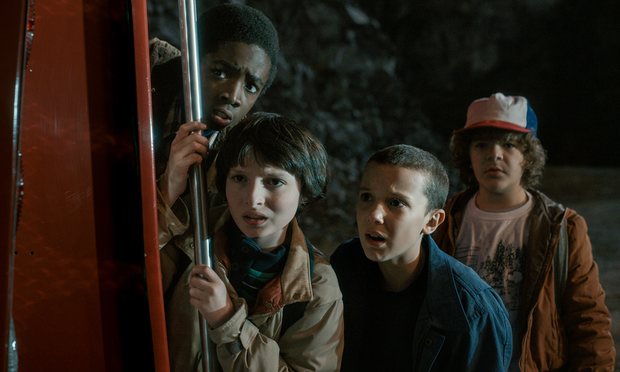
strangerStranger Things is an 8 episode series released by Netflix. It tells the story of the disappearance of Will Byers in the small town of Hawkins, Indiana and the bizarre phenomena that begins to occur around those affected. The series features an ensemble cast with David Harbour (The Newsroom) leading the cast as Sheriff Jim Hopper. Alongside Harbour are Winona Ryder as Joyce Byers, the mother of the missing boy, Finn Wolfhard as Mike Wheeler, Will’s best friend, and Millie Bobby Brown as a mysterious girl who know what happened to Will. The series is dripping in early 1980s nostalgia and plays out like a Stephen King novel or Spielberg film with a bit more darkness added.

The most noticeable aspect of the film is that it is firmly entrenched in creating an early 80s vibe. The title sequence’s music and visuals are tailored to mimic a dark synthy score of horror films and the font of a King novel cover. Because three of the series’ major characters are adolescent boys references to Star Wars and Dungeons & Dragons abound. There’s more tonal and thematic touches that bring E.T., Poltergeist, Alien, and other period films to mind. In fact, this probably the show’s highest selling point, the recreation of the feeling of the childhood of many of its viewers. As a child of the 80s, I definitely felt it, probably not as much as someone who was a peer to the featured children would. I am curious how millennials view the series due to not having the nostalgic buy in. It’s also impossible not to think of Super 8, a very similar homage to the sci-fi/fantasy films of the day. Super 8 is definitely enamored with the Spielberg vein exclusively, while Stranger Things is willing to go to darker places and play with Stephen King and David Cronenberg territory.

The plot is not necessarily revolutionary. Because the show is a nostalgia trip, it weaves together ideas from a number of sources. I was pleasantly entertained by the twists and turns, and there are some predictable moments that don’t detract from the pleasure of watching. The key piece of the story, what took Will and where he is, were the most original parts. Thankfully, there is never a large chunk of exposition to explain away what is happening and the series requires the viewer to piece together segments of plot over time to have a full understanding. I appreciate that the show respected my intelligence enough not to have the central human antagonist sit down and lay out the plot to another character.

The characters and acting were a slightly mixed bag. First off, Millie Bobby Brown is going to be a major actress in the future, and honestly, already is in my opinion. I always say the best way to tell how good an actor is would be to watch them in a scene without dialogue and see how well they convey emotion without being over the top. Ms. Brown knocks every scene out of the park. She tells a rich, nuanced story through her face and her eyes. I learned she was part of a BBC America series called Intruders where her character is possessed by an older evil man and cannot wait to dig in and see how amazing she plays that. David Harbour does a better than expected job as Hopper. So often the role of town sheriff in these sorts of stories comes across as a paint by the numbers character. Hopper’s story adds a tragedy that is never played up too huge and is only highlighted at just the right moments. The character’s descent into paranoia as he comes closer to the truth is very entertaining and if a second season comes, I am interested to see how his character develops. Winona Ryder did not feel natural in many of her scenes. She basically plays one note, hysterical grieving mother for the majority of the series. That is what her character is going through but it would have been interesting so see some more of her. She definitely knows her character’s motivation and it guides her acting in every scene. The trio of young boys are wonderful and they each have a specific dynamic in the group that doesn’t come off as a checklist.

Stranger Things is a very fun series. I’ve enjoyed most of the 1980s nostalgia media and particularly like when it is done with an attention to tone over nitpicky details. It felt like watching a very long film from my childhood and it kept me hooked the whole way through. The series ends with a number of hooks for the second series but I won’t be disappointed if we don’t get another. These eight episodes are a complete, satisfying story, very much in the vein British television where each series attempts to close off its plot. Stranger Things is a perfect recreation of 1980s summer cinema that you can get lost in.

Mustang (2015, dir. Deniz Gamze Erguven)

mustang-2

While Mustang takes place in modern day Turkey it is a story that could happen at any time and almost any place. Five adolescent sisters suddenly have their lives changes when their guardians: their grandmother and uncle, decide they are becoming corrupted by secularism. They have everything that could provide them contact with the larger world taken away, from cell phones to laptops to clothes considered improper to makeup. They begin to seek out arranged marriages for the older girls and the imprisonment takes its toll on the girls.

Told from the perspective of the youngest, Lale, the film is made with a lot of confidence and skill. The camera is mostly handheld and conveys the youthful energy of its characters. Sunlight is also used quite effectively to act as a force that still connects the girls to the world. The subject matter could very easily lead to a bleak, hopeless film but director Erguven is able to sustain a sense of hope at the end of this nightmare. Each of the girls experiences the loss of their freedom in different and interesting ways.

When questioned on her wedding night on why she didn’t bleed after sex with her husband, the eldest sister finds it easier to just confess to having slept around with boys when no one listens to her explain she was a virgin. Another sister, seeing that an arranged marriage is inevitable, convinces her boyfriend to ask for her hand as a way to reclaim some of her freedom and choices. Choosing this story to be told through Lale’s eyes is perfect because it puts us at a disadvantage as it relates to the details. Like Lale, we have to try and figure out what is happening in the world as we go.

There have been some comparisons to the Sofia Coppola directed The Virgin Suicides, but beyond the very basics of the story, there is very little similarity. While The Virgin Suicides is told exclusively from the male perspective, Mustang a very intimate look at these young women’s lives. You gain a greater understanding of how each character is processing the experience rather than the broad strokes of Suicides.

The film must maintain a fine balance between the realism of its situation and refraining from despondency. There are moments in the latter half that are a shocking jolt in the midst of Lale’s dreams of escape. If there is a central message here it would be about the power of determination and will. Lale never resigns herself to the loss of her freedom. From the minute the girls are locked away, she is shaking the bars on windows, spying on locations of keys, and plotting an escape. The film has a quite a bit in common with films like The Shawshank Redemption and Escape from Alcatraz.

Filled with humor and joy, Mustang is a timeless story. It transcends any particular religious or geographic specifics and conveys an experience that is felt by women across the globe at varying levels of intensity. Societies seem to have a preoccupation with controlling the will of their female citizens, based on a fear of loss of control. Director Erguven states firmly that this type of energy is impossible to contain and through Lale she tells a story that gives hope to those who may feel like they have no more freedom.

Comic Book Review – The Ultimates: Omniversal Volume 1

The Ultimates: Omniversal Volume 1: Start With the Impossible
Writer: Al Ewing   |   Artist: Kenneth Rocafort
Purchase this book here

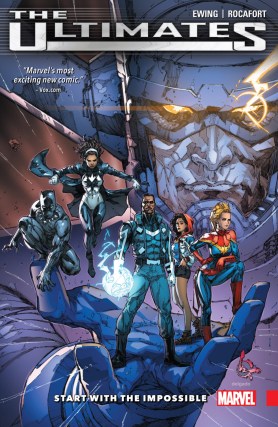
ulitmates vol1The Ultimates has been a superhero team name used in many different contexts in the last decade by Marvel Comics. The current incarnation is a drastic shift from the former. Led by Captain Marvel, the Ultimates is another one of those “pro-active” teams. It’s a concept that’s been done many times before and I’ve never felt it’s never been done too successfully. However, writer Ewing has figured out a format that allows everything to work. The team counts Blue Marvel, Spectrum, Ms. America, and Black Panther among its members and their focus right out of the gate is a huge one: complete the metamorphosis of Galactus that was hindered millennia ago.

Galactus is a carryover from the universe that existed pre-Big Bang. He was saved by his specialized spacecraft and became an omnipotent world devourer in the new reality. The problem was that various armadas from across the galaxy interrupted his gestation and that is why he now eats planets to survive. Blue Marvel has deduced that Galactus needs to be put back in his ship and the process will be completed. Every member contributes their skills to this might endeavor and it’s a very satisfying two-part story. The conclusion establishes a status quo for Galactus that me genuinely shocked and excited.

The remaining three issues in the collection focus on Blue Marvel’s quest to repair the damage done to the timestream in recent years. Between the original teenage X-Men running around in the present day, the timeline catching up with what used to be the “future”, and the reality rendering of the recent Secret Wars, the Marvel universe is operating on a razor’s edge. The team constructs a ship capable of traveling into the space beyond the universe where they plan to fix what’s wrong. What they find ties directly into Blue Marvel’s path and they get help due to some of their previous actions.

ultimates 02This was the first Marvel comic that felt like it was capturing some of the magic I used to love about DC. Having a team that tackles the cosmic and multiverse level problems is always so interesting to me. I also love when a writer takes well-worn concepts, like Galactus, and makes changes that will forever alter them and open up a whole new world of stories to tell. The sense of a growing universe is so much fun, better than comic books that feel stagnate or just kill characters off only to bring them back months later. Character growing and changing their mindset is much more interesting.
The stories here are definitely not new reader friendly. Even with an effort to fill in some backstory for Galactus or Blue Marvel, it’s still pretty essential to do some background reading if you want to fully understand who these characters are and what is happening. The final issue in the collection is particularly impossible to parse due to its focus on a character with a lot of complicated history in the Marvel Universe. So if you enjoy jumping in the deep end you’ll like this comic but if you prefer to have things explained detail you might look elsewhere.

If you read Jonathan Hickman’s work the last few years at Marvel (Secret Warriors, Fantastic Four, Avengers World, Secret Wars) then this takes the ball and keeps it rolling. Events happening in Civil War II were seeded right here. I will definitely be keeping the series on my reading list. It hits those high adventure, exploring the unknown notes that Fantastic Four provided in at its best, continuing an important tradition in the Marvel U.

Comic Book Review – Monstress Volume 1

Monstress Volume 1
Written by Marjorie Liu  |  Artist: Sana Takeda

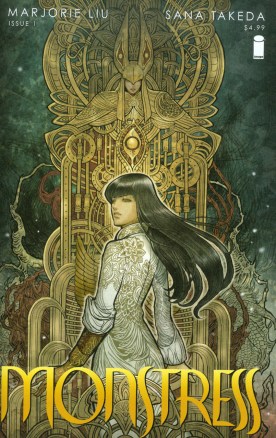
monstress 1At first glance, the protagonist on the cover of Monstress doesn’t look very monstrous at all. Maika is a beautiful young woman without horns or scales or anything denoting a monster nature. That’s sort of the point in this exploration of prejudice and feminism brought to us by writer Marjorie Liu and artist Sana Takeda. The beautiful art deco style cover is immediately given a counterpoint in the first full page panel: Maika naked, a chain collar around her neck, a riding crop under her chin, and the revelation that her right arm from the elbow down is missing. On her chest is a tattoo of a vertical eye. This rather ugly reveal presents what will be the theme of the series, a beautiful ornate baroque world that is hiding a society built on violence against the Other.
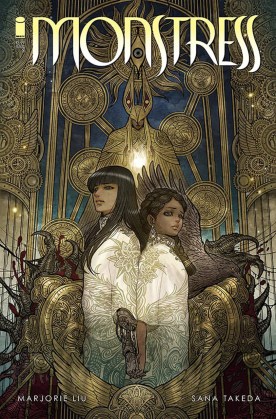
My initial reaction to Monstress was the same sort of disorientation I’ve felt watching most anime or reading manga. There is this push deep into the world where the reader is expected to catch themselves up as they go. Western media typically lays things out in a very deliberate fashion so it takes a little configuring of the brain to get involved. The world of Monstress is built on the divide between humans and the Arcanic. The Arcanic are a mixed race species between humans and a sort of interpretation of East Asian demons and animal spirits. Many Arcanic look perfectly human, they might be hiding a pair of wings or a foxtail, but if found out to not be fully human they lose all rights. Arcanic are part of a massive slave trade and some are even harvested for their essence called Illium.

Chief among the enemies of the Arcanic are The Cumea, a faction of female witches that are more like the Vatican than a coven. They have unlimited wealth and some even appear to be what I would consider Arcanic but avoid that label because they have power. An event occurred prior to the series, a great battle between the Arcanic and the Cumea that left some of these witches scarred by magic energies. They desperately want revenge for this transgression and it seems our hero, Maika is tied deeply to this past conflict.

There are very few male characters in the series and not a single one is in a position of power. All authority is held by women on both sides of the conflict. I particularly enjoyed how there is no sense of unity among the women of the two sides. They are truly human in that the concepts of tribalism and the Other are still going strong. How they choose to deal with problems comes from a different perspective but the hatred of the Cumea for the Arcanic is white hot and unflinching.

monstress 2The growth of Maika is the focus of the series. She starts single-minded and willing to let the innocent die if it means she gets closer to her goal of revenge. As she spends time with other characters she has a conflict with her inner nature and by the end of the first arc, she has learned the value of compromise. Her two companions, Kippa, an Arcanic with fox like attributes and Master Ren, a clever and witty cat, feel like paper thin characters. I was reminded of some forgotten animes that featured characters just for the cuteness appeal. There are hints at deeper levels and a rich history to the villains in The Cumea but it’s not explored very deeply in this first arc.

The pace of the series is very quick. We jump right into the story and hit major plot points every issue. There’s never a point where things feel dull or we lose momentum. You wouldn’t be blamed if you start to lose focus on what the larger conflicts are. The politics are so dense it can be overwhelming at points and it would have been nice to have the history of the world disseminated in a little more palatable manner. Each issue ends with mini “lectures” on some point of history in the world but I never found myself interested in reading these long passages of text when I was more interested in the core story.

Monstress is a very enjoyable first chapter in what looks to be a long sprawling saga. I think in hindsight, once the complete story is published, going back and reading these early issues will feel less challenging. The artwork alone is a great reason to pick up the book, it is so full of detail and movement. If you’re interested in jumping head deep into a complex and complicated new world give Monstress a chance.