Event Fatigue: Shadowland


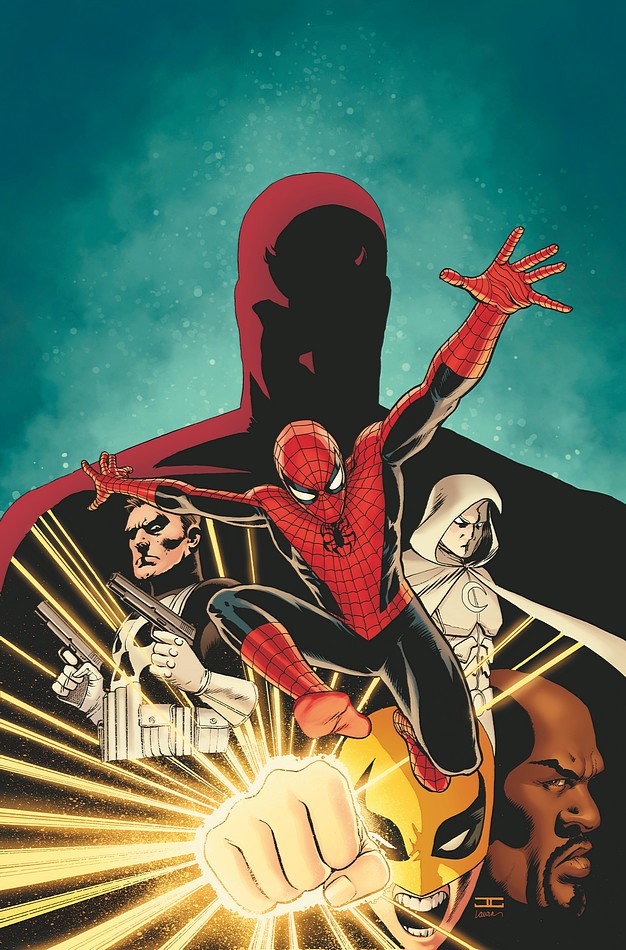
Shadowland #1
Written by Andy Diggle
Art by Billy Tan

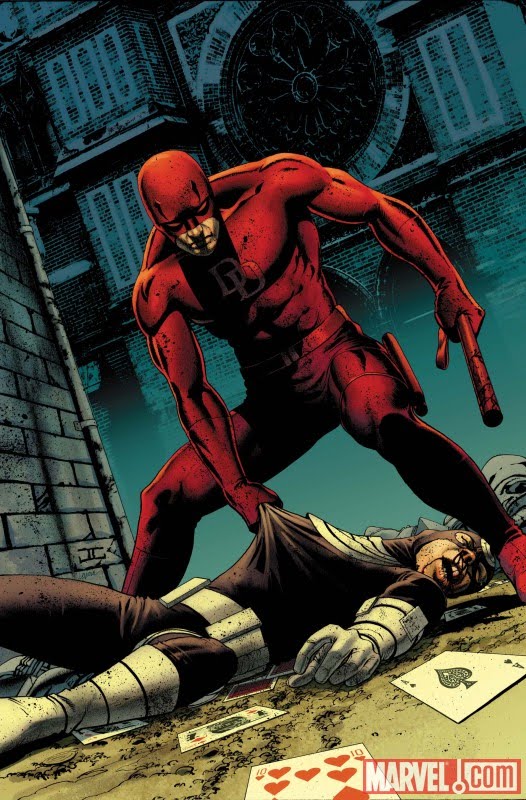
Daredevil #508
Written by Andy Diggle and Antony Johnston
Art by Robert de la Torre

A few months ago if you had told me I would be excited to read the new issues of Daredevil I would have said you were nuts. Daredevil has been one of those characters that never clicked with me, not even the critically acclaimed Frank Miller run or Bendis’ over 100 issues on the series. Blind lawyer vigilante just never appealed. However, Andy Diggle’s current run on the character seems like a shift towards a very interesting change in the fundamental aspects of Daredevil. The once by the books lawyer has abandonded the law in favor of pure street justice and has walled in Hell’s Kitchen, turning into Shadowland, his realm under his protection. And those who get in his way will die.

It began with Norman Osborn. The former Green Goblin assumed control of America’s top security forces after saving the world from an alien invasion and some epic PR. Put in charge of SHIELD, renamed HAMMER, Osborn set out to turn New York’s heroes into criminals in the eyes of the public. HAMMER agents were told to target an tenement in Hell’s Kitchen labeled as a hiding place of the notorious ninja clan known as The Hand. The building was firebombed and 100 innocent people were killed. Daredevil blamed himself for not being able to protect his fellow residents of the Kitchen and pledged himself to The Hand, his long time enemies. They promoted him to the leader of the clan, over all else, and along with his lieutenants Black Tarantula and White Tiger they drove the NYPD from his kingdom. Unbeknownst to Daredevil, the other leadership in The Hand are pushing him down this path in an effort to unleash a level of power their group has never experienced. In the background Wilson Fisk, the Kingpin is slowly reassembling his crime cartel after being released from a long stay in prison.

The events of these first two parts finds Luke Cage and Iron Fist, two fellow street level heroes venturing into Shadowland to talk to Daredevil, who has distanced himself in the preceding months. What they find is that he is unwelcoming to any interference. Just around this time, Daredevil’s arch nemesis Bullseye arrives, newly escaped from a prison transport. How Daredevil deals with his longtime enemy shows Cage and Iron Fist just how different their old friend is. Foggy Nelson, Daredevil’s former law partner and Dakota North, a private eye and former lover of Daredevil, drive to the borders of Shadowland but are stopped by White Tiger and some Hand agents. As the two leave they are attacked and their card explodes due to a masked archer on the rooftops. Needless to say things are getting worse and worse in Hell’s Kitchen.

The idea of making Daredevil a villainous figure is very intriguing to me, and the main reason I have started reading this current run of the series. The blind superhero part of Daredevil/Matt Murdock has always been a yawn for me. What is more interesting is the fact that he is/was a lawyer. How does a man who has devoted himself to the law justify vigilantism to himself. The Shadowland story is revealing how years of tragedy (the murders of Elektra and Karen Page first and foremost) have scarred Murdock. The embrace of some of his worst enemies in The Hand, while pushing away his closest friends marks a major change in the psyche of the character. This is one of those character arcs that you can’t see them coming away from the same every again. In many ways this is probably as close as we would get to a storyline where Batman takes over the Gotham crime families, a story that would be amazing.

Next up: Shadowland #2 in August!

Review: Justice League: Generation Lost #1-5


Justice League: Generation Lost #1-5
Script by Judd Winick, Breakdowns by Keith Giffen
Art by Aaron Lopresti (1,5), Joe Bennett (2,4), Fernando Dagnino (3)

When I was eight I met a Justice League that was a complete stranger to me. I grew up watching the Super Friends and from what I could tell they were the Justice League also. Imagine my surprise when I picked up Justice League America #42 and found characters like Blue Beetle, The Huntress, and Mister Miracle among others. Even though these were not the people I was expecting, I was intrigued. Later, in my first two years of college I was able to track down a complete run of this Justice League through dollar boxes, all sixty issues of Keith Giffen and J.M. DeMatteis’ Justice League/International/America. The series went through some title changes but it was always the League to me. DC has recently gotten this ragtag group of heroes back together again for a bi-weekly 26 issues series that has their former benefactor leading them on a global wild goose chase. So how do the first five issues bode for the series so far?

Once upon a time, a wealthy businessman named Maxwell Lord assembled a group of heroes and formed the new Justice League. There was no Superman or Wonder Woman. Batman was there, albeit briefly. Instead the core of the group were the following characters:
Blue Beetle – computer whiz Ted Kord and the second man to go by the Blue Beetle identity
Booster Gold – visitor from the 25th Century attempting to get rich quick using future tech as a hero
Fire – A Brazilian who could turn herself into a pillar of green fire
Ice – A Scandinavian woman who could turn water molecules in the air to ice
Captain Atom – a jarhead turned living nuclear bomb due to a botched test bombing
Rocket Red – an armor clad Russian with a rather easy disposition

Maxwell went a little evil, ended up trying to kill earth’s heroes, and Wonder Woman was forced to kill him. But, as is the way in the world of comics, the dead don’t stay dead. Max was resurrected during one of those big cross company events and immediately set about causing trouble. Max had an ability to manipulate the minds of others and now he knew he would be the most hunted man alive. Using considerable effort and straining his body beyond its natural limits, Max erased his memory from the mind of almost every living being on earth, except for his old Justice League crew. Now they are hunting him down, with the world around them believing they are crazy, attempt to stop Max before accomplishes what ever it is he’s up to now.

So far the first five issues have had their ups and downs. While DC brought back the original plotter of this Justice League, Keith Giffen, they paired him with Judd Winick, a writer whose work is some of my least favorite ever put to paper. Winick has a very grating way of writing and is not very good when it comes to handling action. Shouldn’t be a problem with a Justice League that was always more about the humor than the action. Once again he fails, nothing is funny and the characters are way too serious. The thing that always drew me to the Giffen/DeMatteis League was that unlike the Silver Age goofy JLA or the cosmic trippy Morrison JLA, theirs felt like people having fun. Blue Beetle and Booster Gold are my all-time favorite comic book duo. It was like a great comedy team and super heroes rolled into one. They frequently used Max’s funds to invest in get rick quick schemes or antagonized the team’s token Green Lantern, Guy Gardner. Now Ted Kord is dead and replaced with Jaime Reyes, the new Blue Beetle. He’s an equally interesting character but there is something lost in the dynamic.

Because of the extended 26 issue story these first five feel like nothing has happened, and really it hasn’t. We’ve seen the characters assemble and some battles that seemed very pointless occur. The only part you could really call plot development would be that the heroes have realized Max has manipulated them into reuniting and that Max seems to have some unwanted side affects to his resurrection. The artwork is also back and forth, as to be expected in a series that comes out more than once a month. Three artists have been employed rotating, the best of which has been Aaron Lopresti on the first and most recent issues. He just a cleaner, more detailed style than the other two. What’s impressive is that DC’s last foray into publishing a title more than once a month was Trinity, a 52 issue weekly series with Mark Bagley handling art on every single issue without a miss. And it was better than this series, which has multiple hands to choose from.

Overall, my excitement for this series before it was released has really waned. You’d be better off checking out the collected volumes of Giffen and DeMatteis’ original Justice League run which is up to four volumes so far. Here’s hoping The Lost Generation can pick momentum in the next twenty-one issues.

Newbie Wednesdays – Greenberg


Greenberg (2010, dir. Noah Baumbach)
Starring Ben Stiller, Greta Gerwig, Rhys Ifans, Mark Duplass, Jennifer Jason Leigh

Hey, you know what isn’t an interesting topic for contemporary cinema right now? Angst ridden white people who live comfortably and don’t have to worry about any necessities. Especially when they aren’t in some sort of hyper-realistic universe (i.e. James Bond, comic book movies). When the films are meant to be set in reality and feature characters whose biggest problems are that their band when they were in their twenties didn’t work out, yet are still rich through other endeavors, then I don’t really have much empathy towards them. This is yet another hugely pretentious piece of cinema from the grating Noam Baumbach. If you’re interested in navel gazing claptrap you’ve found your film.

Florence (Gerwig) is the personal assistant to the Greenberg family, a wealthy couple with two kids and a dog. The Greenbergs are off to Vietnam to open one of the husband’s hotels and they let Florence know his brother, Roger will be visiting for a few weeks while they are gone. Roger had a nervous breakdown and is coming the mansion to relax and work a doghouse. Roger and Florence meet, and she inexplicably ends up liking him. She learns Roger was involved with a semi-successful band in the 80s and they would have made it big if Roger hadn’t freaked out and left. Roger runs into some of his old bandmates (Ifans, Duplass) and while one of them has gotten over it, the other still holds a grudge.

The character of Greenberg is not necessarily a bad concept. I think everyone enjoys a good curmudgeon every once and awhile. But the curmudgeonly attributes of Roger Greenberg come across as cliche and totally dishonest. It doesn’t help that Noah Baumbach is doing what he did in Margo at the Wedding, one of the least watchable films I’ve ever had the privilege of falling asleep during. This is film straining desperately to be so clever and erudite, yet maintain that angst white middle class tone I hate. While some people have the same things to say about Wes Anderson’s films, I argue that Anderson works his damnedest to make his work feel intentionally separate from reality, in effect making contemporary fairy tales. Baumbach thinks he’s making a movie grounded in realism, and I guess for self-absorbed upper middle class people it probably is. I just have zero sympathy who have these problems.

There are few moments of good in it. I think Greta Gerwig is a great actress, more so in more mumblecore type movies than this one. She has a very natural ease in front of the camera and is one of the few people in the movie who doesn’t feel like she is acting. There’s a sub plot involving her ex-boyfriend that I found to be good to see in a film, its something that never really happens even in movies, and if it does there seems to be some moral cultural obligation to make it a big deal. Here Gerwig simply does this thing and everyone moves on with their lives, the way in reality it would probably be. Many of the supporting players are quite good, with the exception of Jennifer Jason Leigh as Roger’s ex from back in the band days. Leigh is also the co-screenwriter, producer, and the wife of Noah Baumbach. She’s just not very good in this role. If you have the option to watch this film, I can’t really say its one of those worth one view ones. It really isn’t, it doesn’t say anything of importance, it doesn’t work to achieve any interesting artistic aesthetic, it is just simply nothing.

Review: Batman #701 and Batman and Robin #13

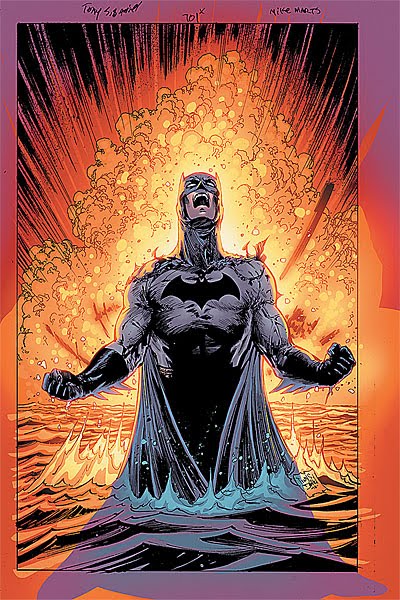
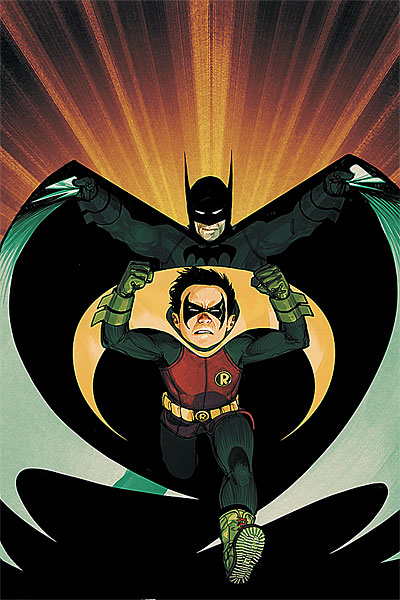
Batman #701 and Batman and Robin #13
Written by Grant Morrison, Art by Tony Daniel (Batman), Frazier Irving (Batman and Robin)

For those of you not keeping up with Batman currently, here’s the score: Over a year ago, Batman was driven to madness by a group called The Black Glove, led by the mysterious Doctor Hurt. Hurt claimed to Batman’s believed dead father, and buzz swept through Gotham that Thomas Wayne never died and had paid the gunman to kill his wife. Batman regained his senses after being put through a psychological gauntlet and both he and Hurt plunged into the bay surrounding Gotham while onboard a helicopter. Batman emerged from the water and Hurt disappeared. Some time later, Bats got involved with Final Crisis, one of those big cross company events where all the heroes show up. He sacrificed himself to stop the mini-series’ villain and the first Robin, Dick Grayson is now wearing the mantle of the Bat. Batman #701 features the first of two parts of writer Grant Morrison filling in the gaps between Batman’s battle with Doctor Hurt and his death in Final Crisis. In Batman and Robin #13, Morrison is setting up the inevitable return of Bruce Wayne with Doctor Hurt attacking the new Batman.

Grant Morrison is my favorite comic book writer and also the one who frustrates me to no end on everything he writes. Morrison goes against the current trend in comics writing which is decompression (i.e. stretching out an event with endless scenes of the heroes gathered together discussing what they are going to and what has just happened). While tells multi-part stories, they feel jam packed with things happening. It may not be traditional action, but you will have a handful of concepts and ideas thrown at you in a single issue that keep you thinking for a whole month till the next handful. And, when I first heard he was signed to write the core Batman title back in 2006, I was a little worried. Morrison’s focus had always been on established heroes or original ideas that contained a hint of the cosmic, and Batman never really seemed to be one of those titles.

But he has pulled off in a spectacular way, referencing some of the reviled “science fiction” Batman stories from the 1950s and incorporating them into the modern interpretation beautifully. He’s also managed to tweak the Joker in a way that has really injected that character with life. What Morrison up to is a reinventing of the character, in the same way that Batman was reinvented in 1950s, 1960s, and 1970s. The 1970s brought us the Dark Knight concept which has remained the way most writers have tackled the character until Morrison. His story this in this month’s Batman is interesting and definitely written as a “fill in the gaps” type arc. Batman comes to the surface of the bay, makes his way back the manor, eventually returns to find Hurt’s body is now missing, then gets brought into the events of Final Crisis. All along the way, he’s fixated on Doctor Hurt’s last words, that the next time Batman wears the cape and cowl it will be his last. Throughout the issue he goes unmasked, with that prophecy looming in his mind. And this first part ends with him putting it on for what we the readers know is the case he dies on.

In Batman and Robin, we’re giving a series of enigmatic panels showing the murder of the Waynes, then a panel where Thomas stands over the bodies of Martha and Bruce. Then Doctor Hurt wearing a Bat costume that Thomas Wayne once wore for Halloween, and would inspire Bruce as an adult. This jumps to three days in the future, where Hurt has Batman (Dick Grayson) and Robin (Bruce’s illegitimate son Damien Wayne) being held captive. He tells Dick that this new Batman could never beat a Wayne and shoots him point blank in the back of the head. Then we jump back three days to where the core story is told. Batman and Robin are interrogating the Joker, who has turned up disguised as a famous British crime author to help bring the original Batman back from the dead. Batman is called away and core of the issue deals with Damien Wayne revealing his true brutal colors by sneaking a crowbar in to beat the Joker to death. Batman and Commissioner Gordon investigate crimes related to the original Batman’s death and it appears that Doctor Hurt is back from the dead.

Both issues set up some intriguing hooks, though Batman and Robin for me has been flawless its entire first year. Every issue builds on the next and its just one of those I have to read as soon as it comes out. Art wise, Batman and Robin is also the stronger of the two. Frazier Irving has come onboard as the new artist and he’s do something amazing things using shadows and has such a clean European style of drawing. Tony Daniel is much more from the Image Comics school of drawing, that early 90s Marvel influenced work that has never cut for me, even as a kid. Morrison’s work has been excellent on the Batman books and these are strong evidence that it is going to continue.

Comics I’m Getting This Week

BOOM! Studios
Calling Cthulhu: Chronicles #1

Dark Horse
Doctor Solar, Man of the Atom #1

DC Comics
Adventure Comics #516
Batgirl #12
Batman #701
Birds of Prey #3
Booster Gold #34
The Brave and the Bold #35
Doc Savage #4
Justice League: Generation Lost #5
Magog #11
The Mighty Crusaders #1 (of 6)
R.E.B.E.L.S. #18
Superman #701
Titans #25

IDW
Locke and Key: Crown of Shadows #6

Image
The Bulletproof Coffin #2 (of 6)
Chew #12

Marvel
Amazing Spider-Man #637
Astonishing Spider-Man/Wolverine #2$
Avengers Academy #2
Daredevil #508
Deadpool Corps #4
Girl Comics #3 (of 3)
Gorilla Man #1 (of 3)
Invincible Iron Man #28
Iron Man Noir #4 (of 4)
The Thanos Imperative #2 (of 6)
Ultimate Comics: Spider-Man #12
Uncanny X-Men #1: Heroic Age (One-Shot)
X-Force: Sex and Violence #1 (of 3)
X-Men: Hellbound #3 (of 3)
X-Men: Second Coming #2

Vertigo
Daytripper #8 (of 10)
DMZ #55
The Unwritten #15

Wildstorm
Astro City: Silver Agent #1 (of 2)
The Authority: The Lost Year #10 (of 12)
The X-Files/30 Days of Night #1 (of 6)

Wild Card Tuesdays – The Living and The Dead


The Living and The Dead (2006, dir. Simon Rumley)
Starring Roger Lloyd-Pack, Leo Bill, Kathy Fahy

It’s very hard for me to write about this film after having just watched it today. It affected me in a deeply emotional way that very few films are able to. After cinema becomes a daily occurrence, you are naturally numbed to the typical emotional tricks of filmmakers. I was aware of this film first as a horror picture. The director, Simon Rumley came out of nowhere with this small picture that made the festival circuits. It never really the mainstream venues, instead traveling to the fringe horror festivals. I am very curious as to how it was received because more than anything this film is a deeply disturbing, yet also sensitive, portrayal of the pain of severe mental illness. The film achieved something very few have in recent years, it made me cry. There is a scene in the last third of the film that is so emotionally devastating I can’t see how anyone could watch it and not break down.

The former Lord Donald Brocklebank must leave his dreary estate in the middle of the English countryside for unknown reasons. His wife, Nancy is suffering from cancer and his son James is severely mentally challenged, requiring daily pills and injections to keep his delusions in check. Donald instructs James that Nurse Mary will round to tend to Nancy. However, James forgets his injections and decides to prove he can be the man of the house by locking Nurse Mary out and trying to tend to mother himself. It’s painful to watch James descend into madness while unknowingly hurting his mother again and again. The film makes a sudden major shift in the narrative about half way through that really cements the idea that we are seeing the story through the mind of a mentally ill person. And the finale is just jolting and ambiguous enough that I believe this film will stay with you for years.

Leo Bill should have received an Academy Award nomination for his portrayal of James. His face is recognizable as that of Darwin in Tarsem Singh’s The Fall, as well as the arranged suitor of Alice in Tim Burton’s recent Alice in Wonderland film. Here is firing on all cylinders, delivering a performance that is so powerful and unrestrained. Even now, just thinking about certain scenes I feel my gut in a knot and heart breaking all over again. James is both terrifying and sympathetic. I thought of the prayer of Christ on the cross, crying out “Forgive them Father, they know not what they do.” That is exactly how we and the other characters in the film inevitably have to view James. His reality is a different plane of existence than ours and he can hurt people while believe he’s simply giving them a hug.

I can’t emphasize enough what a profound piece of cinema this is. While labeled “horror” I would argue that there is no human monster in the film. The monster is mental illness and the shattering pain and emotional trauma we humans are forced to bear. I don’t know if I could ever watch The Living and The Dead again, much in the same way I am unable to revisit Requiem for A Dream. Both movies are so effective in getting across the helpless pain they want to portray that, while we acknowledge them as masterpieces, our psyches are too fragile to confront them again.

DocuMondays – This Filthy World

This Filthy World (2008, dir.Jeff Garlin)

Unlike the other documentaries I have looked at, where you have multiple interviewees and tightly edited footage to form a narrative, this is simply one man on stage in front of a crowd, talking to them. It’s basically a concert film, but while most of those feature either a music performer or comedian this is a film director. I guess the closest equivalent  of this would be the Evening With Kevin Smith DVDs. Both are the result of directors whose personalities are as large as the reputation of their films. John Waters is definitely not a filmmaker who appeals to everyone, something he readily admits, but even if you don’t enjoy his films I think it would be hard not to enjoy this one-man show about his love of all things strange.

Waters was raised in and around Baltimore, Maryland, which is to him like New York is to Woody Allen. Baltimore, named the Ugliest City in America at the time which Waters proudly cites, provided him with a front row seat to the grotesque. Rather than being repulsed, Waters was drawn to the misshapen and demented natives and made them movie stars. His love of film also began in Baltimore when, as a child, he became enamored with the gimmickry of William Castle (House on Haunted Hill, House of Wax) and Kroger Babb. Babb was a filmmaker who had little skill with filmmaking, and more with being a salesman. He produced films like Mom and Dad, which the Catholic Church gave a Condemned rating, and features actual birth footage, one of the few ways of showing female nudity in those days. Babb would have an obvious influence in Waters later work, and Castle got a very gimmicky homage with the Odorama cards handed out at showings of Polyester.

My favorite piece of the performance was the second half, where Water discusses how he even he has lines he doesn’t think people should cross. This allows him to go into very poetic descriptions of teabagging, helicoptering, and other outer edges sexual practices that he gets pleasure from horrifying the audience with, but also seems to honestly think are too far. He addresses his child molestery appearance, which draws looks when he goes to see animated films at the theater. He talks about his love of attending trials and the little club of friends who try to one up each other about which they have attended (Waters got into one of 10 public seats at Watergate for a day, an elderly woman beat him, she was Nuremburg, the Super Bowl of courtroom trials). There’s a wonderful sequence where he talks about the influence The Bad Seed has on him, creating a desire to be a secretly evil child. Even now, he says he loves to encourage children to get into trouble, mentioning when he was attending a parade recently and tried to convince a little girl to help him go knock people’s bicycles over.

Like I said, Waters isn’t everyone’s cup of tea, nor should he be. If he was, then the entire agenda of his work would be subverted. He talks about how his career is now lauded in elite high society circles in New York and that he thinks its wrong. Even if you don’t care for his films, I don’t think you could watch this and not find some anecdote or piece of wry wisdom memorable. If you haven’t seen his work some segments might be confusing, but nevertheless this is an excellent piece of insight into one of the ground breaking directors in America.

Director in Focus: New Director Poll

As we wrap up my look at Brian DePalma’s career with Redacted on Friday, I’m looking ahead to the director I will spotlight beginning in August. Below are the four choices. Vote by leaving a comment below.

John Cassavetes – To many he was the father of modern American independent cinema, filming on New York Streets without permits, making films that would never receive major accolades, but would inspire filmmakers for decades to come. His wife, Gena Rowland starred in many of his pictures, and his children have all gone into the film industry. While he is most famous for his role as Guy in Roman Polanksi’s Rosemary’s Baby, Cassavettes is also one of the most independent voices film has ever seen.
Films I Have Seen: Faces.

Sam Fuller – He didn’t give a damn if they liked his work or not, he made films the way he wanted them. Fuller was a newspaper writer and crime novelist who joined up with the Army when World War II broke out and saw action in both the European and African theaters. It was during the liberation of a concentration camp that he made his first cinematic work, footage that was included in a documentary. Fuller focused on gritty crime drama and war films, but didn’t present pretty pictures of anything. Studios hated his work, and it was with the shelving of his controversial film White Dog, which tackled issues of racism, that he left America never to make another film here again.
Films I Have Seen: Pick Up on South Street

Derek Jarman – Jarman was a filmmaker that optimized the British punk movement. He made films that took cultural tradition (The Queen, Shakespeare) and turned them on their heads. Jarman was diagnosed with AIDs in 1986 and died in 1994. Despite his illness he continued making films till the ending, becoming more meditative and thoughtful in his latter work.
Films I Have Seen: None

Werner Herzog – Herzog is nuts. This is something I have learned through reading about and seeing only a few of his films. Herzog likes to play with the viewer, fooling us and confusing us. He is obsessive, meaning his films are tightly crafted. His battles with frequent acting collaborator and peer in insanity Klaus Kinski are the stories of movie legend. And he’s still making films.
Films I Have Seen: Strosek, Nosferatu, Bad Lieutenant: Port of Call New Orleans, Grizzly Man

Character Actor Month – Part 2


Dylan Baker (IMDB credits: 91, Planes Trains and AutomobilesHappiness, Requiem for a Dream, Thirteen Days, Road to Perdition, Spider-Man 2)

You know him as Dr. Curt Conners in the Spider-Man films, most likely. I remember him mainly for two roles: A pedophiliac psychiatrist in Todd Solondz’s dementedly hilarious Happiness and as the bizarrely backwoods ride in Planes, Train, and Automobiles. He had a modest upbringing in Lynchburg, Virginia and attended William and Mary before moving onto the Yale School of Drama, where his fellow classmates included Chris Noth and Patricia Clarkson. Like most character actors, Baker has garnered great success in live theater, even receiving a Tony nomination for his performance in La Bete, a comedic play inspired by Moliere and written in iambic pentameter. In addition, he’s married to Becky Ann Baker, who played the mother on the amazing ahead of its time television series Freaks and Geeks, seriously, if you haven’t seen it get ahold of the DVDs, I’m not asking you to, I’m commanding! One of Baker’s most recent, best, and I suspect most overlooked performances was as deeply dark and disturbed elementary school principal in the Halloween flick Trick R’ Treat.

Peter Stormare (IMDB credits: 100, Fargo, The Big Lebowski, Dancer in the Dark, Minority Report)

He was one of the Nihilists Lebowski feared would take his balls, he was the man who put Buscemi through a wood chipper, and he was the doctor who replaced Tom Cruise’s eyeballs. Born in Sweden in 1953, Peter Stormare (formerly Rolf Peter Ingvar Storm), has had great success in Hollywood but it didn’t start until he was 43. Before then, worked with the Swedish Royal Dramatic Theater for 11 years and then the Tokyo Globe Theater (Where he worked as the Associate Artistic Director). He moved to New York, was discovered for films by Ingmar Bergman, and played the Swedish equivalent of James Bond. It was a few years later when he was cast by the Coen Brothers in Fargo and finally got the international attention he deserved for all these years. I find Stormare to have incredible comic timing and such a dry sense of humor. The first time I saw him I didn’t quite get it, but as he appeared in more and more films, it grew me on. His slightly doofy line deliveries and hollow eyed look. A style of comedy that is really much more about pulling back than going over the top.


O-Lan Jones (IMDB credits: 45, The Right Stuff, Edward Scissorhands, Natural Born Killers, Mars Attacks!, The Truman Show)

You probably know her as the fundamentalist wacko neighbor in Edward Scissorhands. Or maybe the waitress who won’t give back the autographed photo to Jerry Seinfeld. Or any number of countless waitresses she has played. Jones said once, “Most actresses make money waitressing while trying to find acting work. I’m the only one who makes her career waitressing on screen.” She was born in Los Angeles in 1950, started acting at age 16, she moved to New York where she met and married the brilliant writer Sam Shephard in 1969. The divorced in the early 80s, and she began making her appearances in numerous films, usually as a waitress. Recently, she has embarked on staging her own modern opera using all recycled materials to make props, costumes, and sets, featuring a live orchestra, and her own filmed video pieces. And about that odd first name. Her mother loved Pearl S. Buck’s The Good Earth so much she named her daughter after one of the characters.


Stephen Root (IMDB credits: 109, Office Space, Newsradio, Beavis and Butthead, King of the Hill, O Brother Where Art Thou, Finding Nemo, No Country For Old Men, Idiocracy)

If you don’t recognize his face, I’m sure you know his voice. From television he is most known as Jimmy James, owner of the radio station in Newsradio and the perpetual loser Bill in King of the Hill. From films, you definitely know him as Milton, the man desperate to keep his stapler in Office Space. Born in Sarasota, Florida, Root didn’t have any sort of extraordinary acting background, other than majoring in theater at the University of Florida. It was his friendship with Mike Judge that really got his career going, voicing Milton as a cartoon in a series of crude shorts and doing voices for Judge in Beavis and Butthead. From there, his career saw skyrocketed in the 1990s. Office Space has cemented his place as a cult film figure, while he has befriended the Coen Brothers and been featured in many of their films. He’s one of the best comedic character actors out there, able to tackle a seemingly infinite range of types. His four episode run on True Blood was one of those you wish could have become a regular role.


Dick Miller (IMDB credits: 170 films, The Little Shop of Horrors, Rock N’ Roll High School, The Howling, Gremlins, The Terminator, Innerspace, The ‘Burbs, Pulp Fiction)

When I think Dick Miller, I think of poor Murray Futterman in Gremlins, a man who was convinced the little monsters existed but no one believed him. Miller got his start with the classic shlockmeister Roger Corman, most famously in the original The Little Shop of Horrors as Seymour. Director Joe Dante would cleverly wink at that film by casting the original Audrey (Jackie Joseph) as Miller’s wife in Gremlins, one of those things you don’t realize as a kid but love when find out about when you’re an adult. Miller moved from working with Corman in the late 1970s, to being a regular in Joe Dante’s mainstream Corman-like horror comedies. I absolutely love Miller in The ‘Burbs as a garbageman who has zero patience for the paranoid neighbors in a Chicago suburbs street. Its one scene but it is incredibly memorable due to Miller and co-star Robert Picardo’s perfect comedy timing together.