Asian Cinema Month – Ponyo


Ponyo (2009, dir. Hayao Miyazaki)
Starring (English dub) Noah Cyrus, Frankie Jonas, Tina Fey, Matt Damon, Cate Blanchett, Liam Neeson, Betty White, Cloris Leachman, Lily Tomlin, Carlos Alazraqui

It was freshman year of college and it was a Friday night. We decided to see a movie. We let Clint pick, usually a bad choice…however, he decided on a Japanese animated feature called Princess Mononoke. I make no bones about the fact that I pretty much detest anime. I’ve tried to watch multiple series and can barely make it past the first episodes. Anime films, however, I have been able to tolerate fairly well. Well, that evening as we settled in to the barely occupied theater, I was overcome with amazement at the lush imagery before me. This blew anything Disney made right out of the water. The themes were complex and aimed more at adults than children. After that I would go to see Nausicca of the Valley, Spirited Away, Kiki’s Delivery Service, and Howl’s Moving Castle. All of these are the work of master animator Hayao Miyazaki.

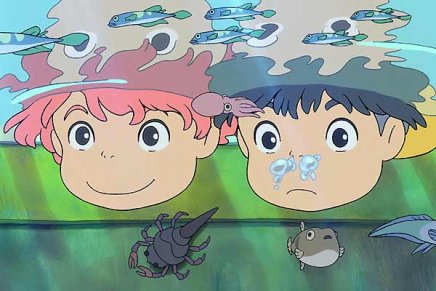
Deep beneath the ocean lives Fujimoto (Neeson), an wizard who has abandoned the surface world and raises his fish daughters to fear humanity. The eldest of these guppy-like creatures escapes and is found by Sosuke, the young son of a navy officer and a nursing home attendant. Sosuke names the fish girl Ponyo and has to avoid her being taken away by a number of human forces. Eventually, Fujimoto surfaces and wants his daughter back while Ponyo has come to enjoy the surface and wants to become human. Some of these elements sound familiar? Yes, this is a Japanese re-imagining of The Little Mermaid.

The plot of the film is incredibly simple and I was reminded of the lighter Kiki’s Delivery Service. There’s never any real peril or chance anyone might actually die. You would think with the stakes being so low the picture would be a bore, but it most definitely isn’t. What pulls you in is the seemingly infinite imagination of Hayao Miyazaki and epic skill of his animators. Every film Miyazaki releases reveals why CG animation will never trump the power of high quality cel animation. It might not be as quick, but when given the proper time and skill you have unparalleled works of art. The wordless opening sequence of the picture is breathtaking, featuring the nighttime migration of jellyfish then transitioning to a panorama of sea life.

The adventures of Ponyo and Sosuke are pure wish fulfillment. I was particularly enamored with their excursion of a tiny steamboat through a flooded village. It felt like that exact thing so many kids would imagine while playing on the couch or in the backyard, the idea of freedom to travel and explore. Ponyo is a delightful character, she is constantly discovering the surface world and find joy in such simple things. Her first sip of hot cocoa drives her wild, her first warm meal puts her into a sleepy coma, and there’s never an adult admonishing for such exuberance. While you may think this is a film made for children, its just as much for adults, tapping into that time of discovery and play I think many of us miss.

Newbie Wednesday – Harry Brown


Harry Brown (2009, dir. Daniel Barber)
Starring Michael Caine, Emily Mortimer, Charlie Creed-Miles, David Bradley, Ben Drew, Jack O’Connell

In the States we call government housing The Projects, in the UK they have the Estates. This is setting of this bleak and tragic story of a man who is alone. The film doesn’t flinch from showing shocking acts of brutality and doesn’t raise up one figure as a champion over another. Harry does what he does, but why? The motives for the killing spree remain vague when you begin to examine things closely. Is it in retribution for his friend? Or is their something much darker going on?

Harry Brown, is ex-marine and pensioner living in the Estates. His wife is living in the hospital stuck in a catatonic state. He has one friend in the world, Leonard, whom he meets at the corner pub for a pint everyday. Leonard is fed up with the way drugs are sold openly and people like himself are harassed by the hoodlums that roam the estates. One morning, Harry wakes up to learn Leonard was found stabbed to death in a pedestrian tunnel. This seems to be the final straw for Harry and he embarks on a crusade to avenge his friend, killing young men where ever he goes.

The film eventually goes down a fairly predictable road with Harry’s action parallel by a police investigation about them. What is more interesting is all the subtext brought to the film, possibly not intentionally. There is a lot of work put into making the world Harry inhabits grimey and flithy and despicable. So we are naturally appalled by the various denizens he encounters. As an audience we are clearly set up to cheer for Harry and boo all those nasty villains (see Gran Torino). However, there is a moment near the end of the film where Harry asks a character to kill him. This immediately caused me to re-evaluate what had gone before. Here’s a man whose wife is gone and has just lost his best friend. He lashes out, presumably because he wants but he then wants to simply die at the end. His entire crusade was a nihilistic one. Harry lost all he loves and now he wants to explode, hitting what ever he can in his path.

If it wasn’t for Michael Caine this would have been a forgettable film. There is something about just his subtle looks that elevates the film. In one scene he sits across from a drug dealer whose girlfriend is overdosing on heroin. The slight glances and looks he makes around the room feed the audience tons of information. While Clint Eastwood seemed one note through Gran Torino, Caine delivers a multi-layered performance. Emily Mortimer is also wonderful as the detective in charge of Caine’s case. By the end, she’s the only virtuous character in the film. She has been devoted to her job and wants to solve the murders. However, we can see the world crumble around her.

Harry Brown definitely wants to be a lofty film, but its very much a continuation of the Death Wish premise. I admit there is some greater emotional depth here. The disappointment for me came from how undeveloped characters are. There is no motive for anyone save Harry and it left me feeling like the picture was very hollow.

DocuMondays – Tales From the Script


Tales From the Script (2009, dir. Peter Hanson)
Featuring Allison Anders, John August, Shane Black, John Carpenter, Larry Cohen, Frank Darabont, Antwone Fisher, Mick Garris, William Goldman, David Hayter, Zak Penn, Adam Rifkin, Jose Rivera, Paul Schrader, Guinevere Turner

The documentary opens with Bruce Joel Rubin (Ghost, Deep Impact) talking about leaving the studio commissary with a group of executives and one of them telling him his script was the best thing he ever read. Months later, Rubin was in the same commissary, leaving behind the same executives with  new writer and heard them say his script was the best they ever read. This anecdote sets the tone of the rest of the documentary which isn’t so much about screen writing as it is about the relationship between writers and the studios. This relationship is one in which the writer wants to accepted and the studio wants to get that script out of his grubby little hands and make it the movie they want to see.

The film is made up of interviews with a wide swathe of writers from mid-century pictures up to those of the last decade. To frame the segments of the documentary, scenes from popular films that revolve around screenwriters are used (Barton Fink, The Muse). The result is a very inside baseball type film that is definitely never going to appeal to a large audience. To people working in the film industry and movie nerds like myself, the picture is fascinating glimpse into the trials and travails of the Hollywood screenwriter. We get to hear from veterans such as William Goldman (Butch Cassidy, The Princess Bride) and Paul Schrader (Taxi Driver, Affliction) as well as young, but equally prolific writers like David Hayter (X-Men, Watchmen) and John August (Big Fish, The Corpse Bride).

I found it very interesting to hear the voices and see the faces of screenwriters of films I was familiar with. I have to say, most of the films represented here were ones I don’t care for, particularly Bruce Almighty and Click, but the writers definitely fit your expectations of them. One of the most fascinating interviewees was Guinevere Turner. She started out scripting the indie lesbian romantic comedy Go Fish and went on to pen a draft of American Psycho. Turner tells the story of working with Uwe Boll on Bloodrayne and learning that he was letting the actors make edits to her script. While this would drive most writers insane, Turner says she told herself to take deep breaths and that she hated the movie anyway.

The film fails to be a helpful guide to novice writers which is a shame. Goldman has become a sort of god of screenwriting and has numerous books on the topic. There’s some interesting comments on the “postcontent” era of films which might be useful, but overall its just an interesting curio that shows us where films are born.

Newbie Wednesday – The Imaginarium of Doctor Parnassus


The Imaginarium of Doctor Parnassus (2009, dir. Terry Gilliam)
Starring Christopher Plummer, Heath Ledger, Lily Cole, Andrew Garfield, Verne Troyer, Tom Waits, Johnny Depp, Jude Law, Colin Farrell, Peter Stormare

After filming the first half of this picture, director Gilliam learned the tragic news that Heath Ledger had died due to an accidental drug overdose. Gilliam is no stranger to films having to overcome obstacles before their release. His 1985 picture Brazil was the victim of an unexcited studio and Gilliam had to break the law to get his version of the picture shown. His attempt to make a film version of Don Quixote at the beginning of the century was ultimately scrapped when financial and natural conditions fought against him. With Imaginarium Gilliam found a way that the film could continue without Ledger’s presence and it hinges on the movie’s core theme: Imagination.

The movie opens in modern day London and follows a old time traveling show made up of the ancient sage Doctor Parnassus, his daughter; Valentina, his right hand man; Percy, and the boy in love with Valentina; Anton. Their show is no longer captivating to contemporary audience and during the opening performance a drunk man stumble through a mirror on stage that places him inside his own imagination. Parnassus has been in a centuries old struggle with Mr. Nick, the Devil who is in a competition to see who can collect the most souls before Valentina’s 16th birthday. If Nick wins he takes Valentina from Parnassus. Into this scenario comes an amnesiac man found hanging underneath a bridge. The man slowly but surely takes over creative control of the show explaining he has Parnassus best interests in mind. As the date moves closer to the bet’s end more of this stranger’s secrets are revealed.

The film is better than much of Gilliam’s more recent films and I credit that to his choice of working with co-writer Charles McKeown. McKeown previously worked on the scripts for Brazil and The Adventures of Baron Munchausen which are two of Gilliam’s strongest pictures. The story here can be a bit straining on the brain but its able to keep up with Gilliam’s visuals the whole way through. I also like the use of CG effects here not in an attempt to replicate reality (see Avatar), but to make surreal landscapes feel tangible. In my opinion, that should be the purpose of using CG in films. While I didn’t care for the story of The Lovely Bones is also did an excellent job of created fully realized surreal worlds.

The subtext in the film seems to be Gilliam’s own examination of his profession. Parnassus starts out as a man sequestered in a Tibetan monastery where he and his disciples sit around telling the story of the universe. He makes a deal with the Devil and travels out to make his fortune with these stories, being told he will be immortal if he does. Valentina is a living breathing creation and the idea of turning her over to the Devil is what drives Parnassus to fight for independence. In his desperation he turns to a smooth talker who assures him he will be present the show in the way the doctor wants, but instead we see the integrity of Parnassus slipping away.

Like most of Gilliam’s work this will never appeal to a mainstream audience. He is very much an artist who makes the things that amuse him and its always coincidental if they appeal to anyone else. If you are open to a film that prefers to play rather than dictate and hit plot beats then I think you’ll enjoy this picture.

DocuMondays – Dirt! The Movie


Dirt! The Movie (2009, dir. Bill Benenson, Gene Rosow, Eleonore Dailly)
Narrated by Jamie Lee Curtis

There’s is something about the smell of healthy soil that is unlike anything else. My father got his degree in wildlife biology and worked for the Illinois Department of Agriculture for many years so soil and gardening and nature were a big part of my early years, whether I liked it or not. As I have gotten older I’ve become interested in nature from a global perspective, particularly the way our agriculture has slowly shifted into the hands of a few private corporate interests and away from typical citizen run farms. This documentary focuses on the impact of these practices on our soil and where this practices will inevitably leads us. It doesn’t sound all too excitement but the style of the film’s presentation keeps your attention.


The film begins with metaphor of soil as a living skin to the earth and goes on to talk about the amount of living microbes in a handful of soil. The film can come across fairly dry at the beginning and sags in moments that feel a little lesson oriented. It’s saving grace are the well educated group of interviewees who come from all over the world and present well thought out and reasoned ideas about how to create more sustainable systems. I particularly enjoyed Vandana Shiva and Gary Vaynerchuck.

Shiva is an Indian physicist whose focus has been on fighting against the corporatization of genetics and push towards stronger bioethics. Her experience growing up in India has helped her see the plight of farmers who are forced into working the land as dictated by corporate agricultural firms. The result is that many farmers end up in debt and kill themselves as the land dies around them. She also emphasizes that cultures where women are moving out of a subservient, second class role and into a more active role in their local agriculture are proving themselves to be incredibly sustainable and productive environments. Vaynerchuck, the host of a internet series about wine, is able to provide a poetic look at soil and its intricacies. He talks in length about going to vineyards where he tastes the grapes and the soil to get a better sense of the wine produced there. He has a lot of enthusiasm on the subject which helps pull the audience in.

Dirt! is by no means the greatest documentary made and it does definitely feel didactic in some sections. However, it is a topic that, if given a chance, will pull people in and teach them a lot about the complexity of their environment. I found the portion on mountain top blasting my mining companies to be particularly relevant to situations here in Tennessee. I think its our responsibility as socially conscious human beings to be informed about these topics and ideas.

Import Fridays – Mother (2009)


Mother (2009, dir. Joon-ho Bong)
Starring Hye-ja Kim, Bin Won, Ku Jin, Yoon-jae Moon

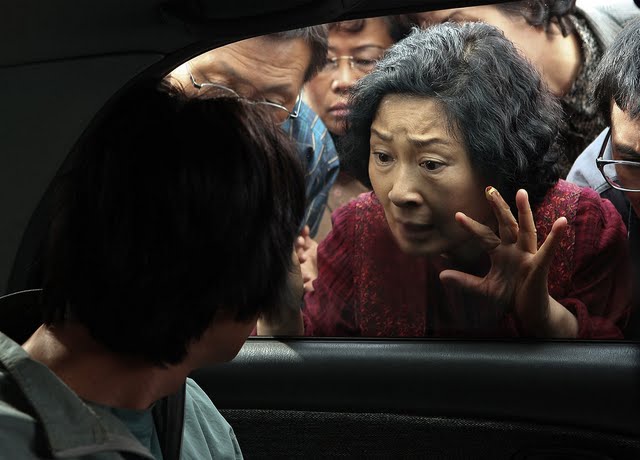
The premise of Joon-Ho Bong’s Mother doesn’t seem to be anything out of the ordinary from any other murder mystery flick: A concerned mother whose mentally disabled son is accused of murder decides she will pursue the case the police refuse to and find her son innocent. In the hands of Joon-Ho Bong, whose 2006 film The Host similarly played with genre expectations, this becomes a taught Hitchcock-style thriller.

Mother (she is never given a formal name in the film) is fiercely protective of her son, Do-joon. Do-joon still sleeps in the bed as Mother and relies on her for his day to day survival. His friend Jin-tae manipulates Do-joon and uses him to escape from trouble, knowing the boy won’t understand what is happening. One night, Do-joon arrives home late and drunk, the next morning the police arrest him in the murder of a local teenage girl. Mother makes it her duty to prove her son’s innocence.

Hye-Ja Kim delivers a magnificent performance as Mother. She is small and timid, yet when circumstances call for it she is a force to be reckoned with. Yet she is never unrealistic. The things Mother does are all things a frail middle-aged woman would be capable of. That fragility and humanity is what makes the character so compelling. The audience knows that if she truly comes up against a murderous, powerful force she is not going to get away. In that way, the film offers wonderful counter-programming to American cinema which commonly seeks to mythologize its protagonists by turning them into people capable of supernatural feats. Even in our most “realistic” contemporary cinema, we are commonly given moments that force to ignore their implausibility.

If you have never seen Korean cinema before, then I would recommend starting with this, or The Host even. Joon-Ho Bong is a director who walks that fine line between commercial and artistic film perfectly. He creates enough tension that it pulls us in, and the payoffs to the tension never feel dishonest. The film is also clever, in the same way Mother would have to be to navigate the dangerous journey she is on. The climax of the film and its mystery will leave you stunned and completely flip your perceptions of the characters in the story. A definite must see!

Newbie Wednesday – Bunny and the Bull

Bunny and the Bull (2009, Paul King)
Starring Edward Hogg, Simon Farnaby, Veronice Echegui, Richard Ayoade, Julian Barrett, Noel Fielding

Note: This film has no planned release date for either theaters or DVD in the US. So, your best bet is to torrent the sucker.

“Come with us now on a journey through time and space”. If you are familiar with the immensely popular British series The Mighty Boosh then those are familiar words to you. The director of that series, Paul King, embarks on his feature film debut, bringing with him some familiar faces in supporting roles as well as the quirky aesthetic sensibilities of his television series.

The premise puts agoraphobic Stephen in the midst a year long hermit period. He is dealing with a trauma that occurred in Europe while he was on holiday with his friend Bunny. The two follow Stephen’s idea of fun by touring the various museums of the continent, but once Bunny takes the wheel things become a lot crazier. They meet waitress Eloisa who is looking for a way back home to Spain, and Bunny decides that once they arrive there, he is going to fight a bull.

The strongest thing this picture has going for it are the inventive visuals. King is definitely a peer to a director like Michel Gondry, in the way he intentionally lets the audience in on the hacked together set pieces. A fast food delivery bag becomes the setting for a flashback in a restaurant. A snow globe becomes the Swiss mountain chateau the men stayed in. A photograph of their train becomes a chain of photos, set against a landscape made of similar snapshots. The Mighty Boosh did the same, and it caused the universe to feel like a timeless fantasy-scape.

The plot on the other hand is not very strong. There’s no real depth to the two main characters, Stephen is a very stereotypical neurotic and Bunny is the typical crazy risk-taker. There’s not attempt to give us more about these characters or attempt to explain their motivations. The rest of the film is populated with set piece characters, such as the dog-milking Polish man, an innkeeper overly fond of her stuffed bear, and a former matador who uses a shopping cart with horns for practice. The film is very pretty to look at, and showcases the cleverness of the director aesthetically, I just hope he can find a richer level of writing for his next film.

DocuMondays – Examined Life


Examined Life (2009, dir. Astra Taylor)
Featuring Judith Butler, Cornel West, Slavoj Zizek, Kwame Anthony Appiah, Michael Hardt, Martha Nussbaum, Avitall Ronell, Peter Singer, Sunaura Taylor

Fans of Michael Bay’s work will no doubt be rushing out to see this one. That was sarcasm. Canadian-American filmmaker Astra Taylor has assembled 8 philosophers and given them ten minutes a piece to muse on some aspect of existence. This could have been pretentious drivel, but Taylor is able to make herself the subject of the film early on in an effort to point out that such an endeavor is imperfect and we should simply sit back and enjoy the mistake. While walking through a park with NYU literature professor Avital Ronell, the subject becomes the interviewer, asking Taylor what the goal of all this is. Taylor responds that philosophy is such an oral exercise, yet it is communicated primarily in printed words, where there is time and space for it to be stretched out and examined. Taylor states she wanted to see if something similar might be accomplished on film, where the philosophers can speak.

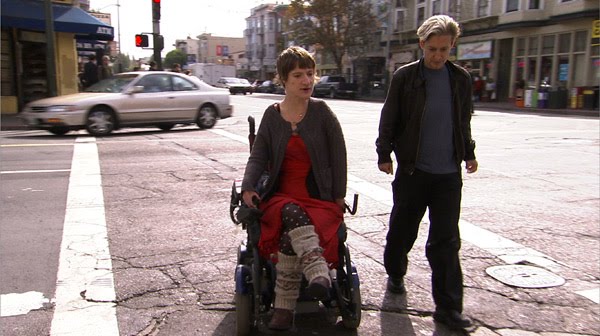
The three standouts for me were Judith Butler, Slavoj Zizek, and Cornel West. Cornel West has had vast experience as a media personality so he has the charisma and verbage to make what could have been a dry seminar into a witty musing on the nature of democracy and authority. Judith Butler is also very interesting, with her segment involving a discussion between Taylor sister, Sunastra, who is a painter and disability advocate. Their talk hinges on the idea of “going for a walk”, and what that means for a wheelchair bound person such as Sunastra. This evolves into the nature of being disabled in a contemporary context and then to an exploration of what the manner in which people walk tells us, and how human behavior is regulated by social expectations.

The best was Slavok Zizjek, a Croatian philosopher whose A Pervert’s Guide to Cinema is a great documentary introduction to film criticism. Zizek delivers his dialogue from a landfill somewhere in New York. He talks about the conflict between humanity and nature, and the trend in some groups to desire a “return to nature”. His argument against this is that Nature is simply an ongoing series of violent biological interactions. He cites oil being such a large part of contemporary life, and how we never contemplate the sheer level of violence that had to occur to destroy so much living matter to produce the oil in the earth. The conclusion of this talk is that it is in humanity’s best interest to create further and further artificial environments that it can control, and that this will involve a redefining of beauty from a pastoral standard to one in which hills of garbage can be found to have a pleasing aesthetic.

The documentary is obviously not for someone needing an escapist film, yet it is not a film for someone who has attained a degree in philosophy. I found it fairly apparent that Taylor is trying to reach out to the contemporary individual who has an interest in continuing their education and not moving through life drone-like. The film is full of idea candy, some interesting questions to contemplate and savor after seeing the picture.

Import Fridays – Un prophete


Un prophete (2009, dir. Jacques Audiard)
Starring Tahar Rahim, Niels Arestrup, Adel Bencherif, Hichem Yacoubi

Un prophete is playing at the Belcourt Theater starting today.

Everyone loves a story of “boy makes good”. Nothing better than a young man pulling himself up by his bootstraps and making a name. The only downside is the body count. That story is what French film Un prophete seeks to tell, and colors its story with issues of racial identity, particularly how it can influence other’s perceptions of us. And the film also manages to not miss the simple moments amongst all the crime and violence. It’s in those moments that the picture shines.

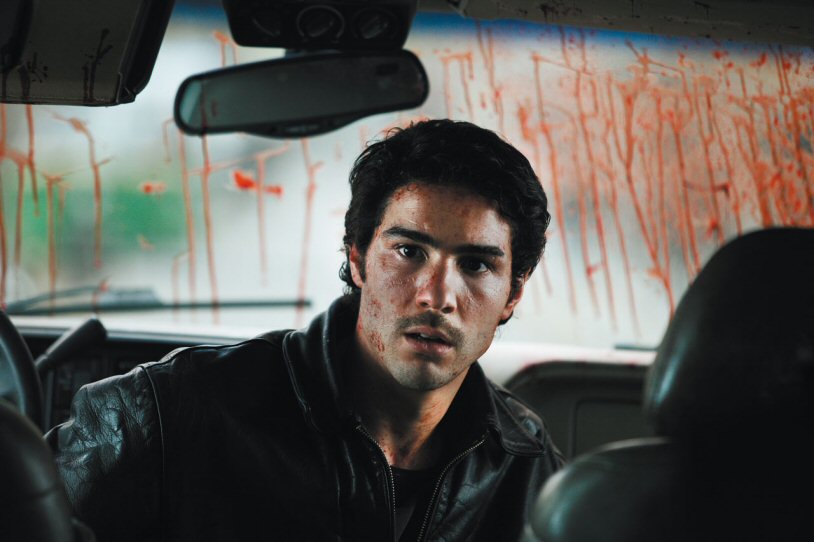
Malik has just entered prison after an undisclosed crime. He’s a very young Frenchman of Arabic descent, who is incredibly nervous and introverted now confronted with years in prison. After a chance encounter with Arab inmate Reyeb, he’s recruited by the Corsican mob on the inside to kill this rival. That murder colors Mailk’s existence, Reyeb appearing in his bed in the middle of the night, his garish throat wound still present. The haunting happen in such a subtle way, Reyeb just suddenly there, Malik never jumping but living with this ghost in his mind.

Malik begins taking on more responsibilities with the Corsicans, who still view him as a “filthy Arab”, while the Arabic in prison see him as a “Corsican dog”. It’s evident that this labeling has a strong effect on Malik. Despite this internal conflict, he soldiers on, running errands while on day leave for Cesar, the head of the Corsican prisoners. What Malik doesn’t tell Cesar is that he is starting his own low level operations on the outside, particularly running drugs.

Every thing Malik does is out of an innate sense of survival. He knows he won’t make it long on the inside so he takes the murder job from the Corsicans, spending hours trying to hold a razorblade on the inside of his cheek for preparation. The film lingers on those moment of prep time, letting Malik fester in the anxiousness of what he has to do. As terrible as you know his actions will be, you still root for him, want him to get away with it because of his relative innocence compared to the weathered inmates around him.

One of the highlights of the film comes when Malik flies a plane to meet with Arabs in Italy. This is his first plane ride and, instead of skipping over it to get to the action with the Arab mob, the film pauses and lets us see Malik’s wonder at riding in a plane. He peers over his seat mate for a glance out the window and is surprised when a flight attendant brings him cookies and glass of water. Scenes like this are what make Un prophete stand out from other “rise to power” mob stories. Malik’s tale ends in the way the audience will probably expect, but its not his position as the new boss that is important, its the journey that brought him to it and the person he was that he left behind.

Newbie Wednesday – Brothers


Brothers (2009, dir. Jim Sheridan)
Starring Tobey Maguire, Natalie Portman, Jake Gyllenhaal, Sam Shepherd, Mare Winningham, Bailee Madison

“Support the troops”. Its a slogan we hear time and time again. Yet, no matter how many yellow ribbons we put up or bumper stickers we slap on our cars, there is a severe situation involving soldiers coming home with Post-Traumatic Stress Syndrome. While Brothers addresses this, it fails to create compelling characters and ultimately comes off as preachy, rather than significant.

Capt. Sam Cahill (Maguire) is preparing to ship off to Iraq, and the day before his little brother Tommy (Gyllenhaal) is being released from prison. Cahill leaves Grace (Portman), his wife and two daughters behind and ends up being declared KIA. While, Grace deals with the loss with the help of Tommy, Sam is actually alive and well, being held by Sunni extremists along with a private in his unit. Sam is put under severe torture and starvation and made to commit horrible acts. Tommy finds himself drawn closer to Grace but the two fight their urges to give in. Eventually, Sam is coming home and there will be a falling out.

The film is slow, but that is not a bad thing. The plot involving Sam is very interesting and were the moments of the film I paid attention to the most. The Grace/Tommy story is where the film drags. There is really no chemistry between the two so the hints that they might end up together feels incredibly forced. The relationship is so muted to the point of feeling like a way to kill time till Sam returns home. The most compelling interactions are between Tommy and his father (Sam Shepherd). It seems their father dealt with PTSD upon returning from Vietnam and drowned it alcohol, eventually taking it out on the kids. Tommy ends up being the black sheep of the family, and Sam enlists in the Marines because of his idolization of his father.

The picture ends on a very melodramatic note, though its last 20 minutes are its best. The top performance comes from 11 year old Bailee Madison, who plays Isabella, Sam and Grace’s daughter. She very natural and composed for her age, and is a key part of the conflict in the film. Overall, a decent picture but this director has made much much better films.