Asian Cinema Month – In the Mood For Love


In the Mood For Love (2000, dir. Wong Kar Wai)
Starring Maggie Cheung, Tony Leung

In writing poetry or prose you have a toolbox called language. This toolbox contains things like grammar, syntax, meter, rhyme, etc. Film has a toolbox as well, but is much much larger. And the idea of having more to work with sounds like it would be easier than writing, however more does not equal easier. In the film toolbox you have elements like sound and images. And subsets of sound would be dialogue, character’s accents, soundtrack, sound effects, sound mixing. Under images we find art direction, costume design, lighting, and the most vital of all cinematography. For even the most seasoned artist, misusing these tools is an easy thing to slip up and do. With this feature from director Wong Kar Wai every single tool is used perfectly and produces a flawless example of how rich style can blend with very clear, stated substance.

The film opens in Hong Kong in 1962. Chow (Leung) is renting a room in an apartment building on the same day as So (Cheung). They pass in the hall, barely acknowledging each other. Cut to a few days later and they happen to both be moving in on the same day. Chow’s wife is seen only from behind, her face intentionally not revealed. So’s husband travels abroad to Japan almost every other week and is glimpsed in a similar fashion. The months roll on and both Chow and So become convinced that their spouses have begun an affair. Not knowing how to deal with this they attempt to recreate the circumstances that led their spouses astray with themselves to understand what happened.

The plot is very loose and is carried mostly by the atmosphere created by Wong Kar Wai and his cinematographers, Christopher Doyle and Pin Bing Lee. You rarely see cinema filmed so beautifully and with such delicate craft. I found this to be the kind of film where I don’t remember scenes of dialogue or action, rather I remember images like paintings. Chow sits over his typewriter working on a story and the smoke from his cigarette billows up above his head. The rich detail of every gray tendril of smoke is captured on screen and I felt excitement at such a profoundly beautiful image. The film’s simple theme (a longing tune played on violin) is used repeatedly in scenes where Chow and So are navigating past each other, both physically and emotionally. The camera peeks around door frames, into crowded rooms of neighbors gathered to play cards. We see Chow and So separated by these people who are caught up in raucous laughing, and the tension bleeds off the screen.

The film is able to convey the conservative social pressures of the time. Chow and So meet in his bedroom, merely to share food and must be cautious of Chow’s landlord. They are unable to touch, made clear in a scene where So reaches for Chow’s hand after being caught up in a rare moment of happiness and then quickly withdraws. The film is greatly concerned with absence: the absence of the spouses, the absence of companionship or love, the absence of the spouse’s full identities. A title card that introduces the film reads “the past was something he could see but not touch”, a phrase that sums up what this lush film is all about.


Import Fridays – The Lives of Others


The Lives of Others (2006, dir. Florian Henckel von Donnersmarck)
Starring Ulrich Muhe, Sebastian Koch, Martina Gedeck, Ulrich Tukur, Thomas Thieme

What if we were able to see Big Brother not as a faceless entity, but as a series of human cogs that make up the machine? And, what if we could see each of those cogs, doing their duty in the name of the state, as an individual human being who possesses empathy and compassion. This is the scenario this Academy Award winning German seeks to explore the humanity of a “Statsi Man”, one of the grey men who did the dirty work of the German Democratic Republic so that the authorities could successfully arrest and detain suspected dissidents.

Wiesler (Muhe) is the best the GDR has to offer in terms of surveillance and interrogation. He’s a natural pick to monitor the playwright Dreyman and his live in girlfriend/actress Christa-Maria. Dreyman has been associating with a number of dissidents and secretly an East German official covets Christa-Maria and wants to ruin Dreyman. Wiesler’s crew wires Dreyman’s apartment and begins his ever constant vigil listening to the daily life of the couple. Slowly but surely Wiesler finds himself becoming captivated with Dreyman’s joy and sadness. The death of a close writer friend cause Dreyman to become inspired to write an expose on the GDR’s efforts to cover up suicide statistics and this puts him in a lot of danger. Wiesler is compromised and must make a choice between his duty to the state and his duty to his fellow man.

Wiesler is comparable to Gene Hackman’s portrayal of Harry Caul in the similar wiretapping film The Conversation. Both men are trapped in a world of paranoiac seclusion. The nature of their jobs planted seeds of mistrust and now they live lives of solitude, only feeling safe when they are alone, yet simultaneously feeling empty. Wiesler is glimpsed mostly sitting alone in the attic above Dreyman’s apartment with headphones on, transcribing what he hears through his typewriter. He finally breaks when Dreyman receives a phone call telling him his friend has killed himself. Dreyman grieves by playing a piece of music this friend gave him and its inter-cut with images of Wiesler weeping.

The film comes to a dark conclusion but emphasizes its hopeful message through its series of denouements. The film wants to remind us that even in the most oppressive of times and the most tightest chokeholds, that human compassion can never be predicted. No matter how loyal a person has become to an authoritarian body all it takes is a brief moment of human connection to forever change that instrument into a full human being.

Import Fridays – Lilya-4-Ever


Lilya-4-Ever (2002, dir. Lukas Moodysson)
Starring Oksana Akinshina, Artyom Bogucharsky, Pavel Ponomaryov

A young girl, face swollen with bruises, cut across her lip, runs through the overcast streets of an anonymous European city. The streets are littered with refuse; broken bottles, crumpled and empty chip bags. She stops on an overpass and stares down at the cars zooming by below. This is how director Lukas Moodysson introduces us to Lilya, an 16 year old Estonian girl trying to overcome a hopeless existence she was born into and unlikely to get out of. Moodysson is grabbing the audience by the scruff of the neck and forcing them to watch this very real tragedy unfolding before their eyes.

Lilya’s mother and stepfather are leaving Estonia, but promise they will send for her once they are settled there. As soon as they leave, Lilya’s aunt claims the girl must leave the flat she shared with her parents for a smaller, more affordable apartment. She ends up in a rundown tenement and befriends Volodya, a boy thrown out of his house by his parents. Lilya is tempted into prostitution as her money and hopes dwindle down. Eventually, she meets Andrei, a man who shows genuine interest in her and gives her hope of leaving this place where she has no chance to better herself.

The film feels completely honest in its characters and the universe it builds around them. Lilya feels painfully real and could be one of millions of teenagers in any country across the globe living in abject poverty. The film doesn’t leave anyone out as responsible for the situation either. The entire system in place to protect children like Lilya is a farce. Teachers ridicule her intelligence so its no surprise she has no interest in finishing school. Her parents abandon her and her only relative, her aunt, dumps her on her own with no money or food. Every adult she comes in contact with wants to use her for sex or abandon her. Its no surprise that she resorts to prostitution as a means to survive. What is interesting is how her mother and her aunt are also sympathetic in their own ways. The women in this culture are fighting to survive, they may have to hurt another in the process, but they have been conditioned to fight tooth and nail. Even Lilya ends up committing the same betrayal when she has an opportunity to leave Eastern Europe.

Lilya-4-Ever could just as easily be remade in the United States and feature the oft vilified Hispanic population. Immigrants are people looking for hope that their homeland couldn’t provide. They fall into crime many times because they are reaching out for anything to hold onto so they don’t sink further. What is most touching about the film are the dream sequences Lilya has in the days where life has gotten the worst. She dreams of having wings, righting the wrongs she made in her past, fixing her life so none of this has happened. That painful regret is what tears at you the most in the end, and breaks your heart to see a life of such potential destroyed.

Wild Card Tuesday – Dead Silence


Dead Silence (2007, dir. James Wan)
Starring Ryan Kwanten, Amber Valetta, Donnie Wahlberg

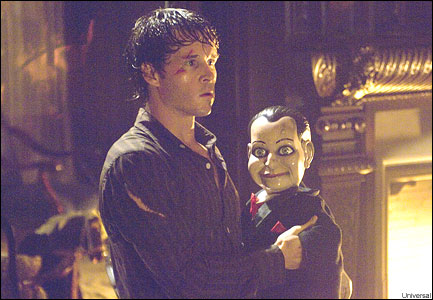
There is just something frightening about facsimiles of humans (i.e. dolls, dummies, mannequins). They have been fodder for horror since the 1920s when both Lon Chaney and Erich von Stroheim played ventriloquists using their wooden cohorts for nefarious purposes. This film seeks to find itself amongst the best of this style of horror and is helmed by the creative team behind the Saw franchise. It begins with a promising opening sequence that evokes a strong atmosphere, but eventually falls into the same chasms contemporary horror can’t seem to help but seek out. A lot style and technique over any substance.

Jamie receives a package at his apartment with a ventriloquist’s dummy inside. He leaves the house to pick up some food and while he is gone the dummy appears to murder his wife, taking her tongue. The police of course suspect Jamie is behind it and a detective is assigned to follow Jamie. Our protagonist returns to his hometown of Raven’s Fair, which happens to have a ventriloquist-related curse behind it. It seems a Depression era performer named Mary Shaw was murdering children and the townspeople assembled a mob who killed her and cut her tongue out. Now her ghost, through the dummies is killing off the members of Jamie’s family as revenge.

James Wan is not a bad cinematographer. Using the best cameras available today and tight editing he generates the perfect amount of atmosphere. The set design is top notch and I especially liked the set piece of he Guignol Theater set in the face of a cliff, alongside a lake. Even the dummies presented throughout the film are very effective. Everything came off with the tone of a great, over the top William Castle horror flick. However, the rest of the film is horrendously terrible.

Wan falls back on the same cliche scares again and again. If you have watched even a minimal amount of horror films in the last decade you could easily write the rest of the script after the first 20 minutes of the picture. There seemed to be a plethora of evil things underneath sheets and dummies menacingly turning their eyes to stare at a potential victim. The attempt to add quirks to characters extends no further than having Donnie Wahlberg’s character act like an obsessive facial hair trimmer. And the final “shocking” reveal of the picture has so many plotholes you can see straight through it. The movie ends up being yet another contemporary horror film to be thrown into the $5 bin at Wal-Mart.

DocuMondays – The Nomi Song


The Nomi Song (2004, dir. Andrew Horn)

In 1963, author Walter Tevis wrote the novel The Man Who Fell to Earth, and 13 years later David Bowie starred in the film adaptation. Little did anyone realize that the premise of the story: an alien being appears out of nowhere and goes on to achieve fame before dying prematurely was to be copied by a fellow Earthling who would lose his identity in the alien persona. Nomi’s story was much like the operas he loved, very beautiful at its heights, but destined to end in tragedy.

Born Klaus Sperber in Bavaria in 1944, the film really only focuses on his days in New York City in the late 1970s when his career as a New Wave artist occurred and ultimately ended in death. There is wonderful archival footage provided, albeit very low quality, but have footage of performances in the East Village at its cultural height is a treat. The Nomi persona came from the mind of Klaus who combined elements of his native German cabaret, classical opera, Japanese kabuki makeup, and retro 50s futurism. This melange of concepts worked together perfectly, and his set lists would consist of 1930s pop songs, 1960s pop, and his own otherworldly inspired tunes. But what truly made him such a unique act was the mastery of his voice, singing in both a tenor and counter-tenor/falsetto.

The man behind the cleverly designed persona was a conflicting mix and seemed to become much colder and distant as he became more popular. Nomi possessed an androgyny that one interviewee describes as more than sexual, but a removal from normal human emotion. He truly behaved like the alien or robot he pretended to be. There are candid moments caught on film when that fades away. On particular scene involves his appearance in a local access music show in NYC where, instead of singing, he showed off his second talent, making cakes and pies. There are also stories from his back up band and friends of how he hungered for fame, at his heart he wanted to be an opera diva.

Nomi also hungered for companionship, but even his persona was viewed as outsider one to the gay community in the late 1970s. They loved what he did but it seemed that his alien nature made it hard for any man to find him sexually attractive. Friends report in the documentary about his proclivity to go “cruising” and they warned him about the potential for disease by doing this. In the early 1980s, after beginning to compromise his work to be able to put out a marketable album, Nomi discovered strange lesions on his arm and was taking an increasing amount of antibiotics to stay healthy. He was eventually diagnosed with what was called at the time “gay cancer”, more commonly known as AIDs. His final months were sad, as he had turned his back on bandmates earlier and sought out any one who would show him compassion.

While the documentary does an excellent job of telling the story of Nomi’s musical career. However, I found myself wanting to know more about Klaus Sperber and how this young man from Germany developed this psychological mindset. What was the appeal of the idea of retreating into the alien persona? It seems that a lack of companionship fueled but how did it begin. This is an excellent documentary and can be viewed for free on Hulu.

The Nomi Song (Hulu)

Maybe Sundays – Blind Date (2007)


Blind Date (2007, dir. Stanley Tucci)
Starring Stanley Tucci, Patricia Clarkson

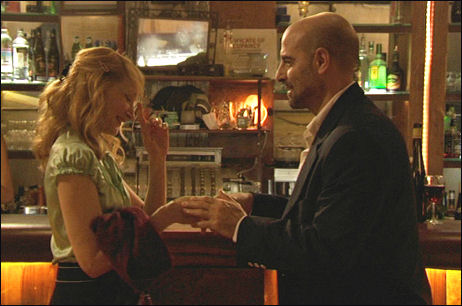
Navigating the waters of a relationship, especially one that has gone on for decades is a dangerous and fragile thing. It is almost instinctual on many people’s part to use the vulnerabilities of their mates in verbal combat, attempting to make painful digs. External circumstances can also damage both parties in a way that makes their relationship irreparable. This very quiet, simple film examines those moments of conflict by combining emotional realism but aesthetic surreality.

Don (Tucci) works in a bar/theater where he performs an intentionally bad magic act. He will regularly place and respond to singles ads in the newspaper, placed by he and his wife Janna (Clarkson) as part of a strange game they play. They always meet at the theater, where their ads have determined what roles they will play. In a few strange episodes, they play psychiatrist to each other. These meetings are revealed as ritual torture around the half way point when a tragedy is revealed as the reason why they do this back-and-forth routine. The rendezvous typically end in frustration on the part of Janna, unable to forget the pain that birthed this dance.

Despite the complex ideas and concept the film is very rough. The surreality of the setting the repetition, which on one hand is crucial to telling this story, feels tedious and the momentum of the film suffers. The acting is amazing, I wouldn’t expect less from these performers though. The film is part of a series which works to release English language remakes of Dutch filmmaker Theo van Gogh’s work. Van Gogh was murdered by an Islamic extremist in 2004 after releasing a film highly critical of the Islamic community’s treatment of women. Despite the flaws in this remake, it does have me interested in seeing the original and the rest of van Gogh’s work.

Wild Card Tuesday – Mean Girls


Mean Girls (2004, dir. Mark Waters)
Starring Lindsay Lohan, Rachel McAdams, Lacey Chabert, Amanda Seyfried, Lizzie Caplan, Daniel Franseze, Tina Fey, Tim Meadows, Ana Gastneyer, Neil Flynn

I know what you are thinking, “Why? Why would you watch this?” My excuse is that the screenplay was worked on by Tina Fey, who also plays the main character’s Math teacher, and I gave it a chance based on her pedigree. Well Tina, you didn’t completely disappoint me.

Cady Heron (Lohan) was raised by her parents in Africa, and subsequently homeschooled because of the experience. Now back in the States, Cady is going to a public school for the first time and completely unaware of the highly structured clique system in place. She befriends two of the art kids, Janis and Damian, who encourage her to infiltrate the Plastics (read: popular girls) and ruin the status of queen bee Regina (McAdams). The rest of the film plays out as a mix of typical high school comedy with moments that rise slightly above that.

The female cast was definitely a strong one. Every single one of the key actresses has done a lot of notable work before and since this film. I don’t think I had actually ever seen a Lindsay Lohan film (save A Prairie Home Companion where she played a very small role), but she is (was?) a very good actress. Her performance as Cady feels very genuine and I never saw the acting going on, which happens a lot with younger actors and actresses. For example, Lacy Chabert was very transparently acting and it showed. Rachel McAdams was also very good, especially knowing her from other such different roles. But the stand out, and you had to be watching closely to catch it, was Amanda Seyfried. Her role appears simple: the ditz, but the girl has some great comic timing. Pair that with her recent role in Jennifer’s Body, and I am excited about seeing her in upcoming films (particularly the soon to be released Atom Egoyan picture Chloe).

As good as these actresses were, it didn’t save the film. The parts I laughed the hardest at were the moments centered around the teachers. Tina Fey, Tim Meadows, and the rest of the cast in those teacher roles were awesome, and I found myself wishing the movie was about the faculty. We have so many teen comedies on the market, but a clever flick, scripted by Fey, about high school teachers would be a treat. The film will definitely make you laugh, but its nothing worth more than a single view. And I couldn’t help but wonder that instead of using director Mark Waters (Freaky Friday, Just Like Heaven) they had hired JOHN Waters to helm the picture. Now that would have been a skewering of high school hierarchies.

Director in Focus: John Sayles – Silver City


Silver City (2004, dir. John Sayles)
Starring Chris Cooper, Richard Dreyfus, Danny Huston, Mary Kay Place, Tim Roth, Thora Birch, Maria Bello, Miguel Ferrer, Billy Zane, Michael Murphy, Kris Kristofferson, Daryl Hannah

John Sayles is not shy about his politics, and this film is definitely the work of a bleeding heart liberal. I myself am a fellow bleeding heart so I sympathize with the sentiments of the picture. However, it is a piece of cinema made out of anger and frustration and, while those elements have helped make great art, they cause Silver City to feel overly bitter and despondent, and way too didactic.

The movie opens on the filming a campaign commercial for gubernatorial hopeful Dickie Pilager (Cooper), the dim-witted son of a former governor of Colorado now believing he can win the seat. Sound familiar? Cooper’s performance, obviously modeled on President George W. Bush was very well done and, as much as I like Josh Brolin, made me wish we could have seen Cooper in Oliver Stone’s W.  During the filming of this commercial, as Pilager casts a rod into the crystalline lake in the frame, he pulls up a hand belonging to a body left in the water. Immediately, Pilager’s campaign manager (Dreyfus) thinks someone is setting Pilager up and hires a detective agency to investigate. The investigator is Danny O’Brien (Huston), a former news reporter who is less than enthusiastic at first. As he journeys deeper he becomes obsessed with Pilager’s connection to a multi-corporate mogul Wes Benteen (Kristoffersen).

On paper, this sounds like a great concept. But it fails, and it fails badly. Huston is completely unnatural in the leading role, proving to me he needs to keep to the supporting ones. I can’t figure out if it was the dialogue or actor, but he comes incredibly stiff and forced in his performance. And with Danny O’Brien as the character we are following, it makes the film that much more painful to get through. Cooper and Dreyfus deliver great performances, but aren’t in enough of the movie to make it work. I would have preferred that it had focused on the Pilager character’s campaign more and been a satire of President Bush. Instead, we get a poorly made activist film where metaphors are incredibly shallow.

The film made me feel very conflicted, as every political note it touches I am right there in support of. But it proves that when views are expressed too overtly they bog a film down. The film takes it self too seriously for the majority of the time, and when it does attempt to go light, such as when Daryl Hannah’s tough hippie character is introduced, the humor feels hollow and tainted by Sayles bitterness. Not the best work of this director; he CAN make great films about his political views (Matewan for example).

Next up: Sunshine State and my final thoughts on John Sayles.

DocuMondays – Young @ Heart


Young @ Heart (2007, dir.Stephen Walker)

The film opens with a jarring scene: a music video featuring a group of senior citizens performing The Ramones’ “I Wanna Be Sedated”. The first reaction is one of amusement, it is “adorable” that these “little old people” are singing a punk rock song. However, once the lyrics sink in, the simple “aw, how cute” fades away and there is a profound expression that is created when these words come from those mouths:

“Twenty-twenty-twenty four hours to go….
Just put me in a wheelchair, get me on a plane
Hurry hurry hurry before I go insane
I can’t control my fingers I can’t control my brain”

There’s something very honest and appropriate about a group of aged faces yelling out these lyrics. It seems more appropriate for them, than a group of young buck musicians. This is what the 2007 documentary Young @ Heart does so well, it balances the “cute, old people” moments with a rich and meaningful exploration of aging and confronting our mortality. 
The heart behind the Young @ Heart Chorus is Bob Cilman, a truly extraordinary person. Bob had dedicated hours of work to help organize and put on performances with the elderly, and he doesn’t coddle them. When his two featured performers have trouble with James Brown’s “I Feel Good”, Bob doesn’t speak to them in hushed tones. He shouts at them, he gets angry and frustrated, and eventually decides to just work on another song. It can appear mean, but Bob has such a high level of respect and such lofty expectations for this group he can’t help but be intense about it. And those expectations pay off a hundredfold.
The performers bring a lot of love into their performances, and the film captures a very tumultuous year for them. Long-time and dedicated performer Bob Salvini takes ill and eventually dies in the middle of the group’s performance season. A profound moment occurs when, during their concert, Fred Knittle performs Coldplay’s “Fix You”, a song he was meant to share with Salvini. The lyrics reflect the feelings of the the performers and Joe’s family who watch in the audience:
“And the tears come streaming down your face
When you lose something you can’t replace
When you love someone, but it goes to waste
Could it be worse?

Lights will guide you home
And ignite your bones
And I will try to fix you”

The documentary is deeply moving. In another scene the group performers for prisoners at a correctional facility. The way the camera shoots the faces of the chorus singing “Forever Young”, then cutting to the faces of criminals having to look down or cover their faces because of the tears welling in their eyes makes it impossible for the audience to not experience the same sense of compassion. Don’t discount this film as made for the old, or purely an attempt to exploit the elderly. This is a film made for the young to discover the depth and wisdom of their elders. This is one to be hunted down as soon as possible.

Fred Knittle performs Coldplay’s “Fix You”

The Young @ Heart Chorus performs “Forever Young”

Newbie Wednesday – Mammoth


Mammoth (2009, dir. Lukas Moodysson)

Starring Gael Garcia Bernal, Michelle Williams, Marife Necesito, Sophie Nyweide, Nathhamonkarn Srinkikornchot
We are constantly alone, even when we’re with the ones we love. And when the decision comes to be away for money, we seem to choose to be away even if it makes us miserable. Swedish director Lukas Moodysson examines these ideas in a very well-acted, but ultimately cold and derivative film. The strongest influences here are the work of Alejandro Innaritu (Babel, Amore Perros) and the 2005 film Crash.
The picture begins with the happy family at play: Leo (Bernal) is a video game designer, Ellen (Williams) is an emergency room doctor specializing in pediatrics, and their daughter, Jackie (Nyweide) is a precocious child caught up in her love of astronomy. Also in their lives is Gloria (Necesito), a live in cook/maid/nanny whom Jackie seems much closer to. Leo leaves for a long business trip in Thailand and Ellen becomes caught up in the tragedy of a stab wound victim brought to her and jealousy of Gloria and her daughter. Gloria is dealing with anxiety of being separated from her own sons back in the Philippines.
Moodysson’s outlook on the world is a bit too simple and feels very predictable. Ellen’s jealousy over Gloria could be seen from the opening frames of the film, and doesn’t really develop in relevant way. The situation with Gloria’s children also comes to a close on a very unsure note, and not in a thought-provokingly ambiguous way, but rather uninspired. The film also makes some bland cross cutting: a pile of elephant dung is followed by Gloria cleaning toilets. These scenes feel more proud of how clever they are than really possessing any real cleverness.
The problem with not creating any sort of metaphors between his ideas and his characters, causes Moodysson to end up moralizing to us in the most patronizing of ways. Much like Crash, a horrific example of patronizing and pretentious cinema, Mammoth slaps us over the head with its message multiple times and then with a barrage in the final scenes. At the end of the day though, the question arises “What is the point?” Yes, I think everyone is aware of the global disparity of wealth and power. The film provides no ideas as to where we go next, which makes it makes of little value.