The Pryor/Wilder Quartet -See No Evil, Hear No Evil

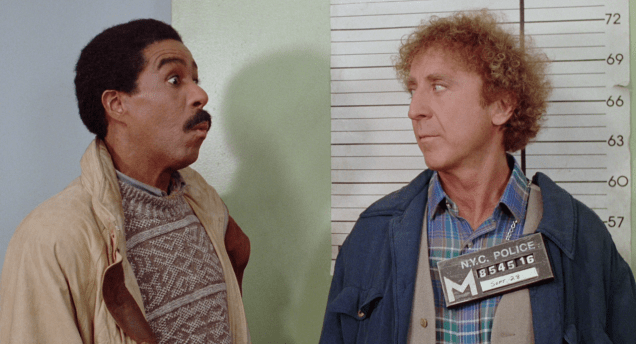
See No Evil, Hear No Evil (1989, dir. Arthur Hiller)
top-365-films-see-no-evil-hear-no-evil

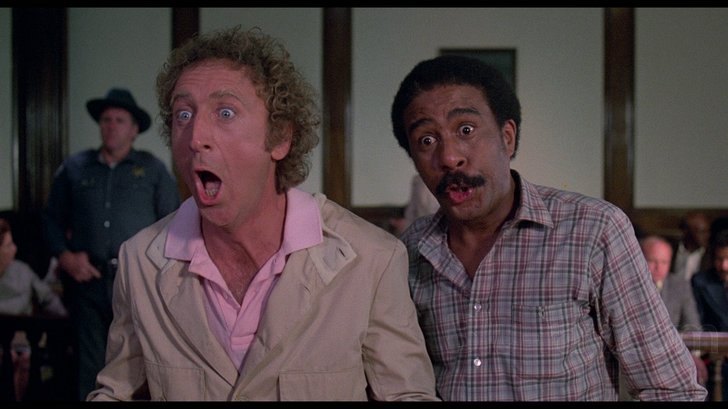
Wally Karew (Pryor) is a blind man who isn’t letting his condition slow him down, despite protests from his sister. He ends up getting a job working for newsstand owner Dave Lyons (Wilder), who happens to be deaf. The two become embroiled in a murder mystery. Karew’s bookie comes looking for money he’s owed but instead stashes a valuable coin in the newsstand when some, even more, unsavory types show up. Karew and Lyons get implicated in the murder, as ludicrous as that sounds and they have to bust out of jail and track down the real killers. Clearing their name involves posing as doctors at a hotel convention and enlisting Karew’s sister for help.

In both Stir Crazy and this film, there is a palpable desire to recreate the past success of Blazing Saddles and Silver Streak. In my Silver Streak review, I mentioned how Pryor was initially set to play the Cleavon Little role. I get the feeling the interaction between Gene Wilder and Cleavon Little looms over these films. Add to that the iconic moment in Silver Streak where Wilder is forced to “black up” to sneak past FBI agents and you can see the pressure these new movies had to create similar iconic comedic moments. That’s the problem with forcing those moments; it won’t ever happen. Comedy is a very organic thing and letting your actors “just ad lib” is rarely a smart move, even if they are as talented as Wilder and Pryor.

Instead, the comedy in this film awkwardly comes from the characters’ disabilities. Almost every joke is a slapstick play on blindness, deafness, or a combination of the two. There are some occasional amusing moments, but often it comes across as offensive and ableist. Isn’t it funny how the deaf guy misreads lips or isn’t it funny how the blind man gropes that lady? It doesn’t help that the main storyline, the valuable coin, is dumb and forgettable. It resolves in a very sloppy way that gives off the sense that the writers and director just threw up their hands and said: “Forget it!”.

A carryover from Silver Streak has been the idea that Wilder’s character must always have a love interest. Here there is an attempt to make it the female villain. It never goes anywhere which makes it better than the forced love interest in Stir Crazy. When I think back to the chemistry between Clayburgh and Wilder in Silver Streak, it feels real and natural. Much like the best moments between Wilder and Pryor, these romantic plots can’t get shoehorned in if there isn’t a reason for them and them chemistry isn’t there between the leads.

1989 was a critical moment in Wilder’s life. His wife of five years, Gilda Radner, died the year this film came out and it had a profound effect on his work. Previously, he had made three films with here that had not been well received by audiences or critics, so he was a rough place personally and professionally. Pryor had a mixed bag in the years since Stir Crazy. He’d co-starred in Superman III and had made the pictures Brewster’s Millions and Moving. He was enjoying a bit more commercial success than Wilder and was working to soften his edges. In 1980, the actor notoriously freebased cocaine which led to him dousing himself in rum and setting himself on fire. That violent incident would be a huge turning point in his personal life and lead to his eventually sobering up.

Wilder and Pryor would make one more film together, Another You, which we’ll look at next week.

Movie Review – The Neon Demon

The Neon Demon (2016, dir. Nicolas Winding Refn)

The-Neon-Demon-pic

Jessie (Elle Fanning) is a fresh-faced Midwesterner just off the bus in Los Angeles. She is making the rounds to become a fashion model and meets Ruby (Jena Malone) along the way. Ruby seems very struck with Jessie, who possesses an otherworldly beauty and brings her into the world of professional modeling. Jessie is also dealing with a potential new romance with an amateur photographer and the leering of a nightmarish hotel clerk.

The Neon Demon is a film about superficiality that thinks it has something profound to say about the nature of beauty but merely ends up being just as vapid as the target of its philosophizing. It is an exquisite film, no doubt, with some gorgeous and iconic cinematography done by Natasha Brier. Throughout the movie, there are great posed shots (a mountain lion snarling on a hotel bed, models bathed in blood-red neon lights, figures emerging or receding into the shadows). But it all adds up to nothing. There is an attempt to monologize some meaning into the story in the third act through an overwrought speech by Jessie, which comes across more as director Refn thinking he’s smart but is more embarrassingly sophomoric in his philosophy.

If you can separate the paper thin story from the film, then The Neon Demon is a very sumptuous visual feast. Refn doesn’t try to hide from his obvious influences; mainly the Dario Argento made Giallo films of the 1970s and early 1980s. The story’s framework is a nod to Suspiria, with a coven of witches and a naive ingenue unaware of the horrors that await her. Thematically, the movie touches on the same ideas as recent pictures like Black Swan, Starry Eyes, and Sleeping Beauty. However, those films explore the themes in much more interesting ways. Starry Eyes, in particular, seems like an apt comparison to The Neon Demon and while it’s visuals are not as stunning, it tells a much more meaningful story.

It’s hard to judge the acting of the cast because they either weren’t given much material to work with or were directing to be one dimensional and uninteresting. The few bright spots come in brief appearances by Christina Hendricks as a modeling agency rep and Keanu Reeves as the previously mentioned creep of a hotel clerk. It would have been nice to spend more time with those characters because they seemed to have deeper roots in this hellish version of Los Angeles and could have proven an intriguing counterpoint to Jessie’s blankness.

Refn has been a very polarizing director with his last film; Only God Forgives being very divisive among critics and fans. I’d argue that it is a better film than The Neon Demon simply because characters behave consistently, and they have a complete, coherent arc. Only God Forgives also has striking visuals and compelling Cliff Martinez score, just like The Neon Demon. The behavior of the characters in The Neon Demon is baffling because from scene to scene the actors seem to be told to play entirely different characters. As a tone piece the movie succeeds, but as a cohesive film with characters, plot, and themes it is as frivolous as cotton candy.

The Pryor/Wilder Quartet -Stir Crazy

Stir Crazy (1980, dir. Sidney Poitier)

5449_1

Stir Crazy is the second collaboration between Gene Wilder and Richard Pryor. This time, they are brought together by actor/director Sidney Poitier. The premise has the men as friends and roommates burnt out from life in New York City. They set out for the American Southwest where Wilder promises they will live a free and happy life. However, they end up framed for a bank robbery and receive a sentence of 125 years. Life is prison quickly drives them nutty, and they find a possible escape when it turns out that Wilder is a natural for the rodeo. The prison warden has a tournament coming up and plans to use Wilder to break his losing streak.

Since Silver Streak, life for Wilder and Pryor has been busy. Wilder has made The World’s Greatest Lover, inspired by a Fellini film, and The Frisco Kid, a Western that made Harrison Ford his co-star. Both films were considered significant failures at the box office. Pryor had two more successful comedy albums and starred in Car Wash, some forgettable comedies, and in Paul Schrader’s (Taxi Driver) drama Blue Collar. The comedian has also suffered a heart attack in 1977 but seemed just to double down on drug consumption which led to reportedly unprofessional behavior in being late the set of Stir Crazy. There was a lot of tension behind the scenes between Poitier and Pryor, and it can be felt a bit on the screen.

Stir Crazy is a pretty major disaster of a film. Silver Streak was a very tightly written and plotted, while Stir Crazy plays it way too loose and gives its two leads way too many scenes to mug and improvise in. There are multiple instances where Wilder especially is encouraged to just riff, and they fall flat in a huge way. His character mainly feels all over the place, in some moments being a naive doof and in others a Bugs Bunny-esque trickster. It becomes impossible near the end to know when he is genuine and when he is messing with the prison staff. There are a couple of moments where the two pull off genuinely humorous reactions. The sentencing scene is the highlight of the film with the result feeling natural and playing to the actors’ strengths. The scene where the two men are thrown into the county jail after their arrest is also funny until Wilder begins ad libbing a kung fu bit that just doesn’t work.

The film suffers from a lot of tone and plot problems. The film switches plot tracks numerous times with many characters introduced and ending up completely unimportant to the movie. JoBeth Williams shows up halfway through the film as an intended love interest for Wilder’s characters but goes nowhere and somehow still ends up with Wilder despite the story never earning that. After reading about the tension between Poitier and Pryor, I suspect Wilder had more plot added to his character as both a way to pad for Pryor’s absence and as a way to get a dig in at the comedian.

With contemporary sensibilities, it’s very hard to watch the Rory character, a horrible gay stereotype that I hope we have moved past. Rory is immediately attracted and clings to Pryor’s character. Pryor’s disgust at the attentions of a gay man is played for laughs culminating in the man kissing Pryor in the final scene. The comedian let’s lose an exaggerated “Yuck” to make sure we, the audience know he doesn’t return the affection. It’s a very gross type of character to include and he ends up being completely one dimensional.

Stir Crazy was the third highest grossing film of 1980 yet still was nominated for a Razzie. It was the highest grossing film by an African American director until I believe, The Wayans Brothers’ Scary Movie (2000). It’s an incredibly diverse cast in a very sloppy film with some problematic elements. Poitier would go on to direct Hanky Panky (also with Wilder), Fast Forward, and Ghost Dad. We’d see Pryor and Wilder come together nine years later in See No Evil, Hear No Evil which we’ll talk about next week.

Movie Review – Tale of Tales (dir. Matteo Garrone)

Tale of Tales (2016, dir. Matteo Garrone)

tale of tales

Tale of Tales is an adaptation of a few fairy tales collected by Italian folklorist Giambattista Basile in the 15th century. Basile’s work would later inspire the Brothers Grimm to publish their collections in the early 19th century. So in this film, there are stories very unfamiliar to American audiences and likely most moviegoers around the world. The stories are loosely interconnected the film cuts between them in simple acts, with all three coming together in the final scene.

The first tale concerns a queen (Salma Hayek) who desperately wants a child. Her husband, the king (John C. Reilly) follows the advice of a wise man and hunts down a sea monster so that the queen may eat its heart and bear a child. The king dies in the process, and the woman who prepares the heart for consumption becomes pregnant from its magic. The unexpected cross-pollination results in a pair of identical twins from two different mothers whose lives as adults become fatefully intertwined despite the queen’s protestations. The second tale tells about a lustful and hedonistic king (Vincent Cassel) who hears beautiful singing and tracks it down to a cottage in the village below his castle. He is unaware the voice belongs to an aged woman and enters into a dance of seduction with her. Magic becomes involved, and this story goes to some horrific places. The third and final story concerns a silly king (Toby Jones) who becomes enamored with raising a flea until it becomes the size of a large dog. His daughter is caught up in the romance of chivalrous stories and wants a husband. The king holds a contest, and she ends up with a less than desirable suitor.

The practical effects work in the film is stunning. The film is one of those where we see the craftsmanship of fields in film production that are a dying art. Very minimal computer-generated effects are used and instead we have magnificent puppetry and makeup work. The costume and set design is also at a remarkable level. The castles and buildings used in the film add the fairy tale nature of the whole piece. I was reminded by behind the scenes content I’ve read and seen in Fellini’s films and how he went out of his way to employ these craftsmen and women who grow smaller in number by the day. Garrone makes a major case for practical effect in film production.

There is little character development in each story, but that’s expected with the emphasis on creating a fairy tale tone and atmosphere. These are morality plays, so the characters are larger than life and representative of points of view rather than individuals. That said, I did find some character moments in the second tale, the story of the elderly woman, to be quite painful, especially its grotesque and heartbreaking conclusion. The one thematic thread tying all three stories together is that of “be careful what you wish for”. No handsome prince is coming to save the day and instead we have three prominent female figures struggling to deal with expectations placed on them and their personal desires.

Director Garrone has previously directed Gomorrah, a hyper-realist film that tells a slice of life, almost documentarian story, of the influence Italian organized crime, has on the life of the nation’s citizens. He brings that same non-judgemental eye to these fairy tales to create a type of film that is unique beyond the deluge of fairy tale revisionism that is quite popular these days.

Masks Actual Play: Junior Elite #0 & 1

junior-elite-logo

For my first online Masks campaign, we have the following characters. To read more about the Masks game system check out my overview from Origins 2016. Illustrations of our campaign’s characters are done by John Alexander. Junior Elite logo by Mick Bradley:

  • Black Hoodie the Delinquent (played by Ariana Ramos)
    • Mentored by and eventually discarded by an enigmatic figure, Black Hoodie can construct a useful gadget out of whatever materials are at her disposal.
  • Silver Arm the Innocent (played by Mick Bradley)
    • Possessor of a silver arm that grants him mystic powers connected to Celtic mythology, Silver Arm was tossed forward from 1996 to present day where he finds his modern self to be a cynical, jaded jerk.
  • Magnificent Lad the Legacy (played by Pamela Alexander)
    • The son of Gravinians Magnificent Man and Magnificent Woman, this young hero has been expected to follow in their footsteps since birth.
  • Kid Atomic the Protege (played by John Alexander)
    • The orphaned son of a pair of super villains, adopted by Doctor Atomic and raised as his ward
  • Phoenix and The Sphinx the Joined (played by Misha B)
    • Twins, one of whom is a precog and one a postcog, more powerful when in each other’s presence.

The team has been named the Junior Elite by the press, due to two of their members’ associations with elder members of The League of Elite, Halcyon’s premiere superhero team. In our first session, we focused entirely on character building with lots of questions and note taking on my end.

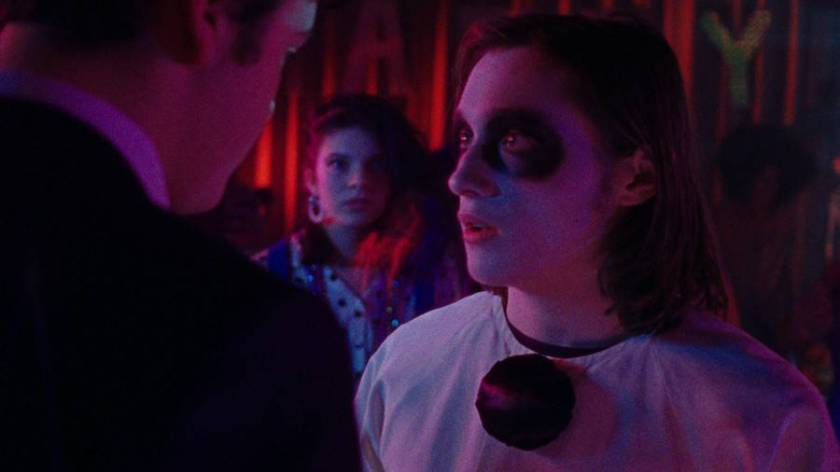
The inciting incident for our campaign is the disappearance of almost all the League of Elite. The Junior Elite responds to an attack on the Eon Institute; a research laboratory focused on multiversal and temporal science. The attack is led by Professor Dark and his Children of the Night; a washed up 1990s goth styled villain. The Professor is wielding cosmic level weaponry that he couldn’t have made himself, and it takes the combined Junior Elite to stop him. Before the team can examine the weapons more carefully, Gen. Juliet Mayhem of AEGIS swoops in and absconds with the tech citing her organization’s ability to keep it locked up tight. The only member of the League of Elite that’s still around is Doc Atomic, and he seems to have been broken psychologically from whatever went down. The Junior Elite also met Dr. Conway Claremont, the lead researcher at the Eon Institute. Claremont explained that Professor Dark broke into the wing that housed viewing equipment for that the scientists had coined “The Dark Star Dimension” and that he believes this was all a diversion from something worse. The twins share a vision of a darkened void with a single molten planet floating in the darkness. From the darknesses rises a being composed of the world’s very essence. It reaches out to make contact with a small being consisting of pure light. The vision ends. The first mini session ended with an object hurtling from space and crashing into a farm on the outskirts of Halcyon. The farmer rushes out to investigate only to see a thorny silver arm reach up over the crater’s edge.

In our first full session, we kicked things off with Magnificent Lad at his family’s secret base on a jungle island off the coast of Halcyon. There his robot butler Symba is trying to get the young to sleep after 18 straight hours of searching the known universe for his parents’ using their alien equipment. The conversation is interrupted by Xion, a former friend turned enemy of the Magnificent family who has arrived on the island. Mag Lad and Xion clash, with Symba alerting the rest of the Junior Elite. The battle leaves the planet’s atmosphere and ends on the moon where Xion is able to explain that he has come to help Mag Lad find his parents. His reasoning is that with their disappearance it finally set in that their species was on the brink of extinction and he will help find them. The team can’t get a good read on Xion but he does seem genuine in his concerns. The former (?) villain sets up shop in the Magnificents’ lab explaining that Mag Lad’s father would likely construct a beacon wherever he might be and that Xion can build a receiver.

The team is pulled away quickly thereafter when massive destruction is reported in the district of Prosperity. Prosperity is a borough of the city that appeared from the 31st Century. However, none of the residents came with it so, while it was amazing and beyond anything Halcyon’s citizens were used to it quickly decayed because there was no one alive who knew how to maintain and repair the technology within it. Now Prosperity is a rundown area of squatters and homeless communities. The Junior Elite, airborne in Kid Atomic’s warthog helicopter, see a path of destruction coming from the farmlands into the city. On the ground is Nuada of the Silver Hand, the mythical Celtic hero who bears the same weapon as young Silver Arm. Silver Arm attempts to calm the time lost warrior but Mag Lad decides to get physical and wants to take Nuada down. The rest of team goes into rescue mode until Silver Arm miscalculates and causes a towering spire to collapse into the energy district, exploding a fusion reactor and taking power out across town. The Halcyon City Jail is hit, meaning Professor Dark has a chance to escape.

Black Hoodie, Phoenix, and Mag Lad head for the jail while Silver Arm, The Sphinx, and Kid Atomic hang back with Nuada. It becomes apparent that Nuada knows more than he originally let on. His silver arm separates itself from his body, revealed as a sentient demonic entity. The silver demon strikes at The Sphinx who loses control of her powers and begins opening rifts in space and time. We get quick glimpses of possible futures and alternate realities, including The Sphinx as a world-destroying cosmic force. Kid Atomic tries to fly the Warthog in to scoop her up but Nuada used his sword to blow out the engine. Across town, Phoenix senses Professor Dark is headed for Damnation, the old town district of Halcyon, but they head back to help her sister when she sense the twin’s pain.

Nuada is finally taken down when Silver Arm reaches out with his consciousness and absorbs the silver hand into his own arm, causing the liquid metal to grow from his arm and shoulder and down his torso and leg. Nuada shrivels into a husk and before he passes out utters, “Heaven has fallen.”

The final scene shows Professor Dark arriving at a strange pit fighting venue in Damnation. We briefly glimpse Apollonia, one of the supposedly missing League of Elite, fighting in the pits against other metahumans. There’s no time to figure out what’s going on there as Dark meets with a figure named Prospero who usher the villain into a backroom for a private conversation.

To be continued…

Patreon Update – August Blog Stats

Patreon-logo

Views and Visitors

Growth in views from July to August was -65% (July: 716, August: 249)

Growth in visitors from July to August was -55% (July: 464, August: 207)

16% of views came from Google Plus

41% of views came from Google searches

6% of views from Facebook

Posts

The top five most visited articles for August were:

  1. Comic Book Review – Omega Men by Tom King – 25 views**
  2. The Childhood of a Leader (2016, dir. Brady Corbet) – 19 views
  3. Games for Two – Lost in R’lyeh & Sushi Go – 15 views*
    Comic Book Review: The Vision Vol.1: A Little Worse Than Man – 15 views**
  4. Great Books You Should Read #1 – 12 views

** denotes post was published in previous months, though the views came exclusively from August.

Analysis
Due to a much-diminished posting schedule for August, I saw inevitable drops across the board. I posted less new content, so search engine hits became the core of my views for the month. As a result, my most viewed posts were more of my older content. It does appear that Tom King was increasing in interest, probably due to his current run on Batman and the release of a few trades at the end of July. Not on the top five for August, but prominent when I look at my statistics for the year is my Origins article on Bluebeard’s Bride. August marked the 100th view of that particular article since it went up in late June. To me, that is a sign of high interest in the unreleased roleplaying game.

Conclusion
Posting will increase by a bit in September. One of my series for this month will be a Gene Wilder/Richard Pryor retrospective that I suspect will get decent views due to Wilder’s recent passing. I don’t expect to see numbers like June and July’s til next summer if I decide to post with that frequency. In October there will be an increased number of posts for Halloween, and I believe the numbers I generate that month will be more reflective of what will be the mean views.

The Pryor/Wilder Quartet – Silver Streak

Silver Streak (1976, dir. Arthur Hiller)

Silver-Streak-Gene-Wilder-Richard-Pryor-gun-in-hand-or-glad-to-see-me

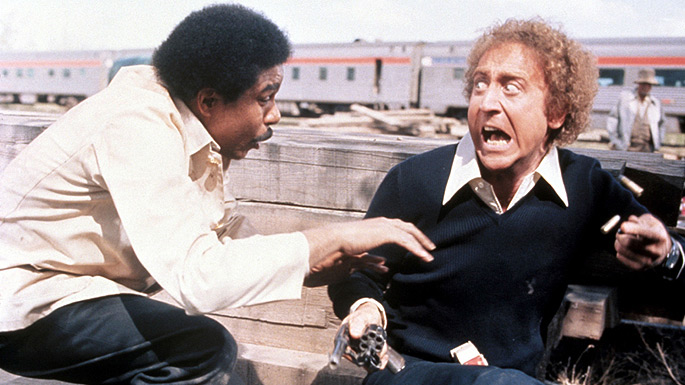
George Caldwell (Gene Wilder) is taking the Silver Streak train from Los Angeles to Chicago. While onboard he meets and spends the night with Hilly Burns (Jill Clayburgh), the secretary to a prominent art professor. George claims he saw the professor dead and thrown from the roof of the train and his investigation the next morning leads to him crossing paths with paid goons and being tossed from the train. A conspiracy behind the professor’s work is uncovered and George must team up with Grover Muldoon (Richard Pryor), a thief who ends up drug into the mess.

When Silver Streak was released, Gene Wilder was at his career peak. He’d come off of Blazing Saddles and Young Frankenstein. Previously, Wilder had struggled to find a breakout role. In retrospect, films like The Producers and Willy Wonka are spoken of fondly but at the time they were considered box offices failures whose love only came later with home video in the 1980s and 90s. Richard Pryor was as big a name and arguably bigger than Wilder at the time. By 1976, he’d had three comedy albums that went gold and hosted what became one of the great Saturday Night Live episodes. Before that, he’d cut his teeth as a writer on Sanford and Son as well as Blazing Saddles. He was set to play the co-lead with Wilder in Saddles but his volatile nature connected to his drug use caused studio heads to nix that idea.

The film was directed by Arthur Hiller, one of the big directors of the 1970s with features like Love Story, The Out of Towners, and The In-Laws. He worked frequently with playwright Neil Simon, however, Silver Streak was the work of Colin Higgins. Higgins was the screenwriter behind Harold and Maude and would go on to write and direct Foul Play, 9 to 5, and The Best Little Whorehouse in Texas.

The biggest thing you’ll notice while watching Silver Streak is that Pryor doesn’t appear onscreen until a full hour into the film. He’s billed third behind Jill Clayburgh and this appears to be because his roll was not meant to be as stand out. After reading the script, Wilder told the producers that the only way to keep elements in the film from becoming offensive would be to hire Pryor for the Grover role and allow him to bring his personality and point of view to the role. He was exactly right because, in scenes like the blackface disguise moment, Pryor is able to comment on white people and their exploitation of blackface in a way that most certainly came from his own mind. It’s very apparent to see why Pryor and Wilder would be teamed together for the next 15 years because they do have a wonderful chemistry together.

Speaking of chemistry, the relationship between Wilder and Clayburgh is one of the most convincing I’ve seen in a film. There was a certain type of naturalistic acting that worked its way into mainstream cinema in the 1970s that I think is present in the interaction between these two actors. It doesn’t hurt that both of them just have very magnetic, genuine, and charming personalities. You just can’t help but smile during their flirtation because it feels like you’re watching a real moment between two people who are attracted to each other.

The supporting cast is one of those great character actor showcases: Ned Beatty, Scatman Crothers, Patrick McGoohan, Ray Walston, Clifton James, and Richard Kiel. The roles are not that meaty on the page, but the actors bring dimensionality to the characters through their choices. The film is also very well-paced with Wilder’s series of ejections from the train marking the act breaks in a very clever manner. This will definitely be the strongest of the four Pryor/Wilder films in the series and serve as a benchmark to compare the subsequent pictures.

Movie Review – I Am Not a Serial Killer

I Am Not a Serial Killer (2016, dir. Billy O’Brien)

not a serial killer

John Wayne Cleaver (Max Records), a teenager with sociopathic tendencies, lives in a bleak Midwestern town, seemingly under a permanent blanket of snow. Against this wintery landscape, a series of killings begin. Cleaver gets a front row seat to examine the corpses due to his family’s prominence as the only mortuary in town. He quickly discovers each body is missing an internal organ or body part. The bodies also appear to have been cut apart with a chainsaw or toothed blade. And there’s that sizzling black oil at all the crime scenes. Cleaver struggles to control his own compulsions to hurt school bullies and the need to connect with others while trying to figure out whose sinister hand is behind the killings.

I did not expect what I got from this film. I knew going in from the atmospheric trailers that it was going to be moody and dark. There is plenty of gore due to the mortuary being a key location. We never see victim’s faces until more than halfway through the film. In many ways, this is from the perspective of Cleaver. He sees the bodies as simply hunks of meat at the beginning, parts of a mystery he wants to uncover. When the victims become people he personally knows the weight of the crimes set in.

Despite this darkness pervading the film, there is humor and softer moments. Cleaver frequently visits his psychiatrist, Dr. Neblin. Instead of Cleaver lying on a couch and unloading his feelings, the two meet in outdoor locations having sessions in a park or on a rooftop while birdwatching. The doctor comes across a very human and truly working to show empathy to the young man while attempting to stoke the fires of empathy in his patient. The family dynamics between Cleaver, his mother, aunt, and older sister feel very genuine with lots of tension around the holidays that the film knows it doesn’t have to get expository about.

The look of the film is grainy and textured. Handheld shots in moments of extreme horror and tension add to the despairing atmosphere of the crimes. It’s clear that slasher horror of the 70s and early 80s influenced the tone and visuals of the picture in all the most positive ways. The movie is also confident in letting itself wander through landscapes. There’s not hurry to wrap up the story. Instead story elements are allowed to simmer and we get some wonderful performances from young Max Records. His most notable role thus far has been as the lead in Spike Jonze’s Where the Wild Things Are. It’s apparent that he understands emotion and subtlety and gives a very honest performance of a very troubled character. Cleaver is never presented as angsty, he’s contemplative and seeks understanding of his condition, even if it means communing with a killer.

There is a major twist halfway through the film that is not presented in any of the trailers I saw and should be avoided at all costs. The shock of what the film becomes in that moment was one of the best elements of the picture. The director manages to take elements that could be eye-rollingly ludicrous and add some emotional weight. If you are looking for a horror film that lives in the “real world” I Am Not a Serial Killer will do the trick.

Pop Cult BC #2 – The Hike

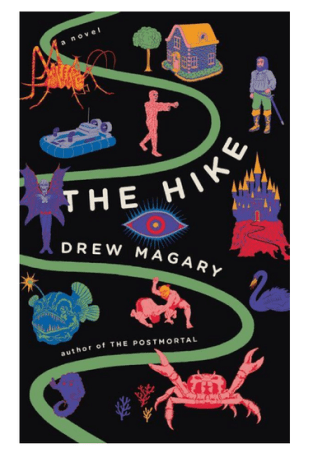
The Hike by Drew Magary
Published Viking, 2016
Purchase the book here!

margary

Our next book in the club will be The Hike by Drew Margary. The Hike tells the story of Ben, a businessman who sets out for a hike in the woods behind his hotel before a dinner meeting with a client. Ben ends up in a world of bizarre fantasy and strange creatures playing out a very D&D-esque scenario. Or that is what the blurb hints at. Reviews are referring to the book as “Cormac McCarthy’s Alice in Wonderland” and “a more cynical version of The Phantom Tollbooth”. Sounds like a lot of fun.

The read begins on September 1st and the review and discussion hit the website on September 30th. Good reading!

Comic Book Review – The Sheriff of Babylon Volume 1

The Sheriff of Babylon Volume 1: Bang, Bang, Bang
By Tom King and Mitch Gerads
Purchase the book here!

2015-12-03-sheriffofbabylonFlorida cop Christopher Henry has a new job training the law enforcement forces in Baghdad. It’s 2003, and he is in the heart of the Iraq War. There is the standard level of chaos and violence in the city but things get personal when one of Henry’s Iraqi trainees is found murdered. Henry teams up with Nassir, an ex-cop still hanging on in the city. In the background is Sofia, an Iraqi-American who has come back to the city to help with the rebuilding process while attempting to take control of the organized criminal underbelly. This is the tv series HBO wishes it had the budget to make.

The Iraqi Occupation has been the topic of numerous films and documentaries, but Sheriff of Babylon is clever in its genre-mashing, bringing the detective noir into play. And it works better than you might expect. The instability in Iraq has blurred the lines of authority and no one can be trusted, not even if they do wear a nice shiny uniform. Between the various sub-groups with the American military, privately contracted forces, insurgents, politicians jockeying for power, and a myriad of other factions Baghdad is an incredibly confusing and scary place.
If you are a regular reader of this blog then you know I love Tom King’s work. I’ve previously read his run on DC Comics’ Omega Men and am still enjoying his work on Marvel’s The Vision. This was the first work I’ve read of his that wasn’t within in the superhero genre, though those previously mentioned titles aren’t superhero stories in the traditional sense. King was an intern under writer Chris Claremont for many years before joining up with the CIA in the wake of 9/11. He worked for seven years in counterterrorism which is very apparent in the detailed storytelling present in Sheriff. The series is written with a level of knowledgeability that doesn’t get too jargon-filled and is still comprehensible to a civilian. The story perfectly hits the notes a good noir should, especially on the protagonists increasing confusion as he navigates the labyrinth. There’s also great moments where we see the effort towards good turned to a pretty hopeless defbabylon02eat, as all noir needs to have.

The artwork is exceptionally well done. It’s very photo-realistic with human expression and faces, but with a gritty abstraction in the right moments. In an interview, artist Mitch Gerads explained that a fan who is also a veteran of the war said the book captured the feel of the environment in its colors. Everything is colored in earth tones and primary colors only appear when something needs to pop out of the landscape around it. The uniformity of color also perpetuates a sense of confusion because military people purposefully become hard to differentiate.

The Sheriff of Babylon is a 12 issues mini-series so this volume is just the first half of the story. I enjoyed it quite a bit and reminds me of a really quality cable drama. No character is ever a stereotype and layers are revealed over time and at key moments in the plot. If you’re seeking out a modern war comic, something dealing with the more complex and gray areas, this series has a lot to offer.