
A Head Full of Ghosts by Paul Tremblay
Published by Harpercollins, 2015

The strongest feeling I had reaching the conclusion was a sense of sadness for the main character. I don’t see how anyone could feel anything but that for Merry Barrett. She will never have closure because she is the only one left alive and obviously doubts her own interpretation of what happened to her family. This is the aspect of A Head Full of Ghosts that elevates it to that premiere level of horror in my personal opinion. It is comfortable with ambiguity and it uses that lack of information/understanding to make its horror tragic yet still frightening.
A Head Full of Ghosts doesn’t shy away from its influences. In fact, portions of the text outright name drop books, films, and authors to make it clear that Tremblay acknowledges these antecedents but works to present a narrative that plays with their tropes. By bringing in elements such as the reality tv show, the fractured point of view of a child, and a modern fan blog he tells a familiar story from a seemingly varying number of perspectives. When we reach the halfway point and learn adult Merry is the author of the The Last Final Girl blog we realize the author is saying that a single person’s point of view can be more complex than originally thought. And it also brings us back to the title of the text, A Head Full of Ghosts and how it doesn’t simply apply to the plight of Marjorie Barrett.
Tremblay has publicly stated that the novel is meant to be open for a multitude of interpretations. The big question when you reach the end is of course “Was Marjorie really possessed?” By not including direct transcripts of The Possession reality series, only having their events filtered through The Last Final Girl blog and Merry’s memories, we are forced to crane our neck around bedroom door frames in an attempt to see what truly went on in that house.
The most terrifying moment for me in the book was the encounter between Merry and Marjorie in the basement. The production crew for The Possession had just moved into the Barrett home and was setting up. Merry ends up down there looking for snacks if I recall correctly. The two engage in a conversation about their father’s understanding of Marjorie’s condition, specifically how he, through the guidance of his priest, believes his daughter is possessed by Satan. Marjorie laughingly rebuffs this notion but goes on to say that she *is* possessed.
“Ideas. I’m possessed by ideas. Ideas that are as old as humanity, maybe older, right? Maybe those ideas were out there just floating around before us, just waiting to be thought up. Maybe we don’t think them, we pluck them out from another dimension, or another mind.” Marjorie seemed so pleased with herself, and I wondered if this was something new she just thought up or something she’d told someone before.
Tremblay has contributed to the modern Lovecraftian horror scene. My first read of his work came in The Children of Old Leech, a tribute anthology to Laird Barron. In that collection is Tremblay’s short Notes for “The Barn in the Wild”. This particular quote from Marjorie struck me as a very Lovecraftian in its existential nature. That sort of cosmic horror is often about horrors that transcend our notions of good and evil as well as existing before our concept of time began. Later in the text, Marjorie makes mention of a minor Lovecraftian demon and this is taken as her doing research online behind the backs of the production crew and clergy. It should be noted that Notes for “The Barn in the Wild” is also a found narrative short story presented as fragments of a “discovered” journal, yet another narrative construct whose validity comes into question.
There’s just as much presented in A Head Full of Ghosts that can lead the reader to believe Marjorie is deteriorating from paranoid schizophrenia or some other similar mental illness. Again, we only hear the story from the point of view of someone who was a child and the younger sibling of Marjorie. Many mentions are dropped that Merry was in no way fully aware of what was going on in her own home fifteen years ago. It’s no surprise to anyone who has read the novel that the biggest shock comes in the third act when we learn through a very casual, distant mention that Merry’s father, mother, and sister all died of poisoning that is publicly contributed to the father. Merry’s memories of the events leading up to that moment are some of the most chilling parts of the book. It’s very telling that in how she remembers the poisoning she is the one who taints the food. Moments later she discusses the trouble she’s had remembering her aunt entering the home and saving her after she lays there with the dead bodies for weeks. But then Merry admits that’s not what happened and she was told in retrospect police entered the home to save her.
This is where we are left, with Merry unable to know what really happened. We have just enough pieces of the story to fashion a narrative but not enough to understand what it meant. Great horror understands that it’s not a monster or scary house or the Devil that wrenches at our soul and tears up our eyes. Horror comes from a place of very raw truth when we confront our powerlessness. Childhood trauma can bring the toughest tough guy to their knees. That is horrifying. So many people seek out professional help to bring closure to those scarring moments of their pasts, but never truly move past them, only learn how to manage their emotions in relation to them. A Head Full of Ghosts posits “What if you were completely unable to move on?”. Whether it be heredity or demons, what if you were damned to spend the rest of your life both haunted by your childhood yet unable to fashion a working understanding of what it meant?
Discussion Questions
What was Merry hoping to achieve through her blog deconstructing The Possession?
How do you interpret the exorcism scene? What really happened? What was imagined by Merry in her memory?
What did Marjorie seek to gain from Merry attending the exorcism?
Are childhood memories simply a sense memory fabrication or is there factual truth within them?

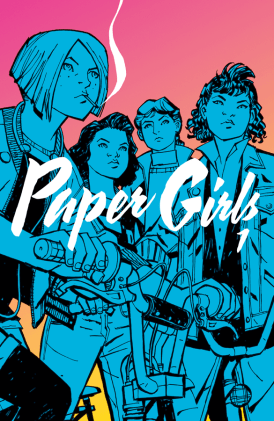 I had no idea what Paper Girls was, not even who wrote or drew it. I just saw the cover and thought that looks interesting. To my joyous surprise, I learned it was written by Brian K. Vaughan (Saga, Y the Last Man, Lost) and illustrated by Cliff Chiang (Wonder Woman, Tales of the Unexpected). I also had wondered what the title meant by “Paper Girls” and found it was so clear I should have figured it out: They are girls who deliver papers.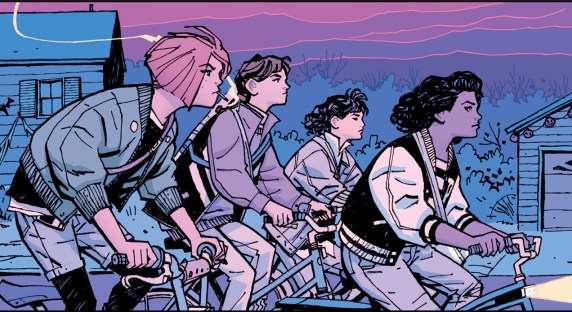
 I became a lover of Jorge Luis Borges’ writing in college. If you’re not familiar, he was an Argentinian writer who trafficked mostly in short stories that evoked magic realism and played with the ideas of authorship, fiction, and meta-reality. Brockmeier doesn’t get as deeply academic as Borges would, but still touches upon the same ideas. The Truth About Celia begins with the mysterious disappearance of the title character, the daughter of science fiction author Christopher Brooks. The book’s structure is that of a collection of short stories written in the seven years since she vanished that revolve around that tragedy. Some are directly about Celia other opt to explore more fantastical spaces.
  I picked this novel off the shelf at a bookstore my sophomore year of college knowing absolutely nothing about it. Over a decade and a dozen books later I consider Japanese author Haruki Murakami one of our greatest living writers. Murakami is unlike anyone else you will ever read and has always felt more like film than literature. He’s about setting a mood and examining characters in their spaces. He’s about hinting at mystery and fantasy but never letting the lens explore it too closely.
 I was in the dorms the summer between my sophomore and junior year when I read this novel. I was blown away. It was my first encounter with Cormac McCarthy and I knew I had read one of the great American works of literature. Surprisingly, this is a variation on the story of Davy Crockett. That is never clear but if you are familiar with some of the tropes you begin to see them underneath the surface. The story follows a character known only as The Kid born under mysterious signs who encounter a powerful figure known as Judge Holden. Holden becomes a recurring figure throughout the novel and might possibly the Devil. The Kid ends up working to help expand America into the west by exterminating Apaches. The landscape becomes a surreal nightmare plane seen through the eyes of the Kid. Blood Meridian is one of those pieces of literature that you must imagine nearly killed the author to write. It is supremely intense, violent, and sprawling. It outright spits in the face of the romantic Western genre by making us seeing the horrible brutality and biblical horror of a lost time.
 While I really don’t enjoy found footage horror films, when the genre is applied to literature or, in this case, audio drama, it works much better in my opinion. The premise of Tanis is that journalist Nic Silver is attempting to uncover what Tanis, a word mentioned in a myriad of sources, is. Is it a person, a place? Why are famous occultists obsessed with it? How does it connect to other urban legends and modern horrors? If you are a fan of slow burning, very creepy, conspiracy theory stories Tanis will provide you with many hours of entertainment. Currently, Season 1 (12 episodes) is available with Season 2 on its seventh of 12 total episodes.
 This was the first movie podcast I ever listened to starting way back in 2005. At the time it was Adam and Sam Van Hallgren hosting, but the latter has moved on to a producing role. No matter the hosts, the film has always maintained a high level of discussion about film. Kempenaar is an instructor at the University of Chicago and Larsen spent over a decade reviewing films for the Chicago Sun-Times. Both men have a very deep knowledge of film and work to spotlight picture beyond what has currently opened at the cineplex. This podcast has probably been the biggest inspiration to my love of film introducing me to filmmakers like Wim Wenders, John Cassavetes, and Robert Altman. Even if you have an extensive film knowledge you will learn something from listening to this series.
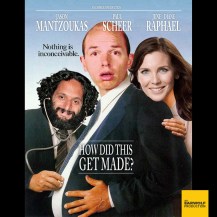 Inspired by Mystery Science Theater 3000 and a plethora of books detailing the “worst films ever made” these three comedians and actors set out to make a series where they explored travesties of cinema in depth. Episode One spotlighted Burlesque; Christina Aguilera and Cher’s gaudy passion project. From there they have looked at films like The Last Airbender, Masters of the Universe, and Zardoz. Some particular highlights have been A View to a Kill, Glitter, and the god awful sequel to Saturday Night Fever, Staying Alive. A very high energy podcast that has very charismatic and witty hosts that make watching bad films a pleasure.
 Lauren Lapkus had become a staple on Comedy Bang Bang thanks to her variety of characters. When she decided to start her own podcast instead of hosting she opted to make the host rotating and to play a different character on each episode. This lets the guest come up with the concept of the show, the topic of conversation and even the basics of Lapkus’ own character. In fact, Lapkus doesn’t know any of this information until they start recording the episode and loves being made to improvise it all on the spot. A nice surprising podcast that never fails to present something unique and funny.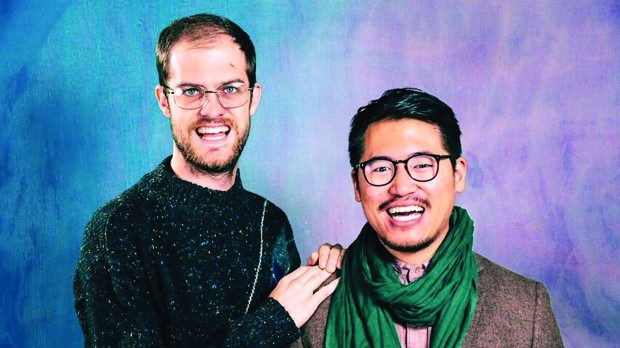
 Views and Visitors


 PopCult Reviews