DC Rebirth: Week #2

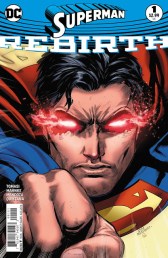
Superman: Rebirth (Writer: Peter J. Tomasi  Artist: Doug Mahnke)

superman rebirthOf the four titles, this felt the least like the beginning of something new, or the reintroduction of some element from DC Comics past. The story focuses on the Pre-New 52 Superman and Lana Lang unearthing the recently deceased Superman’s ashes. Lana made a promise that if he died before her, she would make sure his remains were with his adopted parents, The Kents, in Smallville. The two characters talk about old Superman’s experience with death and rebirth, and he’s pretty insistent this world’s Superman is going to be reborn eventually. It comes across a little meta-contextual about the silly nature of death and rebirth in comics.
The story feels like an epilogue to the previous Superman story arc, rather than the beginning of something new and interesting. There’s never an effort made to establish what made the dead Superman such a great hero or why the old Superman is a great replacement. The story keeps things simple but didn’t do anything to get me excited about the large range of directions the Super-titles are going this summer.


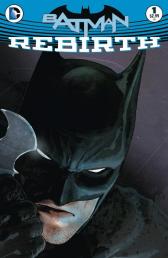
Batman: Rebirth (Writers: Tom King, Scott Snyder  Artist: Mikel Janin)

batman-rebirth-1This was much more interesting and fresh than Superman: Rebirth. Tom King is able to reinvigorate some elements of the Batman mythos. The most stark change is to Calendar Man, a jokey gimmick whose crimes revolved around the seasons or holidays. Now Calendar Man is like Cronenberg body horror, his body shedding its entire skin seasonally. The best Batman villains are ones that unsettle us. With the whole Batman concept being so deeply embedded in human psychology, having horrors that poke around and disturb our minds is when the series shines.
The issues also brings in Duke Thomas, formerly of We Are…Robin. In that series Duke was part of a group of young people who adopted the Robin moniker and iconography to fight street crime. Duke responds to an invite from Batman and the two form what is much more of a mutual partnership rather than a lead hero/sidekick dynamic. Thomas gets a new costume, but no codename established yet. Batman: Rebirth is more about tone setting than plot development. It give a very clear sense of what Batman in the Rebirth period will be


Green Lanterns: Rebirth (Writers: Geoff Johns, Sam Humphries  Artist: Ed Benes, Ethan Van Sciver)

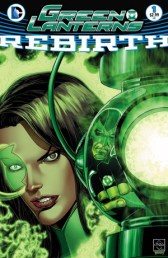
GLs_RB_Cv1What this issue has going for it are two very underdeveloped characters. Simon Baz was introduced in 2012 but fell off into obscurity after a year. Jessica Cruz was introduced a year ago as Power Ring, the host to an otherworldly evil. In last week’s Justice League #50, she shook off her possession and was rewarded with Green Lantern ring. The two leads are used to emphasize the GLs as space cops, with a very reluctant and combative partnership.

It’s difficult to tell here what Sam Humphries brings to the table because so much of this reads like classic Geoff Johns GL storytelling.There is a lot of plot setup: reveal that the Guardians of the Universe have a super secret ring, references to the Dominators and the Manhunters, and some GL history dropped. Other than the characters, this doesn’t feel like much new. It feels like a return to the Johns era GL stories that started back in 2005 until he left the title in 2013. There’s an effort to set up the Hal Jordan & The Green Lantern Corps series as well. I am looking forward to seeing more of our two leads but not sure about the rest.


Green Arrow: Rebirth (Writers: Benjamin Percy  Artist: Otto Schmidt)


green arrow rebirthOf the four Rebirth one-shots, this one felt like the best blend of a fresh style of writing while incorporating classic DC elements. The classic element is front in center in the form of a rekindling of the relationship between Green Arrow and Black Canary. There’s fun banter back and forth between these two and that makes the book. It’s also a done in one story, while the other Rebirth titles are just setting up their core titles.

What’s also interesting is how Green Arrow’s Seattle is fleshed out here. We’re given a very creepy, sinister underworld populated by tree house villages of homeless people and sewer dwelling Nosferatu-like creatures. I’m hoping Percy continues exploring this darker side. I was also unaware that Percy had already been writing Arrow for the last year. This one-shot now has me wanting to go back and explore that year of work.

Holidays (2016, dir. Various)

Holidays-Fathers-Day-Still-116-e1460641150837

Valentine’s Day (written & directed by Kevin Kölsch & Dennis Widmyer)

St. Patrick’s Day (written & directed by Gary Shore)

Easter (written & directed by Nicholas McCarthy)

Mother’s Day (written & directed by Sarah Adina Smith)

Father’s Day (written & directed by Anthony Scott Burns)

Halloween (written & directed by Kevin Smith)

Christmas (written & directed by Scott Stewart)

New Year’s Eve (written by Kevin Kölsch & Dennis Widmyer; directed by Adam Egypt Mortimer)

These days the horror anthology is quite popular. I’d say their revival started with 2007’s Trick R Treat, though in the low budget independent world they never went away. Some popular recent ones have been The ABCs of Horror 1 & 2, V/H/S 1, 2, & 3, A Christmas Horror Story, and Southbound. You know what they all had in common? They’re mostly awful. You get a good segment here or there, but it’s not a complete collection of great horror. I can see the appeal of this type of movie. In the YouTube age, short form entertainment is in high demand so many viewers probably sit down with the mindset of “If I don’t like this in fifteen minutes I’ll be seeing something else”.

Holidays is another horror anthology that suffers from this problem, and has some of the worst segments I’ve seen in a modern horror anthology. The bookending stories are terrible and in particular Kevin Smith’s contribution is pointless garbage, that he also manages to also shoehorn his untalented daughter into. The concept of Holidays is just that: Holidays. Each horror short is themed after a particular holiday. Lots of potential, eh? Of the eight short films included here there are only three good ones. Those three are really good though. Worth paying money to sit through the five other pieces of crap?….ehhhhh.

Let’s be positive though. We’ll talk about the good stuff.

Easter is from the writer-director of The Pact, a pretty decent horror film from a few years back. He knows how to pace things, he knows what ambiguity is. He takes horror seriously and doesn’t view it as gory comedy, like some others in this collection. Easter goes to some really weird places and it leaves us with lots of questions. On the surface we get a very silly monster, but the things he does and says overcome his silly nature and make him really creepy and unsettling. You’ll think about this one more than most of the others.

Mother’s Day is a little predictable. And it’s the second film in the anthology to deal with an evil pregnancy. St. Patrick’s Day also features an unwanted pregnancy but ends on such a stupid, ridiculous note you’ll want to get your tubes tied (snake with a pompadour, really movie?). Mother’s Day is about a woman who gets pregnant every time she has intercourse and has had two dozen abortions. Her doctor can’t figure out why she is so overly fertile so she sends the woman to an isolated commune for holistic healing. Like I said, the plot is pretty predictable but at least the acting and directing show some skill.

Father’s Day is the best film in the collection. Like seriously, turn off the movie after you watching this one. They get progressively worse. Father’s Day is about a young woman who receives an audio cassette recording from her deceased father. Turns out he didn’t die like mom told her. The recording leads her to the last place she saw him and she retraces his steps. This is actually a horror film. It has character development. It has a plot that we can’t predict and a resolution we don’t see coming. It doesn’t think horror stories are one big bloody joke. There’s no gore. It ends in a really really ambiguous way.

Horror anthologies have a shitty trend of thinking the only way you tell horror stories is to make them into jokes with gore. That’s not scary. Horror should be the opposite of comedy. Comedy is set up and then pay off. Horror should be 90% set up and then most of the time not even give pay off. That’s what makes it horror. You don’t get the clean resolution so it gets stuck in your brain and creeps you out every time you think of it. I recommend those three segments, so if you can somehow find them separately online or can get someone to pay for your rental of Holidays watch them. But skip every other segment in this collection.

10 Cloverfield Lane (2016, dir. Dan Trachtenberg)

cloverfield5-xlarge

Out of nowhere, in March of 2016, J.J. Abrams announced a sequel to Cloverfield had been made in secret. Cloverfield was a found footage movie released in 2008 under similar secretive methods. And I hated the original, mainly because it was yet another found footage movie. It had characters who made stupid decisions that merely happened so that the next plot point was possible. It lacked a meaningful resolution and didn’t even leave things ambiguous enough to think about after the film was over. So, you could say I was cautious about 10 Cloverfield Lane.

10 Cloverfield Lane has incredibly loose ties to the original, and I wouldn’t even call it a sequel, more of a distant relative. It’s not found footage (thank god!). It has characters making intelligent decisions. It has themes and layers of plots and even an ending with some ambiguity. Its story is clearly focused on Michelle (Mary Elizabeth Winstead), a young woman running from her fear about a relationship who ends up, after a car accident,  trapped in a survival bunker. She’s told by the owner of the bunker, Howard (John Goodman) that he rescued her and that outside the bunker there’s been an attack on the entire nation. These claims are backed up by Emmett (John Gallagher, Jr.), a contractor who helped build the bunker, that yes, something bad did go down. Claims are made that the air is toxic and everyone is kept locked up inside. But there’s more going on here below the surface.

The film was the first major feature from Dan Trachtenberg. I’ve been following Trachtenberg since way back in 2007 t0 2012 when he was a part of the Totally Rad Show, a web series that reviewed popular media of all kinds and was a sort of inspiration to me. I was very happy with the work our director delivers. Every actor delivers a believable and nuanced performance. The film is full of clever camerawork and pacing, that never comes across as showing off. Everything here is a completely solid piece of tense thrilling film making.

Mary Elizabeth Winstead is the big star of the show. One thing I look for in actors, to really see how good their performances are, is to watch them when they are not the one talking in a scene, when their job is to react. Winstead gives a perfect emotional performance and has a quite a few scenes, the majority of the third act for instance, where she only gets to emote and react. It reads as very real and honest. John Goodman was given a tricky role, he has to play someone we need to trust and believe while simultaneously being unhinged. Up until the final moments of the film it is impossible not to have an internal debate about what is really going on with his character.

The plot has three very clear levels: what is going with Winstead’s character emotionally, the interpersonal conflicts between the three characters in the bunker, and the larger global situation outside the bunker. All three are developed wonderfully, given just enough that each deserves. Where the original Cloverfield came across as a glorified amusement park ride, this picture knows character development is key so that when the bigger, spectacular elements start happening we actually give a damn what happens to the people on screen. In an age where we have films that end in citywide killfests, it’s refreshing to have a movie approaching the same world ending subject matter in such an isolated, quiet way.

Keanu (2016, dir. Peter Atencio)

Key-and-Peele-Movie-Keanu

I honestly never thought much good would come out of MadTV. The series debuted when I was 14 and it quickly became that show I watched the first half hour of until SNL came on at 10:30. Key and Peele weren’t in that original line up, they came around by the time I was in college and lost interest in watching any of MadTV. I was a little surprised when Comedy Central announced in 2012 that Keegan Michael Key and Jordan Peele were getting their own series I was pretty surprised. Not anything against them, I just didn’t think of MadTV as producing anyone or any material that was all that lasting. I was very wrong.

Now that their five season run has wrapped, the duo is trying to bring their distinctive comedy style to the big screen. Their first outing is Keanu, a very strange little film that is deeply inspired by John Wick. Peele plays Rell, fresh off a break up who is encouraged by his friend, Clarence (played by Key) to get himself together. Rell’s relief from grief comes in the form of an adorable kitten he names Keanu. What he doesn’t know is that Keanu has ties to both the Mexican and Los Angeles crime cartels and this send our two protagonists into a comic-ly absurd tribute to action movies.

It is very obvious that both men and the director love movies. Early on, Rell is making a calendar featuring Keanu in iconic film scenes each month. Posters cover walls referencing 1990s action and gangsta films. When Keanu is taken by Cheddar (Method Man) he’s renamed New Jack. Two murderous brothers are featured throughout the film and they harken back to both Boondock Saints and the early work of Robert Rodriguez. However, this is not a parody of those films but more a tribute mixed with the banter of Key and Peele.

The key to the film lies in the interaction between our leads. Key and Peele have such excellent chemistry together that I could sit through a long drawn out dialogue just between them and be perfectly happy. The film even manages briefly to recreate the road trip moments from the television series. They also play with the idea of “blackness” for a large majority of the film. Both men have addressed through their comedy how being biracial was a challenge to them growing up. In Keanu, they must journey into Blip territory (all the people who got kicked out of the Bloods and Crips) to a strip club with a rather unfortunate name. Once inside, they have a conversation about how to talk to the people their and they devolve into movie studio “blackspeak”. So, while tipping their hat to early 1990s crime films they enjoyed they also take time to acknowledge the absurdity of the portrayal of “black thugs” on the screen.

The film does have its lulls and can sometimes feel like a sketch from their series drawn out for too long. The third act gets very messy and lacks clear plot focus. There are a couple character setup to be the villains who fizzle out and the film pulls someone out of left field to serve as the big bad of the climax. Our main characters get satisfying endings, though a romance subplot feels forced onto us but isn’t too terrible. Keanu is a great first outing in feature films for Key and Peele. I think they have a lot of potential, given some more tighter plotting, to produce some very watchable and re-watchable comedies.

X-Men: Apocalypse (2016, dir. Bryan Singer)

xmenapoc39

Back when the first three X-Men films came out, I opted to skip the third. X-Men: Last Stand wasn’t being directed by Bryan Singer and I’d heard very mixed to negative things. My roommate at the time did see the film in the theater and tried to convince me it was the best X-Men film of the three, I wasn’t buying it. Years later, I finally saw the Brett Ratner helmed flick and was proven right. It was dreadful. Too much crammed into too small a movie. So, when X-Men: First Class, directed by Matthew Vaughn, came out I approached it with trepidation only to be pleasantly surprised. The follow up, Days of Future Past, felt like a nice compliment and I enjoyed having X-Men in period pieces. It’s very different than most of the other comic book films out now. This led to me being pretty psyched about an 80s X-Men movie incorporating the villain Apocalypse.

X-Men: Apocalypse has a lot of plots going on. It continues the ideological struggle between Charles Xavier and Erik Lensherr, it gives us the origins of our favorite X-Men (Cyclops, Jean Grey, Nightcrawler, Storm, and more), it picks up some loose threads from way back in First Class, and it features the ancient mutant Apocalypse whose plan is to…well, um…I’m not quite sure. Lots of elements work in this film, but the weakest of them all is Apocalypse, portrayed by Oscar Isaac. Isaac does the best he can with the material he was handed but it’s very generic, nondescript villainous motivations. Apocalypse wants to cleanse the earth of all humans…because why? He doesn’t like them, he believes mutants are superior, but there’s no idea given as to what would happen next if he succeeds.

Apocalypse, while I love him visually, is a very complicated character in the comics. I honestly cannot tell you a single one of his plots or plans and I have read multitudes of stories featuring him. He’s become a stand in when you need a big evil mastermind villain in an X-Men story. Characters produced by stories he’s been featured in have been much more interesting then the big baddie himself. Archangel, Caliban, Psylocke, Genesis, and more have all been touched by Apocalypse and become very interesting. I highly recommend Rick Remender’s run on X-Force that did some amazing things with Apocalypse, but mostly with the characters that surround him. The film opts to combine elements of Apocalypse, The Shadow King, and the incredibly obscure Living Pharaoh to try and make him a villain that pulls you in.

When you look at the third act climaxes of the previous films, very rarely are they world ending events. The Cuban Missile Crisis from First Class probably comes the closest. For the rest of the series the stakes and conflict are all about the future of mutant-kind. Villains plot to wipe out all mutants or trigger the mutant x-factor in all humans or unleash an army of mutant hunting robots. Hell, even The Last Stand kept things focused on one location and with a threat that only affected mutants. This is what has set apart the franchise from many of the other comic book series. To now have a finale that involves the very foundations of the Earth being cracked apart and a blizzard of CGI chaos cause X-Men: Apocalypse to feel very dissonant with the rest of the series.

Not even the Horsemen of Apocalypse are all that interesting. Storm (Alexandra Shipp) comes the closest but I suspect she’ll get more development in a subsequent film. Angel and Psylocke are cardboard cut outs with only hints of actual personality, a shame. Magneto is likely the one villain everyone will love, and I do agree Michael Fassbender brings much more to the character than we would expect from this film. However, I don’t feel that we’ve seen Magneto progress as a character since First Class. Once again, we go through the same beats of tragic loss, mindless revenge and anger, moment of clarity, and then parting ways/til we meet again. The promise of a Brotherhood of Mutants at the end of First Class was never fulfilled and the character feels stuck in a rut. Even a solo Magneto film could do a lot to grow the character because it is tiring seeing Charles and Erik argue the same points over and over.

What’s good about the film are the new kids. I previously mentioned Storm, but the rest are great as well. They don’t get enough screen time and we can hope, that if another film is greenlit, we have them featured front and center next time. Evan Peters as Quicksilver continues the actor’s track record of being wonderful in everything he does. The first act of the film is bloated with plot and they do manage to come together, it just takes a while and is hard to keep yourself interested when everything feels so disconnected. This is due in part to Bryan Singer being such a weird director. In all his films there are some really brilliant moments, even here we’re treated to some great set pieces, but they’re surrounded by really dull movies.

Singer has said he is taking a break from the X-Men, and after four films that is probably a good idea. Many people thought the lesson of The Last Stand was that only Singer knew how to handle these characters. But the real lesson came from First Class, that they just required someone who understood them fundamentally and was willing to take risks (changing the time period of the film). The X-Men are not the easiest comic book franchise to adapt to film and I think a pair of fresh eyes, that are allowed to play and experiment, as we saw with Deadpool, could produce some great films.

About my Patreon

patreon

You might have noticed in the last week the additional links at the top of the page: Support this Blog on Patreon and Beloved Patrons.

After doing some reading online about crowdfunding and blogging I decided to take the plunge. My goal in this is definitely not to “get rich blogging”. I’m under no delusion that I’m building any sort of internet empire. My main goal is to grow a community and connect with other fans of popular media and especially film. My secondary goal is work to get enough monthly donations via Patreon to be able to have movie giveaways and possibly other prizes.

I know through personal experience that employment and income are not a sure thing these days. If you decide to give even a $1 of your own money, know how grateful I am for your contribution. The fact you would even given me that much for the work on my blog stuns me. I will continue to produce content regardless of the donations I receive, probably scaling back when the school year starts.

Have a great day!

Games for 2: Workplace Bully

workplacebully

Workplace Bully is a two player tabletop role playing game written by Steve Hickey. The game uses Vincent Baker’s Apocalypse World as a basis, but also more importantly Avery McDaldno’s Dream Askew, which gets rid of the dice involved.

In Workplace Bully, one player is the Manager (MGR) and the other player is the Employee (EMP). An audience can be included and will actually have ways to contribute to the game.Players contribute in a rotating series of Goes, verbal exchanges referring to a list of actions exclusive from each other. When the story comes to the point that neither knows what happens next the scene ends and Evaluation begins.

Evaluation is made up of a series of subjective decisions made about the scene that just occurred. The MGR could be rewarded with Stress points and the EMP might get some Insight points based on their growing understanding of what is happening at work. If the MGR gets stress points during Evaluation they decide if the EMP has become more Broken or Transformed (into a bully). The EMP does have three uses of a Panic Button to avoid this, but in turn the MGR can spend Stress to still force the EMP to have some sort of public outburst at work.

Stress and Insight are spent during additional goals to use special moves and permanently unlock moves. For every point of Stress the MGR uses, the EMP gains a point of Insight. This means the more active the bullying the more the EMP learns about what their MGR is doing and their methods. The game ends when either the MGR has blown through all their methods of deflecting and defending themselves from confrontation or the EMP is either Broken or Transformed by the MGR.

Workplace Bully is a great, and sometimes overwhelming, example of asymmetrical play: a game where players have opposing goals and ways to play the game. My wife, Ariana, and I played the game twice, each of us taking a turn in each role.

In our first game I was Manager, Mrs. Farnsworth and Ariana was Employee, Mr. Felt. Our place of business was Heartstrings, an online dating Service, I took the stance of being over concerned with details to mask my personal incompetence as a leader. My main strategy as the bully was to turn everyone against Mr. Felt. Mr. Felt finally gained enough Insight to purchase a cell (more than three victims of my bullying in the office). This led to a complaint filed with the Human Resources department and ended with me begging Felt to back off. Felt didn’t have much sympathy for me and rejected those. Eventually I resigned and left the office quietly.

Ariana said we had to take a break because she was getting stressed out at the passive aggressive attacks from my Manager, so I guess I was pretty effective. Because the game is a playtest we had some confusion about how to activate tags, the main way a MGR defends themselves and an EMP confronts. Before our second game, we sat down and made sure every tag had an explicit way to earn them, which helped the second game run more smoothly.

In our second game, I was the Employee, Stanley and Ariana was the Manager, Jenny. Our place of business was Reassurance Inc., an insurance adjuster.  As the employee I was starting a new career after working as a teacher for a number of years. I had a disabled son and was a single parent. I was able to find allies in fellow employees Rhonda and Stan, as well as Jenny’s own secretary, Megan. Ariana’s strategy was that every time I claimed an ally she spent Stress to make that ally neutral and in one case turned that ally into her pawn. For most of the game Stanley was moving speedily down the Broken path. I accrued a good amount of Insight and began to confront the MGR on a daily basis, faster than she could spend Stress to defend herself. In the end I barely beat the MGR who was fired and left in a very destructive way.

Workplace Bully is a very interesting game about a phenomena we encounter in our lives from time to time. While most games we play are escapist, it is interesting to play a scenario of such real weight. It was also a mental hurdle to get into the Stress/Insight points method after being so used to dice rolling. As mentioned above, Workplace Bully is an alpha playtest so it is rough around the edges and requires players to take an active role in shaping the game if you encounter errors or absences. With people of the right mindset this can be an intriguing experiment into stepping in the shoes of other people.

Download Workplace Bully for free.

Check out more of Steve Hickey’s game work here.

Comic Book Review: The Vision Vol. 1: A Little Worse Than Man

Vision Volume 1: A Little Worse Than Man

Releases July 12th, 2016

Writer: Tom King   Artist: Gabriel Hernandez Walta

“To assert as truth that which has no meaning is the core mission of humanity”
– The Vision, Issue 1

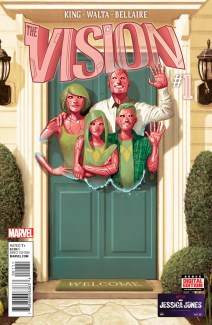
vision 01
Cover for The Vision #1. Art by Mike del Mundo.

The title character of the series shares this philosophy with his wife early on and it remains above their heads afterwards. It’s a clear reveal of what this character, who strives be more like us, actually thinks of humanity. I see it as very cynical view of our species, but that may be because of how accurate it is. The “truth hurts” they say.


The Vision, by Tom King and Gabriel H. Walta, is about the classic Avenger and the family he has constructed for himself. The Vision is not a robot; this is made explicit in a conversation between the first neighbors to visit them. Instead he is a synthezoid, a being made from synthesizing solar energy into Horton Cells, the same material used to create the original Human Torch. Synthezoids contain internal organs and a nervous system like humans, but have no need to eat or sleep. After shaking The Vision’s hand, a neighbor remarks that it felt like shaking hands with a plastic bag. What we are dealing with are like humans, but very much not humans.

Filling out the family are Virginia and their two adolescent children Viv and Vin. Looking at the covers for issues 1 thru 6 we’re shown very Norman Rockwell-esque presentations of the family but always with some drastic twist that constantly reminds us of their defining lack of humanity. In issue 1 The Vision alludes that Virginia’s brain patterns are modeled on someone he knows, fairly obvious if you are familiar with the character’s history. The children are as close to human children as two synthezoids could make: a combination of their brainwaves.

Right away writer King makes is obvious this is not going to be a series about characters in capes

Vision_Vol_3_2
Cover for The Vision #2. Art by Mike del Mundo.

and tights fighting global threats. The Vision is much less about the title character than it is about these beings he brought into the world and the hell their life is becoming. Virginia is in constant fear of how the external world will react to she and the children. She questions why they must be sent off to attend school and her husband explains it is important in their development to become like humanity.


And this is the core tension of the whole series: Can a family that is obviously not human be accepted by a society that has historically feared and shunned the Other? And in addition, can a family survive if its members are building their relationships on a series of lies? The Vision hesitantly believes the former is possible and his spouse lies on the opposite side of the argument, while fixing herself firmly in the latter category of lying to survive. While The Vision is ever stoic and logical when he speaks to his family, Virginia shows outbursts of violence and rage when outsiders threaten her children. And while Vision constantly emphasizes the need to assimilate he uses his abilities to phase through walls and fly constantly. Throughout the first volume, characters present their ideas of what being human is and then do the opposite, while claiming their desire to be human. Is being human being a bundle of contradictions? Vision may not realize it, but the readers will inevitably come to this conclusion.

It’s not essential to know the details of the Vision’s history but some foreknowledge leads

The-Vision-4-cover
Cover for The Vision #4. Art by Mike del Mundo.

to a deeper understanding of the text. The Vision’s previous family with Scarlet Witch ended in a unmitigated disaster that has haunted the character since. By building his own family he is trying to right those wrongs, but also becoming more like his “father” Ultron, a villain notorious for building family members. From the start, his constructions are volatile, but also very human in the quickness of their tempers. Every act of violence is in the context of protecting another member of the family. And when actual death occurs there are circumstances that justify the outcomes. Virginia phases to avoid a bullet and an innocent dies. A villain attacks the family and brutally killed after he almost kills Viv. The Vision is the story of immigrants in a strange land. When violence and trouble occurs they are the first to be blamed because of their Otherness.

I haven’t recommended a comic book as strongly in a long time as I do The Vision by Tom King and Gabriel H. Walta. Of all Marvel’s All-New, All-Different line, The Vision has consistently been my favorite and one of those title you read immediately after you get the new issue. Tom King’s writing feels like a great tv show that you want to binge watch to see where these characters end up. Gabriel H. Walta’s art is simple and messy, but full of emotion. The faces of the Vision family are essentially identical but he gives life and personality to each one. Sadly, King has signed an exclusive contract with DC Comics and will be writing Batman. It’ll be great to read his Batman work, but he has stated his run on The Vision will end with #12 later this year. I’m so intrigued by his work I will be spending the summer reading through his runs on Omega Men, Nightwing, and The Sheriff of Babylon with more reviews to come.

The Lobster (2016, dir. Yorgos Lanthimos)

a24 visions

lobster2-xlarge

I knew I had read literature that fell into the genre of magical realism, but it wasn’t until I read One Hundred Years of Solitude the summer of 2004 and followed that up with a ravenous consumption of Jorge Luis Borges’ short fiction that really came to understand, and in turn fall in love with, the genre. Magical realism is a style of storytelling that presents a normal world where there are extraordinary occurrences that the populace views as simply mundane. This is often used as an extended metaphor to be dissected and explored,usually a commentary on our own perspectives of the world. There are many everyday practices that to alien eyes would pop out as bizarre and unreal, but for us it’s simply life.

The Lobster falls strongly into the category of magic realism, without it become a “cute” gimmick. The film tells the story of David (Colin Ferrell), a divorced man who must stay in a hotel for singles for 45 days and find a partner. If he is unable to find a partner he’ll be transformed into the animal of his choice. In David’s case, he chooses a lobster (They stay fertile their entire lives). There is an eclectic cast of characters that we watch interact, with moments of brilliant dark comedy and painful heartrending tragedy. The film has a very defined split as David makes a drastic decision about his place in the Hotel as well as the society midway through.

This is the second film I’ve viewed from Yorgos Lanthimos, the Greek director. His breakout film, Dogtooth, explores the nature of family units focused on a couple who have kept their adult children locked up on the property for their entire lives. It balances the same comedic tones and horrific violence, but I think The Lobster elevates that to a masterful level. It also continues the director’s work examining the cultural norms of Western society, in this instance the concept of falling in love in the modern era.

Personality is absent from every character in the film. Conversations are monotonous and devoid of emotion. A character is violently punished for self-pleasure and his reaction is fairly muted for what happens. Characters fall in love and barely crack a smile. Characters die and are killed and everyone essentially walks away with a shrug. There’s no room for sentimentality in the world, dating, marriage, and having children are like business transactions. It is expected and frankly demanded of everyone in the world of the film. David is faced with a choice of severe sentimentality at the film’s conclusion and as I simmered on it afterwards it struck me that by not committing this act he would show the strongest sense of individualism in the entire film. So while, the culture around him is unsentimental he would possibly conform to it in the end.

What is most interesting are the “rebel” group in the woods, whose leader (Lea Seydoux) imposes a system of rules between the other loners, especially no physical or romantic contact. We see the bloody results of a simple kiss and worse is implied. While the Leader believes she is shirking the status quo of required relationships, she is actually creating a parallel system of dogmatic social norms that are punished with the most extreme methods. This leaves us to wonder if individualism is even a workable concept in this world.

The couples that do end up together are driven by the requirement of a match up of defining characteristics. David is nearsighted and seeks out a partner who shares that trait. Another character is saddled with a limp (the result of trying to find his mother who was turned into a wolf after a failed matchmaking attempt). Yet more characters present themselves this way: She has chronic nosebleeds, he has a pronounced lisp, she is emotionally distant, she loves butter cookies. Even in the film’s credits a multitude of characters are named by their defining trait. Almost the way, when filling out an online profile for a dating service, you would highlight aspects of yourself that you want to present, aspects that are intended to provide others with a definition of you.

Lanthimos is exploring the way people form romantic relationships in our current era. If you look at the business of matchmaking, whether it is OKCupid or speed dating or Match.com, people are boiled down to their essentials. Personality is near imperceptible and a person’s true nature is impossible to convey through these methods. But Lanthimos isn’t happy to simply comment on technology’s relationship to our relationships, he goes deeper, to the very core of why anyone ends up with anyone else. Characters lie about their defining trait in desperation to end up with someone else. The Hotel guests routinely arm themselves with tranquilizer guns and hunt the band of guerrilla Loners in the surrounding forest. And the Loners in turn sneer at those foolish guests who stupidly pursue companionship. All of these characters are deluded and define themselves based on cultural expectations, whether in conformity or opposition to. The Lobster ends on a suspended note, blatantly letting us stew on what happens next. Is their any way to succeed in this world, or is the best you can hope for to become a lobster?

The Nice Guys (2016, dir. Shane Black)

the-nice-guys-film-goruntusu

Shane Black is one of the fathers of what would become the 1980s buddy cop genre. His addition was Lethal Weapon, written when Black was 23 years old. Black’s career experienced a slump in the 90s and early 2000s when he wrote and directed Kiss Kiss Bang Bang. With this film, Black returned to play with the genre he helped create while poking fun at the movie industry. Some critics disliked the self-awareness of the picture even though it had very sharp, funny dialogue. The Nice Guys has found a nice middle ground, where it plays with genre conventions while also delivering a self-contained mystery film.

Jackson Healy (Russell Crowe) is a grizzled private investigator who specializes in helping young women and girls deal with creeps. This crosses his path with who he believes is a creep, Holland March (Ryan Gosling). March is actually a fellow private eye, except he’s a buffoon. The two, along with March’s precocious early teens daughter (Angourie Rice) become embroiled in a mystery that involves the death of a porn star, an enigmatic college student on the run, and the Detroit auto industry.

The Nice Guys does a lot right. It balances being a 1980s buddy cop film set in the late 1970s, as well as being a variation on the film noir genre. There are a lot of failures in the film. Our protagonists are very flawed, as every good noir should have, and they comically fumble and deal with more serious dramatic character flaws. Healy is a man who goes to violence as his first resort and has to deal with a challenge to that way of thinking. March is more of the comic relief, but has his own guilt about the way he’s raised his daughter and how he caused his marriage to go to ruins. The balance between these two and the lynch pin of the entire film is Holly, March’s daughter played by the remarkable Angourie Rice. If this film had been made in the 1970s this is the Tatum O’Neal role.

The mystery is complex and labyrinthine, but with enough clues being delivered through dialogue that a viewer can figure things out as they go. The film does present a hyper-realized 1970s. Driving down Hollywood Boulevard we see posters for a litany of films from the era, characters read newspapers talking about the gas crisis and Los Angeles’ severe smog. In the end, not much of these elements add to up to anything life changing. The resolution of the mystery is fairly straightforward, but keeping in line with the down endings of traditional noir. What The Nice Guys does provide is a fun alternative to the more overblown CGI-fests that typically flood our movie screens this time of year. The film is an enjoyable throwback to a style of film not made often.